

Gamify Revision for GCSE Biblical Hebrew?
Gamify revision GCSE Biblical Hebrew effectively with retrieval, streaks and rewards that support real learning rather than distract from exam practice.

Revision apps are very good at making progress visible. A streak grows. Points accumulate. A badge flashes. Yet none of those things proves that you can recall vocabulary, recognise a grammatical form or translate an unfamiliar passage under exam conditions.
So, does it help to gamify revision GCSE Biblical Hebrew preparation? The short answer is yes; but only when the game rewards useful learning behaviours. Streaks, points and rewards can encourage you to begin and return regularly. They become a pleasant distraction when collecting them replaces retrieval, translation and careful correction.
That distinction matters beyond Biblical Hebrew. If you are also preparing for GCSE maths, the same rule applies: reward the work that produces learning, not activity that merely resembles it.
The quick verdict
A useful gamified system should:
- make starting a revision session easier;
- reward recalling material without notes;
- bring difficult content back regularly;
- include translation and grammar, not only vocabulary recognition;
- record errors so that they can be revisited;
- lead towards timed, exam-style practice;
- remain simple enough that managing the game takes almost no time.
Gamification is the wrapper, not the learning. The learning still comes from retrieving knowledge, receiving feedback, correcting mistakes and returning to material after a gap.
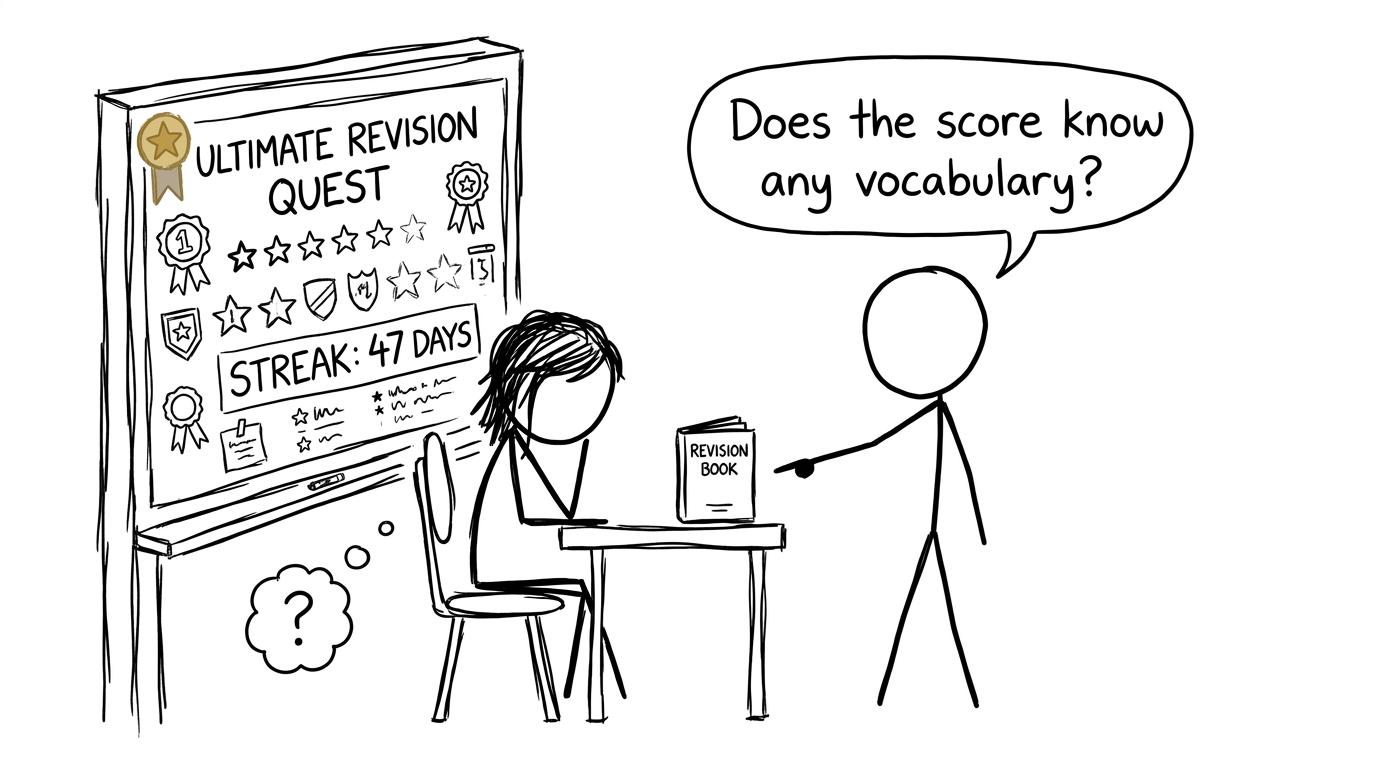 A student discovers that a large revision score cannot answer vocabulary questions
What gamifying revision actually means
Gamification means adding selected features associated with games to a non-game activity. Common examples include points, levels, streaks, progress bars, badges, timed challenges and small rewards.
It does not require an elaborate app. A piece of paper can be enough. You might award yourself credit for completing a closed-book vocabulary test, correcting a translation or returning to an error after several days. The mechanism matters less than the behaviour it encourages.
Research into educational gamification generally presents a more measured picture than app marketing does. Game elements can support motivation, participation and learning, but their effects vary according to the learner, task and design. A leaderboard that energises one student may make another anxious. A streak may build consistency, or it may encourage a rushed session completed solely to preserve a number.
The sensible conclusion is not that games always work or never work. It is that their value depends on what they cause you to do.
Why GCSE Biblical Hebrew can suit gamification
GCSE Biblical Hebrew contains several forms of learning that can be divided into short, repeatable challenges. Students need secure language knowledge and the ability to apply it when reading and translating. They may also study prescribed literature, depending on the current specification followed by their centre.
Always use your exam board's current specification, assessment guidance and prescribed-text information as the final authority. In practice, effective revision is likely to include:
- retrieving vocabulary from memory;
- recognising grammatical forms;
- parsing words accurately;
- translating language in context;
- reviewing prescribed passages where required;
- explaining linguistic or literary details;
- completing questions in the format of the examination.
These activities produce visible outcomes. An answer is remembered or forgotten. A form is identified correctly or needs review. A translation communicates the meaning or contains an error. That makes progress easier to track than in subjects where success can initially feel less concrete.
But there is a trap. The easiest activities to gamify are not always the most valuable. Matching a familiar word to one of four options feels smooth. Producing its meaning without prompts is harder. Translating it accurately in a sentence is harder again. The game should gradually move you towards the demanding version.
Streaks help you return, not remember
A streak answers one question: did you show up? That is useful because revision cannot work if it never begins. A small daily commitment can reduce the effort involved in restarting after a long gap.
But attendance and learning are different measurements. Opening an app, guessing several answers and leaving may preserve a streak without strengthening recall. Conversely, a thoughtful session missed because of illness does not lose its educational value simply because an icon resets.
Use a streak as a prompt rather than a judgement. Define a qualifying session in advance. It might require genuine closed-book retrieval followed by correction, rather than merely opening the resource. Allow sensible rest or recovery rules so that protecting the streak never becomes more important than learning.
This is equally relevant to maths revision. Working through a focused set of GCSE Maths revision topics is more valuable than recording that you looked at a page. Evidence of effort should come from completed questions and understood corrections.
Points should measure productive difficulty
Points are most useful when harder, more exam-relevant actions receive greater recognition. If copying vocabulary earns the same reward as recalling it unaided, the system quietly teaches you to choose the easier task.
A better points system distinguishes between activities such as:
- reviewing notes;
- recalling vocabulary without prompts;
- explaining why an answer was wrong;
- translating under controlled conditions;
- returning successfully to a previous error;
- completing timed exam questions.
There is no perfect scoring scale. Keep it small and stable. You should be able to record a session in seconds. If you spend longer designing categories, colours and badges than testing yourself, the method has stopped serving its purpose.
MathsGenie's grade-based pages offer a similarly clear way to move from accessible content towards greater challenge. Students can consolidate grade 4 maths topics, progress through grade 5 revision and later tackle grade 7 material. The label is useful because it directs the next action; the questions create the learning.
Rewards work best when they follow meaningful work
A reward can help with a task that feels difficult to start. The danger is allowing the reward to become the entire reason for revising. If the prize disappears, the routine may disappear with it.
Choose modest rewards that do not compete with the session. A break, a favourite song or time on another activity can mark completion. Reserve rewards for behaviours under your control: attempting a difficult translation, checking it carefully and logging the errors. Do not base them only on a perfect score, because difficult practice should expose gaps.
Badges can also mark genuine milestones, such as completing a full review cycle or correcting every mistake from an exam task. They are less useful when awarded for repeated clicking or passive screen time.
Build the game around retrieval and feedback
Retrieval practice means bringing information to mind without first looking at the answer. It reveals what is genuinely available from memory. Feedback then prevents an incorrect response from becoming familiar.
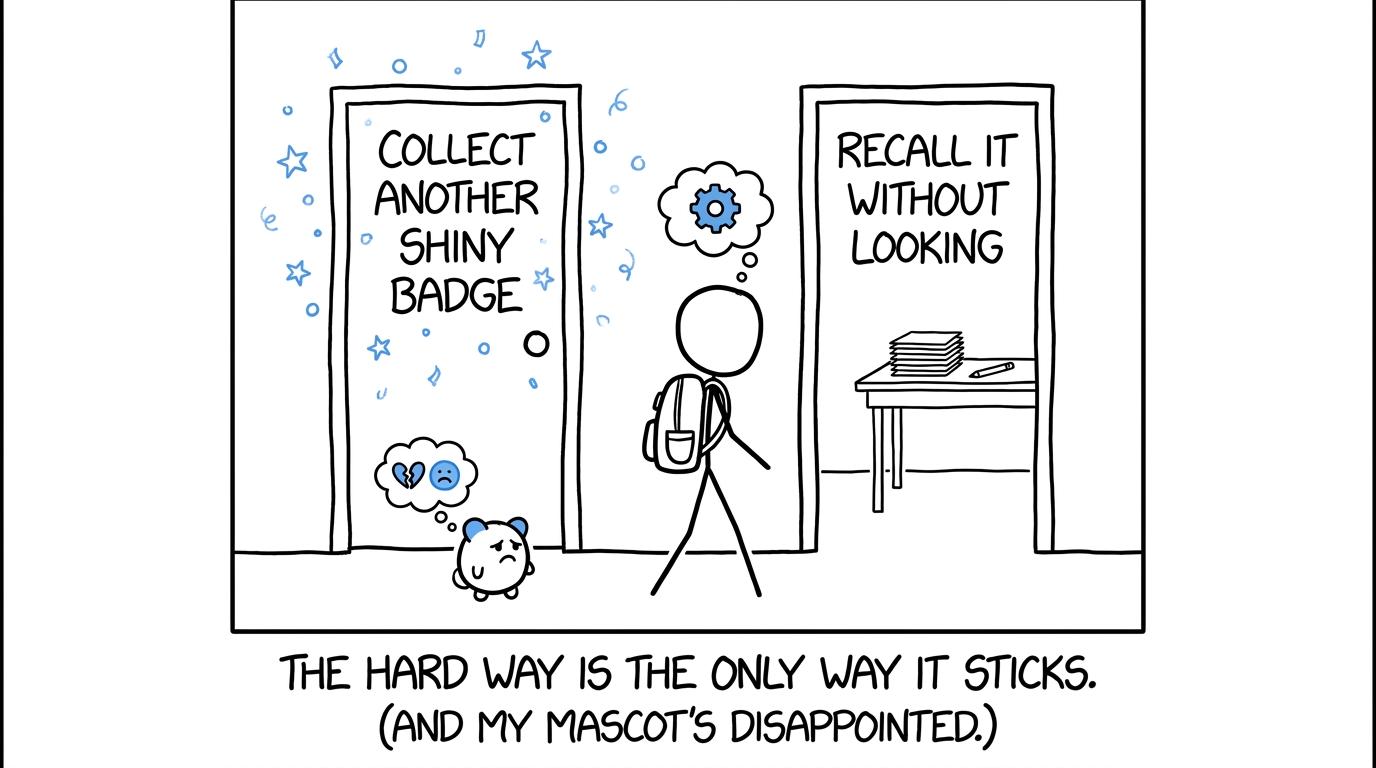 A student chooses recall practice instead of another shiny badge
A sound gamified loop for Biblical Hebrew is:
- attempt the task without notes;
- check against an authoritative answer or teacher guidance;
- identify the precise reason for each error;
- record what needs to return;
- revisit it after a gap;
- apply it in a more complete context.
Vocabulary cards can therefore be the beginning, but not the end. Recognition should develop into unaided recall, grammatical analysis and translation. Literature revision should move beyond recognising a line towards explaining significant language accurately where the assessment requires it.
MathsGenie uses the same underlying rhythm through GCSE practice questions, topic videos and worked solutions. After topic practice, GCSE past papers and mark schemes show whether knowledge survives when topics are mixed and the wording is unfamiliar.
Make exam practice the final level
A revision game can make small sessions more approachable, but the examination will not award marks for maintaining a streak. It rewards what you can understand, retrieve and communicate in the required format.
Your system therefore needs a final level: authentic exam practice. Use questions that reflect your qualification, complete them with decreasing support and check them carefully. Record categories of error rather than just a total mark. A vocabulary gap needs a different response from a misunderstood grammatical form, an imprecise translation or poor time management.
Maths students should take the same route. Topic confidence needs to become mixed-paper performance. Use MathsGenie predicted papers alongside official past papers, rather than treating predictions as a forecast of exact questions. At A Level, the A Level Maths revision hub supports the same progression from lessons and topic practice to complete papers.
When gamification becomes a pleasant distraction
Gamification has failed when you begin optimising the score rather than improving the skill. Warning signs include:
- choosing easy questions to collect quick points;
- repeating familiar vocabulary while avoiding weak areas;
- guessing rapidly because the app rewards speed;
- feeling unable to rest because a streak might reset;
- spending revision time decorating trackers;
- comparing leaderboard positions instead of analysing errors;
- avoiding past papers because they do not provide instant rewards.
A useful test is simple: if every badge and point disappeared tomorrow, would the underlying activity still improve your exam performance? If not, redesign it.
Common mistakes when you gamify revision
Rewarding time instead of outcomes
Time can help establish a routine, but it does not prove that attention or recall occurred. Combine a time target with an observable result, such as a completed retrieval set and corrected errors.
Making speed the main objective
Rapid vocabulary recall can become useful, but speed should not outrank accuracy and understanding. Biblical Hebrew translation requires attention to form, syntax and context. A hurried answer can feel fluent while being wrong.
Using only recognition questions
Multiple-choice and matching tasks may support early familiarity. They should progress towards producing answers without prompts and applying knowledge in complete passages.
Resetting progress after one missed day
An unforgiving streak can turn a small interruption into abandonment. Keep the record, resume promptly and judge consistency over a longer period.
Ignoring the specification and mark scheme
A beautifully designed game cannot compensate for revising the wrong content or misunderstanding how responses are assessed. Check current official requirements with your teacher and exam board. For maths, use exam-board past papers and their mark schemes to understand the required standard.
A balanced revision system
The best system is deliberately unexciting beneath the surface. It contains retrieval, spacing, correction and exam practice. Gamification simply lowers the friction around those actions.
Keep one compact record. Track what you attempted, what went wrong and when it should return. Let points recognise demanding practice. Let streaks encourage consistency without punishing sensible breaks. Let rewards mark completed work rather than replace it.
Then remove support gradually. The goal is not to become excellent at the revision game. It is to make the game unnecessary because the knowledge and habits have become secure.
Turn motivation into marks
Gamifying GCSE Biblical Hebrew revision can help, particularly when starting and maintaining a routine are the main barriers. It cannot substitute for accurate recall, contextual translation, feedback or exam-style practice. Streaks show continuity. Points show whatever you have chosen to count. Neither automatically shows learning.
Build the system so that the shortest route to a reward is also the strongest route to the exam skill.
For your maths preparation, make MathsGenie the practical centre of that routine. Choose a lesson from the free GCSE Maths revision resources, complete the practice questions, use video solutions to investigate mistakes, and then test your progress with past papers, mark schemes and predicted papers. You may keep the badges if they help. Just make sure the questions remain the part that counts.










