Fractions Decimals Percentages GCSE: Grade 4 Guide
Fractions decimals percentages GCSE revision for resit students. Learn grade 4 conversions, calculations, percentage change and avoid common exam mistakes.
A fraction, decimal and percentage can describe exactly the same amount. Yet in an exam, they often feel like three separate topics. That is especially frustrating for a resit student who recognises the question but cannot quite remember which operation comes next.
The key to fractions decimals percentages GCSE questions is not memorising dozens of rules. It is learning a small group of dependable methods, then choosing the one that fits the wording. This guide covers the essential conversions, calculations and percentage change skills that can help you work towards a grade 4.
Individual questions are not officially assigned fixed grades across every exam board. However, these are important Foundation skills within GCSE specifications used by Edexcel, AQA, OCR and Eduqas. They may appear alone or inside questions about money, ratio, probability and measures.
Your grade 4 essentials checklist
You should be able to:
- convert between fractions, decimals and percentages
- recognise common equivalent values
- find a fraction or percentage of an amount
- add, subtract, multiply and divide simple fractions
- express one amount as a percentage of another
- calculate percentage increases and decreases
- find percentage change
- interpret money answers sensibly
- show enough working to make your method clear
Begin with the Fractions, Decimals and Percentages revision lesson if any of the conversion methods below feel unfamiliar. The lesson brings together revision notes, exam-style questions and worked solutions.
Fractions, decimals and percentages describe the same value
Think of the three forms as different languages for the same quantity. For example:
14=0.25=25%\frac{1}{4}=0.25=25\%41=0.25=25%The value has not changed. Only its representation has changed.
These common equivalents are worth knowing because they reduce the amount of calculation needed in an exam.
| Fraction | Decimal | Percentage |
|---|---|---|
| 12\frac{1}{2}21 | 0.50.50.5 | 50%50\%50% |
| 14\frac{1}{4}41 | 0.250.250.25 | 25%25\%25% |
| 34\frac{3}{4}43 | 0.750.750.75 | 75%75\%75% |
| 15\frac{1}{5}51 | 0.20.20.2 | 20%20\%20% |
| 110\frac{1}{10}101 | 0.10.10.1 | 10%10\%10% |
| 18\frac{1}{8}81 | 0.1250.1250.125 | 12.5%12.5\%12.5% |
Do not merely read this table. Cover one column and rebuild it. Retrieval is more useful than recognition, because an exam does not show you the answer first.
How to convert between the three forms
Fraction to decimal
A fraction is a division. Divide the numerator by the denominator:
38=3÷8=0.375\frac{3}{8}=3\div 8=0.37583=3÷8=0.375If a calculator is allowed, enter the division carefully. On a non-calculator question, you may use equivalent fractions or short division.
Decimal to percentage
Multiply the decimal by 100100100:
0.375×100=37.5%0.375\times 100=37.5\%0.375×100=37.5%Moving the decimal point two places to the right is a shortcut for multiplying by 100100100. Understanding the operation is safer than relying only on the movement rule.
Percentage to decimal
Divide by 100100100:
68%=68÷100=0.6868\% = 68\div 100=0.6868%=68÷100=0.68A percentage literally means a number of parts out of 100100100. That is why dividing by 100100100 works.
Decimal to fraction
Use place value, then simplify. For example:
0.36=36100=9250.36=\frac{36}{100}=\frac{9}{25}0.36=10036=259Both the numerator and denominator were divided by 444. A decimal with two decimal places can initially be written over 100100100; one decimal place can be written over 101010.
For more conversion practice, use MathsGenie’s guide to converting fractions, decimals and percentages.
Worked example: ordering different forms
Put 0.620.620.62, 35\frac{3}{5}53 and 65%65\%65% in ascending order.
Convert every value into decimals:
35=3÷5=0.6\frac{3}{5}=3\div 5=0.653=3÷5=0.6 65%=0.6565\%=0.6565%=0.65The values are therefore 0.60.60.6, 0.620.620.62 and 0.650.650.65. In ascending order:
35, 0.62, 65%\frac{3}{5},\ 0.62,\ 65\%53, 0.62, 65%The useful habit is simple: convert everything into one form before comparing. Mixing forms encourages guessing.
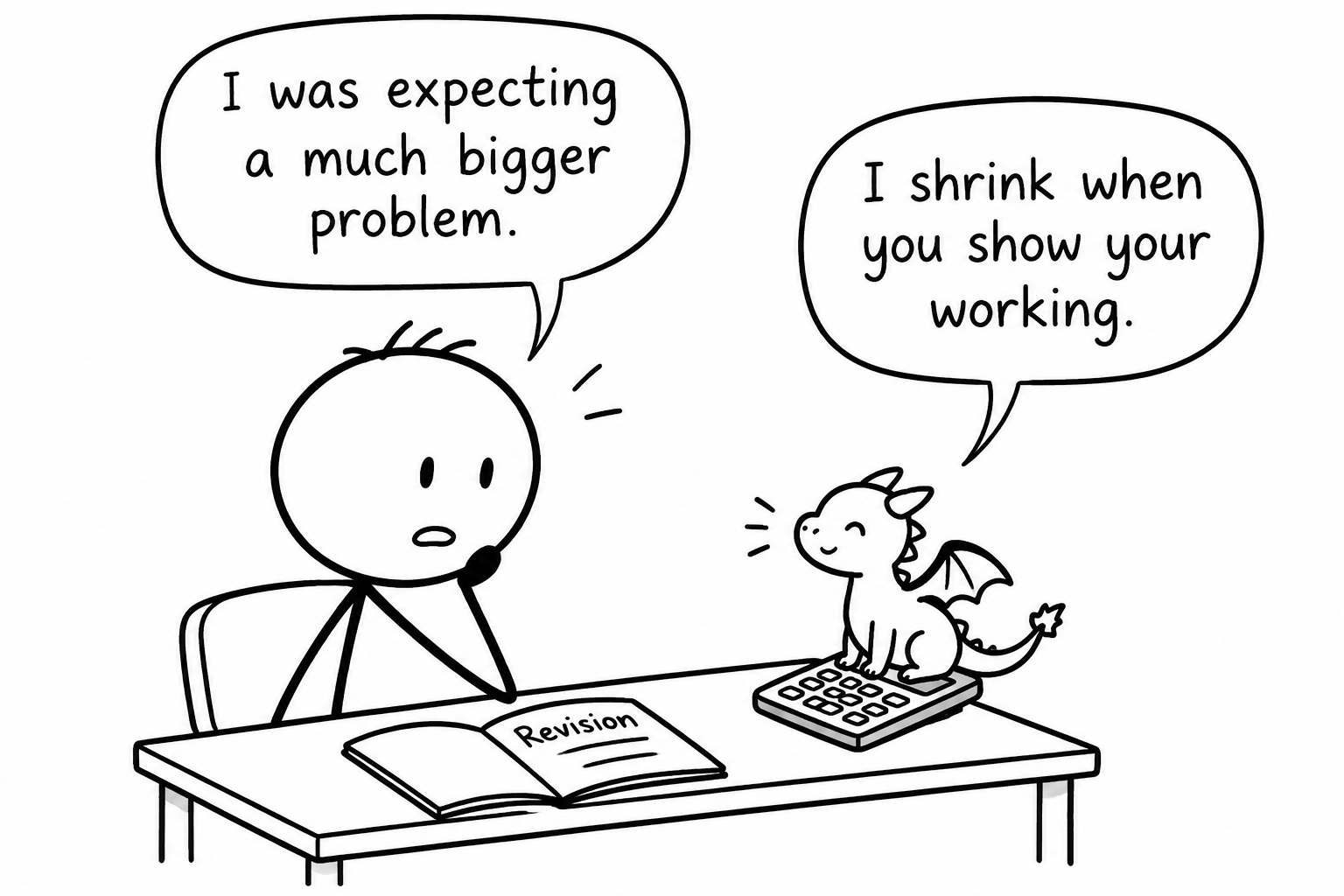 A GCSE revision student discovers that a problem shrinks when they show their working
Fractions GCSE Foundation methods
Questions on fractions GCSE Foundation content test whether you understand the denominator, can find equivalent fractions and can calculate accurately.
Finding a fraction of an amount
To find a fraction of an amount, divide by the denominator and multiply by the numerator.
Find 35\frac{3}{5}53 of £70£70£70:
70÷5=1470\div 5=1470÷5=14 14×3=4214\times 3=4214×3=42Therefore:
35 of £70=£42\frac{3}{5}\text{ of }£70=£4253 of £70=£42The denominator tells you how many equal parts to create. The numerator tells you how many of those parts to take.
Adding and subtracting fractions
Fractions need a common denominator before they can be added or subtracted.
Calculate:
23+14\frac{2}{3}+\frac{1}{4}32+41The lowest common multiple of 333 and 444 is 121212:
23=812\frac{2}{3}=\frac{8}{12}32=128 14=312\frac{1}{4}=\frac{3}{12}41=123Now add the numerators:
812+312=1112\frac{8}{12}+\frac{3}{12}=\frac{11}{12}128+123=1211Never add the denominators. The denominator describes the size of each part, so it must remain 121212 once the parts are the same size.
Multiplying fractions
Multiply the numerators, multiply the denominators, then simplify:
23×35=615=25\frac{2}{3}\times\frac{3}{5}=\frac{6}{15}=\frac{2}{5}32×53=156=52Cancelling common factors before multiplying can make larger calculations easier.
Dividing fractions
Keep the first fraction, change division to multiplication and invert the second fraction:
34÷25=34×52=158=178\frac{3}{4}\div\frac{2}{5} =\frac{3}{4}\times\frac{5}{2} =\frac{15}{8} =1\frac{7}{8}43÷52=43×25=815=187Only the fraction after the division sign is inverted.
Finding percentages of amounts
There are several valid methods. Choose one that suits the numbers and show the stages clearly.
Building from simple percentages
Find 35%35\%35% of £240£240£240.
First find 10%10\%10%:
10% of 240=240÷10=2410\%\text{ of }240=240\div 10=2410% of 240=240÷10=24Then find 30%30\%30% and 5%5\%5%:
30%=3×24=7230\%=3\times 24=7230%=3×24=72 5%=12×24=125\%=\frac{1}{2}\times 24=125%=21×24=12Therefore:
35% of £240=£72+£12=£8435\%\text{ of }£240=£72+£12=£8435% of £240=£72+£12=£84Using a decimal multiplier
Convert the percentage into a decimal and multiply:
35%=0.3535\%=0.3535%=0.35 0.35×240=840.35\times 240=840.35×240=84This is efficient on a calculator paper. The non-calculator method can still be useful because it makes the size of the answer easier to estimate. MathsGenie’s percentages revision guide provides further explanations and practice.
Expressing one amount as a percentage of another
Use the structure:
Percentage=partwhole×100\text{Percentage}=\frac{\text{part}}{\text{whole}}\times 100Percentage=wholepart×100A student answers 424242 questions correctly out of 606060. Find the percentage answered correctly.
4260×100=70\frac{42}{60}\times 100=706042×100=70Therefore, the student answered 70%70\%70% correctly.
The denominator must be the whole amount. In this example, 606060 questions were available, so 606060 belongs on the bottom of the fraction.
Percentage increase and decrease
A percentage change question has two stages:
- calculate the change
- add it for an increase or subtract it for a decrease
A bicycle costs £320£320£320. Its price increases by 15%15\%15%.
First calculate 15%15\%15% of £320£320£320:
10% of 320=3210\%\text{ of }320=3210% of 320=32 5% of 320=165\%\text{ of }320=165% of 320=16 15% of 320=4815\%\text{ of }320=4815% of 320=48Now add the increase:
320+48=368320+48=368320+48=368The new price is £368£368£368.
A multiplier gives the same result. An increase of 15%15\%15% means retaining the original 100%100\%100% and adding 15%15\%15%:
100%+15%=115%=1.15100\%+15\%=115\%=1.15100%+15%=115%=1.15 320×1.15=368320\times 1.15=368320×1.15=368For a 15%15\%15% decrease, the multiplier would be:
100%−15%=85%=0.85100\%-15\%=85\%=0.85100%−15%=85%=0.85The percentage change video lesson is useful if deciding between addition and subtraction is still causing errors.
Worked example: percentage change GCSE method
A monthly bill rises from £80£80£80 to £92£92£92. Find the percentage increase.
First find the change:
92−80=1292-80=1292−80=12Divide the change by the original amount, then multiply by 100100100:
1280×100=15\frac{12}{80}\times 100=158012×100=15The percentage increase is 15%15\%15%.
For percentage change GCSE questions, the denominator is always the original amount:
Percentage change=changeoriginal amount×100\text{Percentage change}=\frac{\text{change}}{\text{original amount}}\times 100Percentage change=original amountchange×100A common error is dividing by the new amount. Ask yourself, “What value did the change begin from?” That value belongs in the denominator.
Once the method is secure, try the timed Percentage Change Question Rush.
Reverse percentage questions
Sometimes you are given the value after a percentage change and must find the original value.
A coat costs £68£68£68 after a 15%15\%15% discount. Find its original price.
After a 15%15\%15% reduction, 85%85\%85% remains:
100%−15%=85%=0.85100\%-15\%=85\%=0.85100%−15%=85%=0.85The original price was multiplied by 0.850.850.85 to produce £68£68£68. Reverse that operation by dividing:
68÷0.85=8068\div 0.85=8068÷0.85=80The original price was £80£80£80.
Do not increase £68£68£68 by 15%15\%15%. The discount was calculated from the larger original price, not the reduced price.
Common mistakes that lose marks
Moving the decimal point in the wrong direction
To convert a decimal to a percentage, multiply by 100100100. To convert a percentage to a decimal, divide by 100100100.
A quick sense check helps:
0.7=70%0.7=70\%0.7=70%An answer of 0.7%0.7\%0.7% would be much too small.
Using the new amount in percentage change
Percentage change compares the change with where the value started. Always divide by the original amount.
Finding only the change
If a price increases by 20%20\%20%, calculating 20%20\%20% of the price gives the increase, not the new price. Read the final instruction and add the increase when required.
Adding fraction denominators
This is incorrect:
13+14≠27\frac{1}{3}+\frac{1}{4}\ne\frac{2}{7}31+41=72Find a common denominator before adding.
Forgetting to simplify
A fraction such as 1824\frac{18}{24}2418 is equivalent to 34\frac{3}{4}43. Simplify unless the question requires a particular form.
Trusting the calculator without estimating
If 25%25\%25% of £80£80£80 appears as £200£200£200, the input or interpretation is wrong. Estimate before calculating and ask whether the answer is a sensible size.
A practical resit revision routine
Confidence tends to arrive after accurate repetition, not before it. Start with one method, answer a short set of questions and check the mark scheme immediately. Record whether each mistake came from knowledge, arithmetic or misreading.
Then revisit the same skill after a day or two. MathsGenie’s AQA fractions, decimals and percentages resources include revision material for students following that specification, while the wider Edexcel GCSE Maths revision hub organises Foundation topics by difficulty.
When individual methods are secure, move to mixed mini tests, past papers and predicted papers. Mixed practice matters because the exam will not announce which method to use. Review each paper with its mark scheme and video solutions, then place weak topics into the free MathsGenie revision planner.
Turn familiar methods into dependable marks
Fractions, decimals and percentages become manageable when you stop treating them as unrelated ideas. A fraction is a division. A percentage is an amount out of 100100100. A decimal is another way to record the same value.
For a resit student, this topic offers something valuable: a small collection of methods that can support questions across number, ratio, probability and real-life contexts. Revise one method at a time, write every important step and check whether the answer makes sense.
Start with the MathsGenie revision lesson, complete the practice questions, and then test the skill inside a full paper. The goal is not to feel instantly confident. It is to make the next correct step so familiar that you can still find it under exam pressure.