

Foundation or Higher GCSE Arabic: How to Decide
Foundation or higher GCSE Arabic? Compare grade ranges, mock evidence and skill profiles to choose the tier that fits your current performance.
Choosing an exam tier can feel strangely personal. Higher sounds ambitious; Foundation can sound as though you are lowering your expectations. Neither impression is useful. If you are deciding between foundation or higher GCSE Arabic, the best tier is the one that gives your current ability the fairest route to your realistic target grade.
For Pearson Edexcel GCSE Arabic, Foundation offers grades 111 to 555, while Higher principally offers grades 444 to 999. A narrow grade 333 safety net may be available on Higher if you fall only slightly below the grade 444 boundary, but it should not be treated as a guaranteed fallback. Students currently expected to achieve grade 444 or 555 will usually be better protected on Foundation. Higher becomes the sensible choice when secure evidence suggests that grade 666 or above is realistic.
The important word is evidence. Choose from marked performances across listening, speaking, reading and writing not pride, pressure or one unusually good mock.
Your GCSE Arabic tier checklist
Before agreeing to a tier, check the following:
- your realistic target grade and any sixth-form or college requirement;
- results from recent timed papers at the tier you may enter;
- performance across all four language skills;
- whether your weakest skill is safely within the grade 444 to 555 range;
- how much improvement is realistic before the entry decision;
- your teacher's judgement and the school's entry deadline;
- official boundaries from several exam series, rather than one year alone.
You can review recent Edexcel GCSE Arabic grade boundaries, but remember that boundaries change between exam series. They are context, not a promise about the next examination.
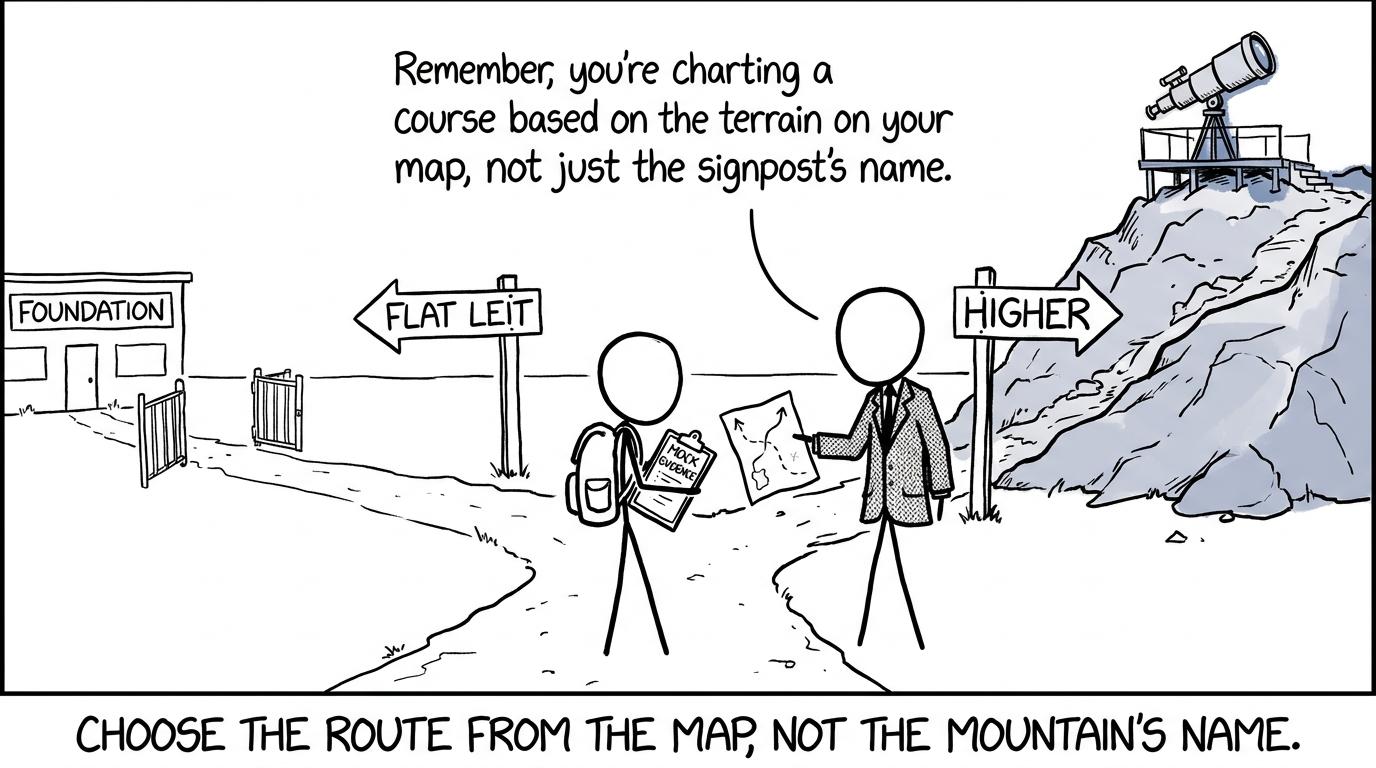 A student using mock evidence to choose between Foundation and Higher tier
What Foundation and Higher GCSE Arabic involve
This guidance refers to the current Pearson Edexcel GCSE Arabic qualification, code 1AA01\text{AA}01AA0. Confirm your exact qualification with your school because GCSE and International GCSE arrangements are not interchangeable.
Both tiers assess four skills:
- listening and understanding;
- speaking;
- reading and understanding;
- writing.
Each contributes 25%25\%25% of the qualification. Listening and reading each have 505050 raw marks, speaking has 707070, and writing has 606060. Pearson scales the relevant raw marks so that the four skills remain equally weighted, producing a total scaled mark out of 280280280.
You must be entered for one tier across every paper. You cannot, for example, take Higher speaking and Foundation writing. This makes your overall skill profile more important than your strongest individual result.
| Feature | Foundation tier | Higher tier |
|---|---|---|
| Main grade range | Grades 111 to 555 | Grades 444 to 999 |
| Best suited to | Students working realistically around grades 111 to 555 | Students securely targeting grade 666 or above |
| Maximum grade | Grade 555 | Grade 999 |
| Main risk | Grade capped at 555 | A result below the narrow grade 333 safety net can be unclassified |
| Entry arrangement | All four assessments at Foundation | All four assessments at Higher |
A grade 444 or 555 achieved on Foundation has the same value as that grade achieved on Higher. The tier is not shown on the GCSE certificate. Foundation is therefore not a lesser version of a grade 555; it is a different route to the same grade standard.
Decide from where you are realistically sitting now
The safest decision begins with recent work completed under controlled conditions. Classroom fluency, vocabulary knowledge and confidence in conversation matter, but they do not replace examination evidence.
Use more than one mock
One paper can be distorted by a familiar theme, an unusually difficult listening extract or nerves during the speaking assessment. Use at least two recent sets of evidence where possible, including a properly timed paper at the proposed tier.
Mark each assessment according to the official mark scheme. Then record both the result and the reason for each lost mark. MathsGenie's guide to finding your weakest GCSE topics is written for maths, but its diagnostic principle transfers well: separate missing knowledge from timing, misunderstanding and avoidable errors.
For an informal overview, convert each skill result to a percentage and calculate:
D=L+S+R+W4D=\frac{L+S+R+W}{4}D=4L+S+R+WHere, LLL, SSS, RRR and WWW are your percentage results in listening, speaking, reading and writing. Because the four skills are equally weighted, DDD provides a useful snapshot. It is not an official predicted grade. your school should use scaled marks and the correct boundaries when estimating outcomes.
Look closely at your weakest skill
An average can hide fragility. A student may be a confident speaker but struggle to read unfamiliar texts or write accurately under time pressure. This can be especially important for students who regularly speak Arabic at home but have had less formal practice in reading and writing.
Alongside your average, consider your consistency floor:
C=min(L,S,R,W)C=\min(L,S,R,W)C=min(L,S,R,W)If one skill remains significantly below the others, ask whether it can realistically be repaired before the examination. Since every skill contributes 25%25\%25%, a serious weakness cannot simply be ignored.
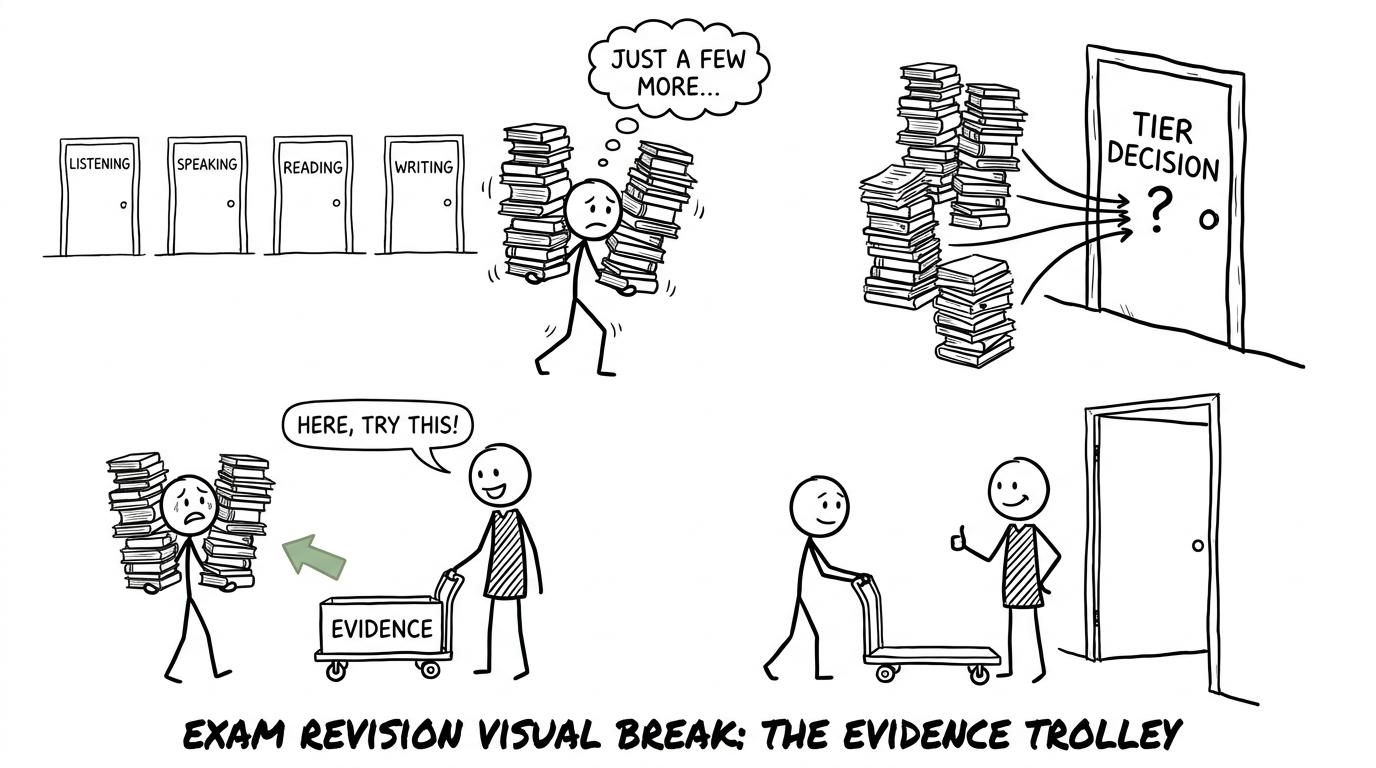 Four language skills being carried together into one tier decision
Compare performance with your target
Foundation is usually the stronger choice when your evidence consistently places you around grades 444 or 555, your priority is securing a pass, or Higher papers leave substantial sections inaccessible. Official Ofqual guidance says students expected to achieve grade 444 or 555 should be entered for Foundation tier.
Higher is appropriate when recent Higher-tier work indicates that grade 666 or above is realistic across the qualification, not merely possible on your best day. It is also necessary if your target is grade 666, 777, 888 or 999, because Foundation cannot award those grades.
Do not choose Higher solely because you might improve. Ask what improvement is already visible. A rising sequence of marked performances is evidence; determination without corresponding paper results is still only an intention.
Ask what the paper feels like, not just what it is called
A borderline student can encounter questions targeted well above grade 555 on Higher. Even when some material is accessible, repeated exposure to demanding tasks can consume time and damage confidence. Foundation may let the same student demonstrate grade 444 or 555 knowledge more consistently.
The reverse problem also exists. A student regularly reaching the Foundation ceiling may be prevented from receiving the grade their ability deserves. If Foundation papers no longer distinguish your performance and Higher tasks are becoming secure, discuss a move with your teacher while entries can still be changed.
This is similar to the evidence-based process described in MathsGenie's guide to moving from Foundation to Higher GCSE Maths. The subjects are different, but the decision principle is identical: a tier change should follow stable performance, not precede it.
Build a short evidence plan before deciding
If your tier is uncertain, create a focused review period with your teacher.
Establish a baseline
Complete appropriately selected listening, reading and writing material under the correct conditions, alongside formal speaking evidence organised by your school. Use current specification materials and do not mix results from unrelated qualifications.
Categorise every lost mark
Use four labels:
- knowledge or vocabulary;
- grammar and accuracy;
- examination technique or misreading;
- timing or incomplete answers.
The label matters because each problem needs a different response. Vocabulary requires retrieval practice. Grammar requires deliberate correction. Timing requires controlled paper practice. Misreading requires slower attention to instructions.
Retest instead of merely revising
After targeted practice, complete different questions under similar conditions. Improvement counts when it survives without prompts. This attempt-mark-fix-retest cycle is central to effective revision, whether you are preparing Arabic or using MathsGenie's GCSE Maths revision hub for your maths papers.
A realistic GCSE revision timetable can help you schedule short repair sessions without allowing one subject to absorb every evening. Make room for Arabic practice, maths revision and rest rather than relying on a final burst of work.
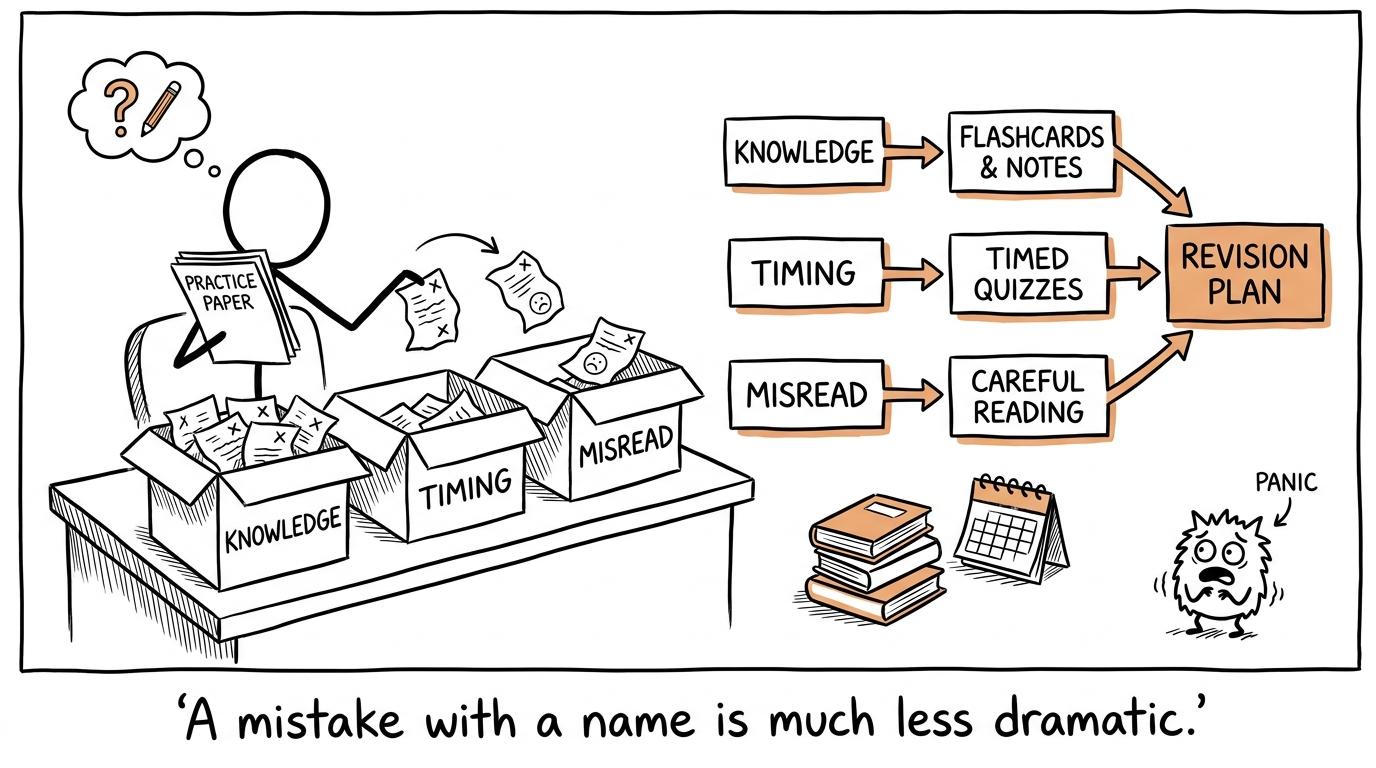 A student turning named mistakes into a sensible revision plan
Common mistakes when choosing an Arabic tier
Treating Foundation as failure
Foundation can award grade 555, and a Foundation grade 444 or 555 is equivalent to the same grade from Higher. The sensible tier is the one aligned with your attainment.
Choosing Higher for status
The word Higher can sound better before the exam. What matters afterwards is the awarded grade. If your evidence is around grade 444 or 555, Higher may introduce risk without creating a realistic benefit.
Assuming the Higher grade 333 is guaranteed
It is not. The safety net applies only within a narrow mark range below grade 444. Falling further below can produce a UUU.
Judging yourself from one strong skill
You take one tier across listening, speaking, reading and writing. A high speaking result cannot by itself justify Higher if reading and writing remain insecure.
Using one year's boundary as a prediction
Grade boundaries are set for each exam series. Compare several years and use boundaries only to interpret completed papers. The same caution applies when using past papers as part of GCSE revision: the purpose is to reveal readiness, not to predict an exact future threshold.
Leaving the conversation too late
Schools must make tier entries in advance, with the decision required before the speaking assessment arrangements are finalised. Ask your teacher when your school will confirm entries and what evidence could change the decision.
Make the tier serve the goal
The decision is simpler when you remove the emotional labels. Choose Foundation if it gives your current grade 444 or 555 performance the clearest route to success. Choose Higher if repeated, properly marked evidence shows that grades above 555 are genuinely within reach.
Then return to the work. A tier does not improve a result; carefully corrected practice does.
MathsGenie is your free home for GCSE and A Level maths revision alongside your Arabic preparation. Use the GCSE maths revision lessons and practice questions, build exam stamina through past papers with mark schemes, and diagnose smaller gaps with Edexcel GCSE Maths mini tests. Nearer your maths exams, add predicted papers and video solutions to the same attempt-mark-fix-retest routine.
Start with one honest paper, one carefully marked result and one conversation with your teacher. Good decisions rarely begin with confidence. They begin with clear evidence.










