Foundation Maths Topics That Appear Most Often
Foundation maths topics ranked for GCSE resits, with quick worked examples, common mistakes and a focused revision route towards a secure grade 4.

A resit can make GCSE Maths feel strangely unpredictable. You remember revising angles, then the paper asks about a phone contract. You practise percentages, only to meet them disguised inside a problem about wages. The contexts change, but the underlying foundation maths topics are much more familiar than they first appear.
The short answer is that number, fractions, percentages, ratio, basic algebra, measures, graphs, probability and statistics appear frequently across foundation papers. No topic is guaranteed to appear in a particular paper, and exam boards can assess the specification in different ways. Still, these areas repeatedly supply the core skills behind many of the most common GCSE maths questions.
This ranking is therefore a revision priority list, not an exact prediction. It reflects the broad emphasis of foundation specifications and the way core skills recur across sets of past papers. Foundation tier covers grades 1-5, so a student aiming for grade 4 needs both reliable basics and confidence with multi-step questions.
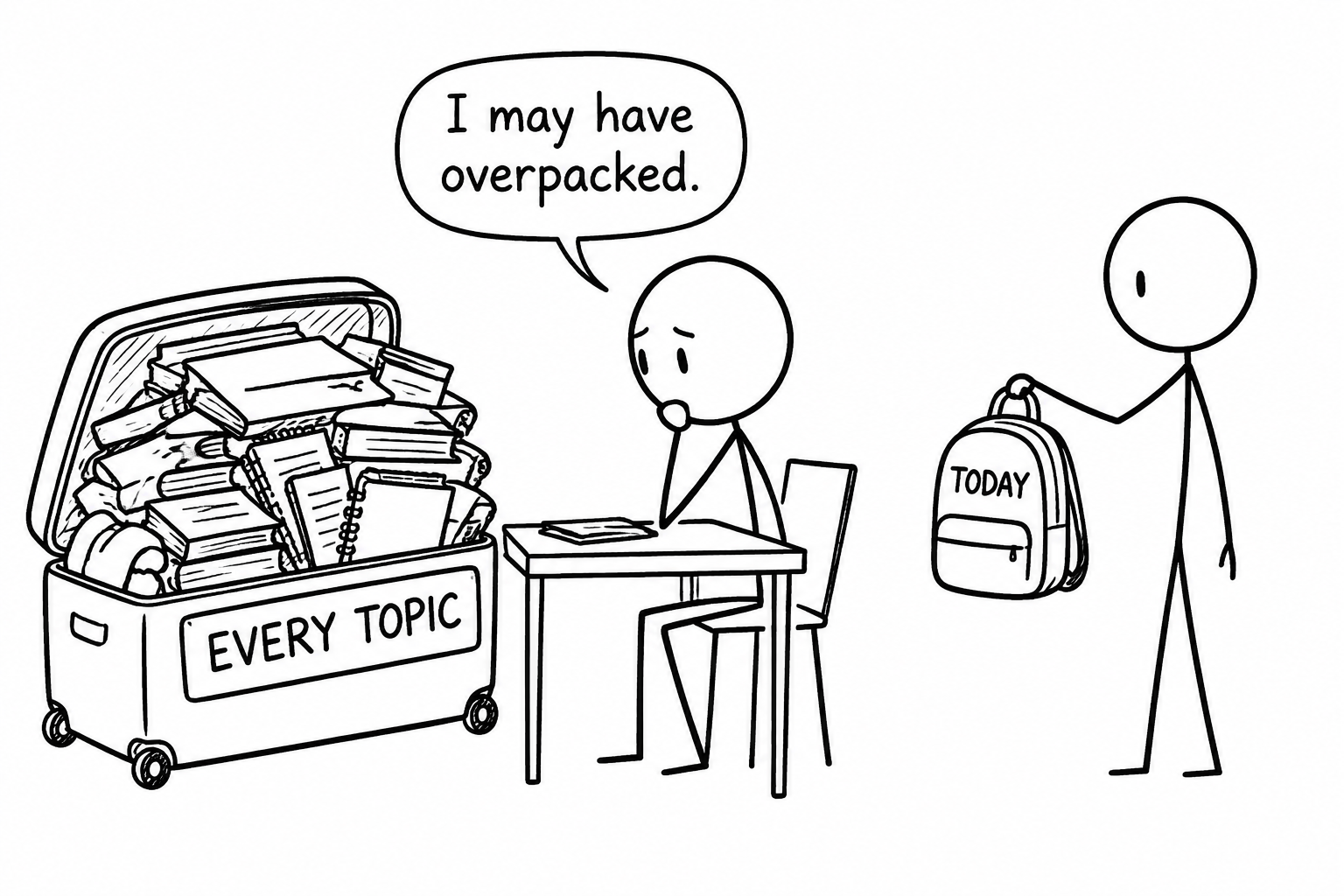 A student realises they have packed every GCSE topic into one revision suitcase
Your foundation revision checklist
Start with these ten areas, ranked approximately by their usefulness and frequency across foundation papers:
- Fractions, decimals and percentages
- Ratio and proportion
- Written calculations and number skills
- Equations, substitution and sequences
- Area, perimeter and volume
- Averages, tables and charts
- Probability
- Angles and properties of shapes
- Coordinates and straight-line graphs
- Units, time, money and compound measures
A ranking cannot tell you the exact contents of your next AQA, Edexcel, OCR or Eduqas paper. Its purpose is simpler: to help you decide what to revise first when time is limited.
The most frequent foundation maths topics, ranked
Fractions, decimals and percentages
Fractions and percentages deserve the first position because they connect to so much else. They appear directly in calculations and indirectly in probability, ratio, money, proportion and data questions.
You should be able to convert between forms, find a fraction or percentage of an amount, compare values and calculate percentage change. Build these skills with the fractions, decimals and percentages lesson.
Quick worked example: Find 35%35\%35% of £240£240£240.
10%=£2410\%=£2410%=£24 30%=£725%=£1230\%=£72 \qquad 5\%=£1230%=£725%=£12 35%=£72+£12=£8435\%=£72+£12=£8435%=£72+£12=£84The useful habit is to break an unfamiliar percentage into familiar parts.
Ratio and proportion
Ratio questions often test more than notation. You may need to share an amount, scale a recipe, use a map or compare prices. These are common grade 4 maths topics because the arithmetic is accessible, while interpreting the situation requires care.
The MathsGenie ratio lesson covers the methods needed for exam-style problems.
Quick worked example: Share £84£84£84 in the ratio 3:43:43:4.
There are 3+4=73+4=73+4=7 equal parts.
£84÷7=£12£84\div7=£12£84÷7=£12Therefore, the two shares are
3×£12=£363\times£12=£363×£12=£36and
4×£12=£48.4\times£12=£48.4×£12=£48.Check that £36+£48=£84£36+£48=£84£36+£48=£84 before moving on.
Written calculations and number skills
Addition, subtraction, multiplication and division may appear as standalone questions, but they also sit underneath almost every longer problem. Negative numbers, rounding, estimation, factors, multiples and order of operations belong in this group too.
These questions can feel basic. That is precisely why lost marks are so expensive. A secure method here supports the rest of the paper.
Quick worked example: Work out 4.8×0.74.8\times0.74.8×0.7.
First ignore the decimal points:
48×7=336.48\times7=336.48×7=336.There are two decimal places altogether, so
4.8×0.7=3.36.4.8\times0.7=3.36.4.8×0.7=3.36.An estimate, 5×0.7=3.55\times0.7=3.55×0.7=3.5, confirms that the answer is sensible.
Equations, substitution and sequences
Foundation algebra usually rewards clear, repeatable processes. Learn to collect like terms, substitute values, solve linear equations, continue sequences and find simple nth-term rules.
For resit students, solving equations is particularly valuable because the same balancing idea can be used in many forms. Practise it through the solving equations revision lesson.
Quick worked example: Solve 5x+7=325x+7=325x+7=32.
Subtract 777 from both sides:
5x=25.5x=25.5x=25.Divide both sides by 555:
x=5.x=5.x=5.Check by substitution:
5×5+7=32.5\times5+7=32.5×5+7=32.Area, perimeter and volume
Measures questions often combine a remembered formula with a practical decision. You might calculate the area of a floor, the perimeter of a garden or the volume of a cuboid. Compound shapes are especially important because they test whether you can split a problem into manageable pieces.
Review the distinction using area and perimeter practice.
Quick worked example: A rectangle is 8 cm8\text{ cm}8 cm long and 5 cm5\text{ cm}5 cm wide. Find its area and perimeter.
Area=8×5=40 cm2\text{Area}=8\times5=40\text{ cm}^2Area=8×5=40 cm2 Perimeter=2(8+5)=26 cm.\text{Perimeter}=2(8+5)=26\text{ cm}.Perimeter=2(8+5)=26 cm.Area uses square units. Perimeter is a length, so it does not.
Averages, tables and charts
Statistics questions frequently ask you to calculate or interpret the mean, median, mode and range. You may also meet frequency tables, bar charts, pie charts, scatter graphs and two-way tables.
The difficult part is often not the calculation. It is deciding which figures matter. The averages revision lesson helps separate the four measures.
Quick worked example: Find the mean of 666, 888, 888, 111111 and 121212.
6+8+8+11+12=456+8+8+11+12=456+8+8+11+12=45There are 555 values, so
Mean=455=9.\text{Mean}=\frac{45}{5}=9.Mean=545=9.Do not divide by the largest value or by the number of different values.
Probability
Probability links fractions, decimals and percentages to uncertain events. Foundation questions commonly involve probability scales, sample spaces, expected frequency and completing missing probabilities.
All probabilities for mutually exclusive outcomes must total 111. That single fact unlocks many questions. Use the foundation probability lesson to practise it in different settings.
Quick worked example: A bag contains 333 red counters and 777 blue counters. Find the probability of choosing a red counter.
There are 101010 counters altogether, so
P(red)=310.P(\text{red})=\frac{3}{10}.P(red)=103.The denominator represents every equally likely counter, not just the blue ones.
Angles and properties of shapes
Expect questions involving angles on a line, around a point, in triangles and in quadrilaterals. Parallel-line rules, symmetry, transformations and shape properties also feature regularly across foundation assessments.
Quick worked example: Two angles in a triangle are 48∘48^\circ48∘ and 67∘67^\circ67∘. Find the third angle, xxx.
Angles in a triangle total 180∘180^\circ180∘, so
x=180∘−48∘−67∘=65∘.x=180^\circ-48^\circ-67^\circ=65^\circ.x=180∘−48∘−67∘=65∘.Write the relevant angle rule. It communicates your reasoning and may earn a method mark even if the arithmetic goes wrong.
Coordinates and straight-line graphs
Graph questions can involve plotting coordinates, reading scales, recognising horizontal and vertical lines, completing tables of values or drawing a graph from an equation. Foundation students may also need to interpret real-life graphs, including distance-time graphs.
Quick worked example: Find the value of yyy when x=3x=3x=3 in y=2x+1y=2x+1y=2x+1.
Substitute x=3x=3x=3:
y=2×3+1=7.y=2\times3+1=7.y=2×3+1=7.The corresponding coordinate is (3,7)(3,7)(3,7). Keeping the substitution visible makes sign and multiplication errors easier to spot.
Units, time, money and compound measures
Conversion questions are often hidden inside practical contexts. You may need to convert metric units, read a timetable, calculate a bill or use a formula such as speed, distance and time.
Quick worked example: A car travels 150 km150\text{ km}150 km in 3 hours3\text{ hours}3 hours. Find its average speed.
Speed=DistanceTime\text{Speed}=\frac{\text{Distance}}{\text{Time}}Speed=TimeDistance Speed=1503=50 km/h.\text{Speed}=\frac{150}{3}=50\text{ km/h}.Speed=3150=50 km/h.Check that the distance and time units match the requested answer before calculating.
How to revise these topics for a grade 4
Reading a method can create the comforting impression that you know it. The exam asks a different question: can you retrieve and use that method without help?
Choose one topic and follow a short cycle:
- Watch or read the revision lesson.
- Complete practice questions without looking at the method.
- Mark your work carefully.
- Rewrite every incorrect solution.
- Return to the topic several days later.
- Test it alongside unrelated topics.
The full Edexcel GCSE Maths revision hub organises lessons and questions by grade, while MathsGenie mini tests provide short bursts of mixed practice.
Once individual skills are becoming secure, move to complete papers. Past papers reveal something topic worksheets cannot: whether you can recognise a method when the question does not name it. Predicted papers can provide further practice, but they should never be treated as promises about the real examination. MathsGenie's free predicted papers include mark schemes and worked solutions for checking your reasoning.
Common mistakes on foundation papers
Revising only grade 4 content
A grade 4 rests on earlier material. Ratio becomes harder if division is uncertain. Probability becomes harder if fractions are weak. Secure grade 1-3 skills before treating grade 4 topics as a separate island.
Doing every calculation on a calculator
A calculator is useful, but it cannot decide which operation a worded problem requires. Paper 1 is non-calculator on major GCSE specifications, so written arithmetic and mental methods still matter.
Ignoring units
An answer of 40 cm40\text{ cm}40 cm is not correct if the question asks for area. Use cm2\text{cm}^2cm2 for area and cm3\text{cm}^3cm3 for volume. Convert units before combining measurements.
Rounding too early
Keep the full calculator value during intermediate stages, then round the final answer as requested. Early rounding can shift an otherwise correct answer outside the accepted range.
Checking answers without studying the mark scheme
A mark scheme shows where marks are awarded. Compare each line of your work, not merely the final answer. This turns a wrong response into a specific target, such as fraction conversion or equation solving.
Build your resit around what repeats
A resit does not require you to become fearless about every question. It requires a growing collection of methods you can recognise and execute reliably.
Begin with fractions, percentages, ratio and number. Add algebra and measures. Then connect those skills to statistics, probability and graphs. These foundation maths topics are not guaranteed predictions, but they are dependable revision priorities because they support such a large share of foundation work.
Open the MathsGenie revision hub, choose the first weak topic on this list and complete one lesson today. Use the practice questions, video solutions and mark schemes, then test the skill again later with a mini test or full paper. Progress often looks less dramatic than prediction. It is also much more useful.