

Fluent Before Starting GCSE Bengali? What You Need
Fluent before starting GCSE Bengali? Learn the real entry level, skills required, course demands and how to balance Bengali with GCSE maths revision.
There is a particular kind of worry that appears before choosing a language GCSE: everyone else seems to know more than you. Perhaps they speak Bengali at home. Perhaps they can read the script while you are still recognising letters. It is easy to conclude that you must be fluent before starting GCSE Bengali.
You do not. AQA states that its GCSE Bengali qualification has no previous learning requirement, although individual schools and colleges decide their own course-entry rules. In practical terms, however, beginning with no Bengali at all will require structured teaching, regular independent practice and enough time to develop listening, speaking, reading and writing.
The distinction matters. Fluency is not the starting requirement. A realistic plan is.
The short answer
Before beginning GCSE Bengali, you do not officially need to:
- speak Bengali fluently;
- understand every family conversation;
- write long, accurate passages;
- know the entire GCSE vocabulary;
- have taken a Bengali qualification previously.
You will be better prepared if you can already:
- recognise some Bengali letters and common sound patterns;
- understand and use basic everyday phrases;
- introduce yourself and answer simple personal questions;
- read and write short words or sentences;
- commit to frequent practice outside lessons.
These are useful foundations, not universal entry conditions. Ask the school or exam centre what its course assumes because a class designed for complete beginners is very different from one designed for heritage speakers.
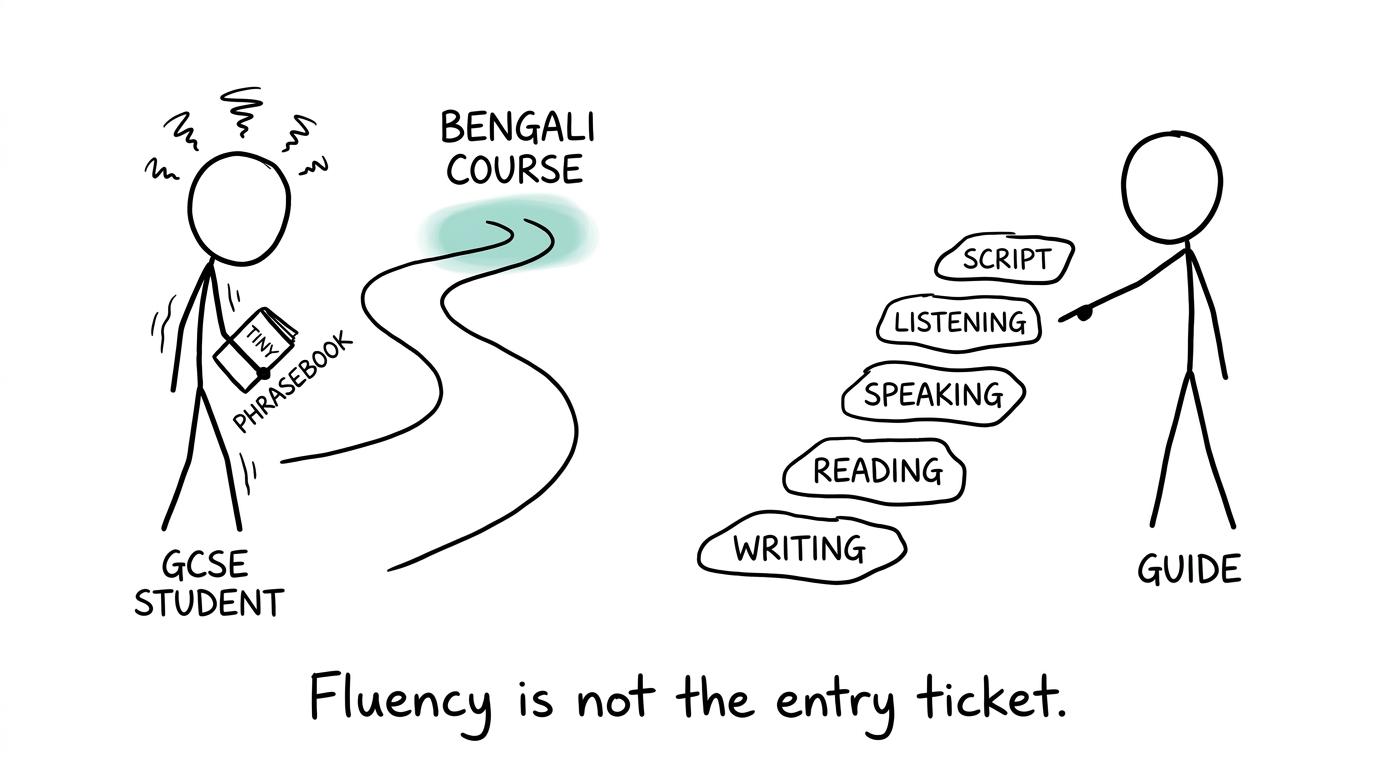 A student discovers that fluency is not the entry ticket to GCSE Bengali
What GCSE Bengali actually assesses
For the AQA GCSE Bengali specification, students are assessed in four language skills:
- listening;
- speaking;
- reading;
- writing.
Each skill contributes 25%25\%25% of the qualification. This means that being confident in conversation alone is not enough. Equally, a student who reads Bengali well but rarely speaks it still has an important gap to close.
The qualification is linear, so the assessments are completed at the end of the course and in the same exam series. Students enter either Foundation or Higher tier across all four components. Foundation targets grades 111 to 555, while Higher targets grades 444 to 999, with AQA also allowing a grade 333 for a Higher-tier candidate who narrowly misses grade 444.
This structure explains why informal familiarity can be misleading. Understanding Bengali at home is valuable, but GCSE success also requires accurate writing, translation, topic vocabulary, grammatical control and familiarity with exam tasks. A beginner has more language to acquire; a heritage speaker may have different work to do, particularly with spelling, formal registers or extended writing.
How much prior Bengali knowledge do you really need?
There is no single minimum level that suits every course. A useful way to judge readiness is to consider four starting points.
Starting with no Bengali
It is possible to begin from scratch if your school offers genuine beginner teaching and you have enough curriculum time. Your earliest priorities will be the script, pronunciation, high-frequency vocabulary and simple sentence construction.
Ask direct questions before enrolling:
- Does teaching begin with the Bengali script?
- How many lessons are provided each week?
- Is independent work expected during holidays?
- Are beginners taught separately from fluent or heritage speakers?
- What support is available for speaking practice?
A course having no formal prerequisite does not guarantee that every class starts at zero. That depends on the centre.
Knowing a few words and phrases
This is still beginner territory, but familiarity with the sounds of Bengali can help. You may be able to greet someone, name family members or understand common instructions without yet being able to read confidently.
Your main task is to connect sound, meaning and script. Avoid relying indefinitely on transliteration. It can offer temporary support, but the GCSE assesses reading and writing in Bengali.
Speaking Bengali at home but not reading or writing it
This is a common type of uneven starting point. Listening and spontaneous speaking may feel natural, yet written Bengali may feel like a new subject.
Do not treat literacy as a small technical detail. Reading and writing together account for half of the AQA qualification, and language from home may differ from the standard forms expected in formal assessment. You may progress quickly, but you still need deliberate work on spelling, grammar, translation and exam conventions.
Reading and writing Bengali already
You have a strong head start, but GCSE preparation is not automatic. You must still learn the specification themes, respond to precise instructions, manage time and understand how marks are awarded.
The question shifts from “Can I use Bengali?” to “Can I demonstrate the required skills under assessment conditions?” That is the same shift maths students make when they move from understanding a topic to completing it accurately in a timed paper.
A readiness checklist for complete beginners
You are in a reasonable position to start if most of these statements are true:
- You know what course you are entering. AQA GCSE Bengali is not the same qualification as Pearson Edexcel International GCSE Bangla, which focuses on reading, writing and translation in one written paper. Confirm the qualification title and specification code with your centre.
- The teacher knows you are a beginner. Do not let assumptions survive until the first assessment.
- You have time for regular practice. Languages improve through repeated contact rather than occasional long sessions.
- You can access speaking feedback. Listening to recordings is useful, but interaction also matters for GCSE speaking.
- You are willing to learn the script early. Delaying it makes later reading and writing harder.
- Your wider GCSE workload is manageable. Bengali must fit alongside maths, English and your other subjects.
Readiness is less about already knowing everything and more about having the conditions needed to learn.
How to build Bengali from scratch
Establish the script first
Learn letters and sound combinations in small groups. Practise recognising them, producing their sounds and writing them accurately. Short daily sessions are usually more manageable than trying to absorb the whole writing system at once.
Keep handwriting practice connected to meaningful vocabulary. The goal is not merely to copy shapes; it is to read and create language.
Build useful language in themes
The AQA course covers broad areas including identity and culture, local and global interests, and current and future study and employment. Organise vocabulary around these contexts rather than memorising an unrelated dictionary list.
Learn phrases that can be adapted. A flexible sentence pattern is more valuable than several isolated nouns because it supports both speaking and writing.
Train all four skills every week
A balanced week should contain some listening, speaking, reading and writing. Your weakest area may need extra attention, but none should disappear completely.
Listening can include short recordings replayed with a clear purpose. Speaking can begin with reading aloud and prepared answers before moving towards less predictable conversation. Reading should progress from short phrases to unfamiliar passages. Writing should develop from accurate sentences to connected responses.
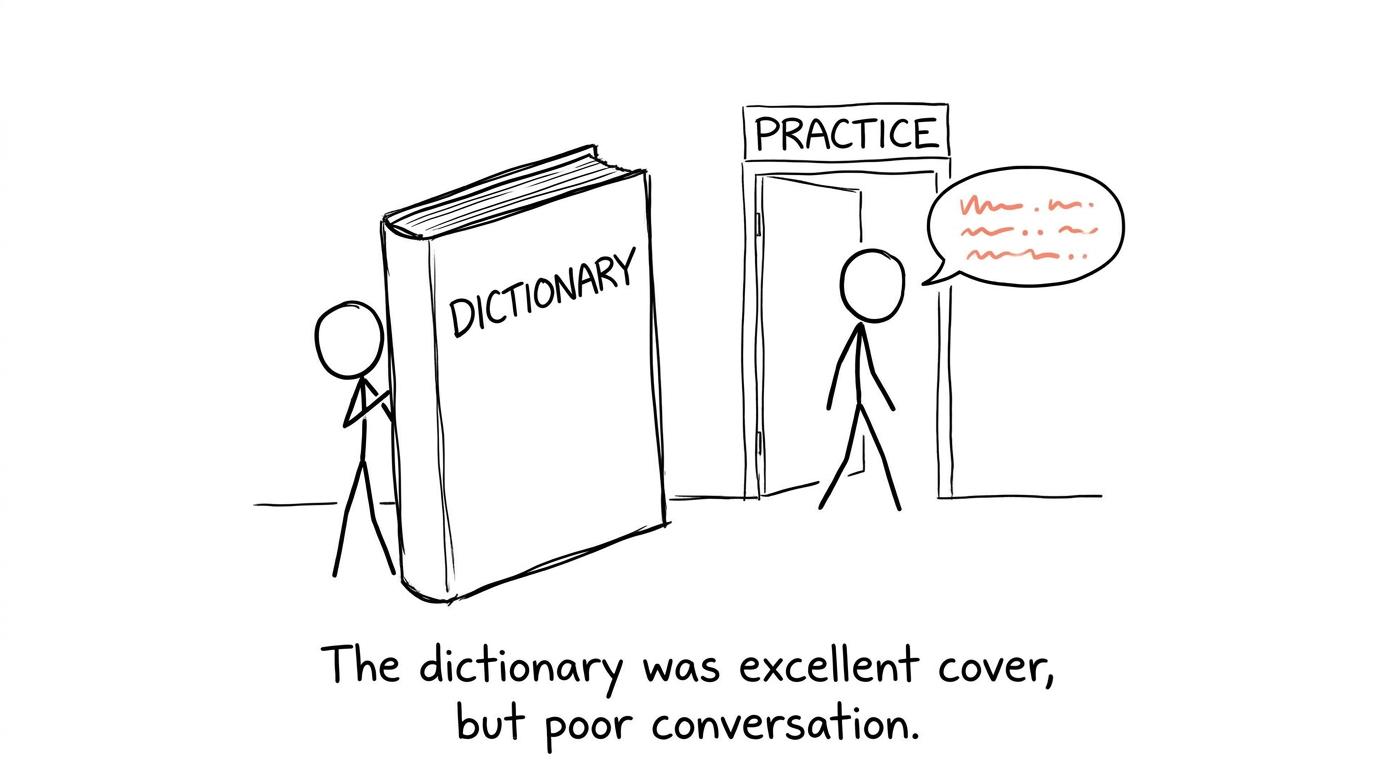 A dictionary proves less useful than actually practising conversation
Use assessment materials carefully
Once you have basic knowledge, use official sample questions and available past materials for your exact qualification. Do not begin by repeatedly sitting complete papers that you cannot yet access. First learn the language and task types; later, use timed practice to reveal gaps.
The principle is familiar from maths revision: attempt, mark, diagnose, repair and retest. MathsGenie's guide to finding your weakest GCSE topics explains how to turn lost marks into specific next actions rather than vague worry.
Balancing Bengali with GCSE maths revision
Taking Bengali does not make your maths workload smaller. A good timetable protects both subjects without pretending that every evening has unlimited space.
Use short, distinct sessions. Bengali benefits from frequent vocabulary, script and listening practice. Maths requires active problem-solving, written methods and regular retrieval. A sensible week might alternate focused language work with maths topic sessions, then reserve a longer block for assessment practice.
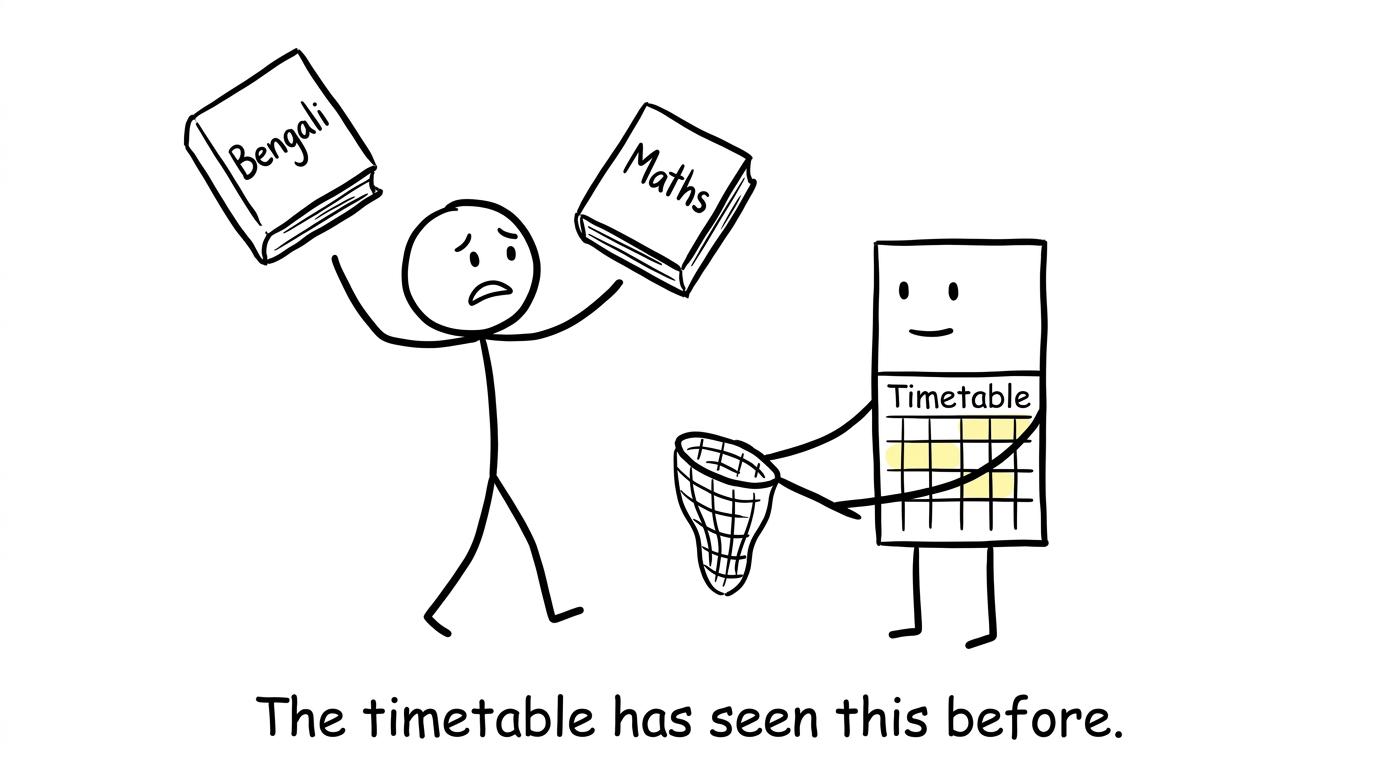 A weekly timetable catches a student juggling Bengali and maths revision
For maths, start with the GCSE Maths revision hub, where you can select the correct exam board and access revision lessons, questions and papers. If your fundamentals need attention, follow the best order for learning GCSE Maths topics instead of choosing topics randomly.
Use GCSE Maths mini tests when time is limited. Short tests provide useful retrieval without taking over an evening intended for Bengali. Longer sessions can include Edexcel GCSE Maths past papers, or the equivalent board page if you take AQA, OCR or Eduqas.
A revision timetable should reduce decisions. The MathsGenie GCSE self-assessment resources can help identify what needs attention, while the one-month maths revision plan shows how to combine focused learning, mini tests and paper practice.
Common mistakes when starting GCSE Bengali
Assuming fluency is required
This can stop capable beginners before they investigate the course. The official AQA qualification has no previous learning requirement, but your centre may set its own expectations. Ask rather than assume.
Assuming home speaking guarantees an easy grade
Conversational confidence is not the whole assessment. Reading, writing, grammar, translation and formal accuracy need separate practice.
Waiting too long to learn the script
Transliteration may make the first few lessons feel easier, but dependence on it can delay the literacy required for the actual qualification.
Revising vocabulary without using it
Recognition is not the same as production. Use vocabulary in spoken responses and original sentences so that you can retrieve it independently.
Ignoring the exact specification
GCSE Bengali and International GCSE Bangla have different assessment structures. Check the awarding body, specification and paper format before choosing resources.
Letting Bengali displace maths practice
A new language can absorb time because there is always another word to learn. Protect regular maths sessions and use the MathsGenie GCSE topics by board and tier guide to keep your work aligned with the paper you will sit.
Start from where you are, not where you think you should be
You do not need to be fluent before starting GCSE Bengali. You need an honest picture of your current listening, speaking, reading and writing, confirmation that the course supports your starting level, and a routine you can sustain.
If you are beginning from scratch, ask about script teaching, lesson time and speaking support before committing. If you already use Bengali at home, identify the skills that informal conversation has not yet developed. In both cases, progress comes from regular, active practice.
Keep the rest of your GCSE preparation equally deliberate. Use MathsGenie as your free maths revision base: learn through revision lessons and video solutions, practise with topic questions and mini tests, then build exam confidence with past papers, predicted papers and mark schemes. Start at the GCSE Maths revision area, choose your board and tier, and give each revision session one clear purpose.










