Fluent Before Starting GCSE Arabic? What You Need
Fluent before starting GCSE Arabic? Learn what beginners need, what the exam assesses, and how to balance Arabic with GCSE maths revision effectively.
It is easy to imagine that everyone entering a GCSE Arabic classroom already speaks confidently at home, reads Arabic quickly and understands every conversation. That assumption can make a beginner feel behind before the course has even begun.
But do you need to be fluent before starting GCSE Arabic? No. The current Pearson Edexcel GCSE Arabic specification states that there are no prior learning requirements. The qualification is designed to assess skills developed during the course, including listening, speaking, reading and writing.
That does not mean starting from scratch will be effortless. Arabic has a different script, unfamiliar sounds and grammatical structures that take time to absorb. You do not need fluency at the entrance. You need enough time, suitable teaching and a willingness to practise consistently.
The short answer: what you need before starting
A complete beginner can begin GCSE Arabic, but the following foundations will make the transition easier:
- willingness to learn and write the Arabic alphabet
- regular access to a teacher or structured course
- time for listening and speaking practice, not only written homework
- a realistic understanding that vocabulary must be built gradually
- confirmation that your school can enter you for the correct qualification
- a revision plan that leaves space for maths, English and your other GCSE subjects
Fluency is the destination, not the entry ticket. The more useful question is whether you have a workable route from your present level to the standard required by the examination.
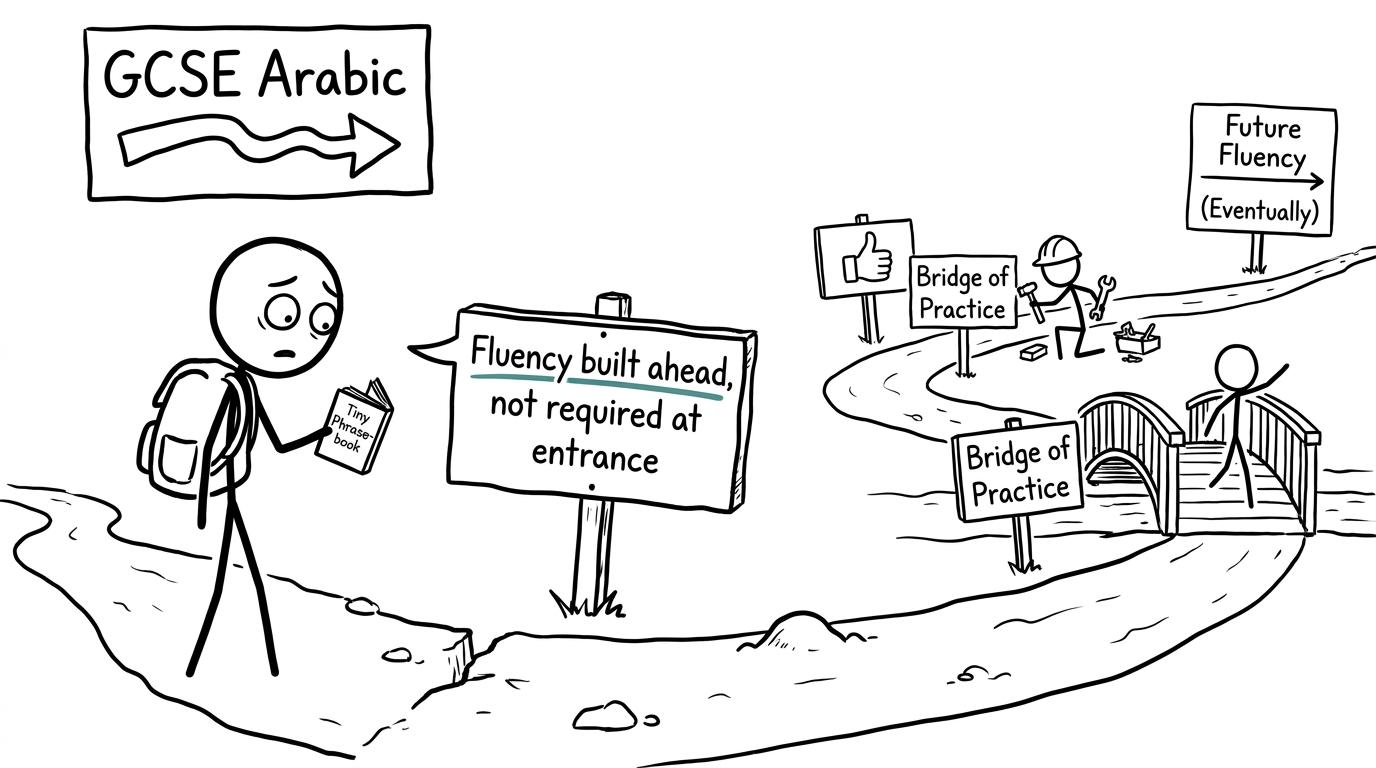 A student discovers that fluency is built along the GCSE Arabic path rather than required at the entrance
What does GCSE Arabic actually assess?
The current Pearson Edexcel GCSE Arabic is built around four compulsory skills:
- listening and understanding
- speaking
- reading and understanding
- writing
Each skill contributes 25%25\%25% of the qualification. Students take all components at either foundation or higher tier; they do not mix tiers between papers. Assessment also includes translation between Arabic and English, while reading material may include advertisements, messages, articles and adapted literary texts.
This balance matters. Someone who speaks Arabic with relatives may possess a valuable head start, but conversational confidence alone does not guarantee strong reading, spelling, grammar or formal writing. Equally, a beginner who follows a structured course can steadily develop all four assessed skills.
The course therefore does not simply ask, “Can you speak Arabic?” It asks whether you can understand and communicate across several contexts and formats under examination conditions.
How much Arabic should a beginner ideally know?
Although there is no formal prior-learning requirement, “allowed to start” and “well prepared to start” are different ideas. A student beginning from absolute zero should expect the early part of the course to focus heavily on foundations.
The Arabic alphabet and sound system
You do not have to know the whole alphabet before your first lesson. However, learning it early should be a priority. Arabic is written from right to left, and letters can change form depending on their position in a word.
Beginners need time to connect three things:
- the shape of a letter
- the sound it represents
- the way it joins to neighbouring letters
Reading may initially feel slow because you are decoding individual characters. That is normal. Speed develops through repeated exposure rather than one large memorisation session.
Basic vocabulary
You are not expected to arrive with a GCSE-sized vocabulary. Early knowledge of greetings, family, numbers, school, hobbies and everyday routines is helpful, but it can be acquired during the course.
Vocabulary becomes useful when you can recognise it while listening, retrieve it while speaking and spell it while writing. Merely recognising a word on a flashcard is only the first layer of learning.
Simple sentence building
A beginner does not need to understand advanced grammar beforehand. You will, however, need to progress beyond isolated words. The course requires communication in sentences and connected passages, so teaching should gradually cover word order, agreement, pronouns, verbs, negatives and ways of expressing different time frames.
Listening and pronunciation
Some Arabic sounds may be unfamiliar to an English-speaking learner. Early listening practice helps you distinguish sounds before incorrect pronunciation becomes habitual. You do not need a perfect accent, but your speech needs to be intelligible.
Recording short responses and listening back can feel uncomfortable. It is also useful. Speaking is a physical skill as well as a memory task, and it improves through actual production rather than silent revision alone.
Starting from scratch versus being a heritage speaker
GCSE Arabic classrooms can contain students with very different backgrounds. One may be a complete beginner. Another may understand a family dialect but have limited experience of reading and writing Modern Standard Arabic. A third may have attended Arabic lessons for several years.
These students do not begin with identical strengths.
A heritage speaker may understand everyday conversations quickly but still need to develop formal vocabulary, accurate spelling and examination writing. A beginner may initially speak and read more slowly but can build habits around the exact forms required by the course.
This is why “fluent” is often too vague to be useful. Fluency in which variety of Arabic? In conversation, reading or writing? In informal family settings or formal examination tasks?
The better approach is to assess each skill separately. Before enrolling, ask the teacher whether the course genuinely supports beginners and how much curriculum time is available. The specification permits students without prior learning, but the pace and support offered by an individual centre will determine how realistic the journey feels.
Check which Arabic qualification you are taking
Do not assume every course carrying the word “Arabic” has the same expectations. Pearson Edexcel GCSE Arabic is a modern foreign language qualification with listening, speaking, reading and writing assessments.
An International GCSE in Arabic as a First Language is different. Although its specification may not impose a formal previous-qualification requirement, it is intended for students able to read and write at a first-language level. It should not be treated as an interchangeable beginner course.
Before committing, ask your school or examination centre:
- What is the full qualification title and code?
- Is it GCSE Arabic or International GCSE Arabic as a First Language?
- Which tier will I be prepared for?
- Does the course begin with the alphabet?
- Who will conduct and prepare me for the speaking assessment?
- How frequently will I receive marked writing practice?
A few precise questions at the beginning can prevent months of revising for the wrong standard.
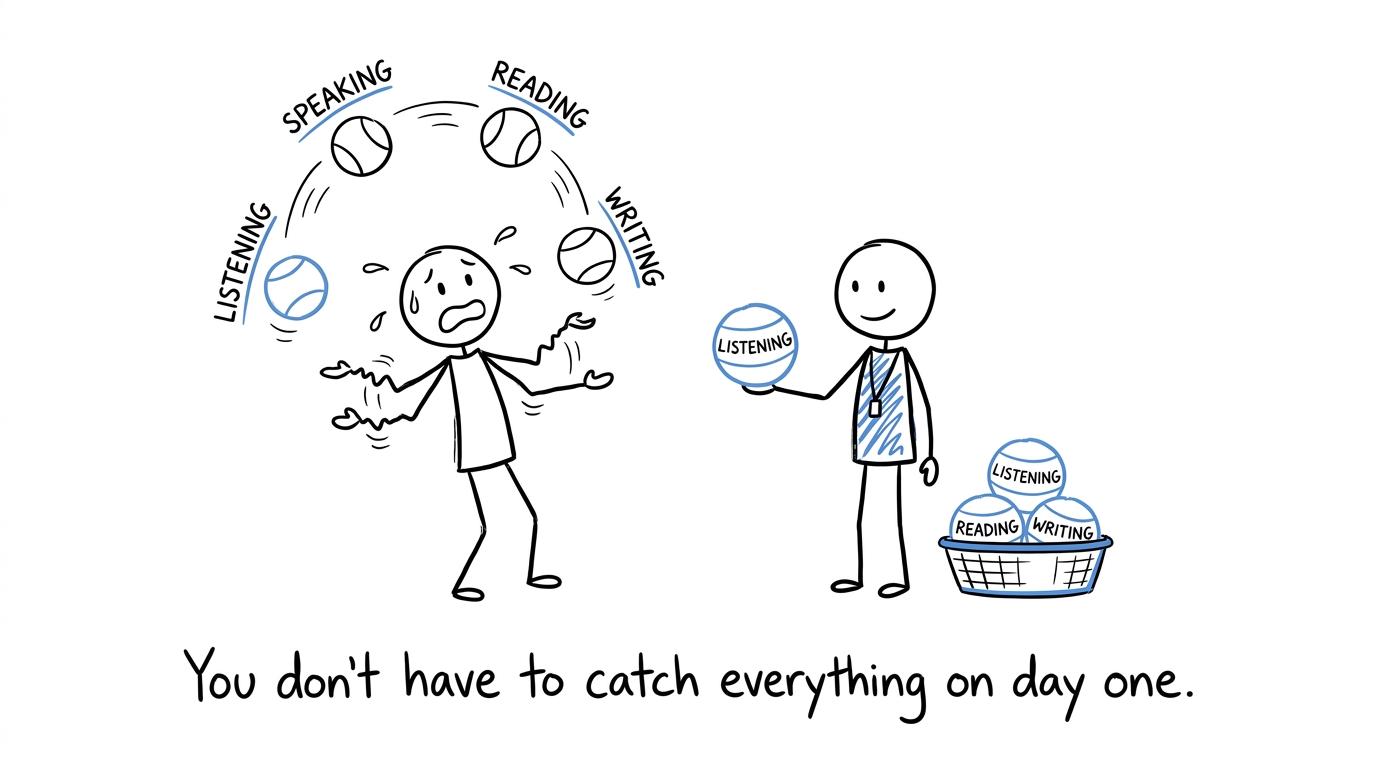 A calm coach hands over the four language skills one at a time
A sensible beginner revision strategy
The most reliable plan is small, frequent contact with the language. A single long weekend session cannot replace hearing, reading and retrieving Arabic across the week.
A balanced session might contain:
- script or spelling recall
- vocabulary retrieval without notes
- a short listening activity
- spoken responses said aloud
- a brief reading or writing task
- correction using teacher feedback
Notice that every skill appears regularly. Avoid postponing speaking until you “know enough”. Speaking becomes easier because you practise it, not because you silently wait for confidence.
Use the same principle for your maths revision. MathsGenie’s GCSE maths revision hub organises free lessons, exam questions and papers by board, while the revision planner can help you protect time for both subjects.
If your week is crowded, a repeatable minimum is better than an ambitious timetable you abandon. The 20-minute GCSE maths revision routine offers a useful model: choose one narrow target, practise actively, check the result and record the next action. The same rhythm can guide language learning, even though the resources and tasks are different.
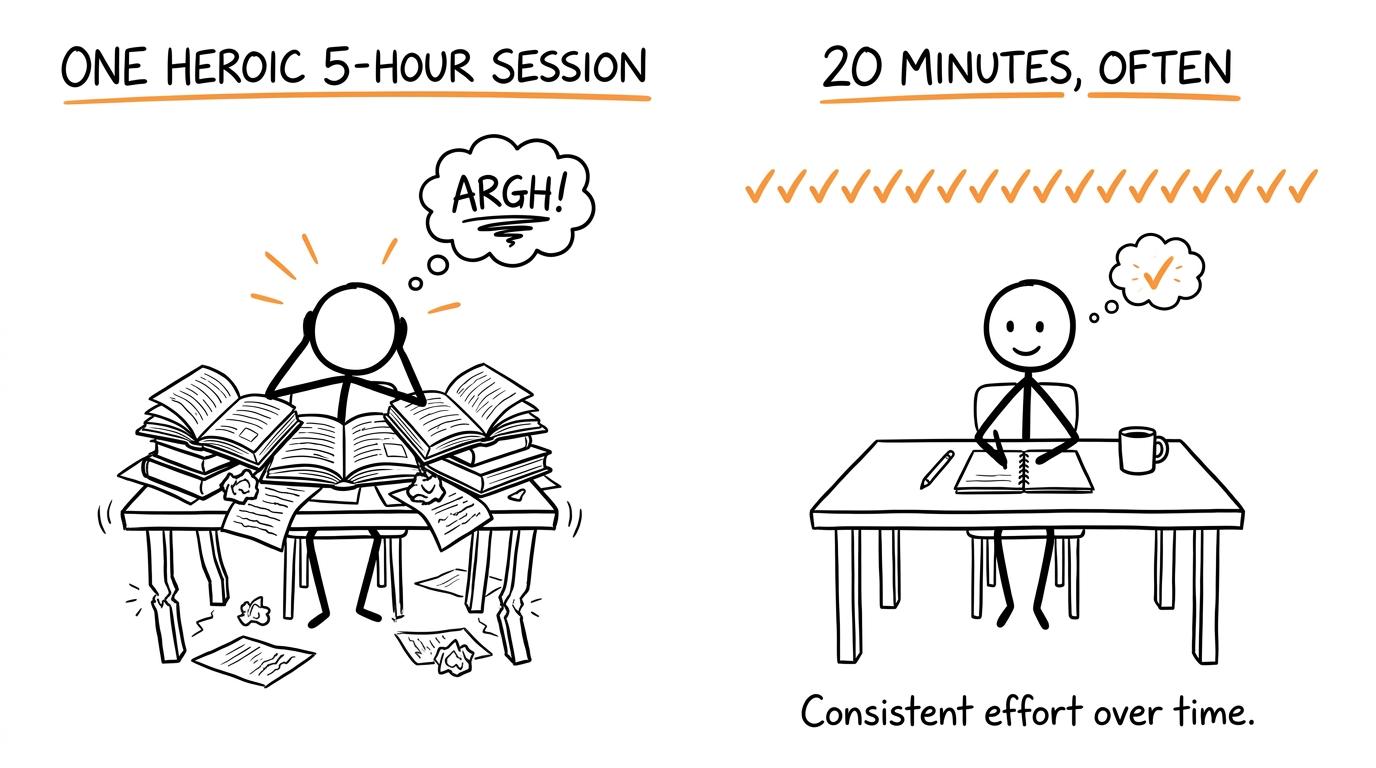 One calm student uses short regular sessions while a heroic revision marathon collapses nearby
How to balance GCSE Arabic with maths revision
Learning a language from scratch creates a particular danger: it can consume every available revision hour because there is always another word to learn. Maths can create the same feeling because there is always another topic or paper.
The solution is not to decide which subject matters every evening. Make the decision once, in advance.
Use three types of session:
Foundation sessions
Learn something new or rebuild a weak skill. In Arabic, that might involve script, grammar or vocabulary. In maths, use a revision lesson and focused practice questions from the MathsGenie GCSE maths hub.
Retrieval sessions
Close the notes and find out what you can produce. For Edexcel maths, short GCSE maths mini tests provide quick evidence of what has stuck. In Arabic, use teacher-provided vocabulary, listening and speaking prompts.
Performance sessions
Practise under examination conditions. For maths, choose material matching your board and tier, such as Edexcel GCSE maths past papers or OCR GCSE maths past papers. Marking matters as much as completion because it reveals where the next foundation session should begin.
The MathsGenie guide to starting past papers explains how to move from smaller sections towards complete timed papers. This gradual approach is useful whenever a full task feels overwhelming: reduce the size of the practice without removing the need for feedback.
Common mistakes when beginning GCSE Arabic
Waiting to become fluent before enrolling
This reverses the purpose of the course. GCSE Arabic is meant to develop language skills. Ask whether the teaching supports beginners rather than waiting for a vague feeling of readiness.
Confusing conversational Arabic with exam readiness
Understanding a home dialect can be a major advantage, but the assessment also requires reading, writing, translation and engagement with standard Arabic. Diagnose each skill independently.
Treating the alphabet as a one-off topic
Learning the letter names once is not enough. Reading and writing need regular practice until recognition and joining become increasingly automatic.
Revising vocabulary only by rereading
A familiar list can create false confidence. Cover the answers, retrieve the words, use them in speech and writing, and return to them on later days.
Avoiding speaking because it feels awkward
Silent knowledge does not automatically become spoken communication. Start with short responses and build gradually with feedback from a teacher.
Choosing the wrong qualification
GCSE Arabic and an International GCSE in Arabic as a First Language are not the same course. Confirm the exact title, code and assessment structure before registering.
Letting Arabic displace every other subject
Starting from scratch requires consistency, not the abandonment of maths and English. Build a realistic weekly structure. The GCSE maths revision timetable guide and one-month maths revision plan can help you organise maths around your wider GCSE workload.
Fluency grows from a system
You do not need to be fluent before starting GCSE Arabic. You need the correct qualification, beginner-appropriate teaching, enough time and a routine that develops listening, speaking, reading and writing together.
Progress may initially look unimpressive: one sound recognised more quickly, one sentence produced without notes, one paragraph read with fewer pauses. Yet these small gains compound. Fluency is rarely one dramatic leap. It is the accumulation of ordinary practice that was repeated long enough to become reliable.
Keep your wider revision equally structured. Use MathsGenie as your free home base for GCSE maths revision lessons, practice questions, mini tests and video solutions. Then test your progress with past papers, mark schemes and predicted papers matched to your exam board and tier. Plan the work, correct what goes wrong and return tomorrow, in Arabic, maths and every subject that matters.