Feeling Behind in GCSE English Language? Start Here
Feeling behind GCSE English Language? Identify the skills costing marks and follow a calm catch-up plan that fits alongside your GCSE maths revision.
It can happen quietly. A classmate mentions finishing a practice paper. Someone else seems able to analyse any quotation instantly. Meanwhile, you are still wondering what “structure” means in an English Language answer.
If you are feeling behind in GCSE English Language, the short answer is yes: this is a common experience, and it does not mean you cannot catch up. English Language is a collection of trainable reading, writing and exam-timing skills. You do not need to repair everything at once. You need to identify the precise skill costing you marks, practise it, get feedback and repeat.
That matters when you are also preparing for GCSE maths. Your revision time is limited. A calm system will take you further than trying to “do more English” while worrying about every other subject.
Your calm catch-up checklist
Start here rather than rebuilding your entire revision timetable tonight:
- Confirm your exam board and paper format.
- Ask your teacher which two skills currently cost you the most marks.
- Use one recent response or mock paper as your diagnosis.
- Practise one reading task and one writing skill at a time.
- Mark, correct and revisit the task later.
- Protect regular maths sessions rather than allowing English panic to consume them.
- Speak to a teacher if you cannot tell what needs improving.
The aim is not to feel caught up by tomorrow. It is to know what tomorrow's task is.
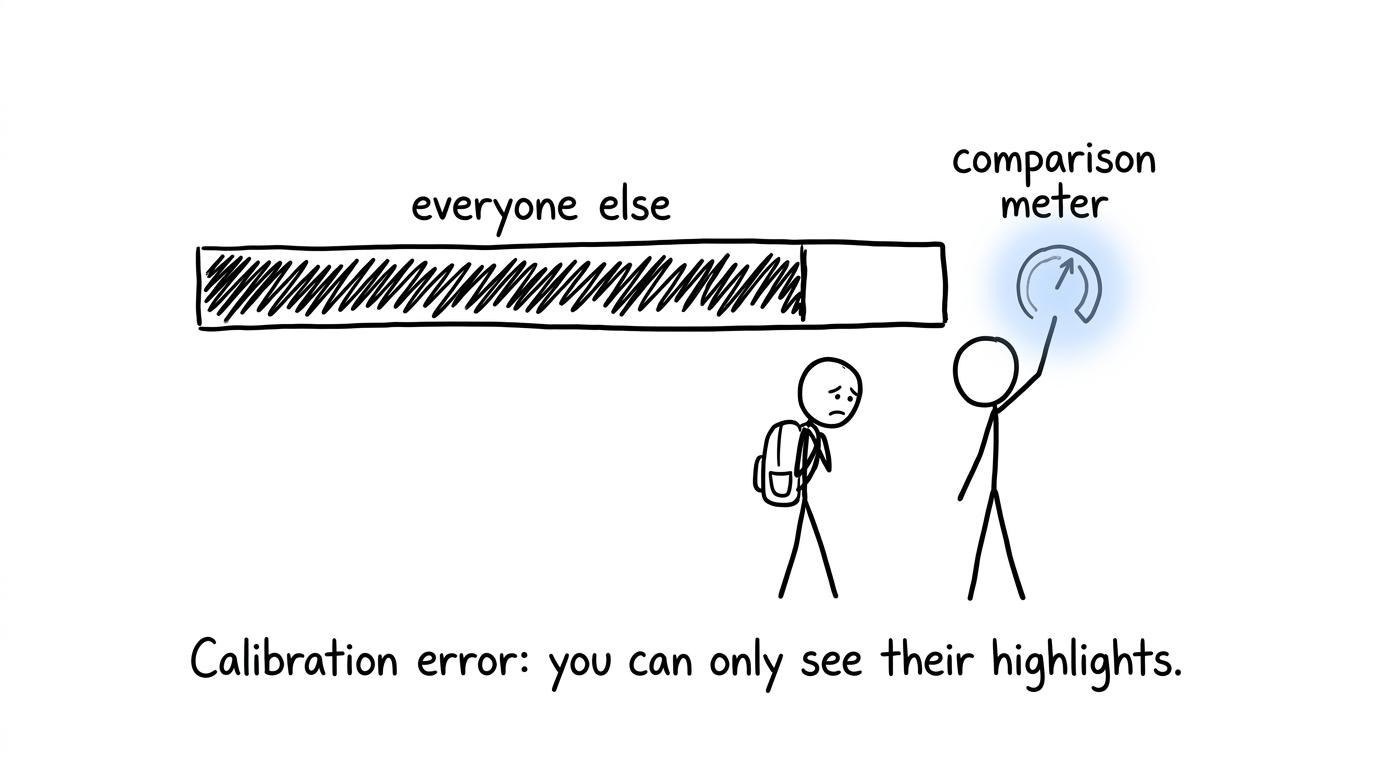 A student discovers that the comparison meter is badly calibrated
Why feeling behind is more common than it appears
English Language progress is difficult to see from the outside. In maths, completing a topic such as simultaneous equations can feel like crossing something off a list. In English, the same underlying skill may appear in analysis, comparison, evaluation and extended writing. Improvement is often gradual before it becomes visible in marks.
Comparison makes this harder. You hear a polished answer in class, but you do not see the planning, teacher feedback or earlier attempts behind it. You are comparing your working process with somebody else's finished performance.
There is another reason the subject can feel vague: GCSE English Language does not have foundation and higher tiers. Students work towards the same broad assessment objectives, although paper structures and question wording differ between AQA, Pearson Edexcel, OCR and Eduqas. Those objectives cover:
- identifying and interpreting information;
- analysing language and structure;
- comparing ideas and perspectives;
- evaluating texts;
- communicating clearly for a particular form, audience and purpose;
- using accurate spelling, punctuation, grammar and sentence structures.
Across the regulated GCSE subject requirements, reading and writing each account for half of the qualification. Technical accuracy in writing accounts for one fifth of the qualification overall. The separate spoken language endorsement is reported independently and does not contribute to the written GCSE grade.
This is encouraging. The exam is not measuring whether you are naturally “good at English”. It is assessing defined skills. Defined skills can be diagnosed and practised.
Replace “I am behind” with a precise diagnosis
“I am behind” feels enormous because it gives you no next action. Replace it with a sentence that describes observable evidence:
- I struggle to select short quotations.
- I identify techniques but do not explain their effects.
- I run out of time before the writing section.
- My comparison paragraphs discuss the texts separately.
- My ideas are clear, but punctuation errors reduce accuracy.
- I do not adapt my tone to the intended audience.
Use a marked mock, class assessment or timed response. Look at the teacher's comments and the relevant mark scheme. Then ask three questions:
- Where did I lose marks repeatedly?
- Was the problem knowledge, technique or timing?
- What is the smallest task that would test that skill again?
Do not rely on a raw mark alone. A total tells you where you finished; feedback tells you where to go next. If the comments are unclear, take the response to your English teacher and ask which one improvement would make the greatest difference.
The same diagnostic principle works in maths. MathsGenie's GCSE maths revision hub helps you choose your board, locate weak topics and move from revision lessons to practice questions. Keeping the process similar across subjects reduces the number of decisions you have to make.
Build an English Language catch-up loop
A useful catch-up session has four parts: retrieve, practise, check and revisit.
Retrieve the skill
Spend a few minutes recalling what the question requires without copying notes. For a reading response, that might mean remembering whether you must analyse, compare or evaluate. For writing, it might mean recalling the intended form, audience and purpose.
Always use the wording and mark scheme for your own board. AQA, Edexcel, OCR and Eduqas assess the common objectives through different papers, timings and question sequences. Advice for the wrong specification can create confusion rather than confidence.
Practise a small task
Do not begin every session with a complete paper. Practise one paragraph, one plan, one reading question or a short section under time. Small tasks make feedback faster and allow you to repeat the precise skill while it is still fresh.
Once individual skills become reliable, combine them in longer timed sections. Full papers matter, but they are most useful when you can learn from what goes wrong. Maths students can use the same progression through focused GCSE maths mini tests before attempting complete papers.
Check against evidence
Use your teacher's guidance, marked models and the official mark scheme supplied for your specification. Ask whether your response actually did what the assessment objective required.
For instance, naming a language technique is not automatically analysis. A useful analytical response connects selected evidence to meaning and effect. Similarly, ambitious vocabulary does not compensate for writing that ignores its audience or lacks coherent organisation.
Revisit after a gap
Correction is only the first half of learning. Return to a similar task on another day without looking at your previous response. If the same problem appears, narrow the task further or ask for feedback.
MathsGenie's guide to the best order for learning GCSE maths topics uses the same principle: build secure foundations, practise them and then test them under exam conditions.
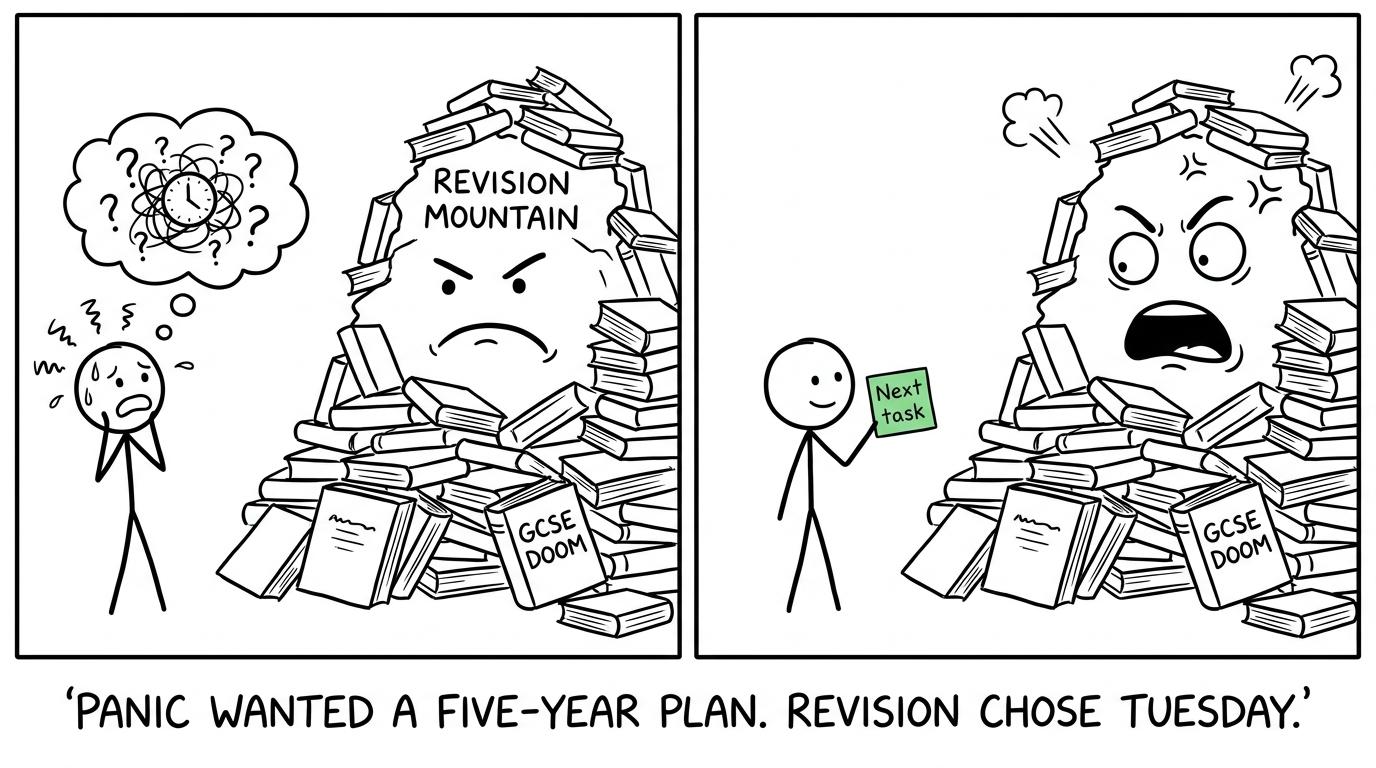 A nervous student chooses one manageable task from an enormous revision pile
Catch up without sacrificing GCSE maths
English anxiety can expand to fill every available evening. That is rarely a sensible answer, particularly when maths also improves through regular practice.
Give each subject protected appointments. A realistic school-night plan might contain one short English Language task and one focused maths block, with rest between them. The exact length matters less than whether the plan can be repeated.
Use the GCSE maths revision timetable guide to organise foundation or higher tier work around your other subjects. If exams are approaching, the one-month GCSE maths revision plan can help you prioritise weak topics without turning every evening into an exhausting marathon.
Keep separate error logs:
- For English, record the question type, missed skill and next correction.
- For maths, record the topic, incorrect step and method to revisit.
This makes progress visible. “English is going badly” becomes “I need to make my comparison explicit.” “Maths is impossible” becomes “I need another session on rearranging formulae.” Precision lowers the amount of uncertainty in your timetable.
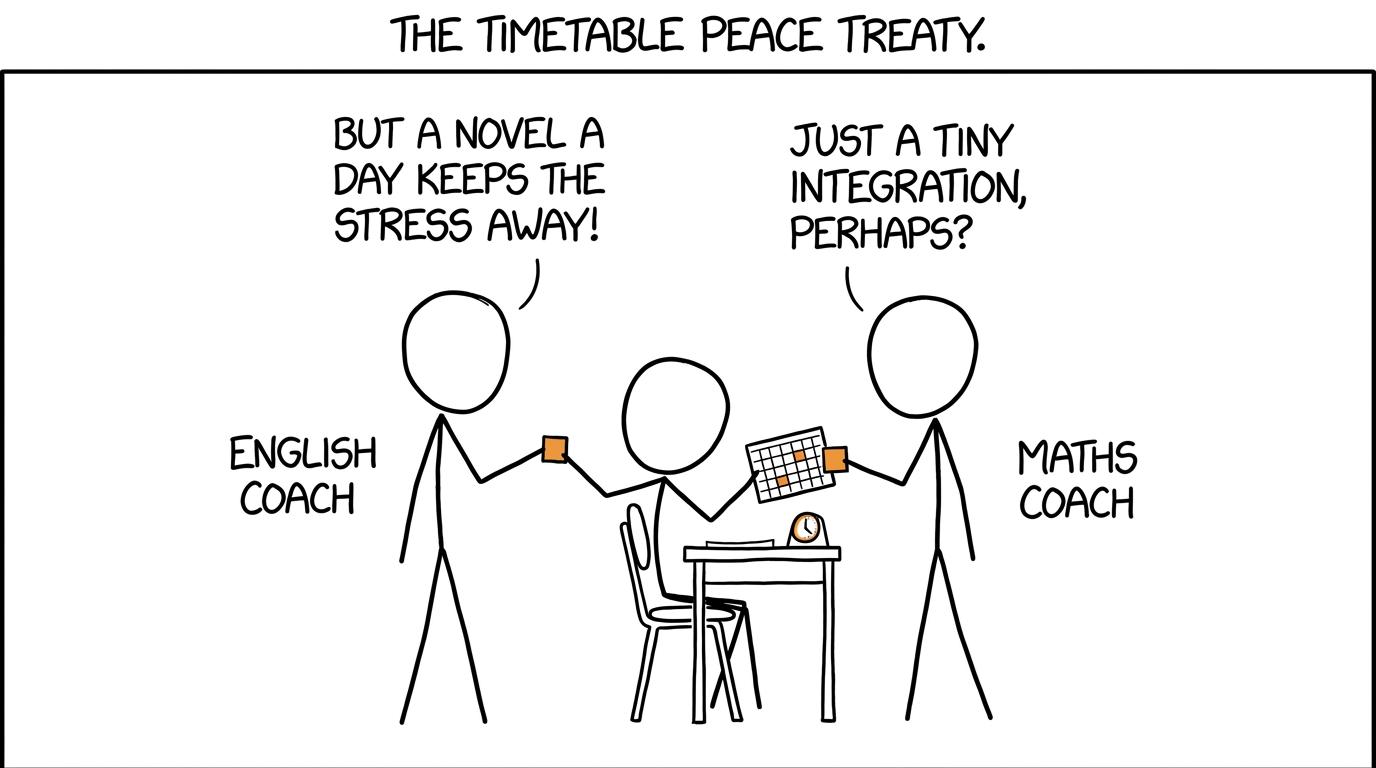 English and maths agree to share a student's revision timetable
What to prioritise when time is short
If you have limited time, do not try to memorise dozens of decorative phrases. Prioritise actions that transfer between questions:
- Read the task carefully and identify its assessment focus.
- Select concise, relevant textual evidence.
- Explain how the evidence supports your interpretation.
- Make comparisons direct rather than writing two isolated mini-essays.
- Plan extended writing before beginning.
- Match tone and structure to form, purpose and audience.
- Leave time to check sentence boundaries, spelling and punctuation.
- Practise moving on when a question consumes too much time.
Then test these habits under gradually increasing time pressure. Begin with one question, progress to a section and finally use complete papers from your school or exam board.
For maths, do the equivalent: topic questions first, then mixed tests, followed by full papers. MathsGenie's advice on when to start GCSE past papers explains why papers should diagnose revision needs rather than merely produce a score. Near the exam, GCSE predicted maths papers can add fresh exam-style practice, but they should complement past papers and topic repair rather than replace them.
Common mistakes when trying to catch up
Revising the whole subject at once
“Revise English Language” is not a usable task. Choose one paper, one question type and one improvement target.
Copying impressive model answers
Models can reveal structure and quality, but copying phrases does not prove that you can respond independently to an unseen text. Study why the response works, then practise on different material.
Confusing technique spotting with analysis
A list of metaphors, verbs or sentence types will not automatically access stronger marks. Explain what the writer's choice suggests, how it shapes meaning and why it matters in that part of the text.
Completing papers without reviewing them
Quantity can imitate progress. One carefully reviewed response may teach you more than several unmarked papers. Feedback, correction and another attempt complete the loop.
Using the wrong exam-board advice
The broad skills are shared, but formats are not identical. Confirm whether you take AQA, Edexcel, OCR or Eduqas and use the correct specification, papers and mark schemes.
Letting panic erase rest and other subjects
A last-minute marathon can leave you too tired to apply what you know. If an exam is close, choose a controlled task, prepare your equipment and stop at a sensible time. The same approach appears in MathsGenie's GCSE maths night-before plan.
You do not have to catch everyone else
The exam does not compare your revision story with the person sitting beside you. It rewards what you can demonstrate on the paper.
Start with evidence from one response. Choose one weak skill. Practise it briefly, check it carefully and return to it later. Then protect the next maths session in your timetable. A feeling of being behind becomes manageable when it is converted into a sequence of specific actions.
For your maths preparation, make MathsGenie your free revision base. Use revision lessons and practice questions to repair individual topics, mini tests to check progress, and past papers, predicted papers, mark schemes and video solutions to build exam confidence. You do not need a dramatic recovery day. You need a clear next task, and a system you can follow again tomorrow.