Failed GCSE Maths Resit Again? Your 2027 Options
Failed GCSE maths resit again? Understand summer 2027, under-19 study rules, Functional Skills Level 2 and how to plan your next step in England.
A second disappointing result can feel heavier than the first. You revised, sat through the papers and hoped this attempt would close the subject for good. Now you may be asking what happens if you have failed GCSE maths resit again.
The short answer is that you still have options. You can enter GCSE maths again in summer 2027, and some students may take Functional Skills Maths Level 2 instead. If you are under 19 and studying in England, your college may also need to keep maths in your programme under current Department for Education funding rules.
The right route depends on your age, your grade, your course and what you want to do next. This is not the end of the road. It is a decision point.
Your options at a glance
- Ask whether your result was close enough to justify checking the marked script or requesting a review of marking.
- Prepare for a GCSE maths resit in summer 2027.
- Consider Functional Skills Maths Level 2 if the funding rules allow it and your future course or employer accepts it.
- Check the exact maths requirement for your intended apprenticeship, job, university course or professional qualification.
- Replace general revision with a topic-by-topic plan based on evidence from your papers.
Start by speaking to your college's exams office, maths department or student support team. They can confirm which qualification you will study and whether they will enter you for the summer series.
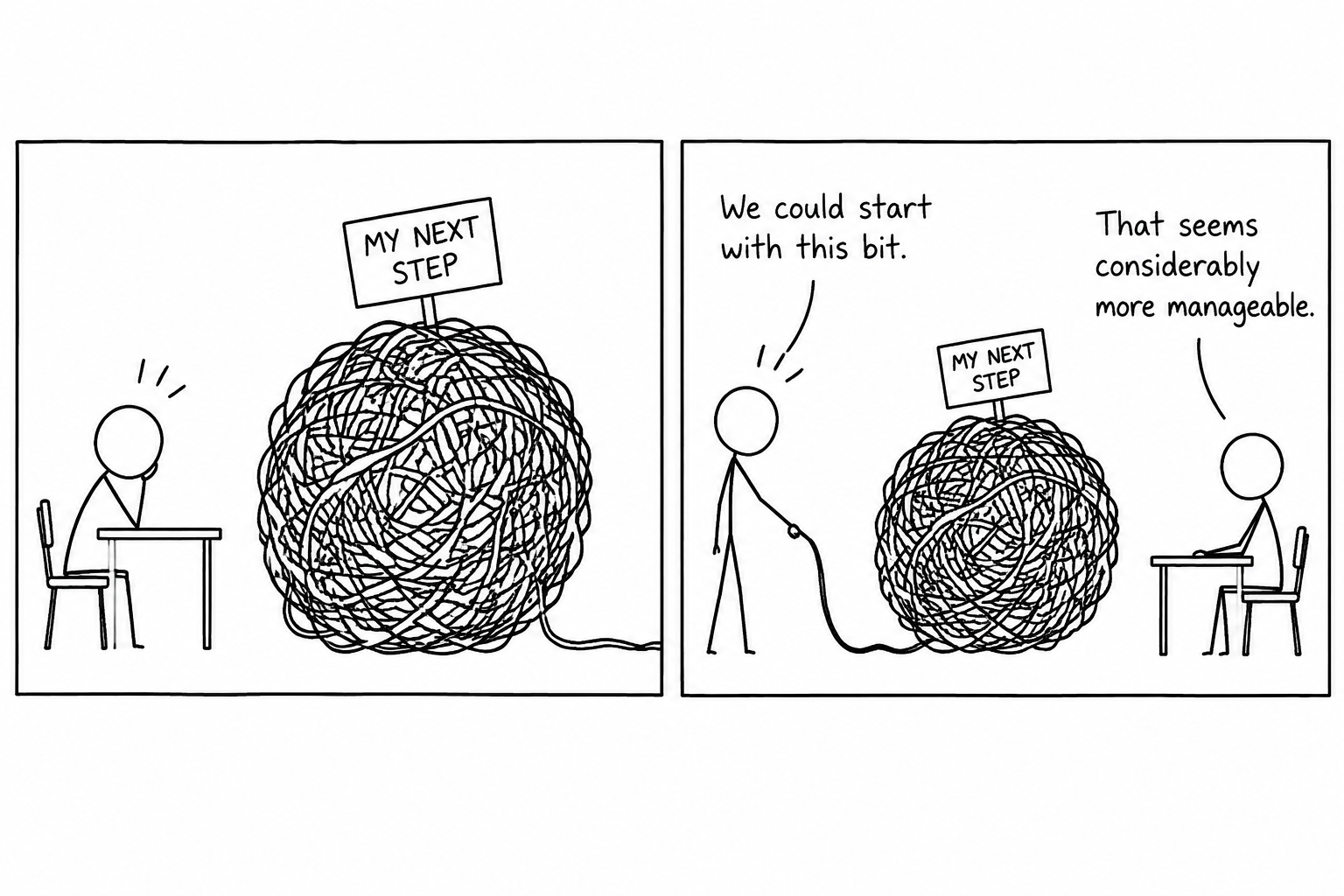 A student discovers that the next step is easier when a tangled problem is approached from one loose end
First, check what your result actually tells you
A failed resit is painful, but the grade alone is an incomplete diagnosis. You need to know how far you were from your target and where the marks disappeared.
Ask your centre whether you can see your marked script or receive a breakdown of your performance. If the result is unexpectedly low, discuss whether a review of marking is sensible. Reviews can leave a mark unchanged, raise it or lower it, and deadlines apply, so speak to the centre promptly rather than assuming this is an automatic solution.
Then separate your mistakes into useful categories:
- topics you did not understand;
- methods you knew but could not recall;
- questions you misread;
- calculator or arithmetic errors;
- answers that lacked sufficient working;
- sections left unfinished because of timing.
That distinction matters. A student who lacks knowledge needs teaching and practice questions. A student losing marks through timing needs controlled paper practice. Repeating the same revision for both problems is unlikely to work.
Use the free GCSE maths revision hub to find resources for Edexcel, AQA, OCR, Eduqas and other exam boards. Make sure you revise the specification and tier that you will actually sit.
Taking GCSE maths again in summer 2027
Summer 2027 is the clearest next opportunity if you need a GCSE grade 4 or above. GCSE maths is available in the summer exam series, and you should arrange your entry through your college, school or another approved examination centre.
Do not wait until spring to ask. Entry arrangements and internal deadlines vary between centres. Confirm these details early:
- your exam board;
- foundation or higher tier;
- who will pay any entry fee;
- where you will sit each paper;
- what lessons and support your provider offers;
- whether access arrangements need to be renewed or confirmed.
Foundation tier gives access to grades 1-5, while higher tier gives access to grades 4-9, with an allowed grade 3 for candidates narrowly missing grade 4. Higher is not automatically the better choice. If your goal is grade 4 and foundation questions give you the best chance of collecting secure marks, foundation may be the more rational route. Discuss the decision with a teacher who has seen your paper performance.
For structured preparation, the GCSE maths scheme of learning breaks the course into stages with lessons and tests. You can also use the MathsGenie revision planner to turn the months before summer 2027 into manageable daily tasks.
What under-19 students need to know
The continuing study rule is often described as being forced to resit maths, but the official position is more precise. It is a condition attached to government funding for institutions providing 16-19 study programmes in England. It requires providers to support eligible students who did not achieve GCSE maths at grade 4 or above at age 16.
Under the Department for Education rules published for the 2026-2027 academic year:
- a full-time student who achieved GCSE grade 3 at age 16 must study towards GCSE maths;
- a student who achieved grade 2 or below at age 16 may study towards GCSE maths at grades 9-4 or Functional Skills Maths Level 2;
- an eligible Functional Skills Level 2 pass can satisfy the condition for a student who held below grade 3;
- limited exemptions exist, including particular circumstances involving education, health and care plans.
These are funding requirements for providers, not a criminal penalty imposed on a student. Your college decides how maths fits into your programme while meeting the rules. Part-time programmes and individual circumstances can be treated differently, so ask your provider how the current guidance applies to you rather than relying on a friend's timetable.
The rules can also change between academic years. The points above reflect the published 2026-2027 guidance, which covers the period leading to the summer 2027 exams.
Is Functional Skills Level 2 an alternative?
Functional Skills Maths Level 2 is a recognised Level 2 qualification in England. GCSE grades 4-9 and Functional Skills Level 2 sit at the same qualification level, but they are not the same qualification.
Functional Skills focuses on applying maths in practical contexts. It may be a suitable route if you originally achieved grade 2 or below, need a Level 2 maths qualification for work or further learning, and your provider can offer it under the funding rules.
However, acceptance is not universal. Some apprenticeships and employers accept an Ofqual-regulated Functional Skills qualification, while certain university courses, teacher training routes, healthcare programmes or other regulated careers may specify GCSE maths at grade 4 or above. The wording matters.
Before choosing a Functional Skills alternative, contact the organisation responsible for your next step and ask a precise question: “Will you accept Functional Skills Maths Level 2 instead of GCSE maths at grade 4?” Get the answer in writing where possible.
If your intended route explicitly requires GCSE maths, another GCSE resit is usually the safer option. If it asks for Level 2 maths or accepts Functional Skills, the alternative may provide a more appropriate path.
Build a different resit plan
Failing again does not necessarily mean you cannot do maths. It may mean that your previous revision produced familiarity rather than exam performance. Watching a method can feel clear because the difficult decisions have already been made for you. A blank question exposes whether you can make those decisions independently.
A stronger cycle looks like this:
- learn one weak topic using a revision lesson or video solution;
- answer practice questions without copying the method;
- mark the work and record the precise error;
- revisit the topic several days later;
- complete a short timed test;
- combine topics in full papers as the exam approaches.
The Edexcel GCSE maths past papers include mark schemes and worked solutions where available. AQA students can use the dedicated AQA GCSE maths revision resources, while the broader GCSE past paper collection helps you find the correct board.
Past papers are most useful after topic gaps have been addressed. Early in the process, use GCSE maths mini tests to isolate one skill at a time. Closer to the summer exams, add full timed papers and, when released, relevant GCSE predicted papers to focus on unseen areas. Predicted papers support revision, but they are not a substitute for learning the full specification.
Common mistakes after failing a resit
Repeating the same revision routine
More hours do not automatically solve a weak strategy. If passive videos dominated your last attempt, increase independent questions, marking and delayed retesting.
Choosing a route without checking acceptance
Functional Skills Level 2 can be valuable, but “Level 2” does not mean every organisation must treat it exactly like GCSE maths. Check the entry requirements for your intended destination.
Starting with full papers every week
A full paper can reveal weaknesses, but it does not teach them. Repair individual topics first, then use papers to test whether those repairs hold under pressure.
Ignoring easy and medium questions
Students sometimes chase the hardest higher-tier topics while continuing to lose accessible marks through fractions, percentages, ratio, units and basic algebra. Secure marks are the foundation of a pass.
Treating the result as a verdict
An exam result records one performance against one mark scheme. It is important, but it is not an identity. Your next plan should be based on evidence, not embarrassment.
Your next step
This week, confirm your qualification route and summer 2027 entry arrangements. Then identify your weakest topics and put the first few sessions into a realistic timetable.
MathsGenie gives you free revision lessons, practice questions, video solutions, mini tests, past papers, predicted papers, mark schemes and a revision planner. You do not need to solve the whole problem today. Start with the next topic, mark it honestly and return tomorrow with one less gap than you had before.