

Exam Anxiety GCSE Economics: A Practical Guide
Exam anxiety GCSE Economics: practical ways to handle calculations, diagrams, data and longer answers, with a calm revision plan for every paper.
A GCSE Economics paper can feel unusually unpredictable. One question asks for a definition, the next presents a table of data, and the page after that expects a developed judgement. If exam anxiety GCSE Economics is making revision or exam day harder, the answer is not simply to “relax”. It is to make each part of the paper more familiar, more structured and therefore less threatening.
The practical goal is not to eliminate every nervous feeling. It is to know what to do even when those feelings appear. That means practising economic calculations, recognising command words, planning longer answers and using timed papers until the process feels routine.
A quick anxiety-management checklist
Before exploring each strategy, start with this checklist:
- Divide Economics into definitions, diagrams, calculations, data response and extended writing.
- Revise according to your exam board's current specification.
- Practise recalling knowledge without notes.
- Use short, timed sections before attempting complete papers.
- Mark your answers and identify one precise improvement.
- Prepare a simple routine for moments when your mind goes blank.
- Ask for support if anxiety is persistent or affects everyday life.
The list is deliberately practical. Confidence rarely arrives before action. More often, confidence is the memory of having completed the task before.
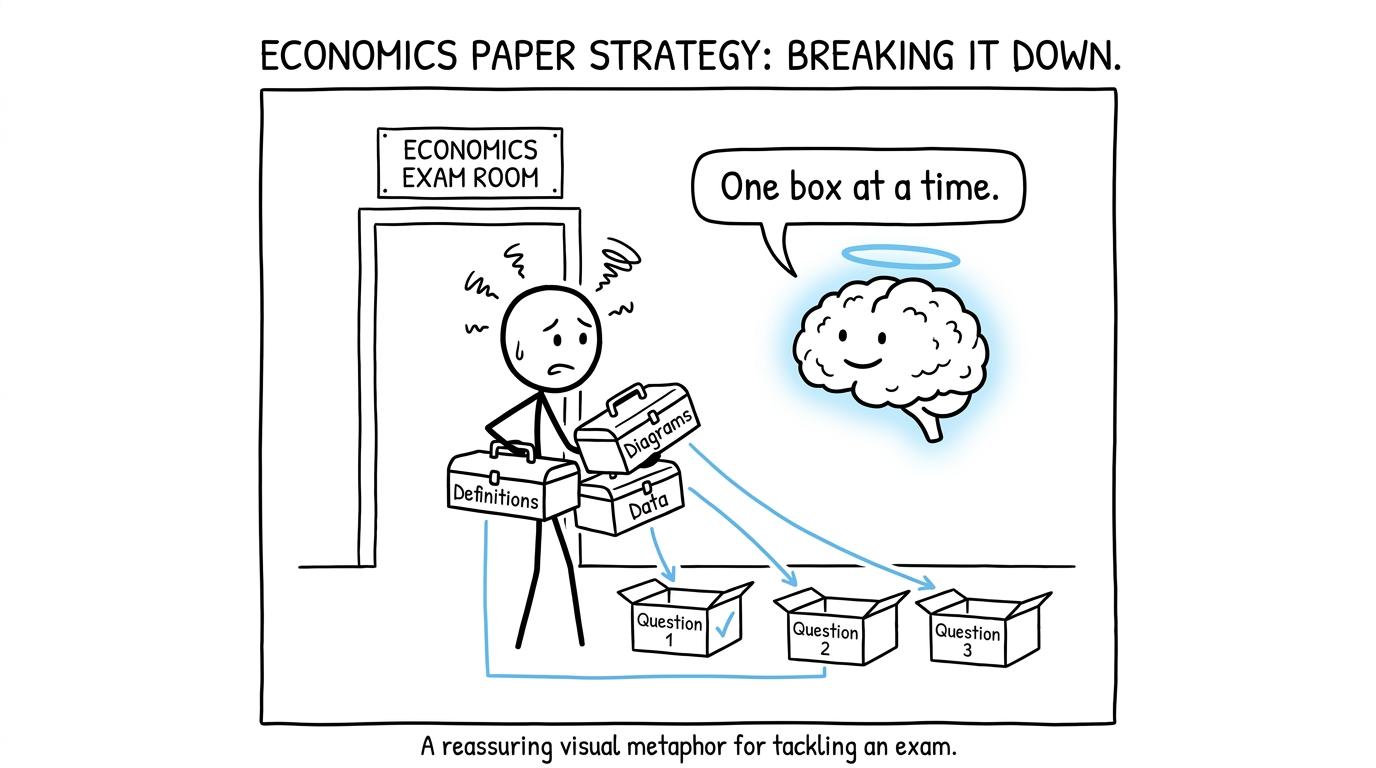 A nervous student carrying small Economics toolboxes into an exam
Why GCSE Economics can create particular anxiety
Economics tests several kinds of thinking within one subject. You need accurate terminology, logical chains of reasoning, quantitative skills and the ability to evaluate competing arguments. A student may understand inflation perfectly but still worry about writing quickly enough. Another may produce strong essays but freeze when percentages appear.
This matters because vague anxiety encourages vague revision. “I am bad at Economics” is difficult to act upon. “I hesitate when interpreting percentage changes” gives you a task.
Separate the subject into controllable skills
Create a simple audit using these categories:
- Knowledge: Can you define the key term accurately?
- Application: Can you connect the idea to the information in the question?
- Analysis: Can you explain the sequence of cause and effect?
- Evaluation: Can you weigh up different outcomes and reach a supported judgement?
- Quantitative skills: Can you interpret data, calculate accurately and describe trends?
- Exam technique: Can you respond to the command word within the available time?
Mark each area as secure, developing or uncertain. This turns one large fear into a small collection of revision decisions.
AQA and OCR specifications and question styles are not identical, so use the documents and mark schemes for your own course. If your school follows another qualification, check its current specification rather than assuming that advice written for a different board applies exactly.
Reduce calculation anxiety through small, regular practice
The mathematical content in GCSE Economics is manageable when the underlying skills are secure. Anxiety often comes from the sudden context: percentages are no longer presented as an isolated maths exercise but hidden inside prices, wages, exports or unemployment data.
Useful skills commonly include:
- fractions, decimals and percentages;
- percentage change;
- ratios and proportions;
- averages;
- interpreting tables, charts and graphs;
- comparing numerical evidence;
- showing a clear calculation and using appropriate units.
For percentage change, the structure is:
Percentage change=changeoriginal value×100\text{Percentage change} = \frac{\text{change}}{\text{original value}} \times 100Percentage change=original valuechange×100Do not wait until an Economics paper to practise the underlying method. Use MathsGenie's GCSE maths revision resources to rebuild the skill separately, then return to an Economics question and apply it in context.
Students who feel rusty can work progressively through the grade 2 revision topics, grade 3 revision topics and grade 4 revision topics. These pages provide revision lessons, practice questions and video support without requiring you to tackle everything at once.
Use a calculation routine
When a quantitative Economics question appears, follow the same sequence:
- Identify exactly what must be found.
- Underline the relevant figures and units.
- Select the required operation or formula.
- Write down the calculation rather than relying on mental arithmetic.
- Check whether the result is plausible.
- State the unit and interpret the result if the question requires it.
A fixed routine reduces the number of decisions your anxious brain must make. It also leaves visible working that may help you gain method marks where the mark scheme allows them.
Make longer answers feel finite
Extended Economics questions can look like an invitation to write everything you know. They are not. They reward a focused response to a particular question.
Begin with the command word. “Explain”, “analyse” and “evaluate” require different depths of response, although the precise expectations and mark allocations depend on your exam board. Read your board's published mark schemes and examiner materials so you can see what developed reasoning looks like.
For an analytical paragraph, think in a chain:
- make a relevant economic point;
- apply it to the context;
- explain the immediate effect;
- continue the chain to a consequence;
- connect that consequence back to the question.
For evaluation, consider conditions rather than attaching a memorised counterargument. An outcome might depend on the time period, the size of the change, consumer confidence, the elasticity involved, government priorities or how different groups are affected. Select only factors that genuinely matter to the question.
Plan before writing
A brief plan can prevent the common experience of reaching the middle of an answer and forgetting its direction. Note your main argument, your alternative argument and the basis of your final judgement. Then write.
This is not lost time. It is a small investment that reduces repetition and helps each paragraph earn its place.
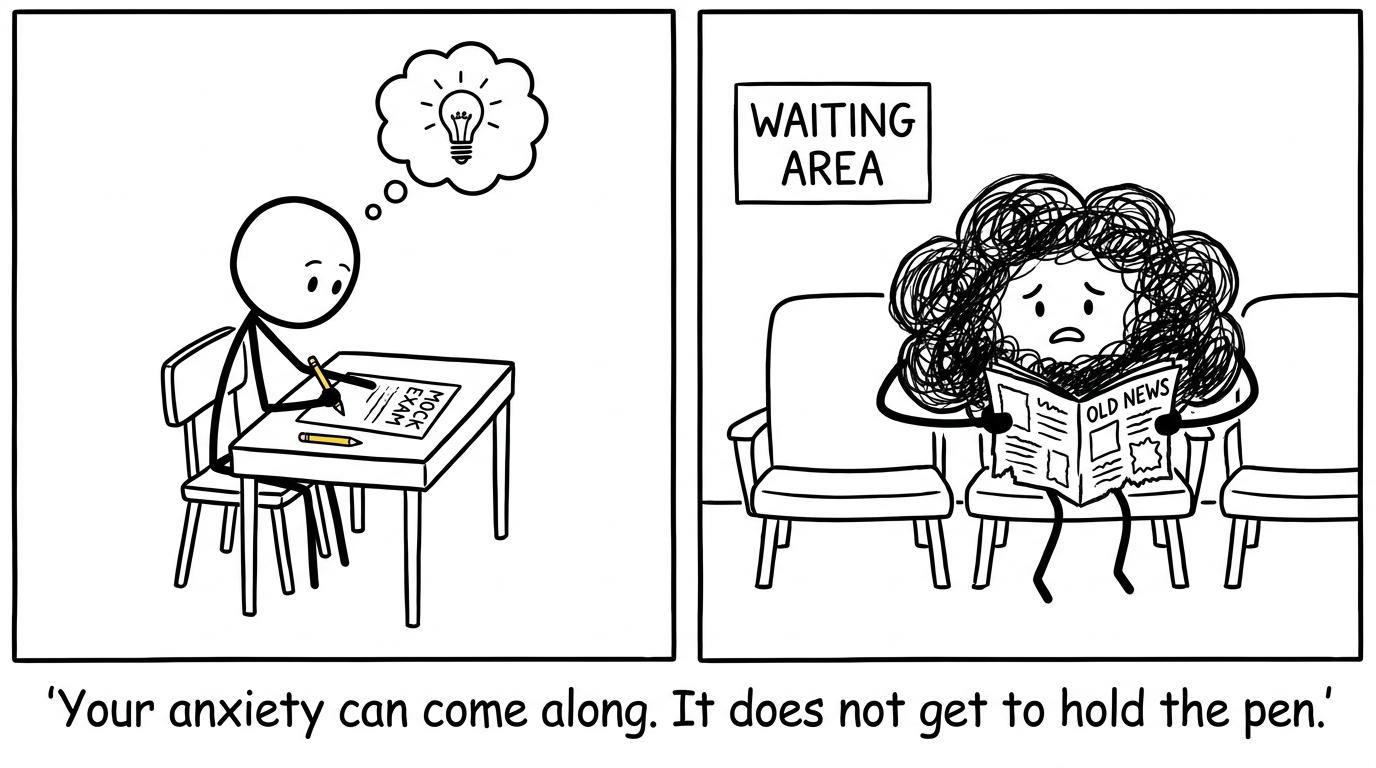 An exam worry cloud waiting while the student gets on with the paper
Revise in a way that trains retrieval
Reading a textbook can feel calm because the answer is always visible. Unfortunately, an exam requires you to produce the answer without that support.
Build revision around retrieval:
- close your notes and write a definition from memory;
- sketch a familiar economic diagram and label it;
- list the stages in a chain of reasoning;
- answer one data-response question under a short time limit;
- compare your response with the mark scheme;
- correct the answer in a different colour.
This may initially feel less comfortable than rereading. That discomfort is useful information. It shows you which knowledge is not yet reliably available.
Use a revision planner to alternate Economics with your other subjects rather than attempting a long, exhausting session. A manageable session might combine recall, one quantitative skill and one exam question. Stop with a written note explaining what to practise next. That gives your next session a clear starting point.
Build up to timed papers gradually
A complete paper can be too large a first step when anxiety is already high. Use a ladder of exposure:
- answer one familiar question without a timer;
- repeat the question type with a generous time allowance;
- complete one timed section;
- complete half a paper;
- attempt a full paper under realistic conditions.
The purpose is not to make every attempt perfect. It is to teach your brain that the situation is difficult but manageable.
For transferable numerical practice, MathsGenie's GCSE maths past papers provide authentic exam-style experience alongside mark schemes and video solutions. The predicted GCSE maths papers can also help you rehearse unfamiliar combinations of questions. They do not predict an Economics paper, but they are useful for practising calm decision-making when data or calculations appear unexpectedly.
After any paper, classify each lost mark:
- missing knowledge;
- misunderstood command word;
- weak application;
- incomplete reasoning;
- calculation error;
- timing problem;
- avoidable reading mistake.
This classification matters more than the raw total. A mark tells you what happened. A category helps you decide what to do next.
What to do when anxiety rises in the exam
If your mind goes blank, do not treat that moment as proof that the entire paper is lost. Pause briefly, place both feet on the floor and allow your breathing to become slower. Then return to a visible action.
Try this reset:
- read the question once for its topic;
- read it again for the command word;
- circle or underline the relevant evidence;
- write one definition, label or calculation step you know;
- continue from that foothold.
If one question remains inaccessible, leave enough space and move on. An exam is a collection of opportunities for marks, not a single verdict delivered by the hardest question.
Use the time and mark allocation printed on your paper to guide your effort. Do not spend a disproportionate amount of time trying to rescue one low-tariff item while leaving an extended response untouched.
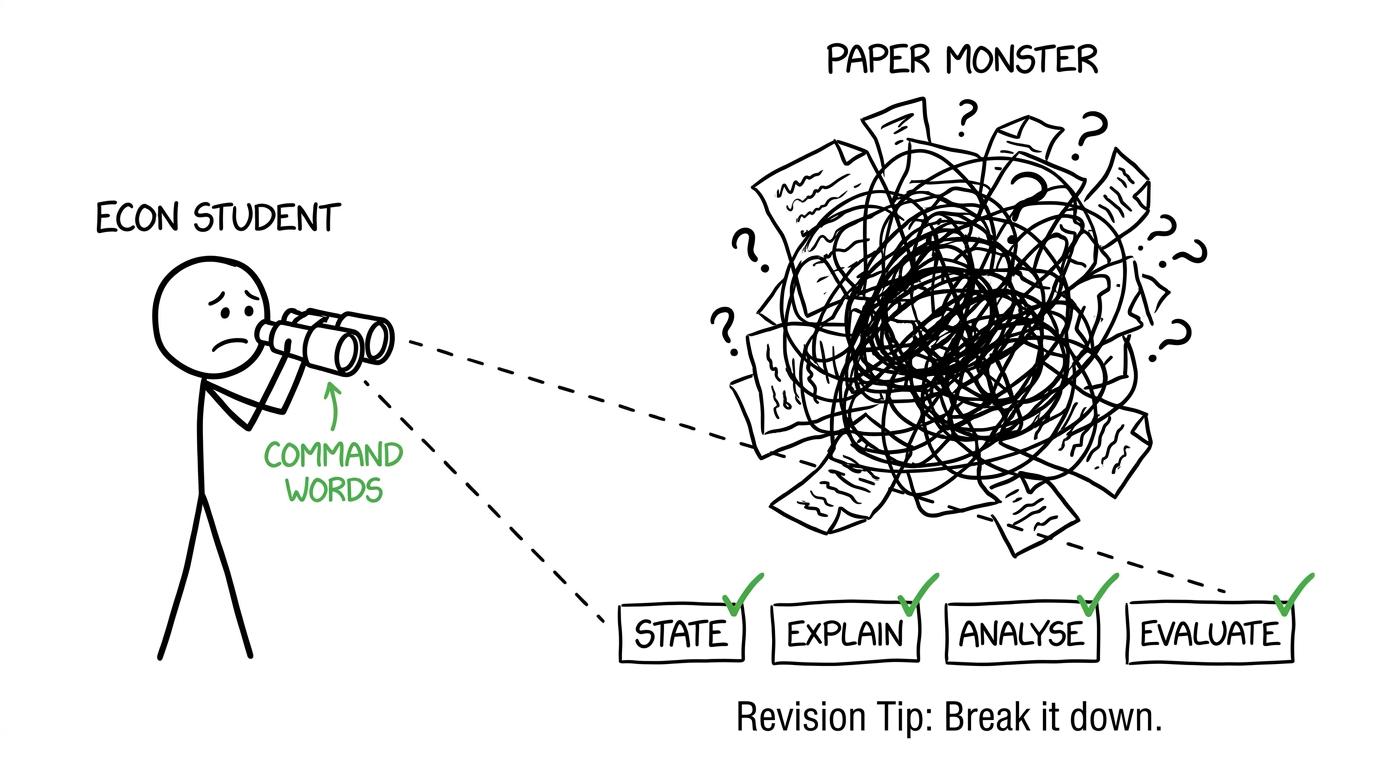 A large paper monster becoming manageable through command words
Common mistakes when managing GCSE Economics anxiety
Avoiding the topic that causes anxiety
Skipping calculations or extended writing brings short-term relief but preserves the fear. Practise the weakest skill in small doses, beginning below full exam difficulty if necessary.
Memorising complete essays
A memorised answer may not fit the question or context. Learn economic knowledge and reusable reasoning structures, but make every response answer the wording in front of you.
Treating every mistake as a knowledge gap
Some marks are lost through timing, units, command words or insufficient application. Diagnose the type of error before deciding that you need to relearn an entire topic.
Completing papers without reviewing them
Practice becomes powerful when it includes feedback. Use mark schemes carefully, identify missing reasoning and rewrite weak sections. MathsGenie's grade 5 revision resources can strengthen the numerical confidence needed for more demanding data questions.
Revising late into the night
Sacrificing sleep to complete one more paper can make concentration and recall harder the following day. Plan revision earlier, prepare your equipment and give yourself a clear stopping time.
Hiding severe anxiety
Speak to a parent, carer, teacher, form tutor or pastoral lead if anxiety is persistent, causes panic, disrupts sleep or stops you attending lessons or exams. Schools can explain available support and the formal arrangements that may apply. Medical or mental-health concerns should be discussed with an appropriate qualified professional.
Turn uncertainty into a revision system
The strongest response to exam anxiety is not endless reassurance. It is evidence: definitions retrieved, calculations completed, diagrams labelled, answers marked and mistakes corrected.
Begin with one uncertain Economics skill today. If calculations are the obstacle, use MathsGenie's free GCSE revision hub, practice questions and video solutions to strengthen the underlying maths. Then apply that skill to your own board's Economics questions and mark schemes.
As the exams approach, combine revision lessons with timed Economics practice, past-paper preparation and a realistic revision planner. Predicted papers and mini tests can add variety to your maths preparation, while careful review turns each attempt into a clearer next step.
You do not need to feel fearless before you begin. Begin with a structure, practise it repeatedly, and let familiarity do the quiet work.











