

Exam Anxiety GCSE Biblical Hebrew: A Calm Plan
Exam anxiety GCSE Biblical Hebrew advice: build a calm, subject-specific revision plan for language, grammar, set texts and confident exam-day decisions.
Sometimes anxiety arrives before revision has even begun. You open an unseen passage, recognise fewer words than you hoped, and your mind jumps from one difficult line to the final grade. For students searching for help with exam anxiety GCSE Biblical Hebrew, the most useful response is not simply to “stay calm”. It is to make the uncertainty smaller.
That means practising the separate demands of the subject: vocabulary retrieval, grammatical recognition, unseen translation, comprehension and prescribed literature. It also means having a plan for the moment when a word, form or quotation will not come back to you.
This guide focuses on those subject-specific actions. If Biblical Hebrew is one of several GCSEs competing for your attention, it also shows how to protect your maths revision rather than allowing anxiety in one subject to disrupt everything else.
Your calm revision checklist
Use this checklist to turn a general feeling of worry into decisions you can control:
- Check the current OCR specification and information from your school.
- Separate language practice from literature revision.
- Identify whether vocabulary, grammar, translation or textual knowledge triggers the most anxiety.
- Practise retrieval without notes before checking your answers.
- Complete timed sections under realistic conditions.
- Use mark schemes to distinguish missing knowledge from avoidable exam technique errors.
- Prepare a short routine for getting stuck in the examination.
- Speak to a teacher, pastoral lead or GP if anxiety is persistent, severe or affecting daily life.
The aim is not to feel perfectly relaxed. It is to know what to do even when you do feel nervous.
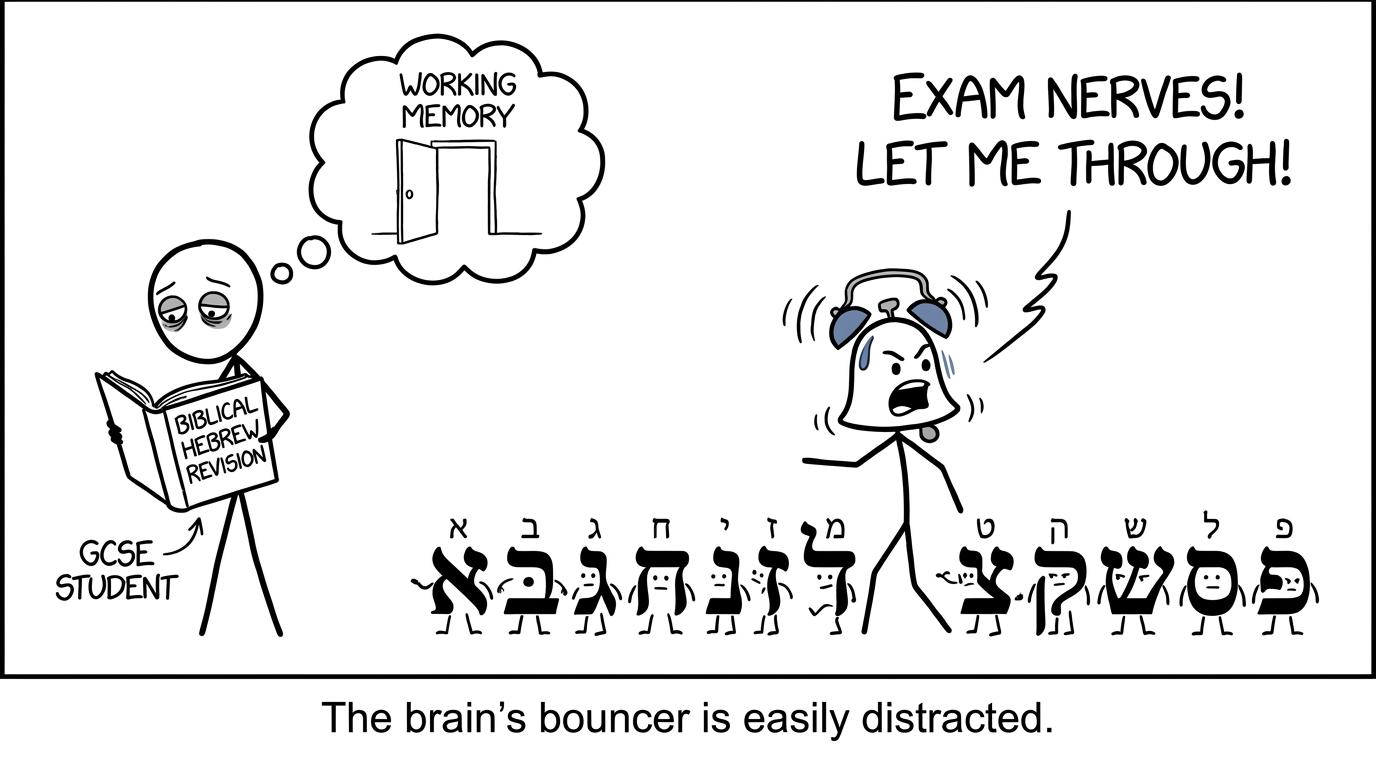 A cartoon alarm bell tries to crowd Hebrew revision out of working memory
Why GCSE Biblical Hebrew can produce distinctive anxiety
GCSE Biblical Hebrew currently follows an OCR specification. Students should always use the current specification, assessment material and set-text information supplied by OCR and their school, because prescribed content and administrative details can change.
The subject can feel unusually exposed. In some GCSEs, recognising the broad topic gives you a route into a question. In an unseen Biblical Hebrew passage, uncertainty about a small word or grammatical form can appear to block an entire sentence. Literature creates a different pressure: you may understand a passage well during revision but worry that precise details will disappear under timed conditions.
These are different problems and should not be revised as though they were one.
Anxiety about unseen language
An unseen passage contains uncertainty by design. Your task is not to know the passage beforehand; it is to apply familiar vocabulary, morphology, syntax and contextual judgement to unfamiliar material.
A useful practice session therefore needs more than reading through a completed translation. Cover the answer, attempt the passage, mark the forms you can identify securely and note exactly where the reasoning breaks down. A label such as “bad at translation” is too broad to guide tomorrow’s revision. “I confuse similar verb forms when working quickly” gives you something specific to practise.
Anxiety about grammar and vocabulary
Vocabulary anxiety often leads to rereading lists. Rereading feels reassuring because every word is visible, but recognition is not the same as retrieval. Test from meaning to Hebrew and from Hebrew to meaning, then revisit missed words after a gap.
Grammar should also be retrieved actively. Practise identifying relevant features in context rather than relying entirely on isolated tables. Keep a brief error log organised by recurring weakness, such as prefixes, suffixes, verb forms or sentence structure. Use the terminology taught by your school and required by the current specification.
Anxiety about prescribed literature
Literature revision can become endless because there is always another note to reread. Reduce that uncertainty by dividing each prescribed passage into examinable categories: context, content, language, themes and details emphasised in your course.
Begin a session with a blank page. Record what you can recall before opening your notes. This reveals the difference between material you know independently and material that merely looks familiar when it is in front of you.
Build a revision plan around the source of the fear
A calm plan does not give equal time to everything. It gives the next useful task to the weakest important area.
Create three columns headed language, grammar and literature. Under each heading, list topics as secure, developing or uncertain. Then choose short tasks that produce evidence. Translating a fresh extract produces evidence. Recalling a passage plan without notes produces evidence. Highlighting a textbook for another hour usually does not.
Alternate task types across the week. This stops one intimidating area from consuming every session and gives your memory repeated opportunities to retrieve material. Short, regular contact is generally more useful than leaving the subject untouched and attempting one exhausting session at the weekend.
If you are also preparing for maths, plan both subjects deliberately. MathsGenie's free GCSE maths revision resources organise topics by grade, while its GCSE exam papers let you schedule realistic paper practice. Giving maths a defined place in the week prevents worry about Biblical Hebrew from quietly taking over all available revision time.
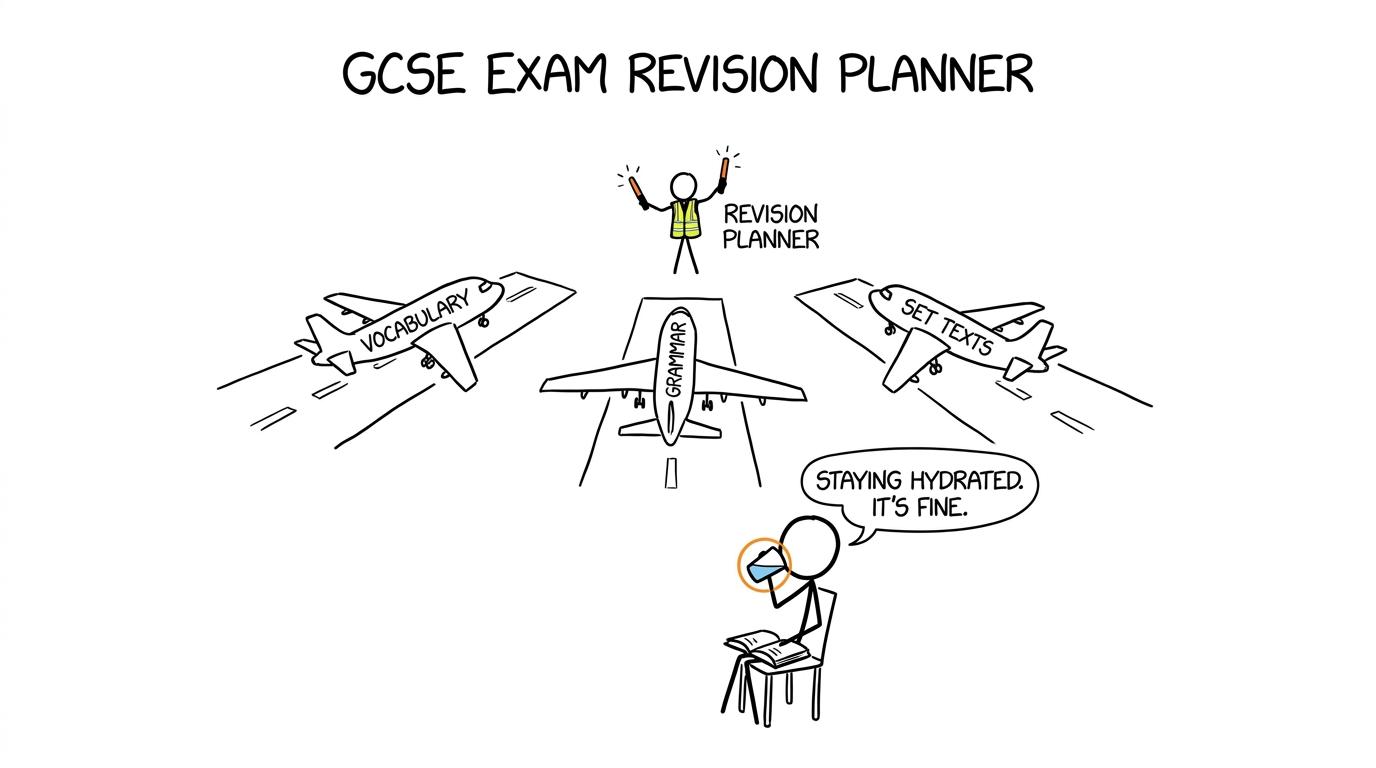 A revision planner directs vocabulary, grammar and set texts towards separate runways
Practise the recovery, not only the perfect performance
Students often rehearse the version of the examination in which every answer arrives promptly. Anxiety needs a plan for the other version.
During timed practice, deliberately notice what happens when you cannot identify something. Instead of repeatedly staring at it, mark the location, record any feature you do recognise and continue to the next accessible part. Returning later is a strategy, not a surrender.
For an unseen passage, use the surrounding sentence carefully. Keep uncertainty visible rather than forcing an early guess and then twisting the rest of the translation to defend it. For comprehension or grammatical questions, answer the precise instruction given. For literature, begin with the knowledge you can support rather than waiting for an ideal opening sentence.
Afterwards, review the process as well as the score:
- Where did you lose time?
- Which questions were actually inaccessible?
- Which became manageable after you moved on and returned?
- Did one missing word cause unnecessary panic?
- Did you answer from the passage or from a vague memory of it?
This turns a difficult practice paper into information. The paper has shown you where your method needs strengthening.
Use mark schemes without becoming dependent on them
A mark scheme is most valuable after a genuine attempt. Mark in a different colour and classify errors as knowledge, interpretation, instruction-reading or time management. Then choose one corrective action for each repeated pattern.
Do not expect every acceptable translation to reproduce one English sentence word for word. Follow the guidance used by your teacher and the official assessment materials, paying attention to accurate meaning and the demands of each question.
The same habit transfers well to maths. Complete a question before watching a solution, compare your reasoning with the mark scheme and return to the topic later. MathsGenie provides topic-by-topic materials such as Grade 4 GCSE revision, Grade 5 GCSE revision and Grade 7 GCSE revision, with practice questions and video explanations for targeted repair.
What to do when anxiety rises in the exam
Your exam-room routine should be short enough to remember under pressure.
First, pause. Place both feet on the floor and let your breathing become slower and steadier. Official NHS advice for exam stress includes preparing practically, maintaining sleep and asking for support rather than trying to manage severe anxiety alone.
Next, narrow your attention to one instruction. Do not mentally sit both Biblical Hebrew papers, every remaining GCSE and results day at once. Read the current question carefully and identify the smallest useful action: recognise a form, locate evidence, write a secure meaning or move temporarily to another question.
Finally, protect your time. Follow the instructions given by the invigilator and the structure of the paper. If you get stuck, leave enough indication to find the question again and continue. A temporary blank is not evidence that the rest of the paper will go badly.
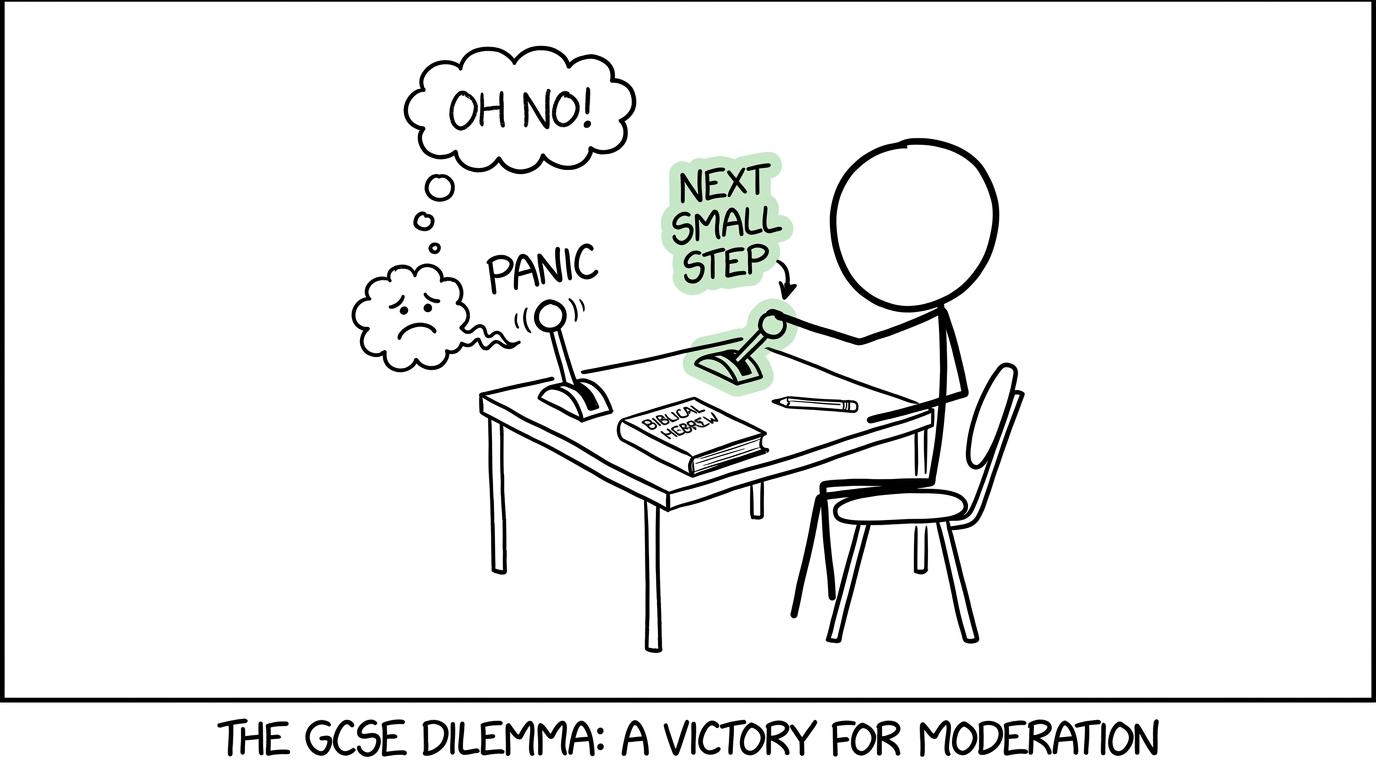 A student chooses the next small step while a panic cloud looks disappointed
Ask for support before the examination period
Tell your Biblical Hebrew teacher what specifically happens when anxiety appears. “I cannot do the subject” is difficult to act on. “I rush the start of unseen translation and stop checking verb forms” allows a teacher to suggest focused practice.
If anxiety is affecting sleep, attendance, eating, concentration or everyday life, speak to a parent or carer, your school's pastoral or safeguarding team, or a health professional. Support is not reserved for the point at which everything has become unmanageable.
Students who may need exam access arrangements should speak to their school's SENCO or exams officer early. Arrangements are governed by current JCQ rules, require appropriate evidence and normally need to reflect the student's usual way of working. Anxiety does not automatically lead to a particular arrangement, so do not rely on informal assumptions or social-media advice.
Common mistakes when managing Biblical Hebrew exam anxiety
Revising only the comfortable material
Repeatedly reviewing a favourite set text may feel productive while leaving unseen translation untouched. Keep some familiar tasks for confidence, but schedule contact with the area you are avoiding.
Treating every error as a disaster
An error log should diagnose patterns, not become a list of reasons to worry. Record the correction and the next action, then move on.
Starting full papers too early or too late
A full paper can be overwhelming before core knowledge is secure, but avoiding timed material until the final week leaves exam technique untested. Build from short sections to longer timed attempts and then complete papers.
Checking answers immediately
Looking at a translation or note after a few seconds trains recognition, not persistence. Give yourself a defined attempt before checking, then return to the same material later without support.
Letting one subject consume the timetable
Anxiety often makes a subject expand to fill every available hour. Preserve balanced revision across your GCSEs. For maths, GCSE predicted papers can support focused preparation, while MathsGenie's free revision homepage provides a clear route to lessons, papers and other resources.
Move forward one controllable step at a time
Managing exam anxiety for GCSE Biblical Hebrew is not about pretending the subject is easy. It is about replacing one enormous fear with a sequence of manageable decisions: retrieve vocabulary, recognise grammar, practise an unseen section, recall a set text, mark the attempt and rehearse how you will recover when stuck.
Use the latest OCR materials and your teacher's guidance for Biblical Hebrew. Then keep the rest of your GCSE preparation organised too. MathsGenie is your free maths revision companion, with revision lessons, practice questions, mini tests, past papers, predicted papers, mark schemes and video solutions to help you turn uncertainty into a practical next step.
Choose one short Biblical Hebrew task and one GCSE maths revision topic now. Calm rarely arrives before action. More often, it grows from knowing that you have begun.










