Evening Classes GCSE Bengali: Are They Worth It?
Evening classes GCSE Bengali: compare teaching, speaking practice, exam support, cost and self-study before choosing the best route as an adult learner.
Searching for evening classes GCSE Bengali usually means you are weighing more than a course. You are asking whether regular teaching, travel and fees will produce enough progress to justify the time, especially if GCSE maths, employment or family responsibilities already compete for your evenings.
The short answer is this: an evening class is often worth it when you need speaking practice, expert feedback, accountability or help arranging the examination. Self-study can be better when you already read and write Bengali confidently, understand the specification and can maintain a structured routine. For many adult learners, the strongest option is a hybrid: selective tuition for feedback alongside disciplined independent practice.
The decision should not be based on whether classes are generally “good”. It should be based on what is currently stopping you from becoming exam-ready.
Your quick decision checklist
Before enrolling, find clear answers to these questions:
- Is the course for AQA GCSE Bengali, or for a different qualification such as International GCSE Bangla?
- Does it prepare you for listening, speaking, reading and writing?
- Is the course suitable for your chosen Foundation or Higher tier?
- Does the fee include examination entry, learning materials or speaking-test arrangements?
- Will the provider accept you as a private candidate?
- Can you attend consistently without sacrificing essential GCSE maths revision?
- Does the teacher mark writing and provide individual speaking feedback?
- Could self-study solve your gaps more cheaply?
If a provider cannot answer the qualification and examination questions precisely, pause before paying.
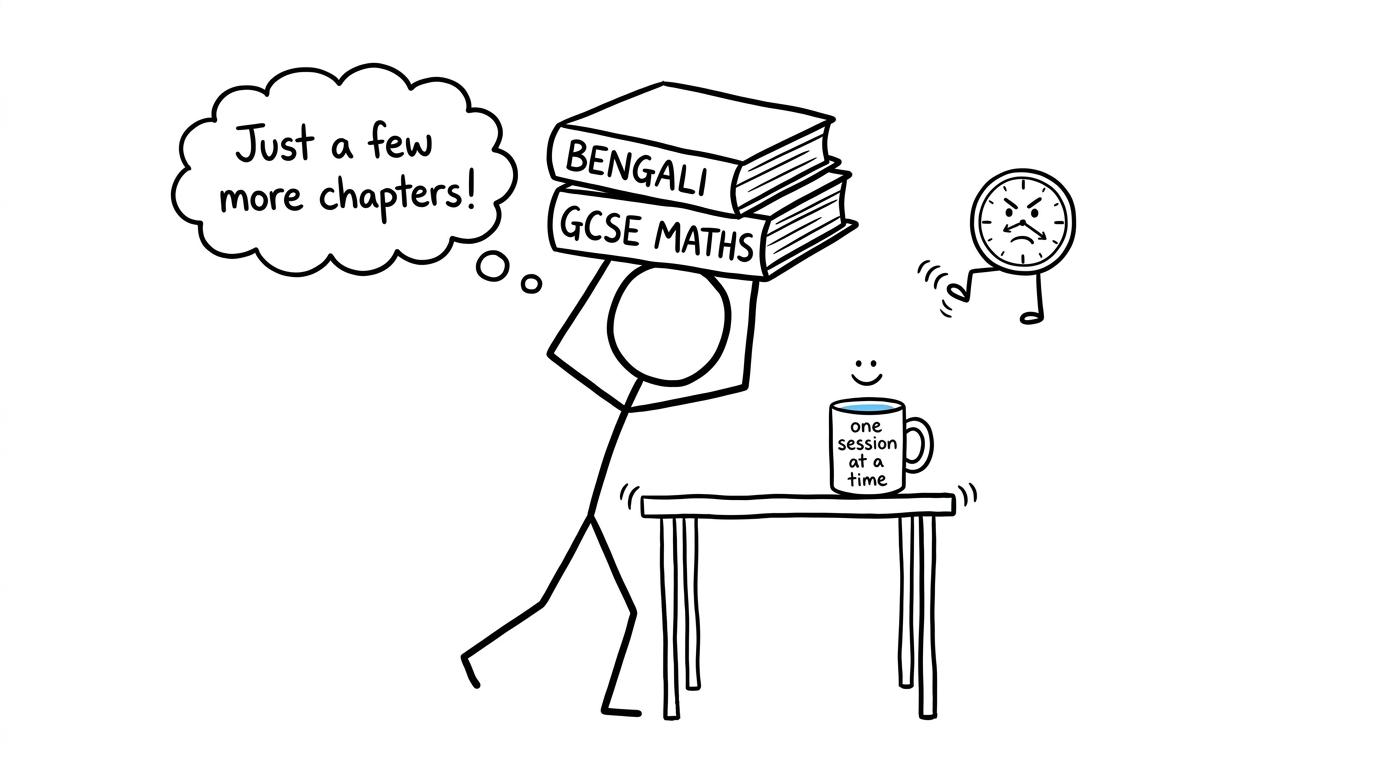 An adult learner balancing Bengali, GCSE maths and an impatient clock
Understand the GCSE Bengali qualification first
The current AQA GCSE Bengali specification assesses four language skills: listening, speaking, reading and writing. Each contributes approximately 25%25\%25% of the qualification. It is a linear GCSE, so the assessments are completed at the end of the course in the same examination series.
There are two tiers:
- Foundation tier targets grades 111 to 555.
- Higher tier targets grades 444 to 999.
All four components must be taken at the same tier. That matters because a class should not simply teach “general Bengali”. It should prepare learners for the vocabulary, themes, task types, timing and level of accuracy required by the correct tier.
AQA permits private candidates, but entry still has to be made through an approved school or college. The entering centre must also be able to supervise and authenticate the speaking component. An adult evening course may help with this, but attendance does not automatically mean examination entry is included.
Pearson Edexcel offers an International GCSE in Bangla, which has a different assessment structure. Do not assume that materials for one qualification fully prepare you for the other. Ask for the exact exam board, specification code and assessment route in writing.
When evening classes are genuinely worth it
You need live speaking practice
Speaking is the clearest reason to consider a class. Reading and vocabulary can be practised independently, but spontaneous conversation is harder to reproduce alone.
A capable teacher can correct pronunciation, ask unexpected follow-up questions and show whether an answer sounds natural rather than memorised. A class also creates repeated exposure to different voices and speaking speeds. That is valuable preparation for a qualification in which speaking and listening together account for approximately 50%50\%50% of the assessment.
Your spoken Bengali is stronger than your literacy
Some heritage speakers communicate comfortably with family but have had less formal practice reading Bengali script or writing extended responses. Familiarity can create a misleading feeling of readiness: understanding a conversation at home is not the same as producing accurate examination writing.
A structured class can identify gaps in spelling, grammar, register and written organisation. This is particularly useful when errors have become habits that are difficult to notice independently.
You need accountability
A class reserves a fixed place in the week. That sounds ordinary, but consistency often matters more than finding the theoretically perfect resource.
Self-study has almost no friction at the beginning. It also has no one waiting when you postpone it. If independent plans repeatedly disappear beneath work, family life and other GCSE subjects, the timetable of an evening class may be part of what you are paying for.
You need help navigating exam entry
For adult and private candidates, administration can be as important as teaching. A useful provider may help you understand entry deadlines, locate a centre and arrange the speaking assessment.
Confirm exactly what is offered. “Exam preparation” and “exam entry included” are not interchangeable promises.
When self-study may be the better investment
Self-study can be effective if you already possess strong Bengali skills and your main task is learning the examination format. It also offers flexibility: you can spend more time on writing and less on content you already know.
It may be the better choice when:
- you read Bengali accurately and regularly;
- you can write without depending heavily on translation tools;
- you have a fluent speaker who can practise conversation with you;
- you can obtain suitable specification-based materials and past papers;
- you reliably follow a weekly plan;
- class travel would consume time needed for GCSE maths or other subjects.
The same principle applies to independent maths revision. MathsGenie’s guide to self-studying GCSE maths explains why resources alone are not enough: you need diagnosis, immediate practice, marking and re-testing.
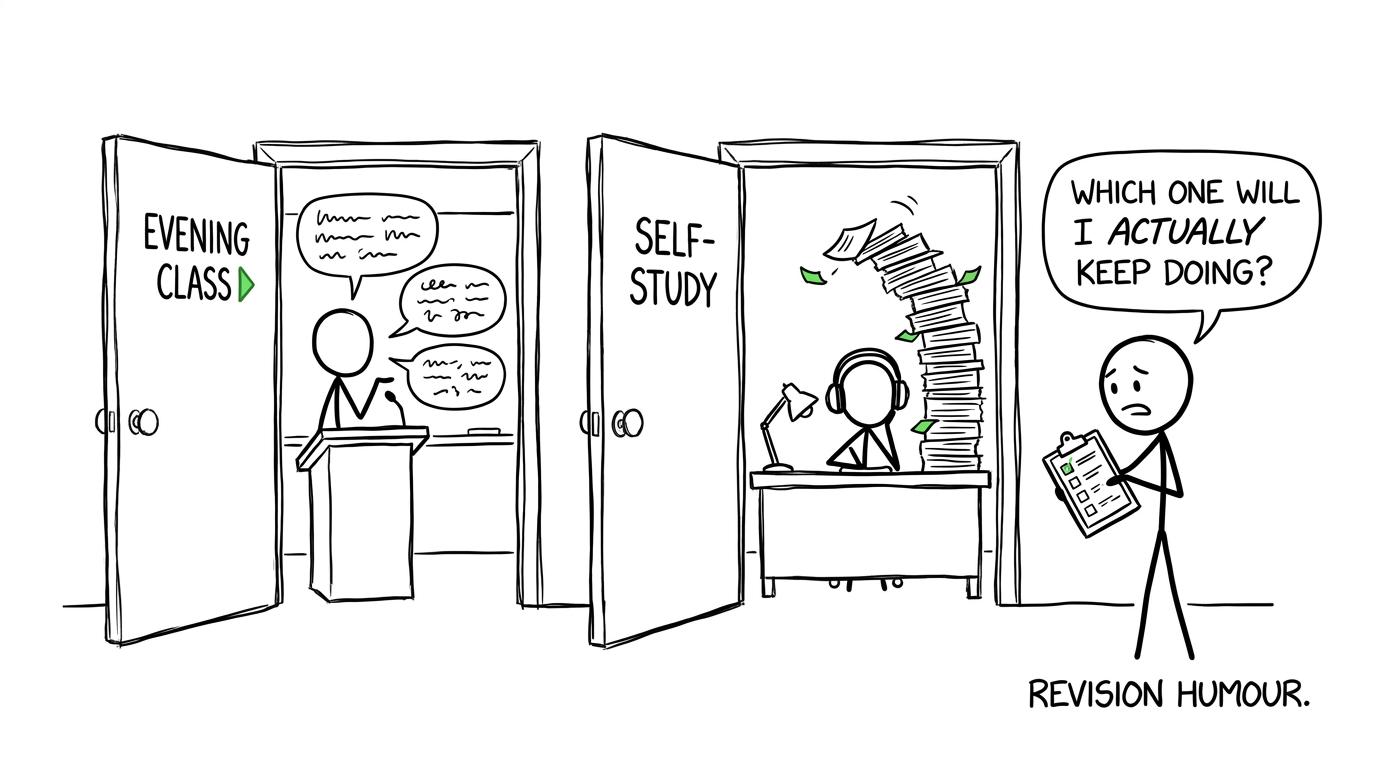 A learner choosing between an evening class and a precarious self-study desk
Compare the real cost, not just the course fee
An evening class costs more than the advertised price. Consider travel, books, examination fees, childcare and the time taken from other revision.
| Factor | Evening class | Self-study |
|---|---|---|
| Teaching feedback | Usually regular, but quality varies | Must be arranged separately |
| Speaking practice | Built in if the course is well designed | Requires a partner or tutor |
| Flexibility | Fixed time and location | High flexibility |
| Accountability | Stronger external structure | Depends on personal routine |
| Direct cost | Course, travel and possible exam fees | Usually lower, but resources and entry still cost money |
| Exam administration | May be supported | Candidate usually arranges it |
| Pace | Shared with the group | Fully personalised |
Adult funding should not be assumed. In England, the clearest adult legal entitlement concerns eligible English and maths qualifications. Funding for another Level 222 qualification can depend on age, previous attainment, income, residency, local policy and whether the qualification is available through a funded provider. Arrangements also differ across the UK.
Ask the provider for the total payable cost and its refund policy. Then confirm independently whether the exam fee and speaking assessment are included.
Protect your GCSE maths revision time
A Bengali qualification can be worthwhile without being allowed to crowd out your main academic priority. This is especially important if achieving grade 444 or above in GCSE maths affects your next course, apprenticeship or employment plans.
Start with a weekly time budget. Record fixed commitments, realistic travel time and the revision sessions that must remain protected. MathsGenie’s GCSE maths revision timetable offers a practical structure, while the GCSE maths topic list by board and tier helps you see the full workload ahead.
A sustainable pattern might include one Bengali class, one independent Bengali review and several shorter maths sessions. The exact balance matters less than whether it can survive an ordinary tired week.
For maths, use the GCSE maths revision hub to select your exam board and tier. Short GCSE mini tests are useful when time is limited, because a focused test is easier to fit around an evening course than an unplanned revision marathon.
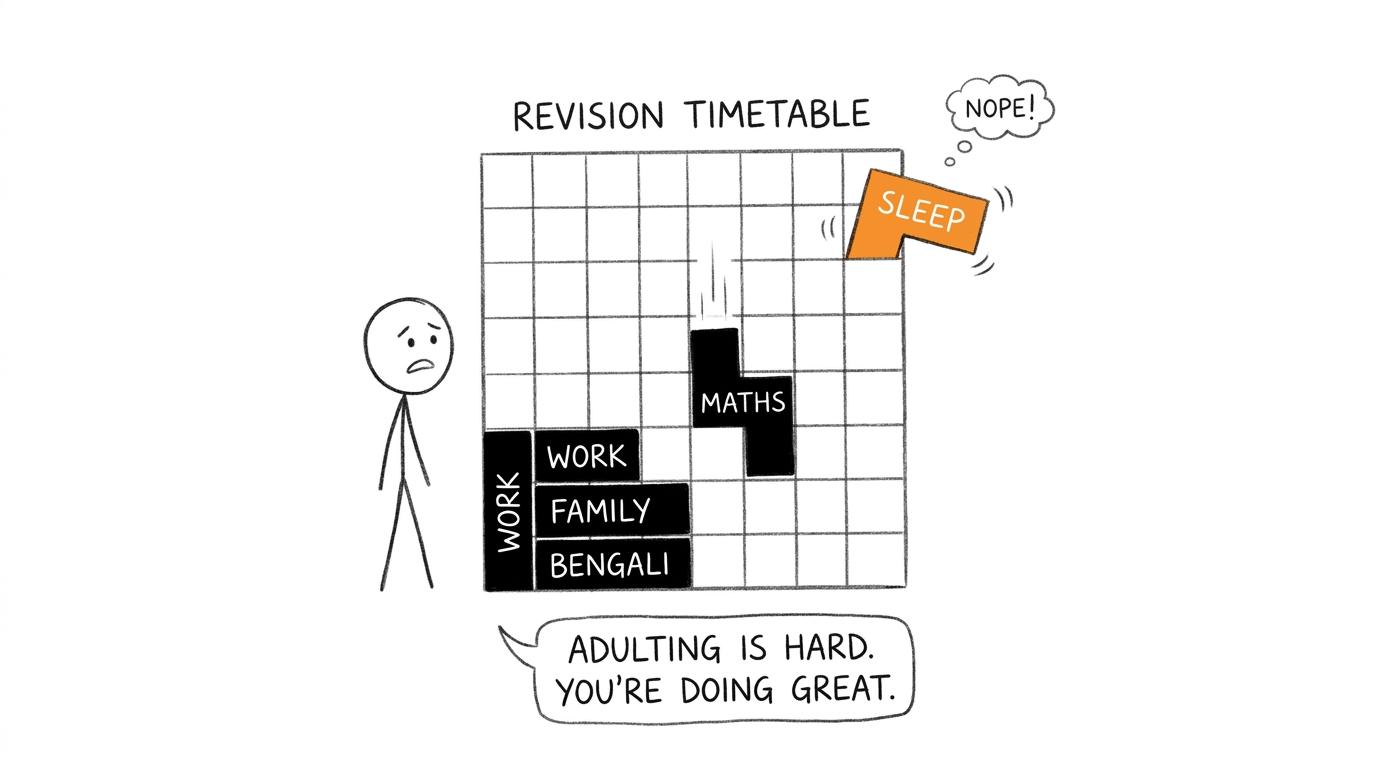 A revision timetable playing Tetris with work, Bengali, maths and sleep
How to judge a class before committing
A polished course description tells you little about the actual teaching. Ask whether you can attend a trial session or speak to the tutor before enrolling.
Look for these features:
- explicit alignment with the current specification;
- separate guidance for Foundation and Higher tier;
- regular listening practice using unfamiliar material;
- individual correction of written work;
- spontaneous speaking rather than scripts alone;
- timed tasks and examination-style questions;
- clear information about private-candidate entry;
- a manageable class size and reliable attendance expectations.
A useful trial period is long enough to test the routine but short enough to avoid paying for months of unsuitable teaching. After several sessions, ask: am I receiving feedback I could not generate alone? If the class mainly consists of copying vocabulary lists, its value may be limited.
A hybrid route often gives the best value
The choice need not be all class or all self-study. You could use occasional tuition for speaking and marked writing while completing vocabulary, reading and listening practice independently.
This concentrates paid support where feedback has the greatest value. It also leaves room for maths. Use MathsGenie’s self-assessment resources to identify mathematical weaknesses rather than revising every topic equally. As exams approach, introduce papers gradually; the guide to when to start GCSE past papers explains how to move from short diagnostic practice towards timed papers.
Near the final examinations, MathsGenie’s Edexcel predicted papers can provide fresh maths practice for Edexcel candidates. Students taking AQA, OCR or Eduqas should select resources matching their own board and specification.
Common mistakes to avoid
Choosing a general language course
Conversational Bengali may improve fluency without covering the exact GCSE tasks. Confirm that the class teaches the correct qualification.
Assuming the exam is included
Course tuition, centre entry and the speaking assessment may be separate. Ask for a complete list of costs and responsibilities.
Ignoring your weakest skill
Heritage speakers sometimes overestimate exam readiness because conversation feels comfortable. Test listening, speaking, reading and writing separately.
Paying for structure you will not attend
A good class has little value if work or travel makes attendance irregular. Choose a format that fits your real week, not an ideal one.
Letting one subject consume the timetable
Do not respond to anxiety by assigning every spare evening to Bengali. Preserve focused maths practice, sleep and recovery. A timetable fails when it demands more energy than you normally have.
So, are evening classes for GCSE Bengali worth it?
They are worth considering when they solve a specific problem: limited speaking practice, weak literacy, lack of feedback, inconsistent revision or uncertainty about private-candidate arrangements. They are less compelling when you are already highly literate, organised and able to arrange suitable speaking practice and exam entry yourself.
Before paying, verify the exam board, tier, teaching quality, total cost and entry arrangements. Then compare the course with a structured self-study or hybrid plan.
Whichever Bengali route you choose, keep GCSE maths revision simple and visible. Use MathsGenie as your free maths base: begin with revision lessons and practice questions, diagnose gaps with mini tests, then build towards past papers, predicted papers, mark schemes and video solutions. The best plan is not the busiest one. It is the one you can keep following until the examinations arrive.