

Drop GCSE Biblical Hebrew Mid-Year? A Clear Guide
Drop GCSE Biblical Hebrew mid-year? Judge the workload, check exam-entry consequences and protect your GCSE maths revision before deciding calmly.

There is a particular kind of panic that arrives when one difficult subject begins consuming revision time meant for everything else. You spend an evening on vocabulary or translation, make less progress than expected, and wonder what those same hours could have done for maths.
If you are considering whether to drop GCSE Biblical Hebrew, the short answer is this: dropping may be sensible when sustained, well-supported effort is producing little progress and the workload is damaging your core subjects or wellbeing. But one bad mock, a difficult set text or an exhausting fortnight is not enough evidence by itself.
Before deciding, speak to your subject teacher, head of year and exams officer. Confirm whether you have been entered, what your school's internal policy allows, and how the decision could affect sixth-form entry or your overall GCSE programme.
Your decision checklist
Before asking to leave the course, make sure you can answer these questions:
- Is the difficulty temporary, or has it continued despite regular practice and teacher support?
- Are you behind in language, literature or both?
- How much weekly time does the subject genuinely require?
- Is that workload reducing your performance in maths, English or science?
- Have you completed a timed assessment and reviewed it with your teacher?
- Could a narrower recovery plan make the course manageable?
- Has your exams officer explained the entry and withdrawal position?
- Do any sixth-form, college or future course requirements make the subject relevant?
- What exactly will replace the freed revision time?
That last question matters. Dropping a subject creates capacity, not progress. The benefit appears only when the recovered time is used deliberately.
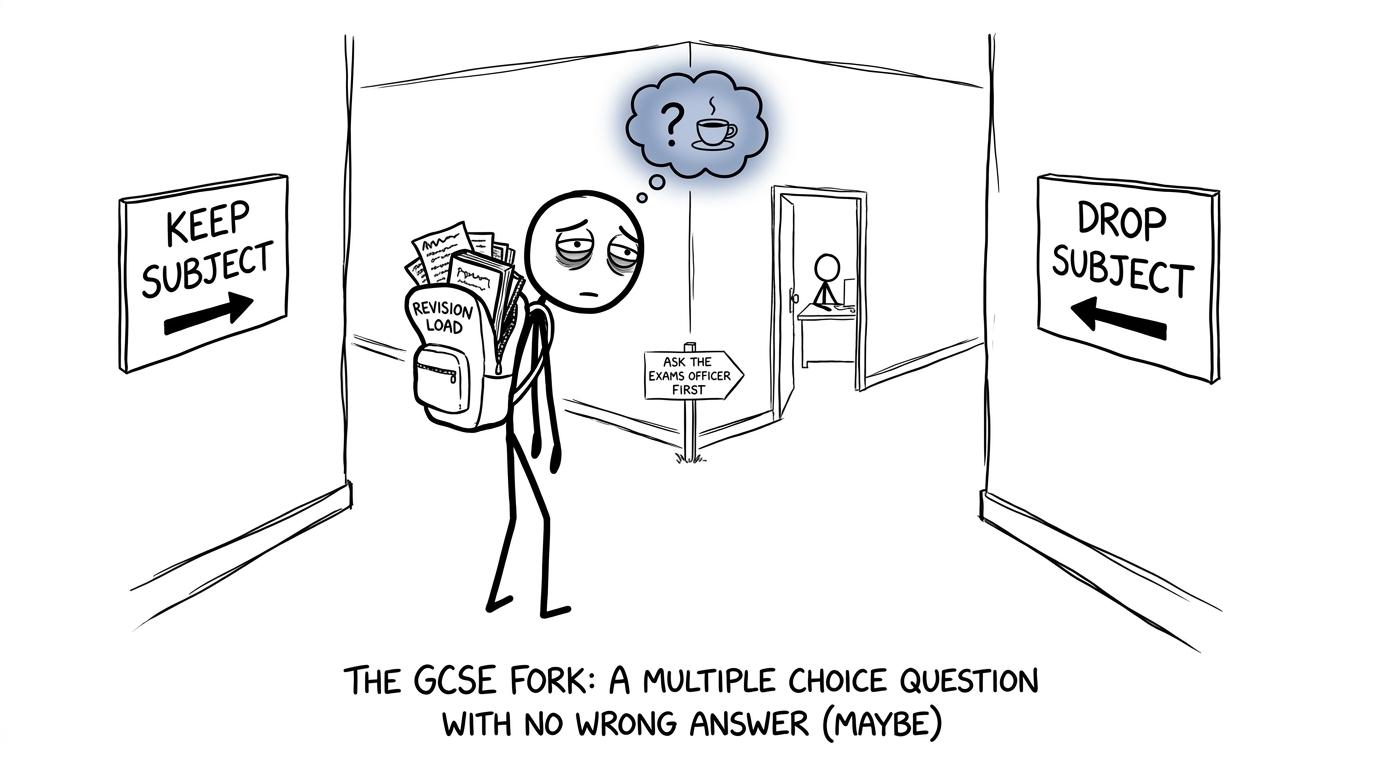 A GCSE student choosing between keeping and dropping a subject while the smallest sign recommends asking the exams officer
Understand what GCSE Biblical Hebrew involves
The current Pearson Edexcel GCSE Biblical Hebrew qualification has the code 1BH0. It is assessed through two written components, each lasting 222 hours and contributing 50%50\%50% of the qualification.
Component 1 assesses language. It includes comprehension of unseen Biblical Hebrew, translation into English and a choice involving grammatical analysis or translation into pointed Biblical Hebrew.
Component 2 assesses literature. Students study prescribed texts and answer questions involving comprehension, translation, grammar, literary analysis and comparison. The precise set texts can change between examination cycles, so check the live Pearson specification and information supplied by your teacher rather than relying on an old revision list.
This structure helps identify the real problem. A student struggling mainly with unseen translation has a different recovery task from someone who has missed substantial teaching on the set texts. Saying “I am bad at Biblical Hebrew” is too broad to guide a decision. You need to know which part is failing and why.
How to tell if you are actually in over your head
Feeling stretched is normal during a GCSE course. Being genuinely over your head is different: the gap remains large even after sensible support, consistent practice and enough time for improvement.
You cannot access the foundations independently
Warning signs include being unable to recognise common vocabulary, identify familiar grammatical forms or follow the broad meaning of a passage without extensive prompting. In literature, you may struggle to locate events, explain context or recall the structure of the prescribed texts.
A knowledge gap is not automatically fatal. The important question is whether it is closing. If four weeks of focused practice produce clearer recognition and more accurate answers, recovery may be happening even if your marks remain modest.
The subject is taking time without producing measurable progress
Keep a brief record for two or three weeks. Note what you practised, how long you spent and what improved. Then compare two similar timed tasks.
This is the same evidence-first approach used to find your weakest GCSE maths topics. A vague feeling says, “Everything is going badly.” A marked task says, “Unseen verb forms and extended literature responses are costing most of my marks.” The second statement gives you something to fix.
If your errors become narrower, the work is helping. If the same fundamental errors remain despite feedback and corrected practice, that is stronger evidence that the course may no longer be realistic alongside your other subjects.
Your core subjects are being crowded out
Biblical Hebrew is a full GCSE, but it is not normally a substitute for essential requirements such as English Language and maths. Sixth forms, colleges and university courses often specify particular GCSE grades, especially in English and maths, although requirements vary by institution and course.
Look for displacement rather than ordinary busyness. Are you repeatedly cancelling maths practice? Are incomplete science tasks accumulating? Is sleep being reduced to preserve an optional subject? If so, the problem is not simply that Biblical Hebrew feels hard. It is that the total timetable may be unsustainable.
Use the GCSE maths revision hub to check whether important foundation or higher-tier topics are being neglected. A short GCSE maths mini test can provide better evidence than guessing how well maths is going.
Your health or attendance is deteriorating
Persistent anxiety, loss of sleep, avoidance or physical symptoms deserve attention regardless of the subject involved. Speak to a trusted adult and the appropriate pastoral staff. Dropping one GCSE is not a complete response to a wider wellbeing problem, but neither should wellbeing be dismissed as a lack of determination.
Try a short recovery test before deciding
Unless the situation is urgent, agree a defined recovery period with your teacher. Two or three weeks is often long enough to gather useful evidence without allowing the decision to drift indefinitely.
Your test should include:
- one language weakness, such as vocabulary recall or grammatical recognition;
- one literature weakness linked to the current prescribed texts;
- short, regular sessions rather than occasional marathons;
- at least one timed task completed without notes;
- marking against the official criteria where available;
- a final conversation with your teacher about the progress shown.
Set a decision date in advance. Without one, students can spend months half-revising a subject while feeling guilty about every other subject.
Do not demand instant mastery. Ask whether your accuracy, independence and pace are moving in the right direction. A low mark that has improved for clear reasons may be more encouraging than a higher mark achieved with heavy support.
What dropping GCSE Biblical Hebrew may affect
Dropping a subject is an academic and administrative decision. Its consequences depend on your school, your exam entry and the qualifications you still intend to take.
Your number and range of GCSEs
If you leave before completing the qualification, you will normally finish with one fewer awarded GCSE. That may matter if a sixth form, college or later course asks for a particular number or combination of GCSEs.
Check actual published entry requirements rather than relying on rumours. GCSEs do not themselves generate UCAS Tariff points, but universities and colleges may specify GCSE subjects or minimum grades separately. Competitive courses can also consider the wider GCSE profile.
Your school's curriculum and performance arrangements
Schools organise option blocks differently. Biblical Hebrew may occupy a slot within your school's curriculum, and leaving it does not necessarily mean that another timetabled GCSE can be added mid-year.
It may also affect how your school's performance measures are calculated. That is something the school must understand, but it does not rewrite grades you have already earned in other subjects. Ask staff to separate consequences for you from consequences for school reporting.
Exam entry and withdrawal administration
Students generally cannot alter official entries personally. The exams officer handles entries and withdrawals through the awarding organisation.
Deadlines, amendment rules and possible fee refunds vary by board, qualification and examination series. JCQ directs centres to the relevant awarding organisation for current details. Therefore, do not rely on a date found in an old forum post. Ask your exams officer whether you are already entered, whether withdrawal remains possible and whether your school has an earlier internal deadline.
If you have already sat an examination or received a result, different reporting and declaration considerations may apply. When completing future applications, follow the instructions carefully and declare qualifications or results where requested.
Your future subject choices
Dropping Biblical Hebrew does not automatically prevent you from taking unrelated A Levels or pursuing university study. However, it may matter if you hope to continue with Biblical Hebrew, theology, ancient languages or a closely connected programme. Ask the relevant sixth form or college directly.
It also does not automatically improve maths. That requires a replacement plan using the correct tier and exam board, whether Edexcel, AQA, OCR or Eduqas.
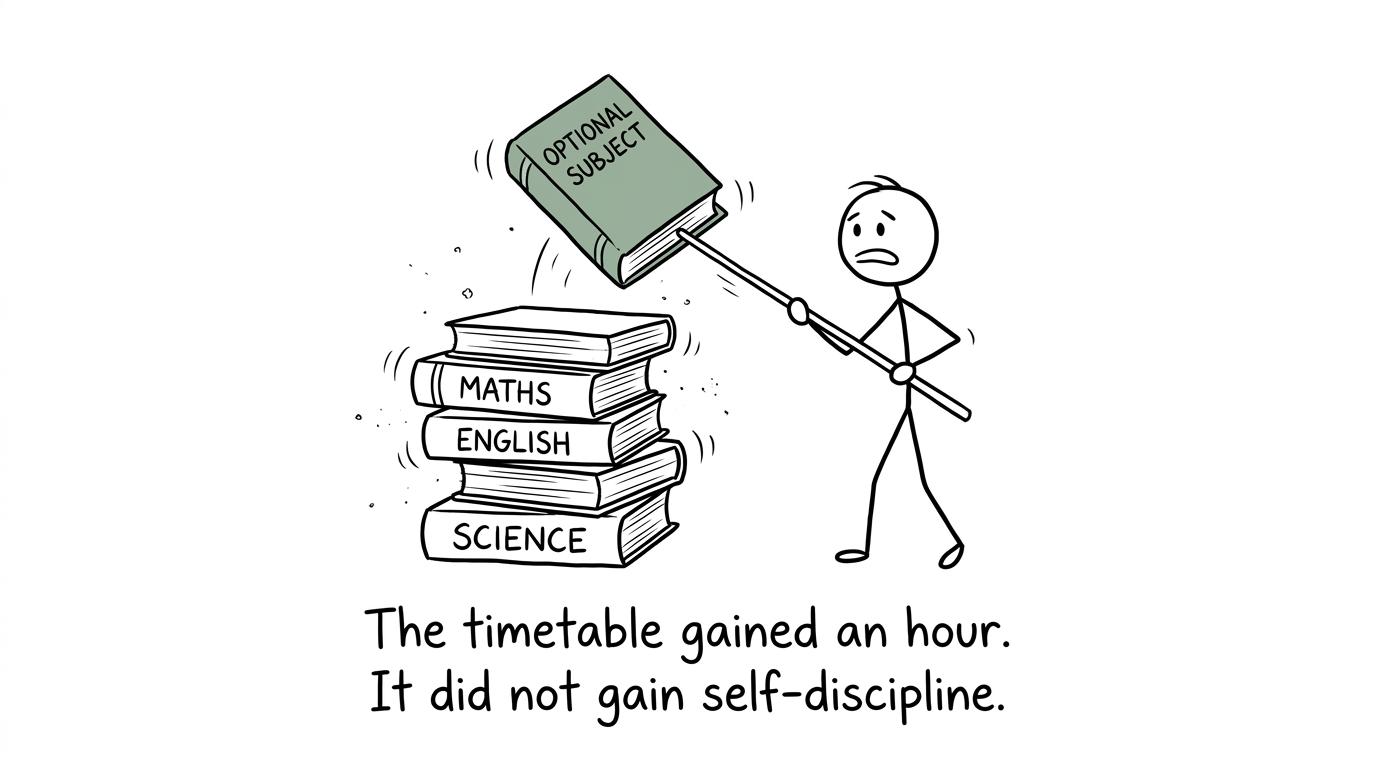 A student removes one optional-subject book from a revision pile but discovers that the core books do not revise themselves
What dropping the subject does not do
Dropping GCSE Biblical Hebrew does not:
- erase marks or qualifications already achieved elsewhere;
- guarantee higher grades in your remaining subjects;
- remove the need to meet English and maths requirements;
- automatically place you in another GCSE class;
- mean you were incapable or that the time already spent was wasted;
- solve poor revision habits, perfectionism or an overloaded timetable by itself.
The decision can still be wise. But wisdom lies in reallocating scarce time, not merely escaping an uncomfortable lesson.
Build a plan for the time you recover
If the subject is dropped, assign the released sessions before they disappear into general free time. A GCSE maths revision timetable can help you turn those sessions into specific tasks.
A useful weekly rhythm is:
- diagnose one weakness with a mini test or paper section;
- use a revision lesson to rebuild the method;
- complete focused practice questions;
- mark them with the mark scheme;
- record the exact reason for each lost mark;
- retest the topic later without notes.
Start with shorter assessments if confidence is low. MathsGenie's guide to when to begin GCSE past papers explains how to move from topic practice towards timed papers. If independent revision is new to you, use the realistic GCSE maths self-study plan rather than trying to redesign your whole week at once.
Common mistakes when making the decision
Deciding after one poor assessment
One paper can be affected by illness, timing, an unusually weak topic or ineffective preparation. Look for a pattern across marked work.
Staying only because of sunk time
Time already spent cannot be recovered. The useful question is what choice gives the best outcome from today onwards.
Dropping without speaking to the exams officer
A teacher can discuss academic readiness, but the exams officer understands entries, amendments and deadlines. You need both perspectives.
Assuming an extra GCSE is always better
An additional strong GCSE can broaden your profile. An additional qualification is not automatically more valuable than protecting required grades and maintaining a sustainable workload.
Leaving the recovered time unplanned
An empty timetable tends to fill itself. Use a structured plan such as the one-month GCSE maths revision plan, adapted to the time available before your exams.
Make the decision from evidence, not panic
Ask your teacher for a realistic judgement: what grade range does your present work suggest, what gaps remain, and can those gaps be closed alongside your other GCSEs? Then ask your exams officer what withdrawal would mean administratively. Finally, compare that information with your core-subject evidence and wellbeing.
If the course remains recoverable, continue with a narrower and more disciplined plan. If it is consuming disproportionate time, damaging essential subjects and showing little improvement despite proper support, leaving may be the responsible choice.
Either way, make the next step concrete. Open MathsGenie's free revision lessons, complete targeted practice questions, check your work with mark schemes and video solutions, then build towards mini tests, past papers and predicted papers. A difficult decision should leave you with more than relief. It should leave you with a better plan.










