Do Documentaries Help GCSE Arabic? A Clear Guide
Documentaries help GCSE Arabic when viewing becomes active practice. Discover what improves listening, vocabulary and exam marks, and what does not.
A documentary can feel like the perfect revision loophole. You press play, hear plenty of Arabic and learn something interesting, all without opening a textbook. But do documentaries help GCSE Arabic enough to improve your grade?
The honest answer is yes, but only as a supporting method. Documentaries can strengthen listening, vocabulary, pronunciation awareness and cultural understanding. They do not, by themselves, prepare you fully for speaking tasks, translation, accurate writing or the precise demands of an exam paper.
For students balancing Arabic with GCSE maths and other subjects, that distinction matters. Enjoyable exposure is valuable. Yet revision time is limited, and improvement comes from turning exposure into something active.
The short answer: useful, but not complete revision
Documentaries are most helpful when you:
- choose material containing Modern Standard Arabic;
- watch short, manageable sections rather than entire programmes;
- use Arabic captions when they are available and suitable;
- record a small number of useful words and phrases;
- replay sections without captions;
- summarise what you understood aloud or in writing;
- connect the content to your specification themes;
- continue practising exam-style listening, reading, speaking and writing.
Watching passively may increase familiarity with the sound of Arabic, but familiarity is not the same as being able to retrieve vocabulary under exam pressure. The documentary becomes revision when you pause, notice, recall and use the language.
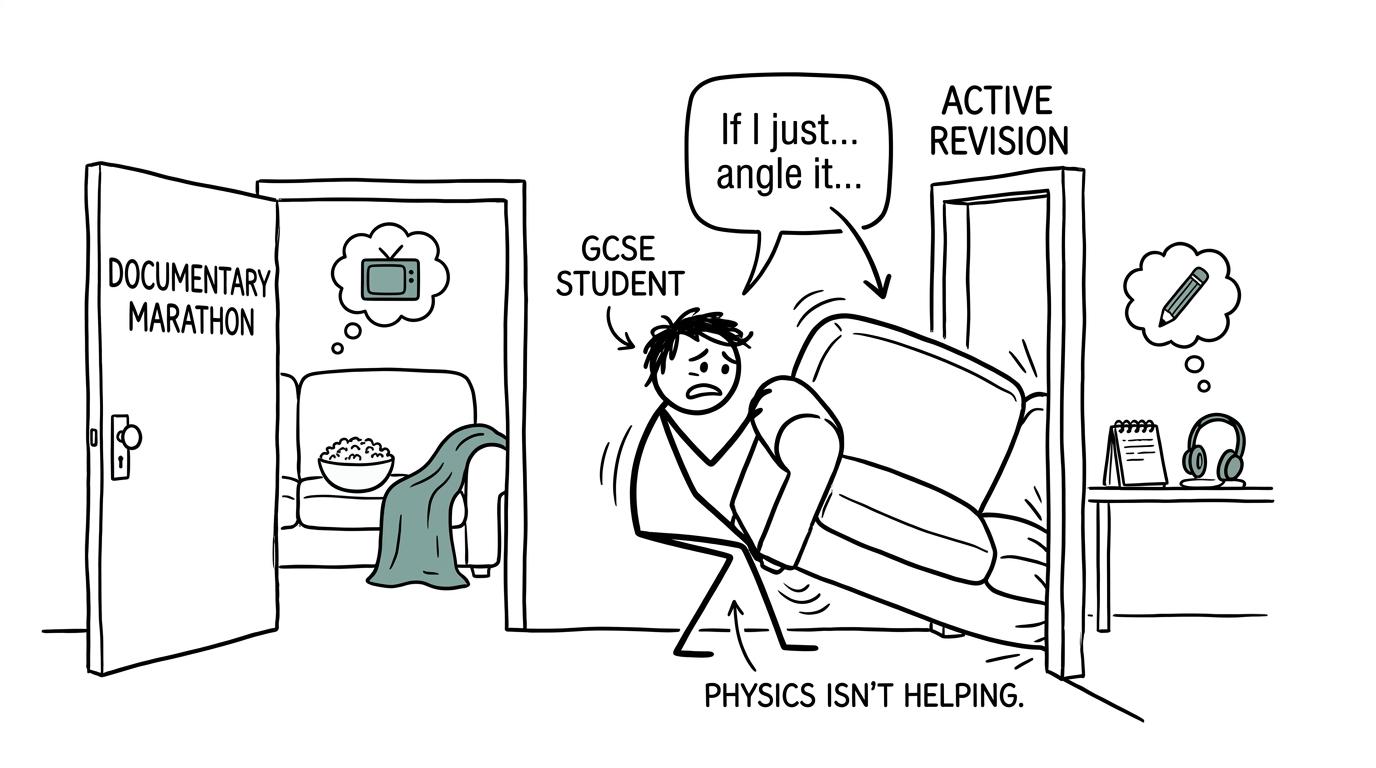 A student choosing between a documentary marathon and active revision
What GCSE Arabic actually assesses
For the current Pearson Edexcel GCSE Arabic qualification, the assessment is divided equally between four skills: listening, speaking, reading and writing. Each contributes one quarter of the qualification. Students enter either foundation or higher tier and take the same tier across all four papers.
That immediately reveals both the value and the limitation of documentaries. They provide direct practice in following spoken language, so their clearest connection is with listening. Captions may also support reading. However, watching does not require you to construct an accurate sentence, respond in conversation or translate independently.
The qualification assesses standard Arabic in public and social contexts. Its themes include identity and culture, travel, school, future aspirations, work, environmental issues and the wider international dimension. A documentary linked to one of these areas can expose you to useful ideas and vocabulary. A fascinating documentary on an unrelated specialist subject may still improve your general Arabic, but it may offer less direct exam value.
If you take an International GCSE or another qualification, check your own specification rather than assuming the assessment structure is identical.
How documentaries can improve your Arabic
They train your ear to follow continuous speech
Classroom recordings are usually selected for learners. A documentary can feel less forgiving: speakers continue without waiting, unfamiliar words appear and sentences connect naturally.
This can help you become more comfortable with longer stretches of spoken Arabic. You begin to notice repeated expressions, linking words and changes in emphasis. Visual context also provides clues. If the speaker is discussing transport while the screen shows a railway station, you can infer meaning without translating every word.
This matters because successful listening is not word-by-word translation. It is the ability to identify the topic, retrieve key details and keep listening after something is missed.
They can build vocabulary in context
Research into second-language learning generally finds that captioned and subtitled video can support vocabulary acquisition. Reviews have reported particularly useful results from captions in the language being learnt, although effectiveness varies with the learner, material and task.
This evidence is not specific to GCSE Arabic, so it should not be treated as a guarantee of higher marks. It does support a sensible principle: hearing a word while seeing it in a meaningful context can make the word easier to notice and remember.
The important word is notice. If twenty unfamiliar words pass by and you record none of them, most will disappear. Select perhaps five useful items from a short segment. Check their meaning and form, then use them later in a sentence, spoken response or short paragraph.
They provide ideas for speaking and writing
GCSE language tasks often ask you to express and justify opinions. Documentaries can give you something worth saying about environmental problems, technology, education, travel or community life.
The benefit is not memorising the presenter's argument. It is developing a bank of ideas that you can express using language you genuinely control. After watching, ask:
- What was the main issue?
- What opinion could I give about it?
- Can I provide one reason?
- Can I refer to the past, present and future where appropriate?
- Which phrases could transfer to another specification topic?
This turns background knowledge into potential speaking and writing material.
The Modern Standard Arabic and dialect problem
Arabic documentaries do not all use language in the same way. Formal narration and news-style reporting often use Modern Standard Arabic. Interviews may include regional dialects, code-switching or informal speech.
That variety is culturally valuable, but it can confuse revision. A student may learn a colloquial expression that is natural in conversation yet unsuitable for a formal GCSE writing response. Alternatively, a fast dialect interview may be so difficult that very little comprehensible language is processed.
Before choosing a programme, listen to the first few minutes. Prefer clear narration in Modern Standard Arabic when your purpose is direct exam preparation. Dialect content can remain part of your wider learning, especially if it is familiar from home, but keep a clear distinction between language you recognise and forms you intend to use in assessed work.
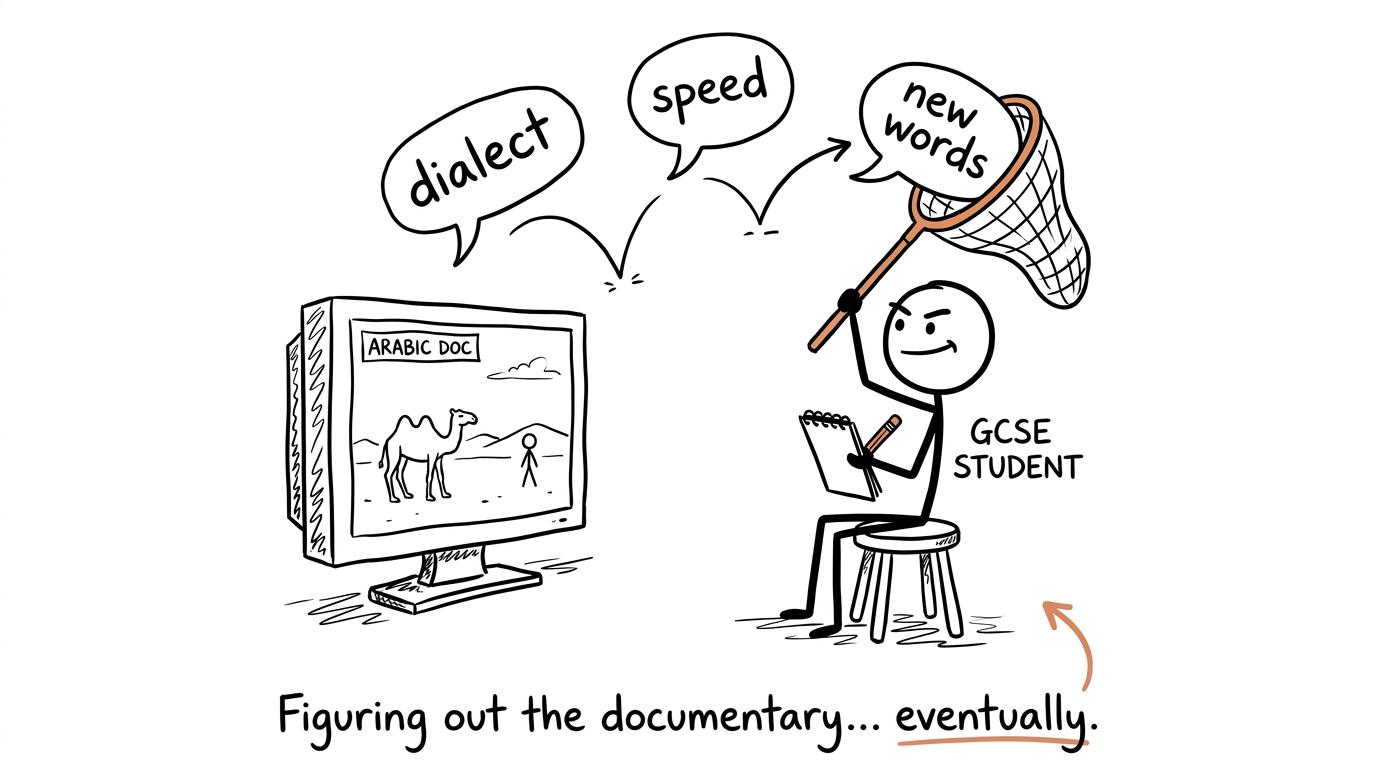 A student catching one useful word from a stream of fast speech
Which subtitles should you use?
English subtitles make the story easier to follow, but they can allow your attention to remain almost entirely in English. No subtitles create a demanding listening test, although the material may become incomprehensible if it is well above your level.
Arabic captions often offer the most useful compromise. They connect the spoken form to the written word and help you separate sounds within a sentence. Research across language-learning contexts suggests that same-language captions can benefit vocabulary and listening, particularly for learners who already have enough knowledge to follow the material.
Try a staged approach:
- First viewing: use Arabic captions and concentrate on the overall message.
- Second viewing: replay a short section and note a few useful expressions.
- Third viewing: hide the captions and listen for those expressions.
- Final recall: explain the main idea without replaying the clip.
If Arabic captions make the video completely inaccessible, use English subtitles once to establish the meaning. Then return to the same short section with Arabic captions. Subtitles should act as scaffolding, not permanent wallpaper.
A practical documentary revision routine
A full-length documentary can consume most of an evening. A focused clip can achieve more in less time.
Use this routine for a section lasting around five to ten minutes:
Before watching
Choose one goal. It might be identifying opinions, recognising vocabulary about the environment or following references to past events. Read the title and predict what language might appear.
While watching
Watch once without stopping excessively. Aim to understand the main subject and a few key details. On the next viewing, note no more than five transferable words or phrases. Too much pausing destroys the listening flow and turns the task into transcription.
After watching
Close the video. Give a short spoken summary in Arabic, or write several sentences using your selected language. Check which details you remembered accurately. Revisit the clip later in the week and test whether the vocabulary can still be recalled.
This routine creates retrieval practice. The useful learning happens not simply while information enters your mind, but when you try to bring it back.
Does reading around GCSE Arabic help too?
Yes, for similar reasons. Short articles, interviews and age-appropriate non-fiction can broaden vocabulary, improve reading stamina and expose you to how ideas are connected. This is relevant because GCSE reading can include authentic stimuli and adapted extracts.
However, reading around the subject should not become endless highlighting. After reading, identify the main message, locate supporting details and summarise the text without looking. Collect language that can be reused across themes rather than obscure vocabulary unlikely to appear again.
Enjoyment is not a weakness. Material you genuinely want to understand can keep you engaged with Arabic beyond compulsory homework. But enjoyable reading improves exam performance most reliably when it is followed by recall, production and exam practice.
Protecting your maths revision time
Many students preparing for Arabic are also working towards GCSE maths, where progress depends on solving questions rather than watching explanations alone. The same principle applies across both subjects: input introduces knowledge; active practice reveals whether you can use it.
Plan documentary viewing as one defined part of the week, not as a replacement for everything difficult. You could use the GCSE maths revision hub to organise maths lessons and practice, then reserve a separate short session for active Arabic viewing.
A realistic plan is more valuable than an ambitious one you abandon. MathsGenie's guide to building a GCSE maths revision timetable can help you balance subjects, weak areas and timed practice. For maths, move from revision lessons into questions and Edexcel GCSE Maths past papers. For Arabic, move from documentary input into speaking, writing and specification-matched questions.
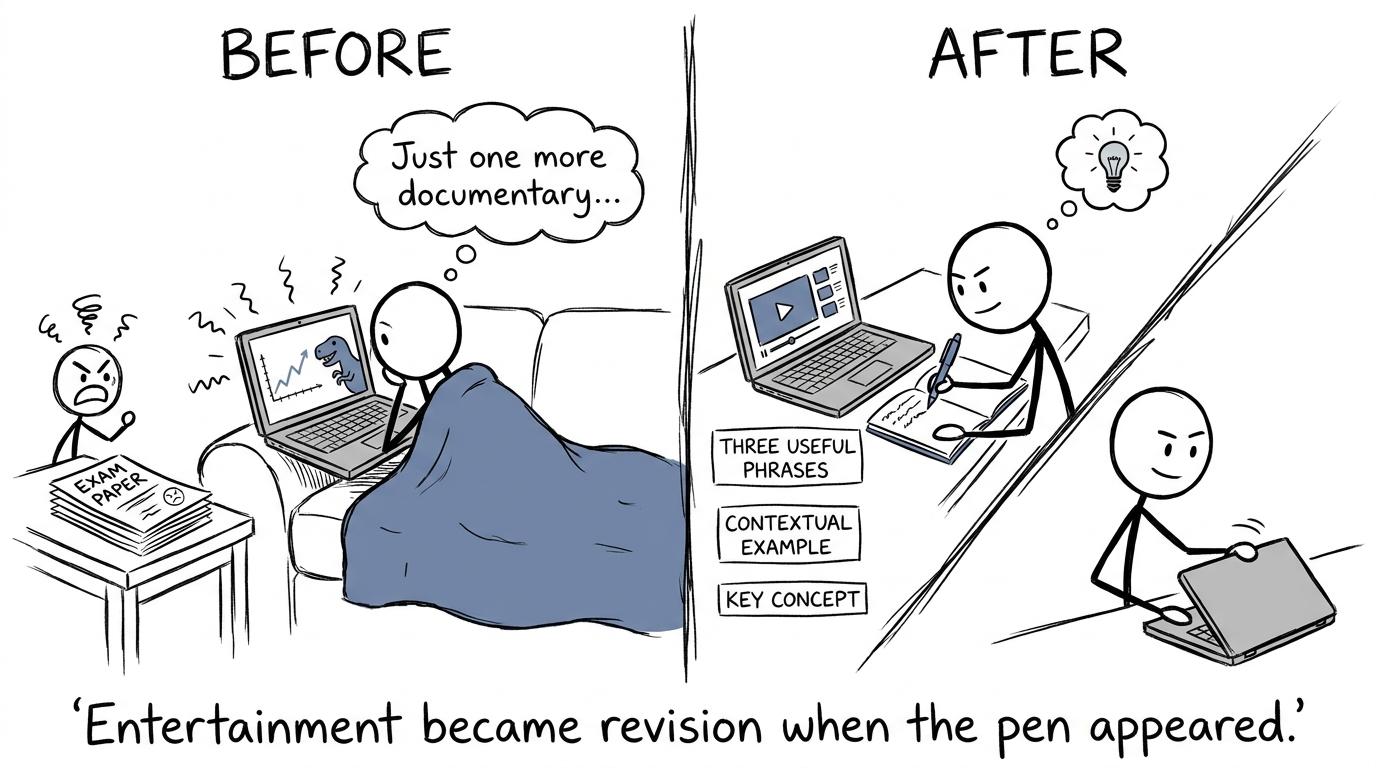 Entertainment becoming revision when the student starts writing
Common mistakes when using documentaries for revision
Counting viewing time as proof of learning
Finishing a programme is not evidence that its language can be recalled. Test yourself after watching. If you cannot summarise the message or retrieve useful expressions, the session remained mostly entertainment.
Choosing material that is far too difficult
Constant confusion is not productive challenge. Select clearer narration, shorter clips or a familiar subject. Difficulty should stretch your understanding without removing every foothold.
Writing down every unfamiliar word
This creates a long list and a short memory. Prioritise language connected to GCSE themes or phrases that could support several speaking and writing answers.
Using only English subtitles
English subtitles can support initial understanding, but they often reduce attention to Arabic. Return to Arabic captions or remove subtitles during a later viewing.
Replacing exam questions with documentaries
Documentaries cannot reproduce the exact timings, task formats or mark-scheme demands of your qualification. They belong beside past papers and teacher-set practice, not instead of them.
The same trap appears in maths when students watch solutions without attempting questions. Edexcel GCSE Maths mini tests are designed for short, active checks, while the guide to using past papers properly explains how to turn errors into targeted revision.
The verdict: helpful exposure needs an exam bridge
So, do documentaries help GCSE Arabic? Yes. They can improve listening familiarity, vocabulary awareness, cultural understanding and the range of ideas available for speaking and writing. Reading around the subject can bring similar benefits.
But the grade does not rise because the documentary was educational. It rises when you convert what you watched into language you can recognise, retrieve and produce under assessment conditions.
Keep the enjoyable part. Just add an exam bridge: watch a short section, capture a few useful expressions, recall the message, produce your own response and return to GCSE-style practice.
Apply the same discipline to maths. Start with MathsGenie's free GCSE maths revision resources, use revision lessons and practice questions to repair gaps, then test yourself with past papers, predicted papers, mini tests, mark schemes and video solutions. When the exams approach, the GCSE maths night-before plan can help you keep the final stage calm and focused.
Enjoyment can begin the learning. Active practice is what carries it into the exam.