

Do Documentaries Help GCSE Engineering Revision?
Documentaries help GCSE Engineering when paired with active maths practice. Learn what to watch, record and turn into useful knowledge and exam marks.
A documentary about a suspension bridge can make engineering feel wonderfully clear. You see the cables, hear why materials were chosen and watch a design become something real. Then you open a GCSE maths paper and meet a ratio question that still refuses to cooperate.
The short answer to whether documentaries help GCSE Engineering is yes, but mostly as supporting revision. They can improve context, vocabulary and motivation. They do not replace specification knowledge, mathematical practice, technical drawing or exam questions. Enjoyable viewing becomes useful revision only when you actively connect it to what you may need to explain, calculate or evaluate.
This matters even if your immediate target is a GCSE maths exam rather than a separate engineering qualification. Engineering provides a memorable setting for ratio, scale, graphs, measures, geometry and accuracy. The documentary supplies the picture. Practice supplies the marks.
The quick verdict
Documentaries and wider reading are worth your time when they help you:
- recognise how maths appears in genuine design and manufacturing;
- understand materials, processes, sustainability and design decisions;
- build technical vocabulary for written explanations;
- connect abstract topics such as scale or volume to physical objects;
- generate questions that you then answer using your specification and revision resources.
They are less useful when you watch passively, choose programmes unrelated to your course or count viewing time as a substitute for answering questions.
A sensible rule is simple: watch briefly, record selectively and practise immediately afterwards. Start by identifying your weaker topics through the GCSE maths revision resources, rather than selecting a documentary merely because its title sounds impressive.
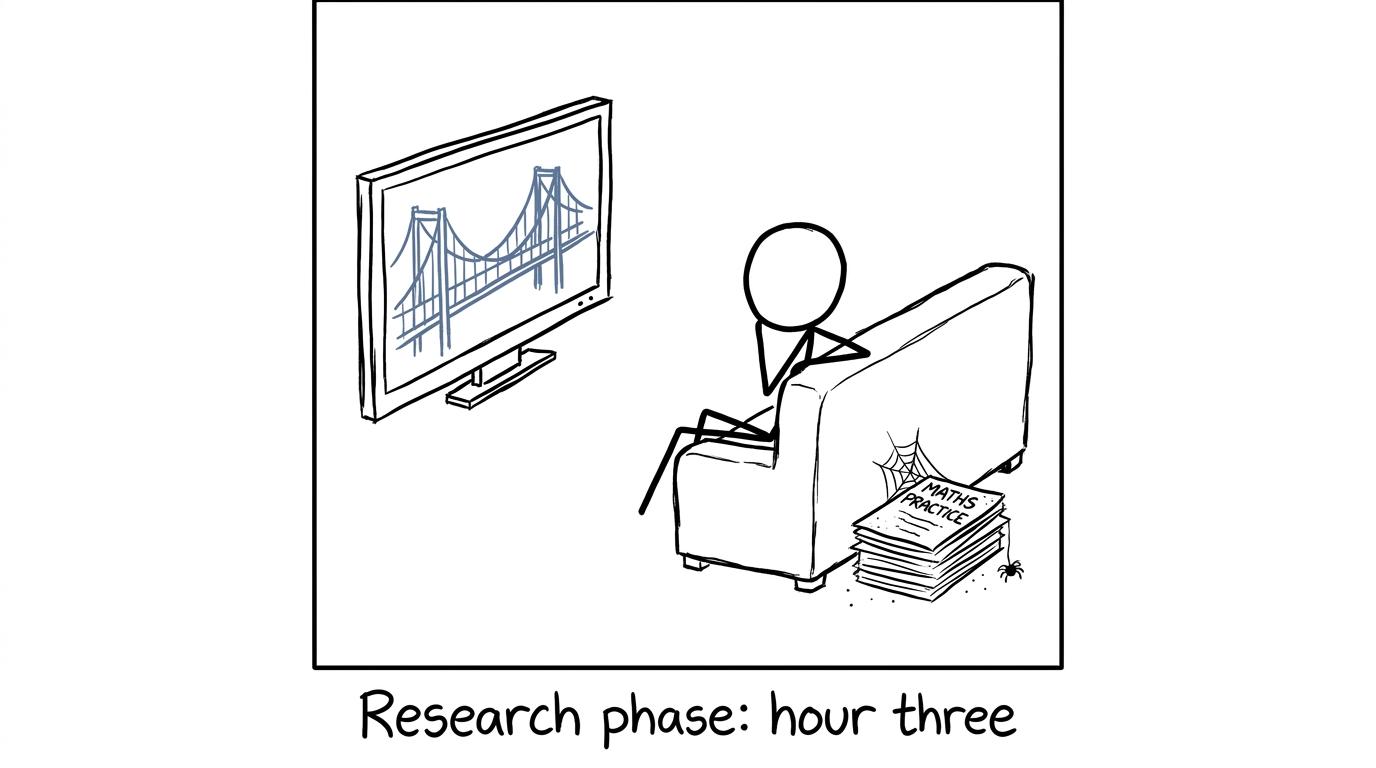 A student conducts a very long research phase while a practice paper waits
What documentaries can genuinely teach you
Good engineering documentaries reveal something textbooks sometimes struggle to convey: every finished object represents a chain of compromises. Cost, strength, mass, safety, appearance, environmental impact and manufacturing time may all pull a design in different directions.
That context can make familiar maths more meaningful. A programme about transport might draw attention to speed, distance and journey time. Factory footage can reveal repeated components, tolerances and quality control. Architecture can make scale drawings, plans, elevations, area and volume feel less like isolated chapters.
Useful mathematical connections include:
- ratios used in mixtures, models and proportional designs;
- scale factors connecting drawings, prototypes and finished products;
- percentages describing waste, efficiency or changes in cost;
- conversion between metric units;
- area and volume when estimating material requirements or capacity;
- graphs showing performance, temperature, load or production over time;
- averages and sampling in quality assurance;
- bounds and tolerances where measurements cannot be perfectly exact.
These connections are valuable because memory is often helped by meaning. The formula for average speed,
speed=distancetime,\text{speed}=\frac{\text{distance}}{\text{time}},speed=timedistance,may be easier to recall when you can associate it with a vehicle being tested. But recognition is not mastery. You still need to rearrange formulas, convert units and interpret unfamiliar questions independently. MathsGenie's speed, distance and time lesson lets you turn that initial recognition into exam practice.
Why watching alone rarely improves your grade
Documentaries are designed to hold attention. Examinations are designed to test what you can retrieve and apply without the programme guiding you.
That distinction is easy to miss. While watching, an explanation may feel obvious because the animation, narrator and images are doing part of the thinking. Once those prompts disappear, you may remember the bridge but not the principle behind its design.
The practical lesson from research into retrieval practice is that recalling and applying knowledge is more powerful than repeatedly encountering it. For a maths student, that means closing the video and attempting a question. For an engineering course, it may mean explaining a design decision from memory, sketching a process or comparing materials against stated criteria.
Watching can therefore be the beginning of revision, but it should not be the final stage. Exam marks come from producing answers that meet the question and mark scheme.
How to turn viewing into active revision
Begin with your specification
The label “GCSE Engineering” can cover different courses and technical qualifications, and their titles, content and assessment arrangements may vary. Always check the current specification supplied by your school or college and the relevant awarding organisation. Do not assume that a topic appearing in a documentary is examinable for Edexcel, AQA, OCR or Eduqas.
Choose a precise course heading first, such as materials, manufacturing processes, sustainability, systems or design considerations. Then find viewing or reading that supports it. This prevents interesting but irrelevant material from taking over your revision time.
Use a three-column note method
Keep documentary notes deliberately short. Divide a page into:
- Observation: what happened or what was shown?
- Course link: which specification idea does it illustrate?
- Action: what must you now recall, calculate or practise?
For example, footage of a scale model could prompt you to revisit proportional reasoning through the ratio revision lesson. A discussion of storage capacity might direct you towards volume questions. The programme creates the cue; the action develops the skill.
Pause for prediction, not transcription
Copying every sentence produces a detailed record of someone else's thinking. Prediction makes you think.
Before an engineer reveals a decision, pause and ask which material, shape or process you would choose. State your reason. When the programme resumes, compare its explanation with yours. A disagreement is useful because it exposes an assumption or a missing piece of knowledge.
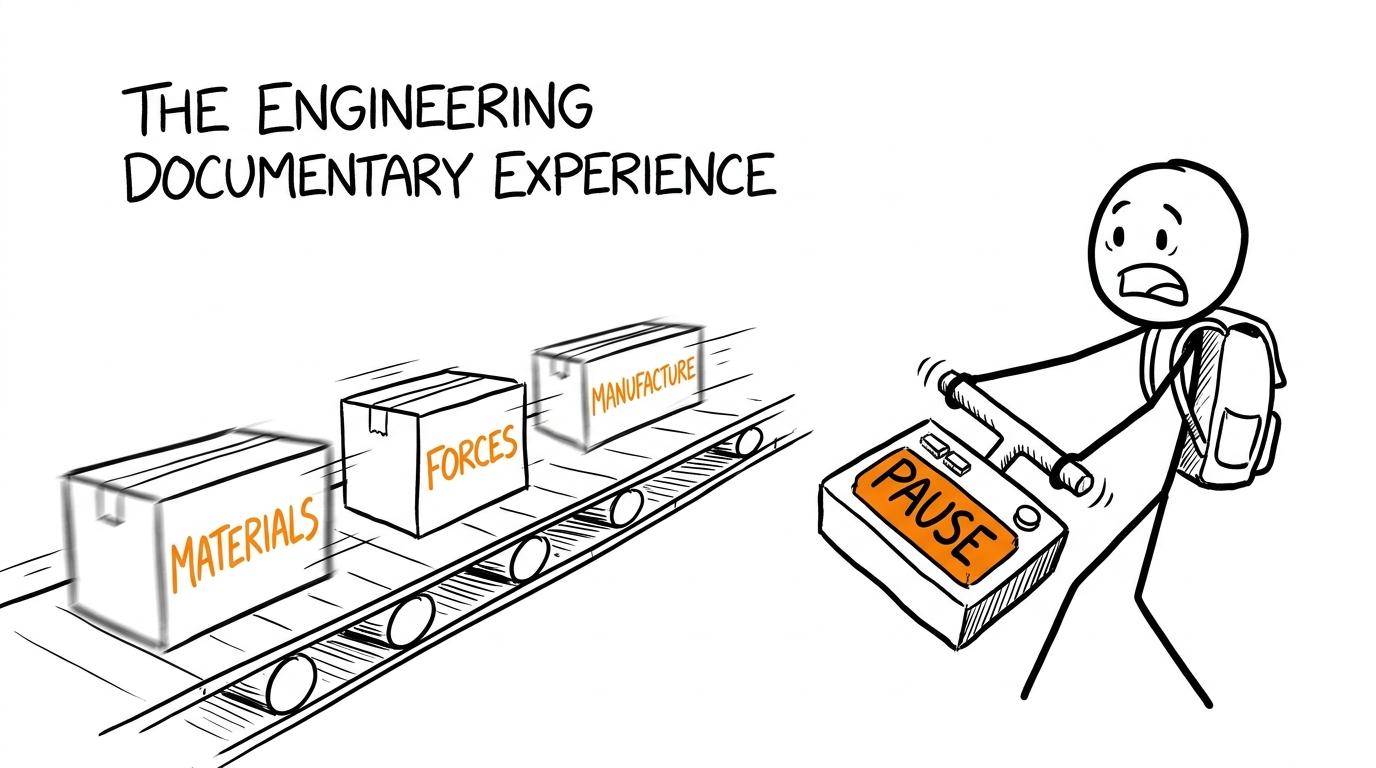 A student uses the pause button as an emergency brake for rushing ideas
Translate images into mathematical questions
When a documentary shows a drawing, component or data display, ask what mathematical demands might sit behind it:
- Would dimensions need converting?
- Is the diagram drawn to scale?
- Could an area or volume be required?
- What would the gradient of a graph represent?
- How accurately could a measurement have been recorded?
- Would an answer need rounding to a practical degree of accuracy?
You do not need to invent elaborate calculations. The purpose is to notice the underlying topic and then use proper questions. Revise circular components with area and circumference practice, or strengthen data interpretation through the relevant lessons on the GCSE revision page.
Finish with retrieval
At the end, close your notes and write down:
- three ideas you can explain accurately;
- two mathematical links you noticed;
- one question you still need to resolve.
Check your recall against your course materials afterwards. This small step distinguishes revision from entertainment because it forces your memory to work without visual prompts.
How much viewing is sensible?
There is no universal number of documentaries that will improve a grade. Their value depends on relevance and what you do afterwards.
A short, focused segment followed by practice is usually more useful than an entire evening of loosely related programmes. You might allocate around 20%20\%20% of a revision session to gathering context and the remaining 80%80\%80% to retrieval, practice questions and checking corrections. This is a practical guideline, not an examination rule.
Reading around the subject works in much the same way. A museum article, manufacturer explanation or engineering case study can deepen understanding, but it should have a clear purpose. Record the source, identify the course connection and verify important technical details against authoritative materials.
If your main priority is GCSE maths, protect the time needed for GCSE past papers. Wider viewing should support that work, not crowd it out.
What actually earns marks in maths exams
Engineering context can improve confidence, but GCSE maths questions reward mathematical evidence. Depending on the command and topic, that may include a correct method, appropriate units, clear reasoning, accurate construction or a conclusion supported by calculations.
Foundation and higher tier papers may present familiar mathematics through unfamiliar settings. A student who understands the context but cannot form a ratio or calculate a volume will struggle to secure the method marks. Conversely, a student with reliable mathematical habits can often handle an unfamiliar machine, component or manufacturing story because the mathematics underneath is familiar.
This is why practice matters. Use topic questions while building a skill, then attempt mixed questions where the method is not announced. Nearer the examination, add timed papers and MathsGenie predicted papers to practise choosing methods under pressure. Predicted papers are preparation tools, not guarantees of the questions that will appear.
Common mistakes when using documentaries for revision
Confusing familiarity with recall
Understanding an explanation while it plays does not prove that you can reproduce it later. Test yourself with the screen off and your notes closed.
Taking attractive but unusable notes
Beautiful pages can still lack specification language, mathematical links and questions. Write fewer notes and attach an action to each important idea.
Ignoring units and scale
Engineering footage often moves between tiny components and enormous structures. GCSE questions require disciplined unit conversion and attention to scale. Always check whether lengths, areas and volumes use compatible units.
Treating every claim as examinable fact
Documentaries simplify stories and may focus on unusual projects. Check definitions, processes and required terminology against your current course specification and teacher guidance.
Replacing practice with viewing
The most tempting revision task is often the one that feels easiest to continue. If you have watched something, complete questions afterwards and use the mark scheme honestly. Return to the relevant revision lesson when an error exposes a gap.
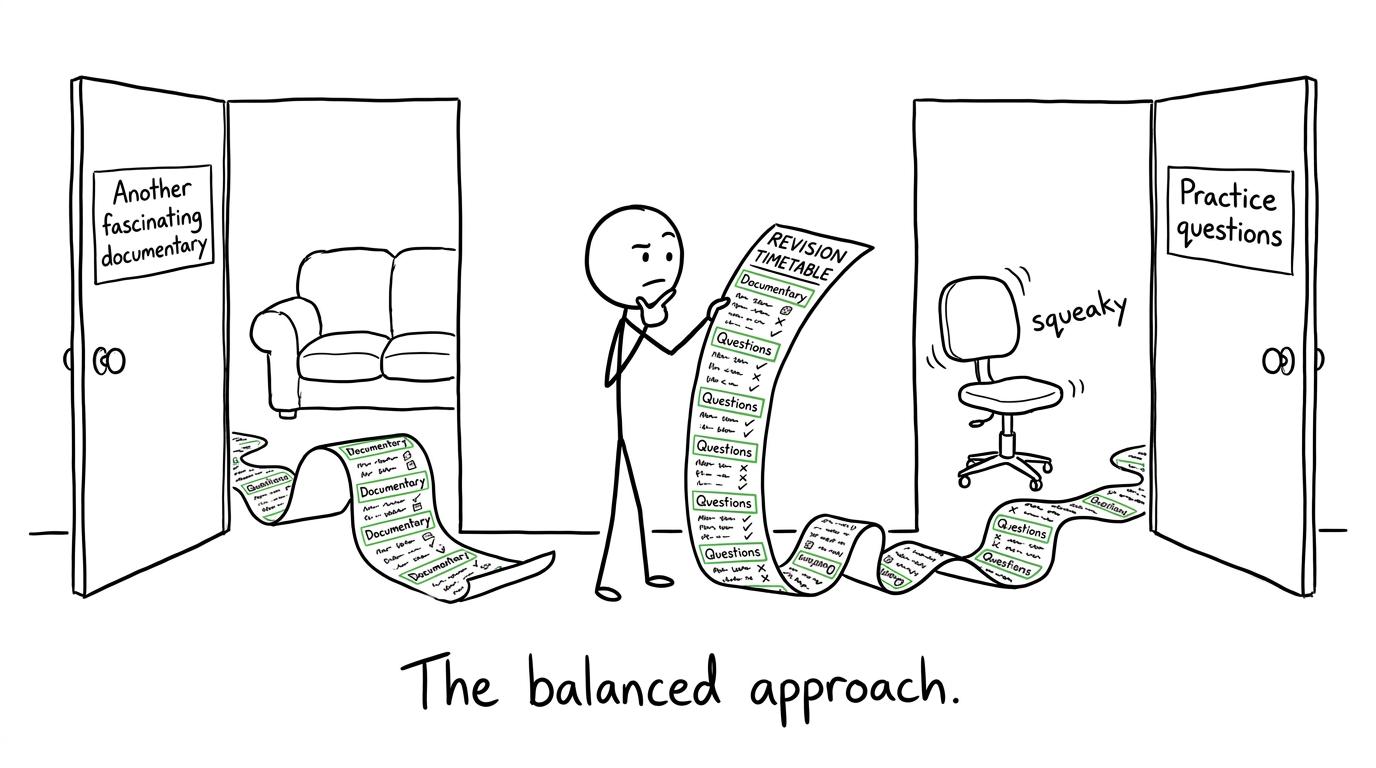 A student creates an ambitious timetable to choose documentaries and practice questions
A balanced documentary revision routine
A productive session can remain simple:
- select one specification-linked question before watching;
- watch a short section with minimal notes;
- pause to predict decisions or explain key ideas;
- identify one or two mathematical connections;
- recall the main points without looking;
- complete related practice questions;
- mark the work and correct every error.
Over time, use the MathsGenie revision resources to revisit weak areas rather than repeatedly practising what already feels comfortable. Mini tests, video solutions and mark schemes can reveal whether understanding is becoming dependable.
Turn curiosity into marks with MathsGenie
So, do documentaries help GCSE Engineering? They can. They make engineering visible, provide context and show why mathematical decisions matter. Reading around the subject can do the same. Both are genuinely useful when they lead to retrieval, specification knowledge and focused practice.
But enjoyment and effectiveness are not identical. A fascinating programme may inspire you without directly improving your exam performance. That is still valuable, provided you know which job it is doing.
Use documentaries to become curious. Use MathsGenie to become accurate. Choose a topic from the free revision lessons, complete the practice questions and mini tests, then build towards past papers and predicted papers with video solutions and mark schemes. Add each weak area to your revision planner, return to it deliberately and let every interesting engineering story finish with something you can now do.










