

Degree After A-Level Maths: Results Day Options
Degree after A-Level Maths: compare university courses, entry grades, subject fit and Results Day choices, including Clearing and foundation years.
Results Day can make two years of work feel strangely small: one envelope, a few grades and a decision that suddenly looks permanent. It is not. If you are considering a degree after A-Level Maths, your options extend well beyond a mathematics degree. Engineering, economics, computer science, actuarial science, physics and data-focused courses can all build on the same habits of reasoning.
The best choice depends on three things: which problems you enjoy, how much mathematical theory you want, and which entry requirements your results satisfy. Start there rather than choosing only by course title.
Your Results Day decision checklist
Before comparing universities, ask:
- Do I prefer pure ideas, data, technology, money or physical systems?
- Do I want mathematics to be the main subject or a tool within another subject?
- Does the course require A-Level Further Maths or another science?
- Are my grades above, close to or below the published offer?
- Have I compared compulsory modules, assessment methods and professional accreditation?
- Would a joint honours course, foundation year or degree apprenticeship suit me better?
Entry requirements vary by university and year. Always check the live course page before applying or accepting a Clearing offer.
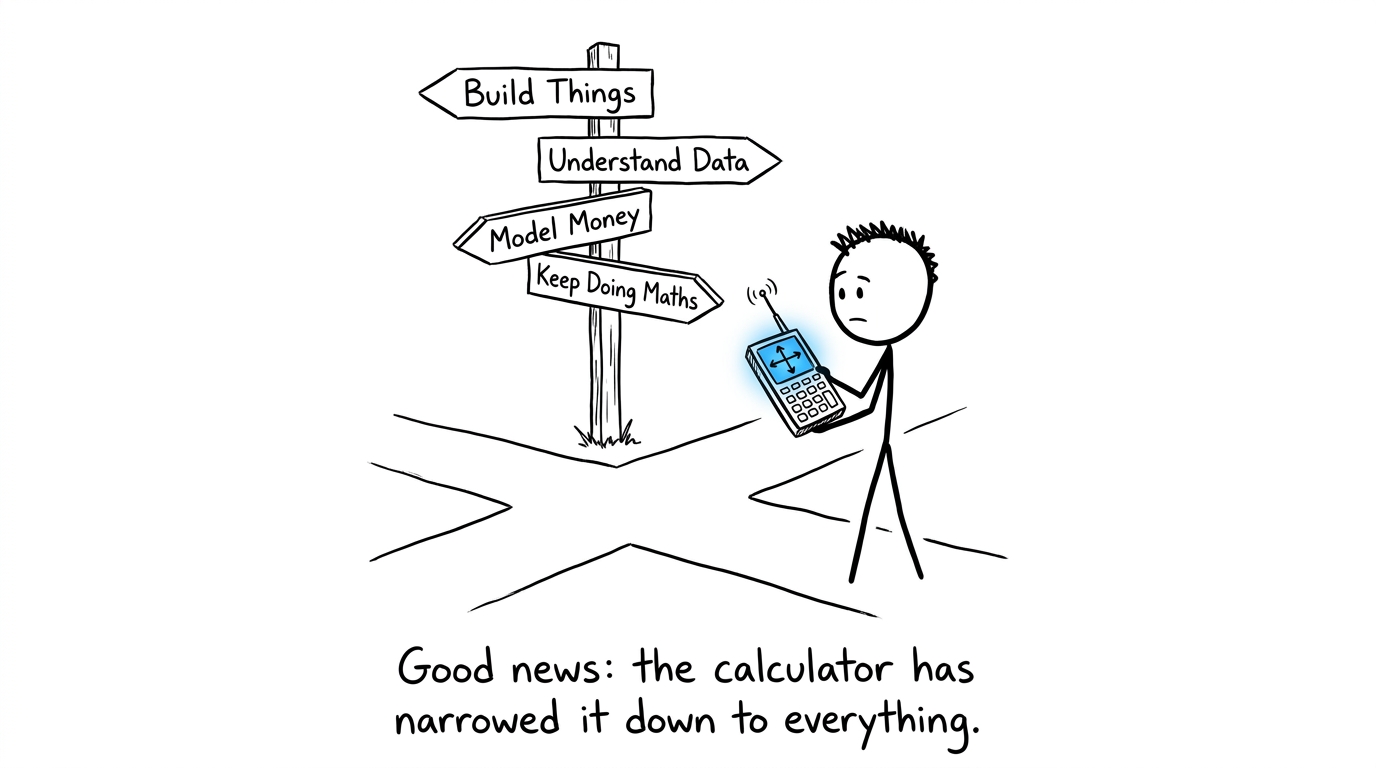 A student uses a calculator as a compass at a university-course crossroads
University courses for Maths A-Level students
Mathematics and statistics
A mathematics degree is the most direct route if you enjoy proof, abstraction and understanding why methods work. Typical modules include calculus, linear algebra, probability, differential equations, numerical methods and mathematical modelling. Statistics courses place greater emphasis on uncertainty, data and inference.
Entry requirements cover a wide range. Current published examples for 2026 entry run from BBB including B in Maths at Keele to AAA at highly selective universities. Oxford currently asks for AAA, with the A* grades in Mathematics and Further Mathematics when Further Mathematics is available. Some competitive courses also use admissions tests.
Further Maths is valuable and is required or strongly recommended by some universities, but it is not universally essential. If your school did not offer it, read each university's policy carefully.
Engineering and physics
Engineering suits students who want to use mathematics to design, test and improve real systems. Civil, mechanical, electrical, electronic and aerospace engineering share mathematical foundations but lead towards different applications.
Physics is a strong option if mechanics, modelling and explaining natural phenomena appeal to you. Depending on the course, Physics A-Level may be required alongside Maths. Engineering offers commonly range from around BBB to AAA, but subject conditions matter as much as the overall grades.
If mechanics is your strongest area, explore the mechanics resources within Edexcel A-Level Maths revision. The point is not merely to improve an exam grade. It is to notice whether modelling forces and motion is work you genuinely want to continue.
Computer science and data science
Computer science combines logical reasoning with algorithms, programming and the study of computation. Some universities require A-Level Maths; others accept applicants without it. The most mathematically demanding courses may prefer Further Maths.
Data science usually combines programming, probability, statistics and modelling. Course titles can hide substantial differences, so compare the modules. One programme may emphasise machine learning and software, while another is closer to applied statistics.
Students interested in these routes should be comfortable moving between algebra, functions and probability. MathsGenie's A-Level topic questions and solutions help you test that interest against the actual work rather than an appealing course description.
Economics, finance and actuarial science
Economics degrees range from essay-led programmes to highly quantitative courses using calculus, statistics and econometrics. A-Level Economics is not always required, but competitive quantitative courses often require a strong Maths grade.
Actuarial science focuses on financial risk, probability and long-term uncertainty. For example, Southampton's published 2026 offer for Economics and Actuarial Science is AAA including Mathematics. Requirements elsewhere may be higher or lower.
This route may suit you if statistical models feel more interesting when they answer questions about risk, markets or decision-making. Practising probability and hypothesis testing through the A-Level Maths revision hub gives you a useful preview.
Joint honours and less obvious routes
Going from A-Level Maths to a degree does not require choosing a single traditional subject. Joint courses may combine mathematics with computer science, economics, philosophy, finance or physics. Mathematics is also useful in architecture, chemistry, geography, psychology and some biological sciences, although additional subject requirements vary.
A joint degree can preserve two interests, but inspect the balance. “Mathematics and Economics” may not divide time equally, and optional modules can change between universities.
How to interpret example entry grades
| Course direction | Illustrative published offer | Requirement to examine |
|---|---|---|
| Mathematics at Keele | BBB | B in A-Level Maths |
| Economics and Actuarial Science at Southampton | AAA | A-Level Maths included |
| Mathematics at Manchester | A*AA | A* in Maths or Further Maths |
| Mathematics at Oxford | AAA | A* in Maths and Further Maths if available |
These are examples, not national rules or guaranteed Clearing offers. Contextual offers may be lower, while admissions tests, GCSE requirements and specific subjects can add further conditions.
For GCSE students, this is why present choices matter. A secure algebraic foundation supports A-Level Maths, while a strong higher-tier result may affect sixth-form entry. Use the GCSE Maths revision hub or the Edexcel GCSE Maths resources to strengthen those foundations early.
What to do on A-Level Results Day
For 2026, A-Level Results Day is Thursday 13 August. Check your UCAS application first, because a university may confirm your place even if one grade differs from the original offer.
If you are unplaced, Clearing is the official route for finding courses with vacancies. Prepare your UCAS ID, results, course questions and contact details. Compare modules and requirements before adding a choice; urgency should not replace judgement.
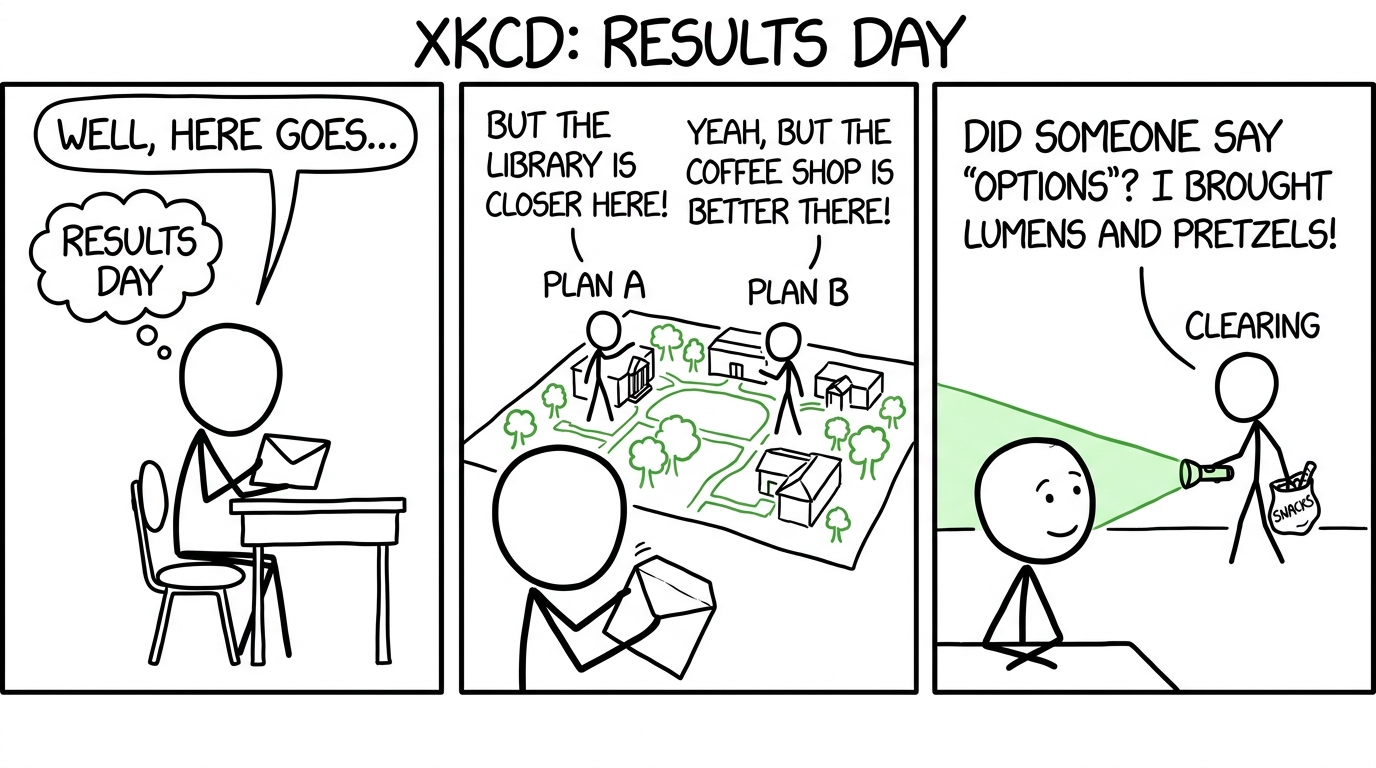 Plan A, Plan B and Clearing gather around a university map
Your realistic routes may include:
- accepting your confirmed firm place;
- considering your insurance choice;
- contacting universities through Clearing;
- choosing a related course or joint degree;
- taking a foundation year;
- resitting and reapplying if that serves a clear goal.
Common mistakes when choosing a degree
Choosing by prestige alone. A famous university cannot make unsuitable modules enjoyable. Read the course structure.
Treating entry grades as the whole decision. Assessment style, placements, accreditation, location and cost also matter.
Assuming every course with the same title is identical. Compulsory content can differ considerably.
Ignoring subject-specific conditions. Meeting the overall offer is not enough if the course requires a particular Maths, Further Maths or Physics grade.
Making a rushed Clearing decision. Ask about modules, accommodation and any foundation-year progression rules before accepting.
Turn today's revision into tomorrow's choice
A degree decision is easier when you know which kind of mathematical work holds your attention. Use the MathsGenie revision planner to organise weak topics, then move from revision lessons and practice questions to Edexcel A-Level past papers. Mark carefully, revisit errors and use video solutions, mini tests and predicted papers to build confidence.
Your results create options, but they do not choose for you. Explore the relevant A-Level Maths degree preparation topics, compare current university requirements and choose the course whose everyday work you would still find worthwhile after Results Day has passed.










