

Degree After A-Level Law: Courses to Consider
Degree after A-Level Law: compare LLB, joint honours and related UK courses, entry grades, career routes and smart results-day choices with confidence.

Results day can make a distant question feel suddenly urgent: what degree after A-Level Law should you choose? The direct answer is an LLB Law, but it is not your only sensible option. Joint honours courses, criminology, politics, business, international relations and other degrees can all build on the research, argument and evaluation skills developed through A-Level Law.
Your best choice depends on three things: the subjects you enjoy, the career you may want and the offers available with your results. A-Level Law opens a door. It does not lock you into one room.
Your results-day decision checklist
Before accepting a place or searching through Clearing, check:
- the course modules, not just its title;
- whether the degree supports your intended legal career route;
- the published entry grades and GCSE requirements;
- how the course is assessed;
- whether placements, legal clinics or a year abroad are available;
- accommodation, travel and total living costs;
- whether you would still value the degree if you changed career direction.
Entry requirements vary substantially between universities and may change each year. Always check the live course page before making a decision.
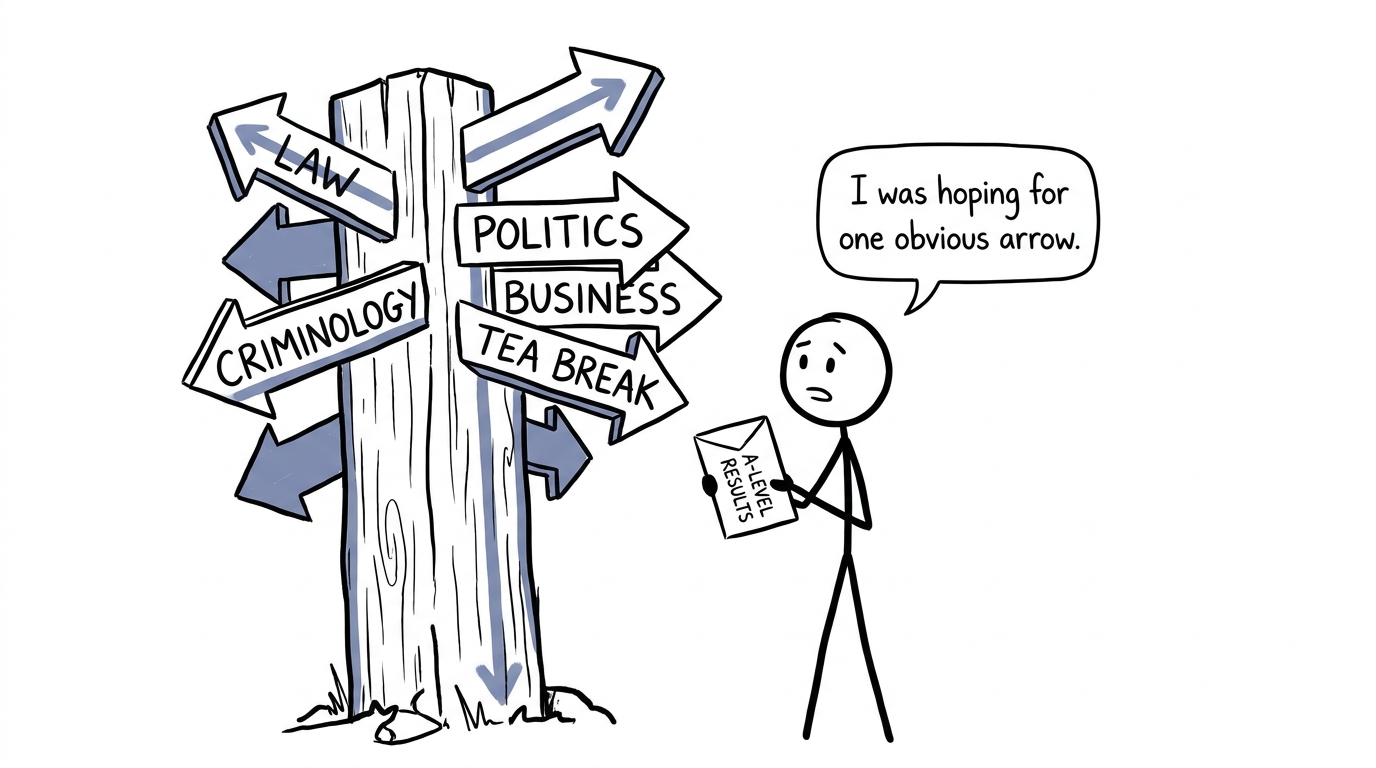 A student faces an oversized university course signpost
The most direct A-Level Law to degree route
LLB Law
An LLB is the clearest continuation from A-Level Law. Typical modules include contract law, criminal law, public law, tort law, land law and equity and trusts. You may also be able to choose options such as human rights, commercial law, family law or intellectual property.
Universities do not normally require A-Level Law for an LLB, and many courses assume no previous legal knowledge. Having studied it can still help because you already understand ideas such as precedent, statutory interpretation and structured legal argument.
Published requirements for 2026 entry illustrate the range rather than guaranteeing future offers:
| Example course | Published A-Level requirement |
|---|---|
| UCL Law LLB | A*AA |
| University of Warwick Law LLB | A*AA |
| University of Manchester Law LLB | A*AA |
| University of Leeds Law LLB | AAA |
| Cardiff University Law | AAA to ABB |
| Royal Holloway Law | AAB to ABB |
| UWE Bristol Law | Around 112112112 UCAS Tariff points |
Some universities make contextual offers, while others consider an EPQ or alternative qualifications. Certain providers also use the LNAT. Read every condition carefully rather than assuming that all law degrees follow the same admissions pattern.
Joint honours university courses for Law A-Level
A joint degree can be valuable when two subjects genuinely interest you. Common combinations include:
- Law with Politics;
- Law with Criminology;
- Law with Business;
- Law with International Relations;
- Law with a modern language;
- Law with Sociology.
Look at how the course is divided. “Law with Politics” may contain more law than “Law and Politics”, but naming conventions differ between universities. Compare compulsory modules, optional modules and assessment methods.
Joint honours is not automatically easier than a straight LLB. Moving between two academic disciplines can demand flexibility, especially when one uses problem questions and the other relies heavily on essays or research projects.
Related degrees that build on A-Level Law
Criminology
Criminology examines crime, offending, punishment and the institutions surrounding criminal justice. It suits students who enjoyed criminal law but were especially interested in why offences happen and how society responds.
It is not the same as a law degree. Expect more sociology, research methods and analysis of criminal justice policy.
Politics and international relations
These courses develop your understanding of government, power, public policy and global institutions. They connect naturally with constitutional law, parliamentary law and human rights.
They can support careers in government, policy, journalism, charities and public affairs. They can also provide a route towards legal training later, although further study or professional assessments may be required.
Business, economics or accounting
If company law, employment law or commercial disputes interested you, a business-related degree may offer a wider route into management, finance, compliance or entrepreneurship.
Some courses have specific GCSE Maths requirements. Strengthening your numeracy now therefore protects future choices. MathsGenie’s GCSE Maths revision hub provides board-specific support for Edexcel, AQA, OCR and Eduqas, while the Edexcel GCSE Maths lessons cover Foundation and Higher tier skills topic by topic.
Sociology, social policy or philosophy
Sociology and social policy explore institutions, inequality and how rules affect communities. Philosophy develops close reasoning, logical analysis and the ability to challenge assumptions. Both build skills that are useful in law without limiting you to a legal career.
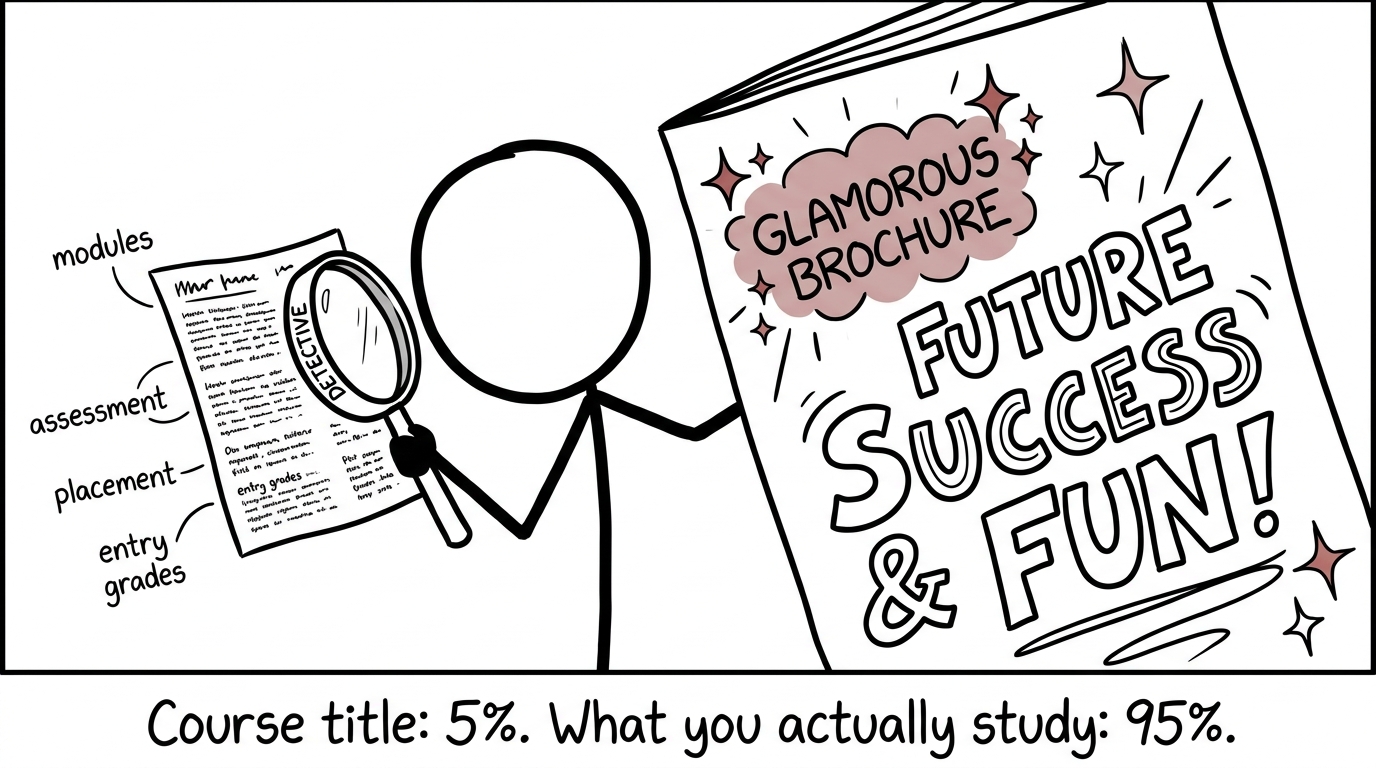 A student investigates university brochures with a magnifying glass
Match the degree to the career route
If you want to become a solicitor in England and Wales, the current SQE route requires a degree or equivalent qualification in any subject, passing SQE1 and SQE2, two years of qualifying work experience, and meeting the Solicitors Regulation Authority’s character and suitability requirements. An LLB is therefore useful, but it is not compulsory.
The barrister route is different. The Bar Standards Board describes academic, vocational and work-based components. The academic component can be completed through a law degree or through a non-law degree followed by an appropriate law conversion course. Pupillage is the work-based stage and is highly competitive.
Rules differ in Scotland and Northern Ireland, so check the relevant professional body if you intend to qualify there.
If you are uncertain about becoming a lawyer, ask a broader question: which course would still interest you if your career changed? A degree lasts several years. Its daily content matters more than the label you imagined on results morning.
How GCSE and A-Level Maths support your options
Law is language-heavy, but legal and related careers still use evidence, financial information, statistics and careful reasoning. Secure GCSE Maths also matters because universities may specify a minimum grade even when the degree itself is not mathematical.
Use GCSE predicted papers to identify gaps, then return to targeted lessons and practice questions. The MathsGenie resources collection includes mini tests and shorter papers for focused revision.
If A-Level Maths is one of your subjects, the A-Level Maths revision hub brings together lessons, past papers and predicted papers across major exam boards. Students following AQA can go directly to AQA A-Level Maths revision for topic questions, worksheets and mark schemes.
Common mistakes when choosing a degree
Choosing only by university reputation
A respected name cannot rescue a course whose modules, assessment style or location do not suit you. Compare the actual curriculum.
Assuming A-Level Law guarantees an LLB place
Universities assess your full academic profile. Strong results, careful course research and any required admissions test still matter.
Treating Clearing as a panic button
Clearing can reveal worthwhile opportunities, but compare courses calmly. Confirm the offer, read the conditions and understand accommodation implications before releasing an existing place.
Ignoring professional qualification rules
A degree and professional qualification are not the same thing. Check the latest SRA or BSB route before committing money to postgraduate training.
Forgetting GCSE requirements
Some courses specify minimum GCSE English Language or Maths grades. A-Level results do not always remove those conditions.
Make the next choice calmly
The right degree after A-Level Law is not necessarily the course with “law” in the largest letters. It is the course whose content, entry requirements and future routes fit you best.
Compare modules, build a shortlist and check every live offer before deciding. Meanwhile, keep your academic options open with MathsGenie: use free revision lessons, practice questions, past papers, predicted papers, mark schemes and video solutions to turn weak topics into dependable marks. Your university choice may be made on one day, but the preparation behind it is built one careful session at a time.











