

Degree After A-Level Economics: Course Guide
Degree after A-Level Economics: compare economics, finance, data and joint degrees, typical entry grades, maths requirements and results day options.
Results day can make years of work feel strangely small. One envelope, one screen and several decisions suddenly demanding attention. If you are choosing a degree after A-Level Economics, the main options include economics, finance, business, politics, data-focused courses and joint honours degrees. The right route depends less on the course title than on three things: its mathematical content, entry requirements and compulsory modules.
For GCSE students looking further ahead, this matters now. Your choice of A Levels, particularly whether you take Mathematics, can affect which university courses remain open later.
Your course-choice checklist
Before comparing universities, ask:
- Do I enjoy economic theory, data analysis or real-world policy most?
- Does the course require A-Level Mathematics?
- How much econometrics, statistics or programming does it include?
- Are the published grades realistic for me?
- Would I prefer a placement year, study abroad or a foundation year?
- Do the compulsory modules interest me, not just the course title?
Entry requirements change between universities and application cycles. The example grades below reflect published requirements for recent entry and should be treated as a starting point, not a substitute for checking the course page for your year.
 A student discovers that choosing a university course creates even more choices
Economics degrees
A straight Economics BA or BSc is the clearest A-Level Economics to degree route. Typical modules include microeconomics, macroeconomics, mathematics for economists, statistics and econometrics. Many courses also introduce programming or applied data analysis.
Economics degrees can be considerably more mathematical than A-Level Economics. Competitive courses commonly require A-Level Mathematics even when they do not require A-Level Economics. For recent entry, published examples have ranged from approximately AABAABAAB at some universities to A∗AAA^*AAA∗AA or higher at highly selective institutions. Recent requirements included A∗AAA^*AAA∗AA with Mathematics at UCL, AAAAAAAAA including Mathematics at Queen Mary University of London, and AAAAAAAAA including Mathematics at Manchester.
Not every economics course requires A-Level Mathematics. Some universities accept applicants without it, while others offer less mathematical BA routes or foundation years. Read the requirements carefully rather than assuming that every course called “Economics” follows the same pattern.
If you are taking Mathematics, strengthen the algebra, calculus and statistics that will support university study through A-Level Maths revision lessons and questions. Edexcel students can also use the dedicated Edexcel A-Level Maths revision hub.
Finance, accounting and business economics
Finance and accounting degrees suit students interested in markets, investment, corporate decisions and financial reporting. Business economics combines economic reasoning with areas such as strategy, management and competition.
Requirements vary widely. Some finance degrees require A-Level Mathematics; others accept strong GCSE Mathematics instead. The course may still contain statistics, quantitative methods and financial modelling, so “Mathematics not required” does not mean “no maths involved”.
Check whether the programme is mainly theoretical, professionally focused or quantitative. Also investigate professional accreditation if accountancy is your goal, as this may provide exemptions from some professional examinations.
Data science, statistics and econometrics
If the data sections of economics interest you more than essays, consider economics with data science, econometrics, statistics or business analytics. These courses explore how evidence can test economic claims rather than simply describe them.
They are usually among the most mathematical university courses for Economics A-Level students. A-Level Mathematics is commonly required, and Further Mathematics may be useful for particularly quantitative programmes. Expect probability, statistical inference, regression, optimisation and programming.
You can begin building the relevant skills with Edexcel A-Level Statistics past papers. Past papers reveal whether you can select and interpret methods under pressure, rather than merely recognise them in notes.
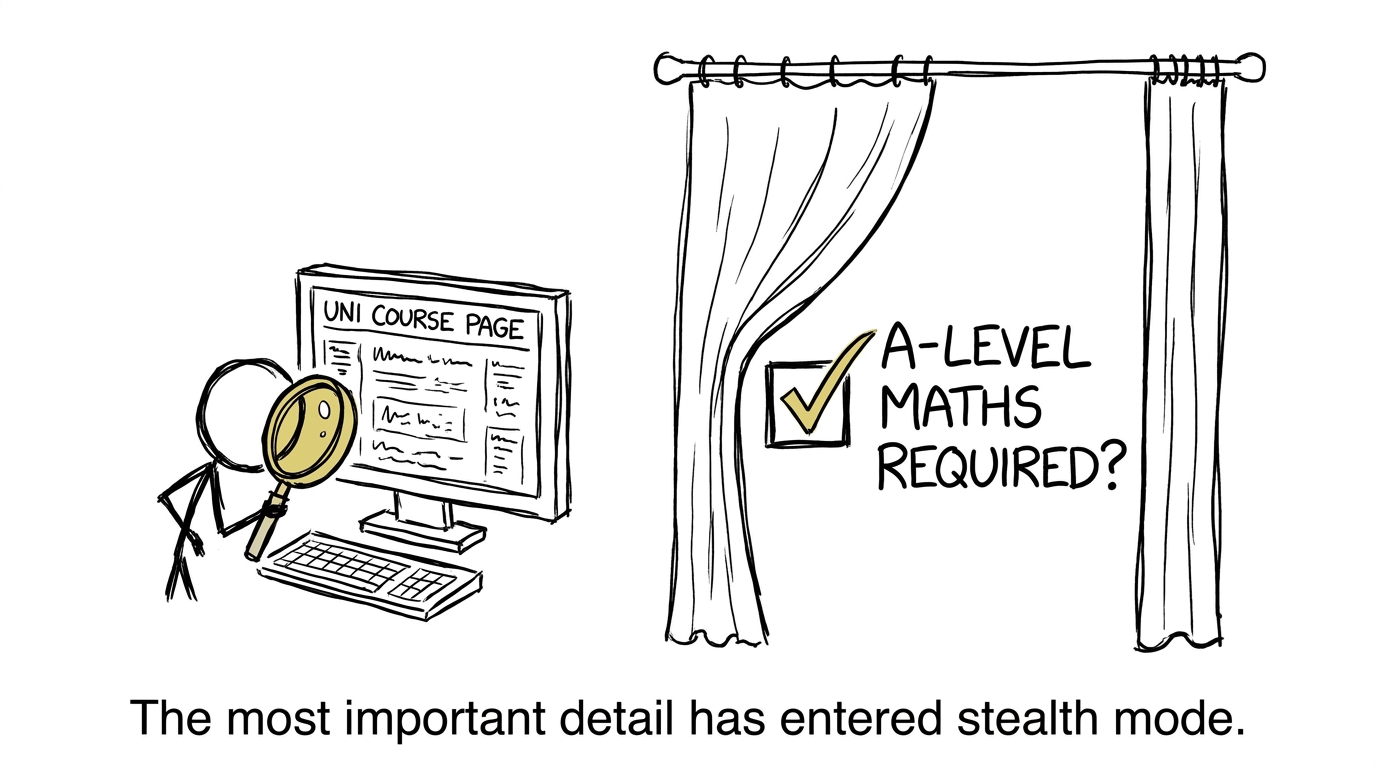 A detective searches a course page for the hidden A-Level Mathematics requirement
Politics, international relations and public policy
Economics is ultimately about choices made under constraints. Politics and public policy examine who makes those choices, how institutions work and why apparently sensible policies can become difficult in practice.
Courses such as Economics and Politics, Political Economy, International Relations and Economics, or Philosophy, Politics and Economics can suit students who enjoy evaluation and extended writing alongside quantitative analysis. Joint degrees vary sharply: one may contain substantial econometrics, while another gives greater weight to political theory.
If you hope to work as a professional economist, inspect the proportion of economics modules. UK public-sector economist routes commonly expect substantial economics content, including both microeconomics and macroeconomics. A course containing economics in its title may not automatically provide enough of either.
Joint honours and flexible degrees
Joint honours can connect economics with mathematics, geography, history, a language, finance or management. This is valuable when the combination reflects a genuine interest, not simply uncertainty.
Read the module structure for every year. Ask whether both subjects remain balanced, whether modules become optional later and whether the timetable restricts your choices. BA and BSc labels can offer clues, but they do not reliably measure mathematical difficulty. Compulsory modules are better evidence.
How to compare entry grades on results day
Build a short comparison using four categories:
| Factor | What to check |
|---|---|
| Entry grades | Standard and contextual offers |
| Subject requirements | Whether Mathematics or another subject is compulsory |
| Course content | Core modules in each year |
| Course structure | Placement, foundation year or study-abroad options |
Recent examples show the range. Surrey published AABAABAAB for its Economics BSc, with a reduction to ABBABBABB for applicants taking A-Level Mathematics or Economics. Nottingham published a range around A∗AAA^*AAA∗AA to AAAAAAAAA and welcomed applications without A-Level Mathematics, subject to its wider requirements. These examples illustrate why searching by course title alone is unreliable.
On results day, compare your achieved grades with both the overall offer and every subject-specific condition. If your place is uncertain, use the official application system and contact the university directly. Do not rely on old screenshots, forum comments or requirements from a different entry year.
MathsGenie’s A-Level grade boundaries can help you understand previous exam thresholds, but grade boundaries do not change a university’s offer conditions.
Common mistakes when choosing a degree
Assuming A-Level Economics is required
Many economics degrees do not require the subject. Mathematics is often the more important requirement for quantitative programmes.
Ignoring the mathematical content
Students sometimes choose economics because they enjoy market discussions, then discover that the degree contains calculus, statistics and econometrics. Review the first-year modules before applying.
Choosing from rankings alone
A highly ranked course is not automatically the best personal fit. Module choice, assessment methods, location, cost, placements and student support also matter.
Treating the offer as the whole decision
Two courses with identical grades can teach economics very differently. Compare compulsory modules and assessment formats, including the balance between examinations, coursework and projects.
Neglecting current maths revision
University plans feel distant when GCSE examinations are close. Yet algebra, graphs, percentages and statistics are part of the bridge towards A-Level Economics and quantitative degrees. Use the GCSE Maths revision hub, then test your progress with GCSE predicted papers.
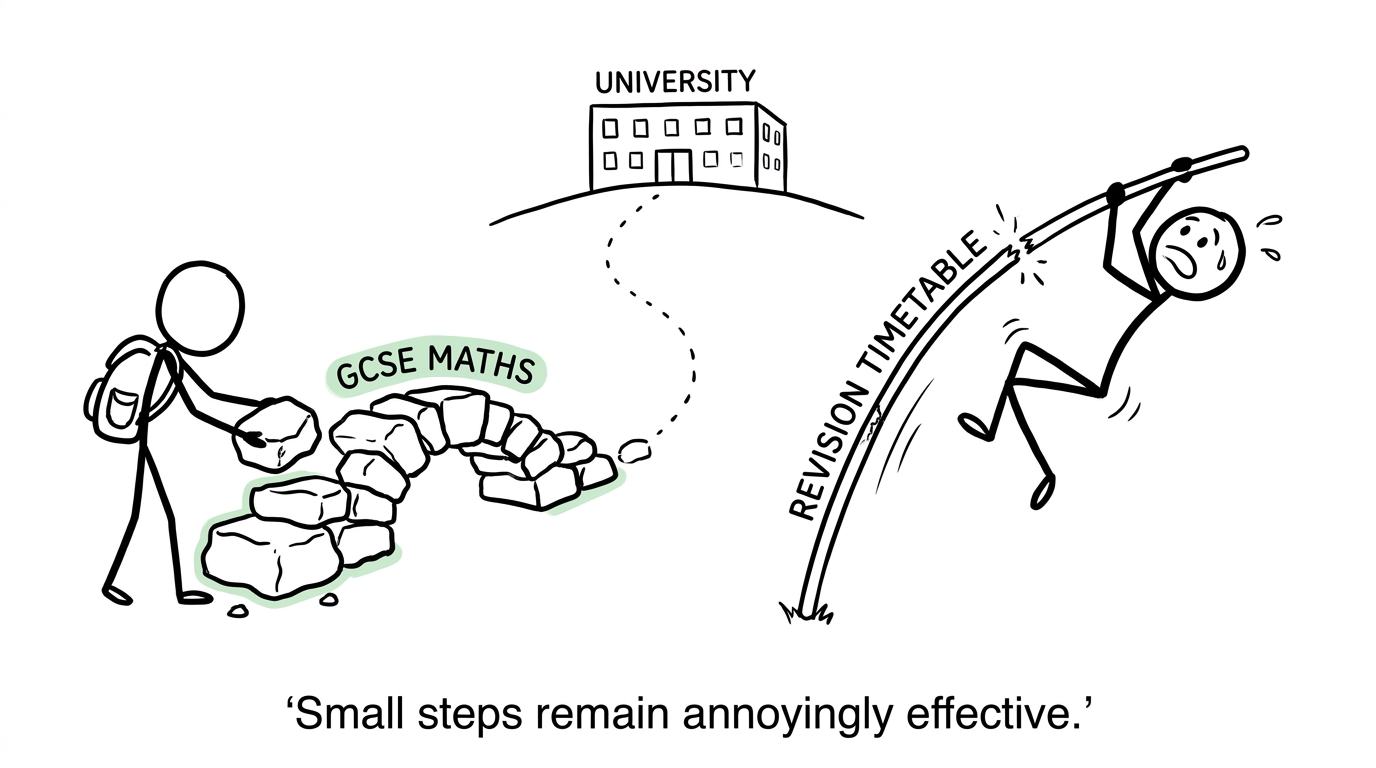 A student builds a bridge towards university using small GCSE Maths steps
Turn a course idea into a practical plan
Choosing a degree is easier when you work backwards. Select several possible courses, record their grade and subject requirements, then identify the skills you need to strengthen. If economics remains your preferred route, explore the Edexcel A-Level Economics revision resource to see how the subject develops.
For mathematical preparation, combine revision lessons with practice questions, mini tests and mark schemes. Later, use AQA A-Level Maths past papers or OCR A-Level Maths past papers for your exam board.
The best degree after A-Level Economics is not the one with the most impressive title. It is the course whose content, mathematical demand and opportunities fit the way you want to think and work. Start with MathsGenie’s free revision lessons, practice questions, past papers, predicted papers and video solutions; then make your next decision with evidence rather than guesswork.











