

Daily Maths Practice Routines That Fit Your Life
Daily maths practice routines for GCSE and A Level: use recall, questions and feedback to make revision manageable, then build your own realistic schedule.

Imagine a student sitting down after school with a revision timetable, a pencil and no clear idea what to do first. The timetable says “maths”. That still leaves a surprising number of decisions.
Useful daily maths practice routines remove those decisions: recall something you have learnt, answer questions independently, mark your work and schedule a return to anything you found difficult. Start with a manageable session of around twenty minutes, then adjust it around your workload. This is a practical starting point, not a scientifically prescribed duration.
For parents, the useful question becomes “What will you practise today?” It gives a student somewhere concrete to begin.
Your daily routine at a glance
Keep the structure steady while changing the topic:
- Recall: try a little previously learnt maths without notes.
- Practise: answer questions on one clearly defined skill.
- Check: mark your attempts and identify why mistakes happened.
- Return: record what needs another attempt and when.
Your wider timetable decides where maths fits among your subjects. This routine decides what happens once you sit down. Use the GCSE maths revision timetable guide for that broader revision planning, then put a specific task inside each maths slot.
Give each session a clear job
“Revise algebra” sounds purposeful until you open the book. “Practise rearranging formulae, then retry yesterday’s mistake” tells you what to do and when you have finished.
Choose the task before the session, ideally when marking your previous work. Use evidence from homework, a topic test or a past paper rather than choosing whichever worksheet feels comfortable.
For GCSE revision, check that the material matches your exam board and foundation or higher tier. The GCSE maths revision hub provides a starting point for finding suitable resources. A Level students can use the A Level maths revision hub to find resources for their board.
Keep the task narrow enough to complete and check. A short session should leave you with useful feedback, not simply another half-finished worksheet.
A twenty-minute routine you can use today
Begin with three minutes of recall
Close your notes. Try a question from a previous session, write down a method from memory or explain when you would use a particular technique.
This is retrieval practice: attempting to bring learning back to mind. Research reviewed by the Education Endowment Foundation supports its usefulness, although results depend on how it is used. For maths, make recall include doing something with your knowledge, rather than only reciting formulae.
If you cannot begin, use that information to choose your next step. A brief reminder may be enough; a missing method may need teaching again.
Spend ten minutes practising independently
Work on the chosen skill with your notes closed initially. Show your working so you can distinguish a sound method from a lucky answer.
If you become stuck, identify the first step you cannot explain. Consult the relevant revision lesson or video solution, then close it and attempt the question again. Watching a solution can make the method feel familiar before you can reproduce it yourself.
Choose the number of questions to suit their difficulty. An A Level problem may need most of this time; shorter GCSE questions may allow several attempts.
Use five minutes to mark and repair
Check your work against the answers or mark scheme. Go beyond recording whether the answer was correct.
Ask whether you misunderstood the question, chose an unsuitable method, made an arithmetic slip or stopped too early. Write one useful correction, such as “define the variable before forming the equation”.
Then repair the work yourself. Copying the finished solution leaves the hardest thinking to someone else.
Finish with two minutes of planning
Record the topic, the obstacle and the next action. For example: “Method understood after a prompt; retry without help later this week.”
Leave tomorrow’s task ready. The twenty-minute maths revision guide offers a related approach for busy school days; keep one routine you can actually repeat rather than collecting several competing systems.
Build this recall, practise, check and return pattern into your schedule in the Revision Planner, so you know what each daily maths session is for.
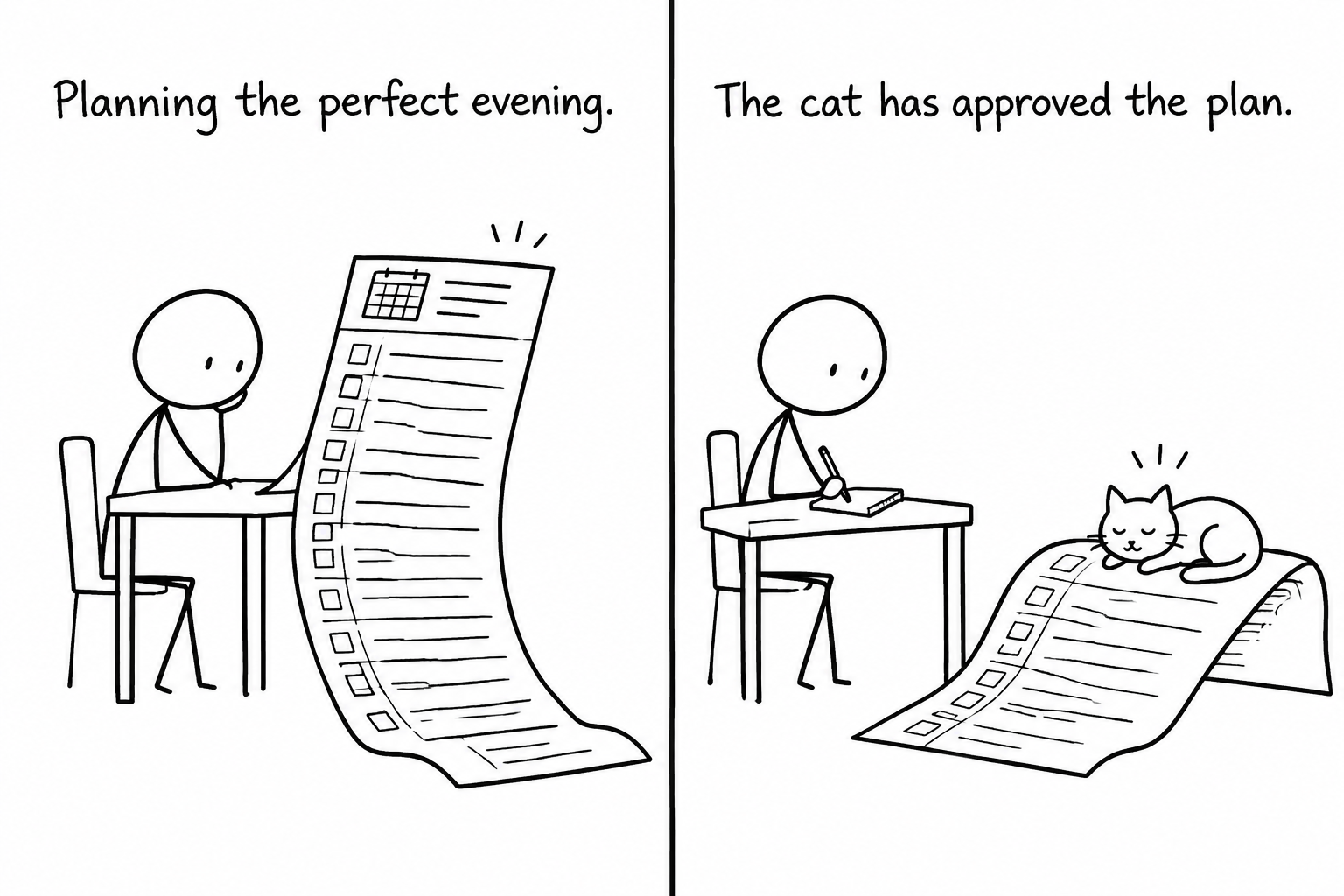 A stick-figure student's elaborate revision timetable becomes a comfortable bed for a cat.
Make the week connect
Daily practice becomes more useful when sessions speak to each other. Return to a difficult skill after a gap, then include it among questions where the method is not announced in advance.
A manageable week might begin with a topic exposed by homework, revisit it midweek and finish with mixed questions. Use the final check to choose the following week’s priorities. Spacing attempts gives you opportunities to discover whether you can still use a method after the immediate familiarity has faded.
There is no need to turn every evening into a full paper. Longer sessions can accommodate timed past-paper sections, while shorter sessions can repair the weaknesses those papers reveal. Mini tests can provide a compact checkpoint. If you use predicted papers, treat them as additional practice rather than a promise about what will appear.
For A Level, include pure maths, statistics and mechanics across your wider plan. Allow longer blocks when a connected problem needs sustained reasoning.
Common mistakes that weaken the routine
Counting minutes without checking learning. Time is useful for protecting a revision slot, but your work should reveal something: a method completed independently, an error corrected or a gap identified.
Repeating only comfortable questions. Begin with an accessible task if it helps you start, then address something your recent work shows needs attention.
Leaving marking until another day. Reserve time for feedback within the session. Otherwise, tomorrow’s practice may repeat today’s misunderstanding.
Treating a missed day as a broken plan. Resume at the next realistic opportunity. Avoid doubling every future session to repay an imaginary revision debt.
Turning parental support into constant supervision. Agree a starting time and offer practical help. Ask your child to explain one correction afterwards, while leaving ownership of the work with them.
Build a routine you can return to
The student at the kitchen table needs a clear next task and a realistic place to do it. You now have the session structure; the remaining job is fitting it around lessons, other subjects and rest. Build your daily maths practice schedule in the Revision Planner.















