

Comparing GCSE Bengali Progress With Friends: Is It Bad?
Comparing GCSE Bengali progress with friends can distort confidence. Learn what to track instead and build a calmer, evidence-led revision routine.
There is a particular kind of panic that arrives when a friend says their revision is going brilliantly. Suddenly, your own work feels smaller. Their confident speaking, higher mock mark or longer revision session becomes evidence that you are behind.
If you are comparing GCSE Bengali progress with friends, the short answer is this: occasional comparison can reveal a useful idea, but repeated, unstructured comparison usually does more harm than good. It measures two students with different starting points, strengths and circumstances as though they were running the same race.
This matters beyond Bengali. The confidence lost through comparison can follow you into GCSE maths, where steady practice matters far more than appearing ahead of somebody else. A better approach is to compare your current performance with your own earlier evidence, identify the next weakness and build a revision routine around it.
A quick checklist for healthier comparison
Before worrying about a classmate's progress, ask:
- Are we taking the same qualification, tier and assessment?
- Am I comparing evidence or reacting to what they have said?
- Which Bengali skill am I measuring: listening, speaking, reading or writing?
- What has improved since my previous attempt?
- What is the next action within my control?
- Is this comparison helping me revise, or merely changing my mood?
The final question is the most important. A comparison is only useful when it produces a sensible next step.
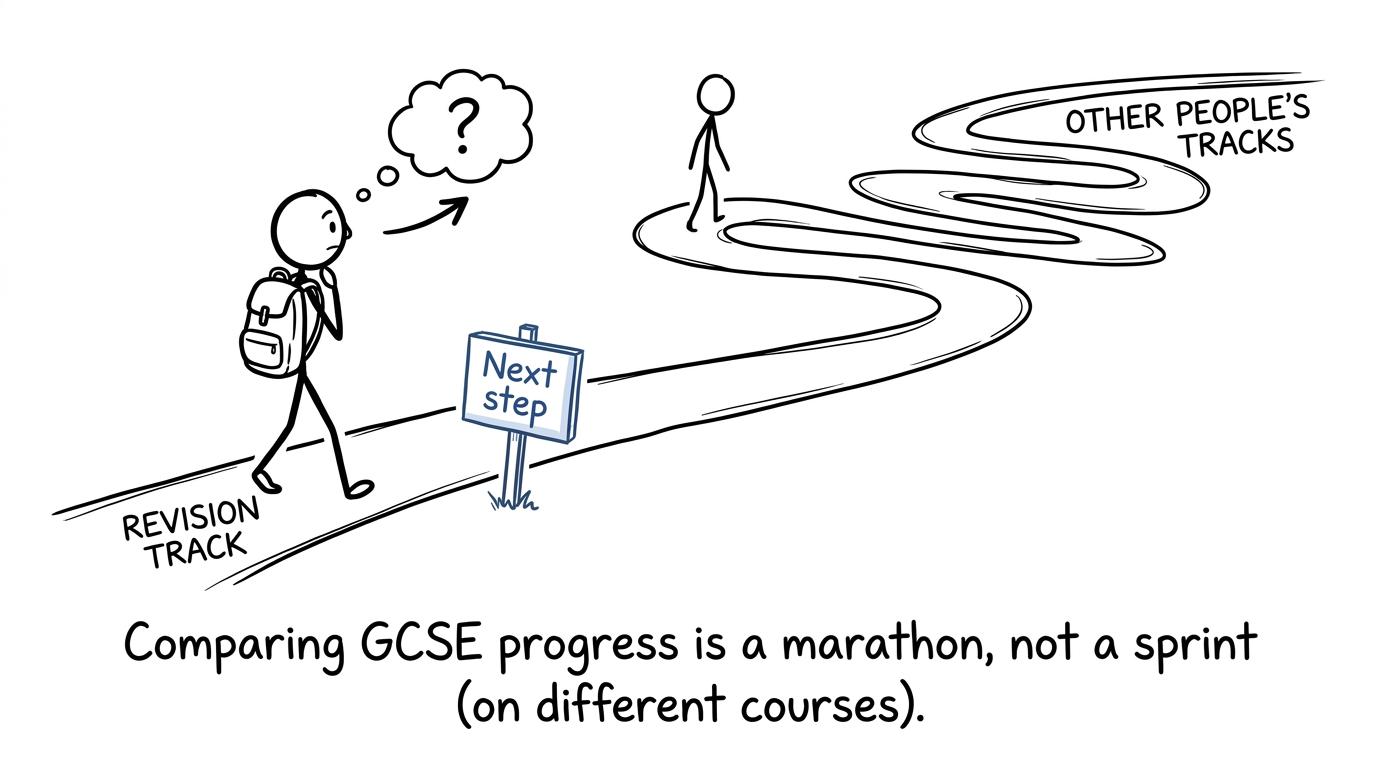 Two students unknowingly following different revision tracks
Why comparing GCSE Bengali progress with friends is misleading
A friend's visible performance is not their complete story. You may hear their fluent answer in class without seeing how often Bengali is spoken at home, how much vocabulary they already knew or which skills they find difficult in private.
The reverse is also true. A student who speaks confidently may still need to improve spelling, reading accuracy or extended writing. Another student may speak less spontaneously but perform strongly when translating or interpreting a text. The word "better" hides too much information to guide revision.
Educational research on classroom comparison is nuanced. Looking towards a stronger peer can sometimes provide motivation or a useful strategy. However, upward comparison can also produce negative feelings and weaken academic self-concept. The deciding factor is often what you do with the information. Borrowing a revision method can help; turning another student's performance into a judgement about your ability usually cannot.
GCSE Bengali is made of separate skills
For the current AQA GCSE Bengali specification, assessment covers listening, speaking, reading and writing. Each contributes 25%25\%25% of the qualification, and students take all components at the same tier. Foundation tier offers grades 111-555, while higher tier offers grades 444-999.
That structure makes broad comparison particularly unreliable. Saying "my friend is ahead in Bengali" does not identify whether the difference lies in listening comprehension, spontaneous speech, reading, translation or written accuracy.
Your school should confirm your exact specification and tier. This is important if students are discussing different qualifications, including an International GCSE, because assessment structures may not match.
Comparison often measures confidence, not competence
Classrooms make confidence highly visible. Competence is quieter.
A friend who answers quickly may simply be more comfortable speaking in front of others. A student who reports a high mock mark may have revised the tested topics recently. Neither fact proves that the same student is stronger across every assessment objective.
Even marks require context. A raw score from one paper cannot be compared fairly with a score from a different paper, tier or set of conditions. Grade boundaries also convert marks into grades after assessment; a remembered grade is not a permanent measure of ability.
The same principle applies to maths. One student might have completed several papers but barely reviewed their mistakes. Another might have completed fewer questions while carefully correcting every lost mark. The first number looks more impressive. The second routine may create more learning.
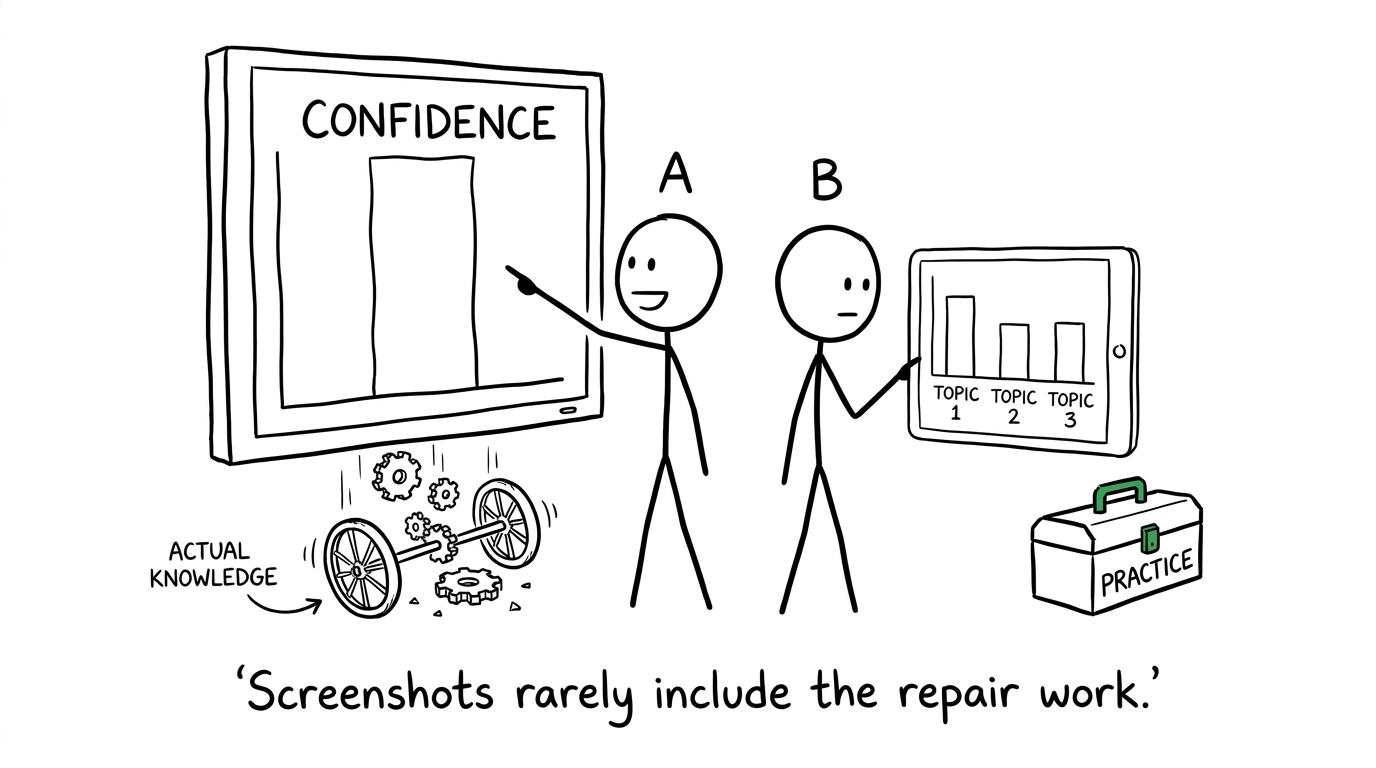 A flashy revision dashboard beside a sturdy practice toolbox
What to focus on instead of your friends
Replace social comparison with three forms of evidence: skill evidence, trend evidence and action evidence.
Track individual skills
For Bengali, keep separate notes for listening, speaking, reading and writing. Within each area, record specific issues such as vocabulary recall, understanding unfamiliar speech, pronunciation, grammatical accuracy, translation or responding to every bullet point.
For maths, divide mistakes by topic and cause. The GCSE maths revision hub lets you choose your exam board and move between revision lessons, questions and papers. You can also follow the Maths Genie scheme of learning rather than allowing a friend's latest topic to determine what you revise.
Specific evidence creates specific action. "My algebra is bad" is difficult to solve. "I lose marks when rearranging formulae involving fractions" gives you somewhere to begin.
Track trends rather than isolated marks
One disappointing result may reflect the paper, timing, nerves or a particular gap. Look across repeated attempts completed under reasonably similar conditions.
You can record accuracy as:
accuracy=marks earnedmarks available×100%.\text{accuracy}=\frac{\text{marks earned}}{\text{marks available}}\times 100\%.accuracy=marks availablemarks earned×100%.The purpose is not to calculate your worth. It is to notice whether performance is becoming more reliable.
Track other indicators too:
- How many questions can you begin without help?
- Which errors keep returning?
- Can you explain a correction without copying it?
- Are you completing tasks more accurately under time pressure?
- Can you recall the method after several days?
A personal trend is more useful than a class ranking because it shows whether your revision process is working.
Track completed actions
Outcomes fluctuate. Actions are easier to control.
A productive weekly record might include Bengali vocabulary retrieval, speaking practice, one marked writing task and listening practice. Your maths record could include a revision lesson, targeted practice questions, a mini test and a reviewed paper section.
If organising this feels difficult, use a realistic GCSE maths revision timetable. The aim is not to create the busiest-looking plan. It is to choose a routine you can repeat.
How to use friends without turning revision into a contest
Friends can still be valuable revision partners. The solution is not isolation; it is changing the purpose of the interaction.
Compare strategies, not identities
Ask questions such as:
- How do you remember unfamiliar vocabulary?
- How do you prepare for spontaneous speaking?
- How do you review mistakes after a mock?
- What helps you start a difficult maths question?
These questions collect methods. They do not ask who is naturally better.
Use collaborative retrieval
Test one another on vocabulary, ask follow-up speaking questions or discuss why a response lost marks. In maths, each person can complete the same short test independently before discussing methods. The Maths Genie Target Tests are useful for focused, manageable practice.
Keep the mark private if sharing it would become distracting. Collaboration does not require a leaderboard.
Set boundaries around grade conversations
You are allowed to say that you would rather discuss corrections than predicted grades. This is not avoidance. It is choosing information that improves the next revision session.
If comparison repeatedly causes anxiety, disrupts sleep or makes it difficult to work, speak to a teacher, parent, carer or another trusted adult. Revision should challenge you, but it should not make you feel that your value depends on outperforming a friend.
Build a personal evidence loop for Bengali and maths
A useful revision loop is simple:
- Attempt: complete a short task without immediate help.
- Check: use teacher feedback, a mark scheme or a reliable solution.
- Diagnose: name the exact reason for each lost mark.
- Repair: revisit the relevant skill and practise it.
- Retest: return later without notes.
For GCSE Bengali, the check may involve teacher feedback on pronunciation, communication, grammatical accuracy or written content. Use the assessment criteria for your specification rather than a friend's opinion.
For maths, mark schemes and video solutions help distinguish a knowledge gap from an accuracy error. If you take Edexcel, the GCSE maths past papers bring papers and official mark schemes together. The guidance on when to start GCSE past papers also explains how to move from shorter diagnostic work towards timed papers.
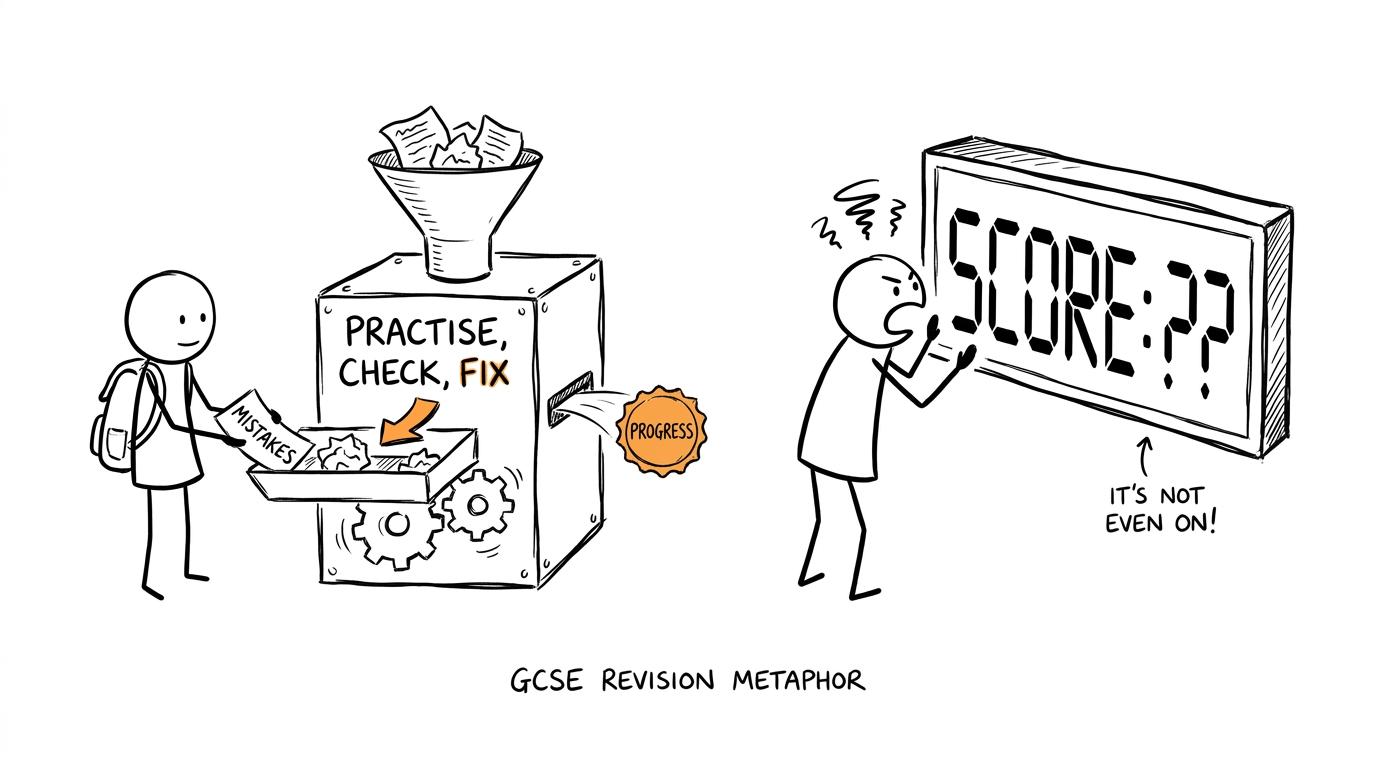 A student turns mistake notes into progress while another argues with a scoreboard
Protect maths revision from comparison spillover
The original worry may be about Bengali, but the emotional effect can spread. Feeling behind in one subject can lead to frantic revision across every subject. Students then abandon their own plan, copy somebody else's timetable and attempt work at the wrong difficulty.
Pause before changing direction. For maths, confirm your board and tier, then use actual marked work to choose topics. Edexcel, AQA, OCR and Eduqas assess common national maths content, but papers organise and present it differently. Foundation and higher tier also have different grade ranges and demands. The guide to foundation and higher GCSE maths can help you understand the distinction, although entry decisions should be discussed with your teacher.
If the exams are close, a structured one-month GCSE maths revision plan is safer than copying a friend's last-minute workload. Your plan should respond to your marks, available time and current understanding.
Common mistakes when judging your progress
Comparing different starting points
Prior knowledge, language exposure and previous teaching differ. Starting points explain why equal effort may not create equal results immediately.
Treating one mock as a final verdict
A mock is evidence from one moment. Use it to locate weaknesses, not to define the highest grade you can achieve.
Counting hours instead of learning
Revision time says little about concentration, difficulty or correction. Record completed tasks and repaired errors instead.
Copying a friend's resources without diagnosing your needs
A resource is useful only when it addresses your next gap. Begin with evidence from marked work.
Revising only comfortable skills
A student may repeatedly practise Bengali reading while avoiding speaking, or complete familiar maths topics while ignoring algebra. Balanced assessment requires deliberate attention to weaker areas.
Turning predicted papers into predictions of your grade
Predicted papers provide fresh exam-style practice; they cannot guarantee future questions or results. Use them alongside official past papers, topic practice and mark schemes.
Your progress needs a better reference point
Your friends can offer encouragement, useful methods and honest revision company. They cannot provide a fair scale for measuring your GCSE Bengali progress. Their strongest moment is not your baseline, and their reported grade is not your destination.
Compare today's evidence with your earlier evidence. Identify one skill, complete one focused task, check it properly and return to the mistake later. That process may look less dramatic than a classroom ranking, but it is how progress becomes dependable.
For maths, make MathsGenie's free GCSE revision resources your starting point. Use revision lessons to rebuild methods, practice questions and mini tests to strengthen weak topics, then past papers and predicted papers to develop exam readiness. Mark carefully, use video solutions where available and let your next action, not somebody else's progress, guide the work.










