Colour Coding Notes GCSE Engineering: Does It Help?
Colour coding notes GCSE engineering: learn when colour can support recall, when it becomes decoration, and how to combine it with effective maths practice.
A fresh pack of highlighters can make revision feel as though it is moving forward. Definitions turn blue, formulae become green and warnings glow red. Yet the uncomfortable question remains: could you use the information without looking?
The honest answer to whether colour coding notes GCSE engineering content improves recall is: sometimes, but only modestly and only when colour has a clear purpose. Colour can direct attention, separate categories and make complex notes easier to navigate. There is much stronger evidence, however, for actively retrieving knowledge, spacing your practice and answering questions with feedback.
In short, colour-coding can support effective revision. It cannot replace it.
The quick verdict
Use colour-coding if it helps you:
- distinguish formulae, units, definitions and common errors;
- see relationships between engineering and GCSE maths topics;
- locate information quickly before attempting questions;
- identify weak areas that need further practice;
- keep diagrams and annotations visually clear.
Be cautious if you are:
- highlighting most of the page;
- choosing colours for appearance rather than meaning;
- repeatedly copying notes instead of recalling them;
- spending longer organising stationery than answering questions;
- assuming familiar-looking notes mean you can apply the content.
The best test is simple: close the notes. If the colour system helps you reproduce, explain or apply the idea, it is useful. If you can only admire the page, it is decoration.
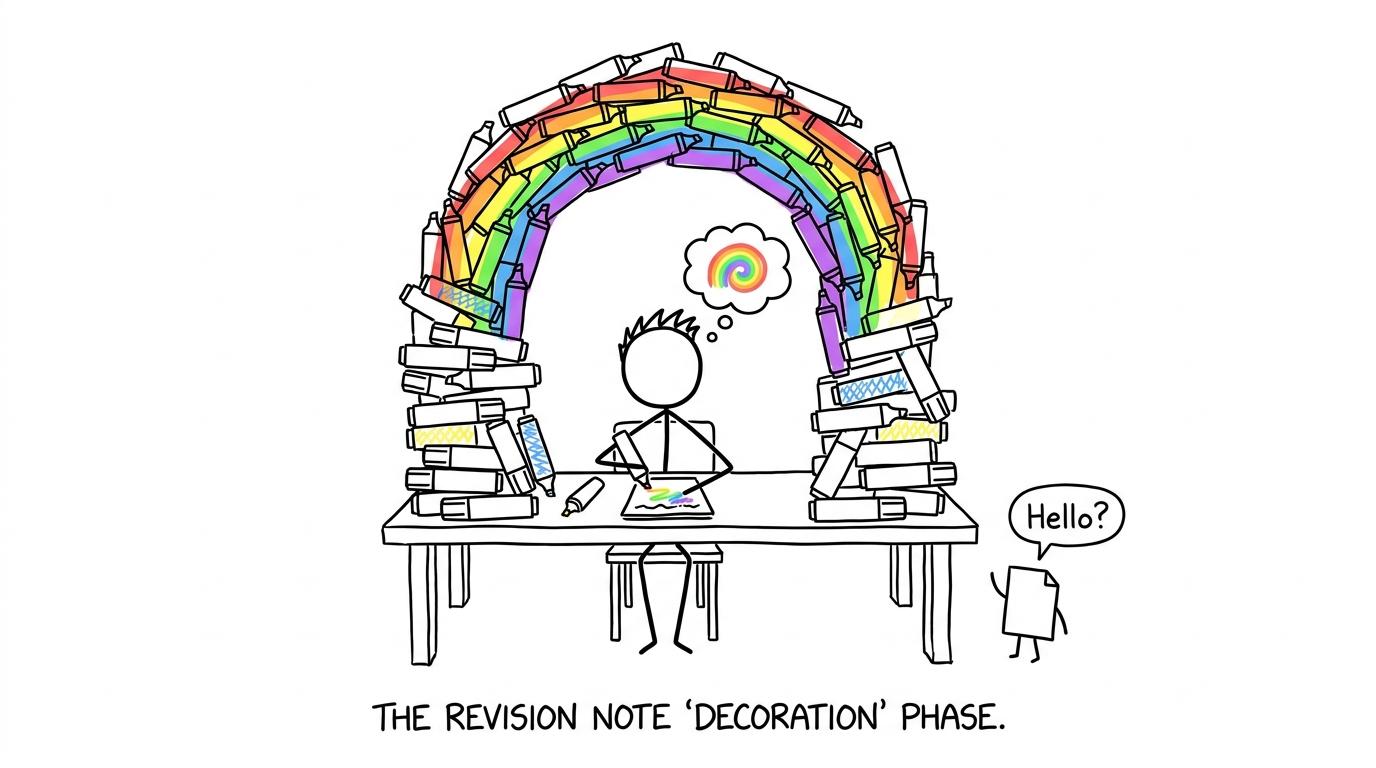 A student surrounded by highlighters while a practice paper waits for attention
What research says about colour and recall
Research into colour and learning does not support a sweeping claim that colourful notes automatically produce better exam results. The findings are more conditional.
Colour can attract attention and signal that pieces of information belong together. This is useful when the colour communicates meaning, perhaps one colour for equations and another for units. Studies of instructional materials suggest that purposeful visual signalling can sometimes support comprehension and memory.
But colour itself is not the knowledge. Recent research into coloured backgrounds found that background colour alone was not a reliable retrieval cue for learning from text. Other studies have found benefits in particular settings, especially where colour was integrated consistently into the material rather than added as decoration. These findings come from varied learners and subjects, not specifically from GCSE Engineering students, so they should not be overstated.
Retrieval practice has firmer support. Trying to recall information without seeing it, checking the result and returning to it after a delay can strengthen access to that knowledge. Evidence reviews also advise caution when transferring any cognitive-science strategy into every classroom or subject in exactly the same way. Context matters.
That leads to a balanced conclusion: use colour to organise attention, then use retrieval and questions to build recall.
Why colour-coding can feel more effective than it is
Recognition is easier than recall. When you reread a neatly highlighted formula, it feels familiar. Familiarity can be mistaken for mastery because your brain is responding to information already on the page.
An exam asks for something harder. You must decide what information matters, retrieve an appropriate method and carry it out accurately. Engineering calculations may also require units, substitutions, rearrangement and interpretation. None of that is tested while you are choosing between two shades of green.
There is also an emotional reason colour-coding is appealing: it produces an immediate, visible result. A page changes in front of you. Progress in problem-solving is less tidy. It includes wrong answers, corrections and methods that take several attempts to settle.
The satisfying activity is not necessarily the valuable one. Good revision often feels slightly effortful because it reveals what you cannot yet do.
A useful colour system for engineering maths
A small, stable system is better than a rainbow with no rules. Try no more than four functional categories:
| Colour purpose | What it could identify |
|---|---|
| Core knowledge | Definitions, principles and material properties |
| Mathematical method | Formulae, substitutions and rearrangements |
| Precision | Units, tolerances, significant figures and conversions |
| Action needed | Misconceptions, incomplete knowledge and questions to revisit |
The particular colours do not matter. Consistency does. If red means “error to fix” on Monday, it should not mean “fully understood” on Thursday.
Engineering specifications can involve arithmetic, ratio, percentages, standard form, area, volume, trigonometry, Pythagoras, algebra and graphs. They can also require equations such as density,
ρ=mV,\rho=\frac{m}{V},ρ=Vm,or pressure,
P=FA.P=\frac{F}{A}.P=AF.Colour may help separate the quantity, equation and unit, but you must still know how to select and manipulate the relationship. The exact content you need depends on your qualification and specification, so use the documents and guidance supplied by your school or exam board.
For the underlying skills, begin with the free GCSE Maths revision hub. MathsGenie organises lessons, videos, questions and papers by exam board, including Edexcel, AQA, OCR and Eduqas.
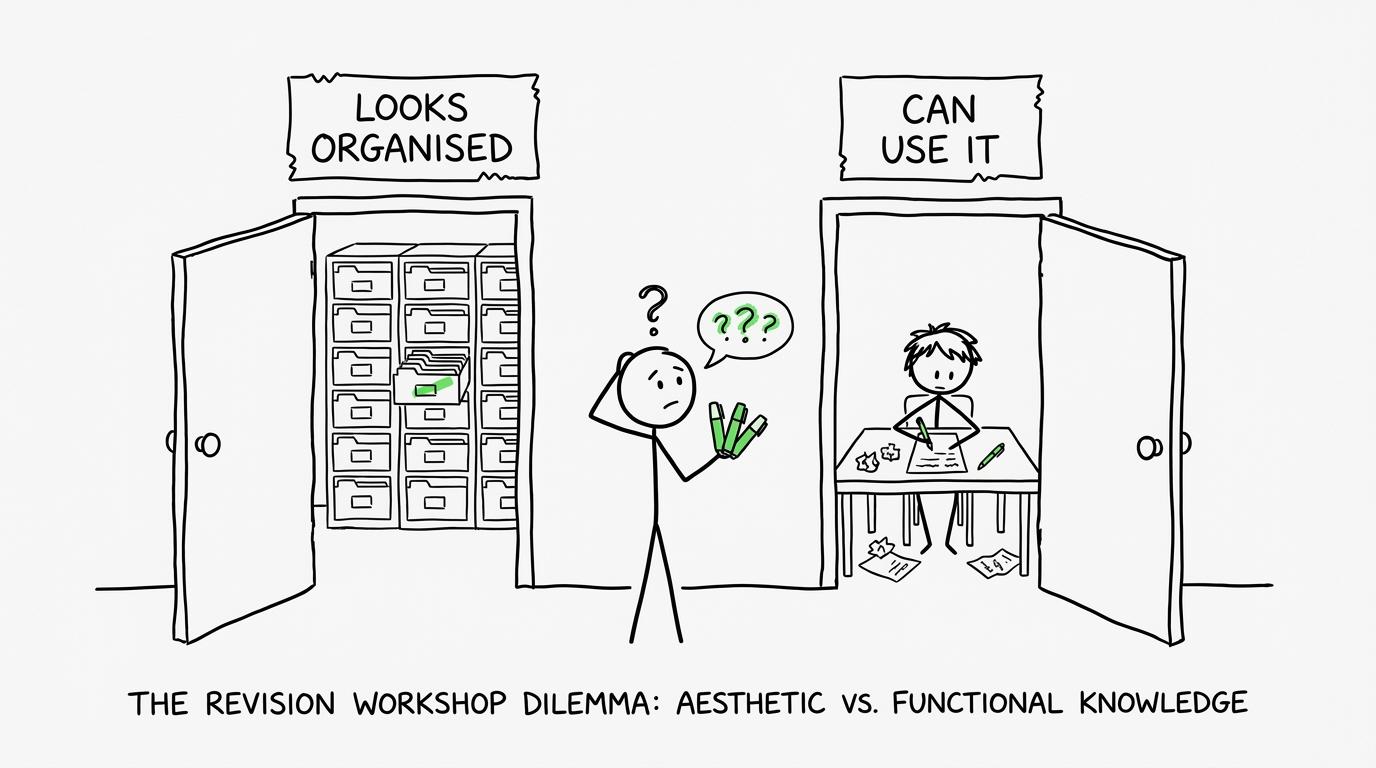 A student choosing between notes that look organised and knowledge they can use
Turn coloured notes into active revision
Colour becomes useful when it starts a revision cycle rather than ending one.
Build a compact reference page
Reduce one topic to its essential definitions, equations, units and warning signs. Use your colour key sparingly. Deciding what deserves emphasis requires more thought than colouring every sentence.
For engineering-related measures, you might group areas, volumes and scale relationships. The similar shapes area and volume guide is useful when your course involves models, dimensions or scale factors.
Hide the page and retrieve it
Cover each section and write what you remember. You could reconstruct a formula, define a term, name the required unit or explain when a relationship applies. Do this before looking back.
Then check carefully. Add missed information in your “action needed” colour, but do not immediately recopy the whole page. The correction should direct your next attempt.
Apply the knowledge to questions
A formula recalled in isolation is not yet an exam skill. Practise selecting it from the wording of a question and using it accurately. MathsGenie provides topic-based material across foundation and higher tier; for instance, the OCR GCSE Maths worksheets include units, scale drawings, ratio, equations, graphs, area and volume.
Choose resources matching your own maths exam board. Your engineering qualification and GCSE Maths qualification may not use the same board.
Mark, classify and revisit
Use solutions or a mark scheme and label each error by cause:
- knowledge: you could not recall the fact or formula;
- selection: you chose the wrong method;
- process: your algebra or arithmetic broke down;
- communication: units, working or rounding were unclear.
This is a better use of colour: it exposes patterns in lost marks. After repairing a weakness, return to it on another day. MathsGenie’s guide to using GCSE past papers properly explains the paper, mark, fix and retest cycle.
Match the method to the kind of knowledge
Different material needs different revision.
Definitions and short facts suit flashcards or quick written recall. Formulae should be recalled and then used. Diagrams can be labelled from memory. Multi-stage calculations need exam-style practice. Graph interpretation needs actual graphs rather than a paragraph describing them.
This matters because an attractive page can flatten every topic into the same activity. Engineering is not one kind of knowledge. It combines terminology, design decisions, practical understanding and mathematical application.
If your GCSE Maths foundations are uneven, follow a deliberate sequence rather than colour-coding topics at random. The best order for learning GCSE maths topics moves from number and ratio through algebra, graphs and measures before mixed exam practice.
A realistic weekly routine
A useful routine could include:
- one short session condensing or updating notes;
- two sessions of closed-book recall;
- two sessions of topic questions with immediate marking;
- one mixed mini test or timed paper section;
- a later return to the mistakes recorded earlier.
Your notes should occupy a small part of this plan. Most time should be spent recalling, applying, checking and correcting.
Use the MathsGenie revision planner to place weaker skills across several days. As exams approach, move towards mixed questions and timed papers. The article on GCSE maths topics that appear regularly gives a helpful overview of core number, algebra, geometry, statistics and probability areas, without pretending that any topic is guaranteed.
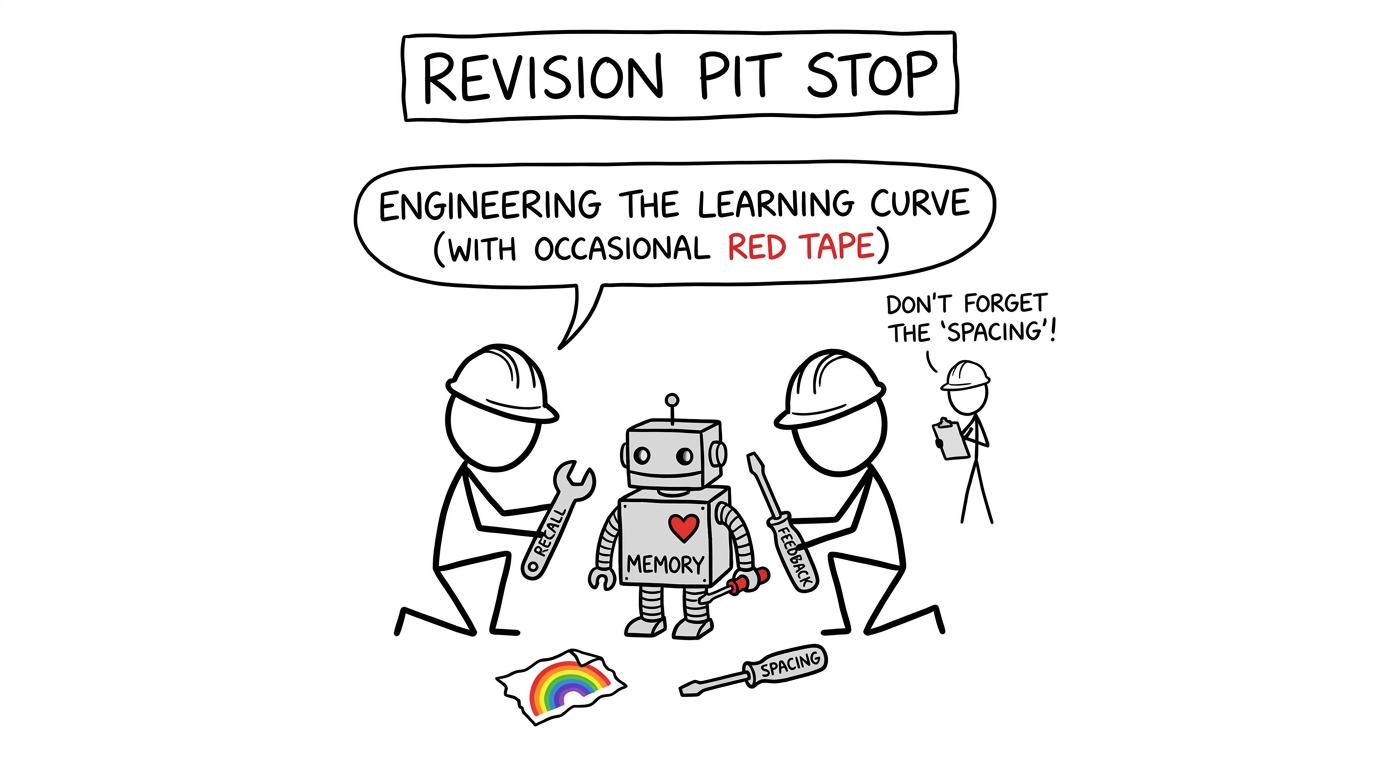 A memory robot repaired using recall, feedback and spacing while a rainbow sticker waits nearby
Common mistakes with colour-coded engineering notes
Highlighting too much
If nearly everything is coloured, nothing has priority. Highlight only after reading a section and deciding what role the information plays.
Creating an overcomplicated key
A system with many shades is difficult to apply consistently. Use a few categories that answer practical questions such as “Is this a formula?” or “Must I revisit this?”
Copying without retrieval
Rewriting can clarify disorganised material, but repeated copying quickly becomes passive. Follow every note-making session with a closed-book check.
Ignoring units and conditions
Remembering a formula without its quantities, units or appropriate context creates fragile knowledge. Engineering calculations demand precision, so give units a clear place in your system.
Treating notes as proof of readiness
Readiness is demonstrated by answering unfamiliar questions accurately. Use Edexcel GCSE Maths predicted papers if that is your board, alongside official past-paper practice. Predicted papers are useful rehearsals, not guarantees of what will appear.
The conclusion: keep the colour, change the purpose
Colour-coding GCSE Engineering notes is not pointless. It can make structure visible, focus attention and help you navigate demanding material. It is mostly satisfying, however, when the colours have no stable meaning and are never followed by recall or application.
Keep the highlighters if they help. Just make each colour earn its place.
Then close the notebook and test what remains. Use MathsGenie’s free GCSE Maths resources to rebuild weak methods with revision lessons and video solutions, practise with topic questions and mini tests, and measure progress using past papers, mark schemes and predicted papers. The page does not need to look perfect. Your next answer needs to be stronger.