

Choosing University After A-Level Results
Choosing university after A-level results? Use a calm framework to compare offers, Clearing courses, costs and next steps before giving up a confirmed place.

Results day can make several years of work feel compressed into one screen. You see your grades, open your UCAS application and suddenly face decisions that once seemed safely in the future.
The key to choosing university after A-level results is not to chase the most impressive course available or react to one disappointing grade. First confirm your application status. Then compare every realistic option using course fit, entry requirements, cost, location and long-term flexibility. Keep any confirmed place until you have properly investigated the alternatives.
For students currently preparing for GCSEs, this process may feel distant. Yet GCSE grades can affect sixth-form subjects and some university entry requirements, so the habits you build now still matter.
Your results-day checklist
Before making a university choice around A-level grades:
- collect your full results and check your UCAS application;
- distinguish your grades from your actual offer status;
- write down what you still want from a course;
- investigate your firm, insurance and Clearing options;
- compare course content, costs, location and support;
- speak to your school, college or university before giving up a place;
- record names, telephone numbers and offer details;
- make one informed decision rather than several hurried ones.
In England, Wales and Northern Ireland, A-level results day in 2026 is Thursday 13 August. UCAS states that Clearing for 2026 runs from 2 July to 19 October, although individual vacancies can disappear much sooner.
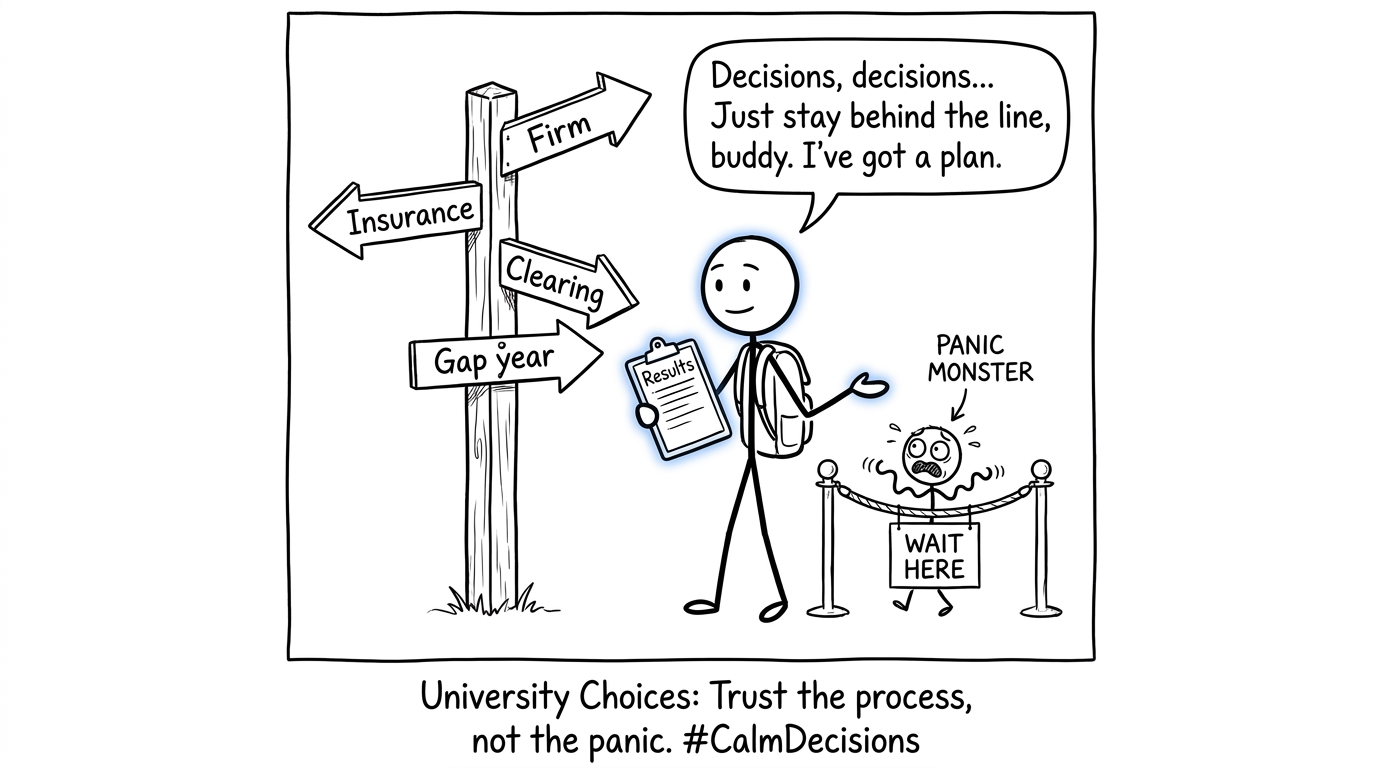 A student calmly choosing between firm, insurance, Clearing and a gap year while panic waits behind a barrier
Start with your UCAS status, not your first emotion
Grades and decisions are related, but they are not identical. A university may still accept you after a narrow miss, offer an alternative course or leave your application pending while it checks information.
Your next step depends on what UCAS shows.
Your firm place is confirmed
Check the exact course title, campus, start date and any message from the university. If you still want the place, you normally do not need to search elsewhere merely because your grades were higher or lower than expected.
Better grades create an option, not an obligation to move. A course you chose carefully yesterday does not become unsuitable because another institution is now possible.
Your insurance place is confirmed
Treat it as a genuine university choice, not a consolation prize. Revisit the modules, accommodation, travel, student support and graduate opportunities. You selected an insurance course because it could work under different results, and that reasoning may still be sound.
Your application is still pending
Do not assume silence means rejection. Check whether the university needs evidence of a qualification, then contact admissions if the position remains unclear. If you met the offer conditions, confirmation may simply be taking time. If you missed them, the university could still be considering you.
You have no confirmed place
This is when Clearing becomes useful. UCAS lists official vacancies, but you should contact the university before adding a Clearing choice. You can add only one Clearing choice at a time, and you should do so only after the provider gives you permission.
A framework for reassessing university choices
A university choice based only on grades is fragile. Grades determine which doors may be open; they do not tell you which room you will enjoy living in.
Use the following framework for every option, including your existing place.
Course before university name
Compare compulsory modules, optional modules, assessment methods, placement opportunities and professional accreditation where relevant. Two courses with the same title can contain substantially different material.
A hypothetical student reconsidering mathematics might prefer one course with more statistics and computing over another focused heavily on pure mathematics. The useful question is not, “Which university sounds better?” It is, “Which course would I rather attend on an ordinary Tuesday in November?”
If mathematics remains part of your plans, the free A Level Maths revision hub provides resources across AQA, Edexcel, OCR, OCR (MEI), WJEC and CCEA.
Entry requirements and offer details
Check the full conditions rather than the headline grades. A course may require a particular result in mathematics, another named subject or an existing GCSE qualification.
Ask admissions whether your achieved grades meet the current Clearing requirements. Do not rely on an old prospectus page or assume that being close guarantees acceptance.
Cost and practical reality
Compare accommodation, travel, course materials and the cost of returning home. Also investigate bursaries, scholarships and accommodation availability directly with the provider.
The best academic option on paper may become difficult if the practical arrangement is unsustainable. That is not pessimism. It is planning.
Location, support and belonging
Consider whether you want a campus or city university, how far you are comfortable living from home and what academic, disability, wellbeing or careers support is available.
If possible, attend a Clearing open day or virtual event. Ask who teaches first-year modules, how tutorials work and where students usually live when university accommodation is limited.
Long-term flexibility
Look beyond the first year. Can you choose a placement year, study abroad, transfer between related courses or specialise later? Flexibility matters when your interests develop.
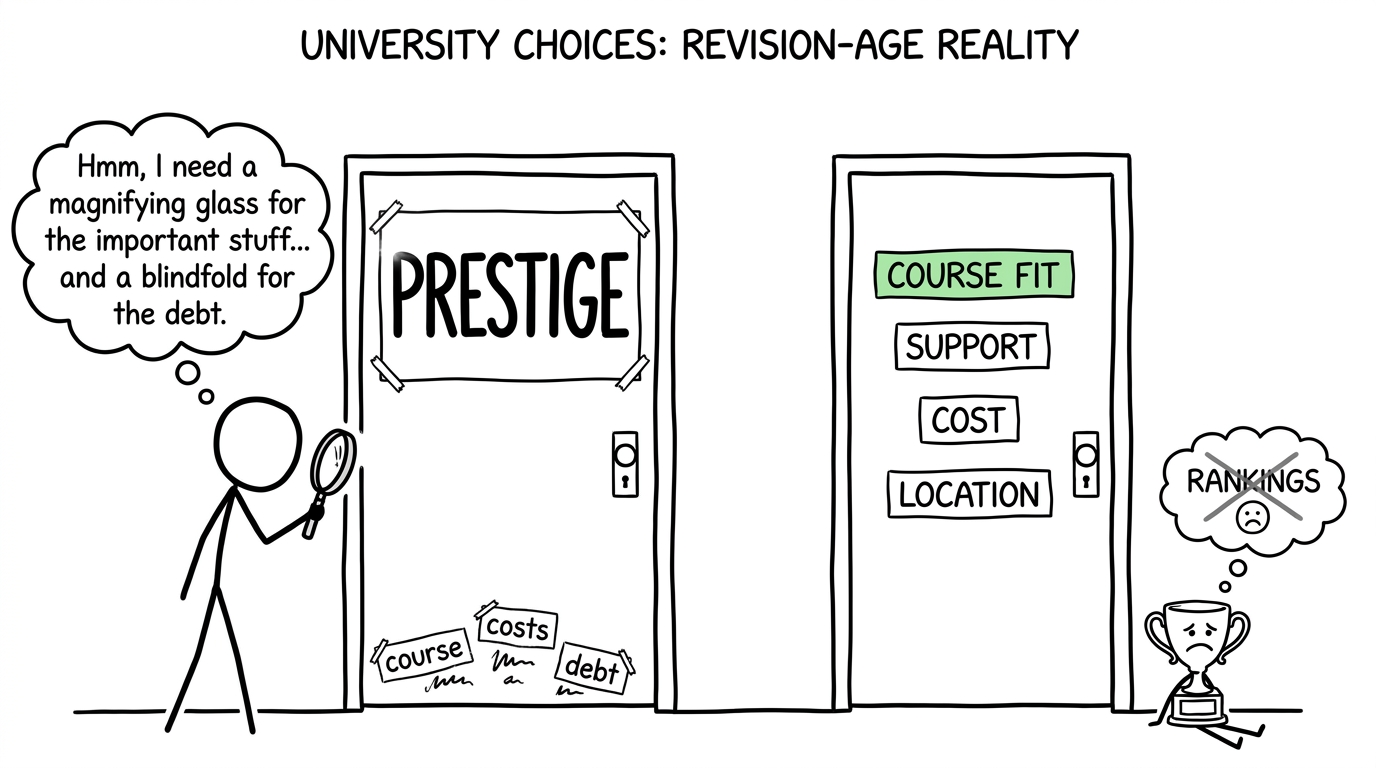 A student examines course fit, support, cost and location while a university rankings trophy sulks nearby
What if your grades are higher than expected?
Strong results do not automatically mean you should abandon your firm choice. The former UCAS Adjustment service no longer operates; students wishing to move generally need to decline their confirmed place and use Clearing.
That is a serious step. UCAS warns that declining a place cancels it and may also affect accommodation or scholarship arrangements. Before pressing the button:
- find a suitable vacancy;
- speak directly to the new university;
- understand whether its offer is formal or provisional;
- check accommodation and funding;
- discuss the decision with an adviser;
- be certain you are prepared to lose your existing place.
If you want a different course at the same university, contact that university first. It may be able to discuss an internal change without you immediately releasing your place.
What if your grades are lower than expected?
First check UCAS. Missing an offer condition does not tell you, by itself, whether the university has rejected you.
If you are unsuccessful, search for courses that fit your achieved grades and priorities. Ask Clearing admissions teams about course content, entry requirements, accommodation and the deadline for accepting any offer. Keep clear notes because several telephone conversations can quickly blur together.
You can also discuss a review of marking with your school or college if there is a specific reason to question a result. Review deadlines and university policies vary, so ask what could happen to your place while the review is processed. A review can leave a mark unchanged, raise it or lower it.
A gap year and a fresh application may also be sensible if the available courses do not meet your needs. “Available today” and “right for me” are different standards.
Common mistakes when making a university choice
Declining a confirmed place too early
Research alternatives before releasing yourself into Clearing. A conversation with another university is not always a guaranteed place.
Choosing by reputation alone
Rankings cannot tell you whether you will enjoy the modules, assessment style, location or teaching environment. Compare the details that shape weekly life.
Ignoring total costs
Affordable tuition arrangements do not make accommodation and travel irrelevant. Investigate the complete practical picture.
Assuming a missed grade settles everything
Your UCAS status is the decisive information. Universities may still be considering applicants who narrowly missed an offer.
Letting urgency erase judgement
Clearing rewards preparation, but speed without checking creates avoidable mistakes. Use a shortlist and consistent questions rather than accepting the first available course.
Build options before results day arrives
GCSE students can reduce future uncertainty by keeping more academic doors open now. Begin with the GCSE Maths revision hub, choose your exam board and confirm whether you are taking foundation or higher tier.
Use GCSE past papers to diagnose gaps, then repair them with targeted lessons and practice questions. Nearer the exams, GCSE predicted papers and MathsGenie revision resources can add timed practice.
Students already taking A-level mathematics can combine topic revision with board-specific material, including Edexcel A Level Maths past papers and OCR A Level Maths revision. Mark schemes and video solutions turn each paper into feedback rather than a verdict.
Make the next decision calmly
Choosing a university after results is not about finding a perfect institution in one morning. It is about protecting the good option you already have, investigating alternatives and deciding with better information.
Keep your confirmed place while you compare. Put the course before the logo. Check costs, support and flexibility. Then choose the option you would still respect after the noise of results day has faded.
For more support, visit the MathsGenie revision blog for Clearing and results-day guidance. Then use MathsGenie's free revision lessons, practice questions, past papers, predicted papers, mini tests, mark schemes, video solutions and revision planner to build the grades that give you more choices in the first place.











