

Can You Change Results If You Miss Results Day?
Can you change your results if you aren’t there on results day? Yes. IB students can act remotely through their coordinator. Learn the next steps quickly.

The strange thing about results day is how much power we give to a single moment. One login, one screen and a few numbers can appear to settle years of work. Being away makes that moment feel even less controllable.
So, can you change your results if you aren’t there on results day? Yes: being absent does not remove your right to query an IB result, request an Enquiry Upon Results or arrange a retake. You can access your results online, and the formal processes are handled through your school’s IB Diploma Programme or Career-related Programme coordinator.
You cannot personally edit a result, and simply missing results day will not cause a grade to change. But you can take action from elsewhere. The important things are having your candidate login details, knowing how to contact your coordinator and responding before your school’s deadlines.
The short results-day checklist
If you expect to be away, prepare these details before leaving:
- Check that you have your IB personal code and individual PIN.
- Confirm the exact time at which your online results become available.
- Save the contact details for your IB coordinator and university adviser.
- Ask who will cover enquiries if your usual coordinator is unavailable.
- Make sure the IB has permission to send your transcript to the correct university, where required.
- Read your university offer carefully, including every subject-level condition.
- Agree how your school will handle an Enquiry Upon Results while you are away.
- Keep access to your email, UCAS Hub and the IB candidate website.
This is mostly administration. That sounds dull, but administration is often what protects your options when emotions are running high.
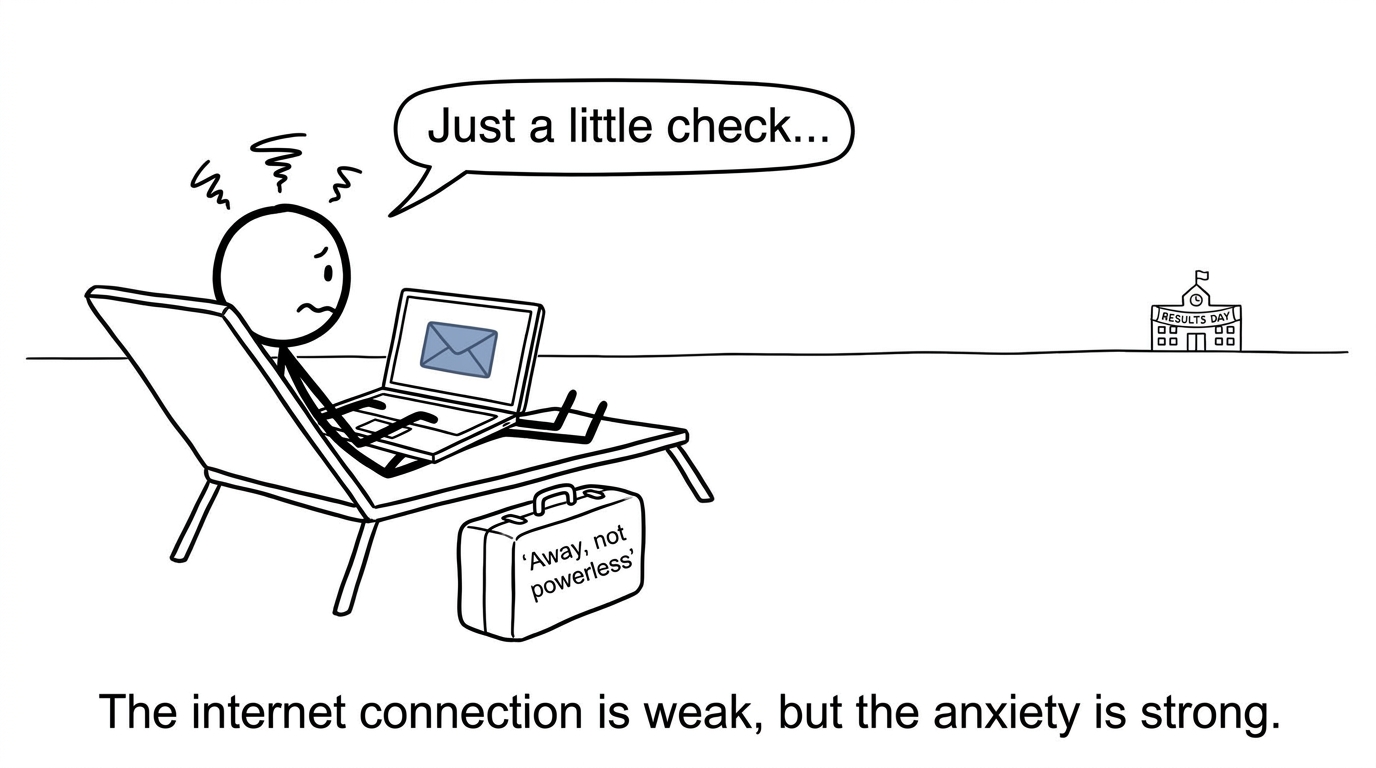 A student accessing results remotely while away from school
You do not have to attend school to receive IB results
IB Diploma Programme and Career-related Programme candidates can view their results through the official candidate website. Your coordinator supplies the personal code and PIN needed to log in.
According to the IB’s current published guidance, results for the May examination session are released to candidates from midday GMT on 6 July. November-session results are released in staggered time slots from 13:00 in the school’s local time zone on 17 December. Your individual PIN report or coordinator should confirm your precise release time.
The IB currently states that there is no deadline for accessing eligible results through the candidate website. That means being on a flight, at work or away from home does not make the result disappear. Nevertheless, you should still check promptly because enquiries, university decisions and school procedures have deadlines of their own.
If your login details are missing, contact your coordinator. The IB does not provide personal codes or PINs directly to candidates for data-protection reasons. Do not send your login credentials to a university or ask somebody else to log in as you.
What “changing your results” can actually mean
The phrase can describe several different actions. Identifying the right one prevents a rushed decision.
Correcting access or administrative problems
Sometimes the concern is not the grade itself. You may be unable to log in, your university may not have received a transcript, or UCAS Hub may not yet show a decision.
These problems do not necessarily mean your result is wrong. Contact your coordinator first and check whether the transcript was authorised for release to the relevant institution. If a university cannot locate it, contact its admissions office and keep your coordinator informed.
Requesting an Enquiry Upon Results
If you believe an IB grade does not fairly reflect your externally assessed work, your school can submit an Enquiry Upon Results, usually abbreviated to EUR. Candidates and parents cannot send this request directly to the IB.
A Category 1 EUR is a re-mark of all externally assessed components for one subject. The subject grade can rise, remain unchanged or fall. Because a lower result is possible, the school must obtain written consent from the candidate or, where appropriate, a legal guardian.
A Category 2 request provides copies of externally assessed material. This can help the school examine how your work was marked before deciding what to do next. Category 3 concerns re-moderation of internally assessed work and is a school-level request rather than something an individual candidate can demand for their work alone.
Fees and internal arrangements vary, so ask your coordinator for the current cost and deadline. Your school may set an earlier cut-off than the final IB deadline. Being abroad does not extend either deadline.
Retaking an IB subject
A retake is different from a re-mark. The IB currently permits candidates to retake a subject in a future examination session, subject to its rules and to finding an IB World School willing to register them. A school is not obliged to accept retake candidates.
If a subject is retaken to improve an existing result, the highest grade for that subject or core requirement normally contributes towards the Diploma. A curriculum change may mean preparing for a newer syllabus, so confirm the specification with the registering coordinator before beginning revision.
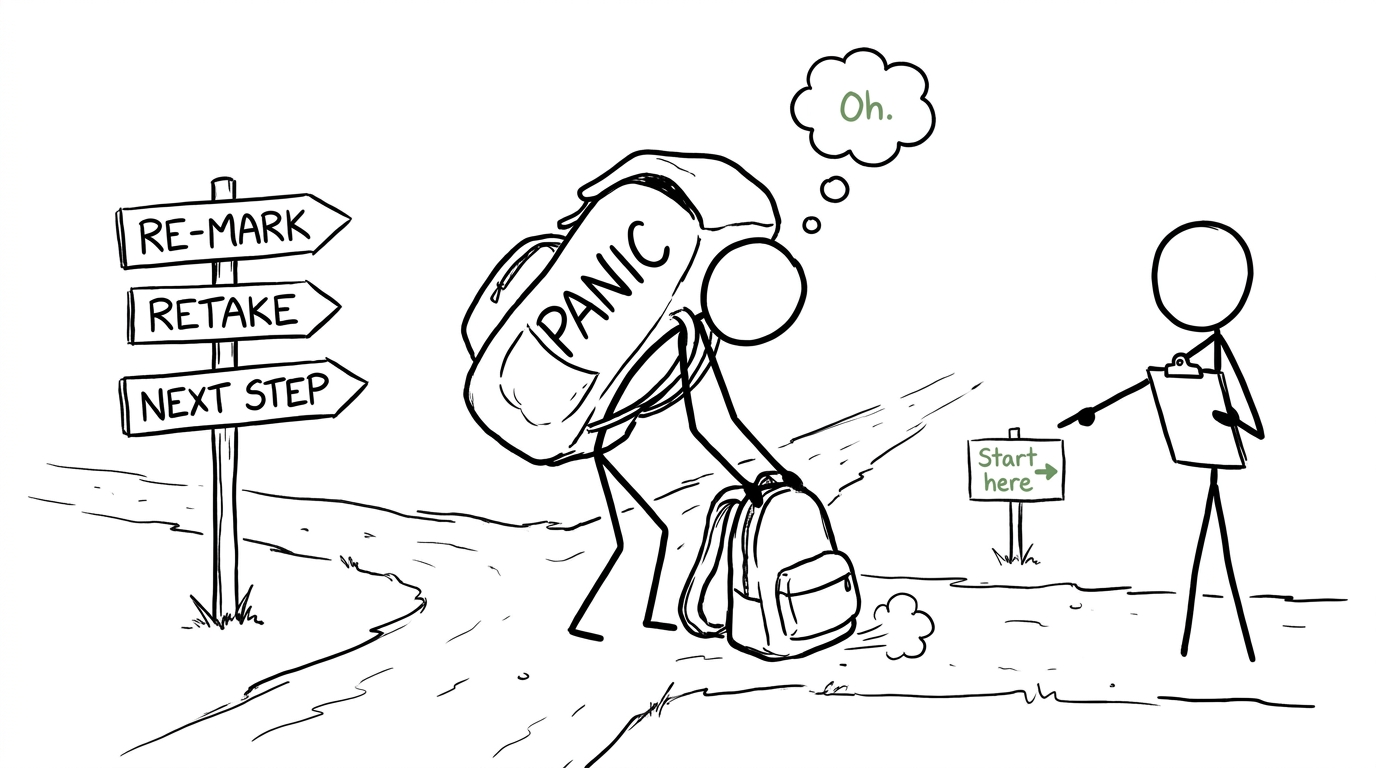 A calm coordinator helping a student choose between a re-mark and retake
How to request an IB re-mark while you are away
You do not need to stand in the school office. You do need a clear line of communication.
Contact your coordinator promptly
Send a concise message containing:
- your full name and candidate details;
- the subject and level concerned;
- the awarded grade;
- how close the result is to the next grade boundary, if shown;
- whether the result affects a university offer;
- a reliable telephone number and email address.
Ask what evidence the school recommends reviewing and what written consent or payment it requires. The IB’s rules require schools to ensure that an appropriate contact is available after results are issued to deal with EUR requests and possible registration for another session.
Consider the risk rather than only the upside
A near-boundary result can make a re-mark worth discussing, particularly in a subject involving extended written judgement. But proximity to a boundary does not guarantee movement, and an EUR is not a request for a sympathetic extra mark. The work is judged again against the assessment criteria.
Your decision should consider both boundaries. Ask how far the mark is from the grade above and from the grade below. Then consider the consequence of each possible outcome.
Keep universities informed
If the grade affects a conditional UK university offer, contact the admissions team quickly and explain that your school is considering or submitting an official EUR. Ask whether the university can keep the application under review and what evidence it needs.
UCAS advises applicants to speak to their school and university as soon as possible. A university may agree to wait, but it is not automatically required to hold a place indefinitely. Continue checking UCAS Hub and consider alternative options at the same time rather than assuming a re-mark will succeed.
If the result changes, the revised grade should appear on the IB candidate website after the EUR is completed. Your coordinator receives the formal outcome and should tell you when it is available.
Make arrangements before results day
The most useful results-day decision is often made several weeks earlier.
Ask your coordinator three questions: who should you contact, how quickly should you respond, and what documents will be required? Save the answers somewhere available offline. If your internet access may be unreliable, agree whether a parent or guardian can communicate with the school without accessing your private candidate account.
Check your contact details with every university too. The IB can provide official transcripts directly to universities when the correct request has been made. For UK applications, failure to authorise the relevant results service can delay the information reaching UCAS or an institution.
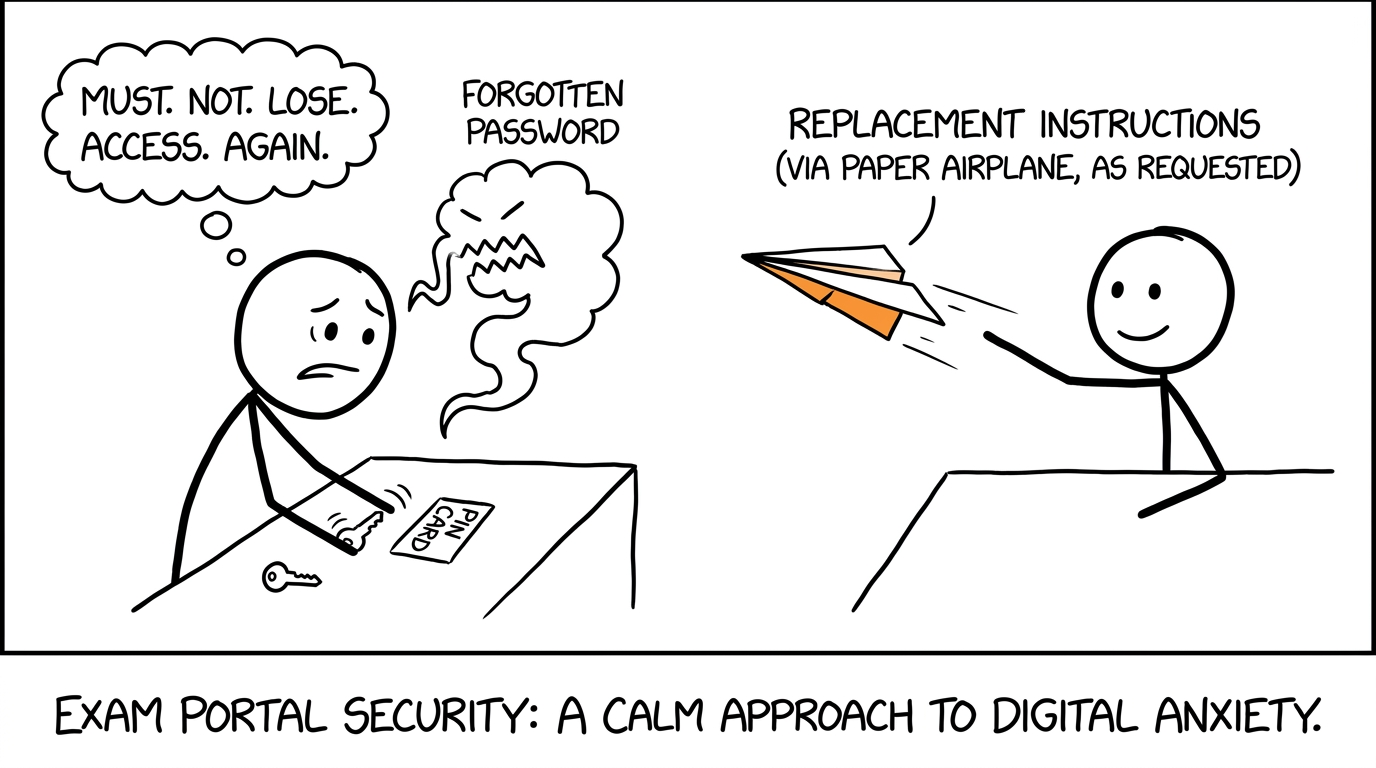 A student protecting their results login from the forgotten-password cloud
If you are also waiting for GCSE or A Level results
The broad principle is similar for Edexcel, AQA, OCR and Eduqas qualifications: physical attendance is not normally required to ask about a result, but the request must go through your school or examination centre. The terminology and deadlines differ from the IB process, so do not assume that an IB EUR and a UK awarding-body review of marking are interchangeable.
If you are planning a UK maths resit, begin by checking the appropriate GCSE Maths revision resources or Edexcel A Level Maths revision hub. MathsGenie brings lessons, exam-style practice questions, mark schemes and papers together, making it easier to turn a disappointing result into a specific revision plan.
Previous GCSE grade boundaries can provide context, but boundaries vary between examination series. They should not be treated as predictions for a future Edexcel, AQA, OCR or Eduqas paper.
Common mistakes when dealing with results remotely
Waiting until you return home
Your online access may remain available, but the deadline for a formal request will not wait for your journey. Contact the coordinator while you are away.
Assuming the school will request a re-mark automatically
A disappointing grade does not trigger an EUR. The school needs your instructions and, because the grade can fall, your written consent.
Treating every missing university update as a failed offer
A delayed UCAS decision may mean that results or transcripts are still being processed. Check UCAS Hub, then contact the university and your coordinator before drawing conclusions.
Sharing candidate login details
Your personal code and PIN are private. Universities receive official results through transcript services, not by entering your candidate account.
Revising before diagnosing the problem
If a retake becomes the best option, do not immediately repeat every topic. Use GCSE past papers or the relevant A Level papers to identify where marks are being lost. Review each paper with its mark scheme, then return to focused lessons and questions.
A strong sequence is topic revision, timed practice, error analysis and retesting. MathsGenie’s A Level predicted papers can provide additional exam-style practice later, but they should support rather than replace genuine past papers.
Your next step matters more than your location
Not being there on results day does not surrender your options. You can see your IB result online, ask your coordinator to investigate it, authorise an Enquiry Upon Results, communicate with universities and discuss a future retake from wherever you are.
The calmer approach is to prepare before the result arrives. Secure your login, save the right contact details and understand that a re-mark can move a grade in either direction. Then act promptly using verified information rather than guesses.
If your next step involves rebuilding your maths result, start at MathsGenie’s free revision homepage. Use revision lessons to repair gaps, practice questions and mini tests to check understanding, and past papers with mark schemes and video solutions to develop exam technique. Finish with predicted papers when the examination approaches. One result may close a chapter, but careful revision gives you control over what you write next.











