

Calling Universities in Clearing: Script and Tips
Calling universities Clearing script, preparation checklist and phone etiquette to help you speak clearly, compare offers and handle Results Day calmly.
The hardest part of a Clearing call is often the moment before it begins. You have your results, a course page open and a telephone that suddenly feels unusually heavy. A calling universities Clearing script removes some of that uncertainty: introduce yourself, name the course, give your results accurately and explain briefly why you want to study there.
You do not need a polished speech. You need the right information, a few thoughtful questions and space to record the answer. In England, A Level results day is Thursday 13 August 2026, so preparing before that morning can make each conversation calmer and more useful.
Your Clearing phone call checklist
Have these items beside you before calling:
- your UCAS Personal ID and Clearing number, if you have one
- your A Level, AS Level, GCSE and other relevant results
- the exact course title and course code
- your personal statement for reference
- two or three reasons the course interests you
- questions about modules, accommodation and next steps
- a charged phone, reliable signal, laptop, paper and working pens
- a table for recording names, offers and deadlines
Check the university's own website for its current Clearing number, vacancies and hotline hours. Course availability can change quickly, so prepare several realistic options rather than depending on one call.
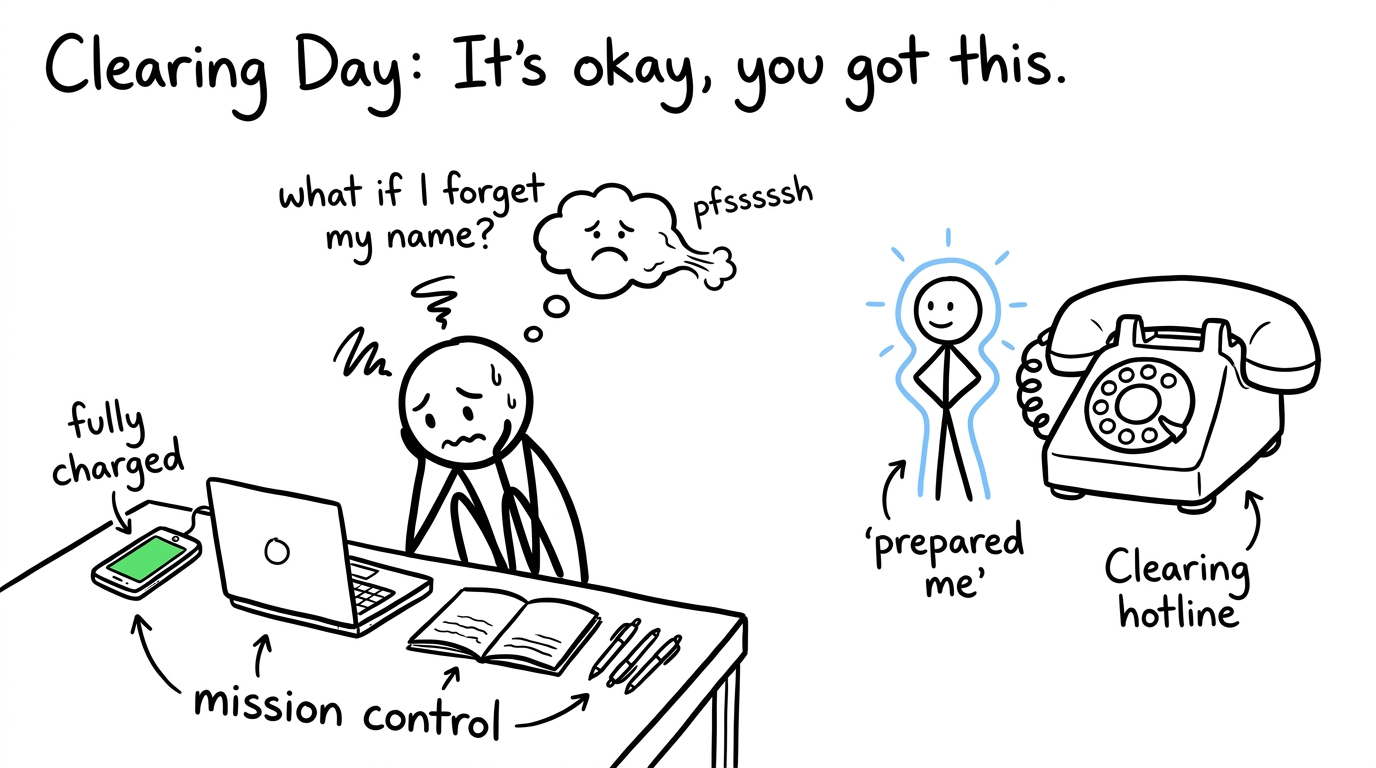 A prepared student faces the Clearing hotline with a mission-control desk
A practical calling universities Clearing script
Treat this as a framework, not something to read without pausing. Admissions staff may guide the conversation and ask for your details first.
Opening the call
Hello, my name is [full name]. I am calling about Clearing for [course title and code]. I have my UCAS Personal ID, Clearing number and results ready. Is the course still accepting applications?
If it is, provide each detail slowly and accurately. Give qualification titles as well as grades. The university may ask about GCSE English and maths, even when you are applying with A Levels or another Level 3 qualification.
Explaining your interest
I am interested in this course because [specific reason]. I was particularly drawn to [module, placement, facilities or course feature], and my experience of [relevant subject, project or activity] has made me keen to develop further in this area.
Specificity matters more than dramatic language. Research the actual course and choose an honest reason. Avoid saying that you are calling only because another university rejected you.
Asking for the decision and next steps
Based on my results, would you be able to consider me for a place? If so, could you explain what happens next and whether there is a deadline for responding?
If you receive an informal offer, ask for written confirmation and record any expiry time. Repeat the course title, campus and year of entry to make sure you have understood correctly.
Thank you. May I confirm the course, the deadline and the name or reference for this conversation? Will you send the next steps by email?
An informal offer does not become your confirmed UCAS place merely because it was discussed on the telephone. UCAS advises applicants to add a Clearing choice only after the university has given permission. You can discuss possibilities with several universities, but you can add only one Clearing choice at a time in your application.
Clearing phone call tips that make a difference
Make the call yourself
Universities normally need to speak to the applicant. A parent, teacher or trusted adult can sit nearby, help organise notes and provide encouragement. If someone must speak for you, you will generally need to be present and give permission before the university can discuss your application.
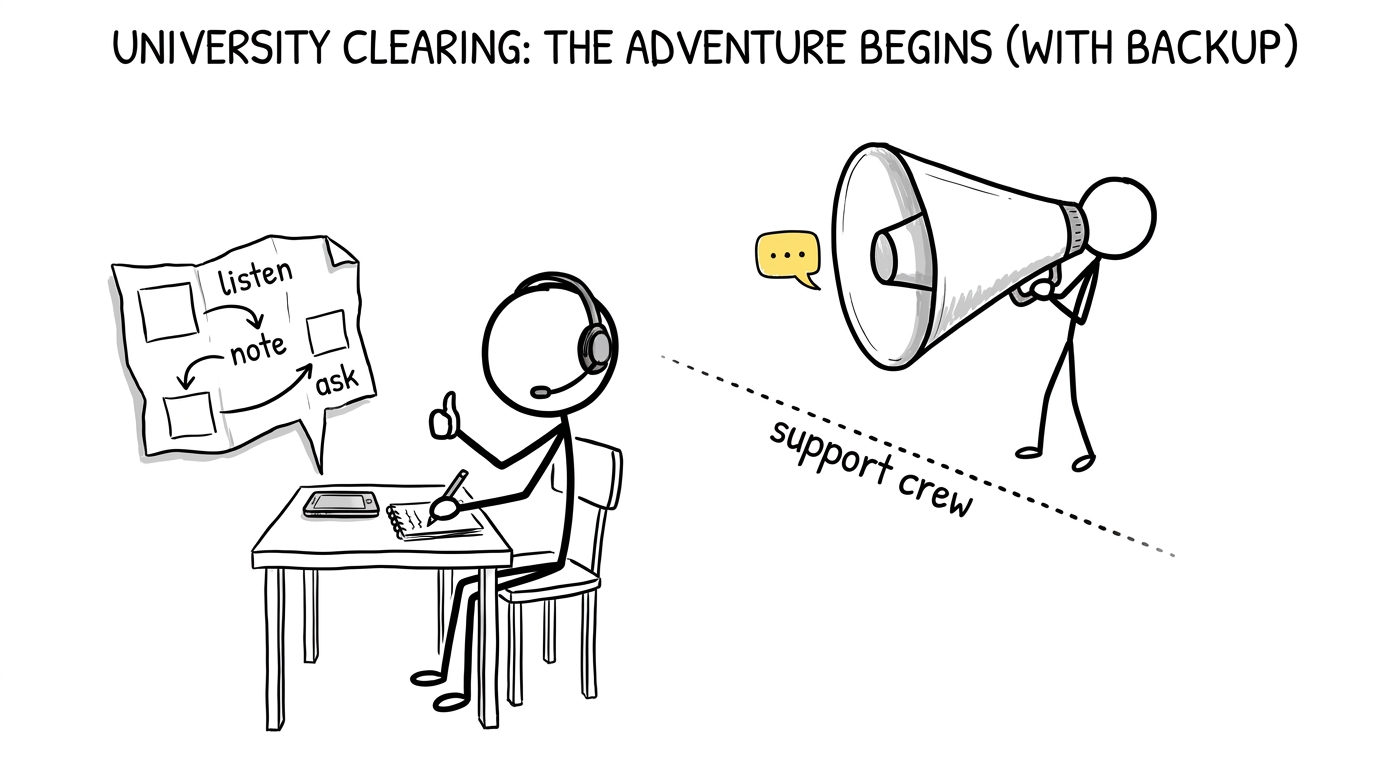 A student makes the Clearing call while the support crew waits behind the boundary
Speak slowly enough to be accurate
Confidence does not mean speaking quickly. Pause before giving identification numbers, spell an email address clearly and ask the adviser to repeat important information. If you do not understand something, say so politely.
Keep a record for every university
Write down:
- who you spoke to and when
- the course and campus discussed
- whether an offer was made
- conditions attached to it
- the response deadline
- accommodation information
- the required next action
This prevents one conversation blending into another. It also helps you compare courses rather than reacting to the relief of receiving the first possible offer.
Ask questions that affect the decision
Useful questions include:
- Which compulsory and optional modules will I take?
- Is the offer for the course and campus I requested?
- Are placements, professional accreditation or study-abroad options available?
- What accommodation remains available to Clearing applicants?
- When will I receive written confirmation?
- By what date and time must I respond?
Admissions staff may not handle accommodation or student finance directly, but they should be able to direct you to the correct team.
Remain polite if the answer is no
A full course or an unsuccessful application is not a judgement on your wider potential. Thank the adviser and ask whether a related course has vacancies. Then move to the next prepared option.
Common mistakes during Clearing calls
Calling without researching the course. Knowing one relevant module or course feature helps you ask better questions and shows that your choice is considered.
Giving estimated grades instead of confirmed results. Read directly from your results record and include subjects, qualification types and grades.
Treating an informal offer as final confirmation. Follow the university's written instructions and check your UCAS application carefully.
Adding a Clearing choice too early. Contact the university first and obtain permission. Adding a choice signals that you want UCAS to send that application for confirmation.
Forgetting the deadline. Informal offers may have response windows. Record the exact date and time rather than relying on memory.
Allowing somebody else to take over immediately. Support is useful, but the applicant should ordinarily lead the conversation.
Choosing only because the call felt friendly. Good service matters, but compare the course, location, costs, accommodation and longer-term fit before committing.
Prepare for Results Day before Results Day
Clearing is easier when the academic work has already been given a structure. Students awaiting maths results can keep key resources together through A Level Maths revision, the Edexcel A Level Maths hub and A Level predicted papers. These resources combine revision lessons, exam-style practice, papers and solutions.
Younger students can build the same calm habits early. Start with the GCSE Maths revision hub, then use GCSE past papers and mark schemes to identify weak topics rather than guessing what to revise. The wider MathsGenie A Level subject hub is useful when considering the step beyond GCSE.
Make the next action small and clear
A Clearing call is not an audition for the perfect sentence. It is an exchange of accurate information. Prepare your details, use the script, listen carefully and record what happens. Calm usually comes after the first action, not before it.
For the wider results-day picture and further guidance, continue to the MathsGenie revision blog. Then return to MathsGenie's free revision resources for lessons, practice questions, mini tests, past papers, predicted papers, mark schemes and video solutions. Whether Results Day is close or still years away, good preparation begins in the same place: one clear next step.











