Best GCSE English Language and Literature Revision Apps
Best GCSE English Language and Literature revision apps for 2026, compared by purpose, cost and exam value, with a practical plan for using them.
Choosing an English revision app should not feel like revision
The strange thing about revision apps is that choosing one can become a substitute for using one. You compare features, watch introductory videos and arrange colourful folders. An hour passes. Nothing has been retrieved, analysed or written.
The best GCSE English Language and Literature revision apps are not necessarily those with the most content. They are the resources that help you perform the real work of English: recalling ideas, analysing unfamiliar extracts, planning arguments, writing accurately and learning from feedback.
For most students, the strongest combination is simple: one structured course such as BBC Bitesize or Seneca, one retrieval tool such as Quizlet or Anki, reliable videos from an established English teacher, and regular exam-board questions. You do not need every platform on this list.
This guide is particularly useful if you are balancing English with maths revision. English can expand to fill every available evening, while maths improves through steady question practice. A clear resource system protects time for both subjects.
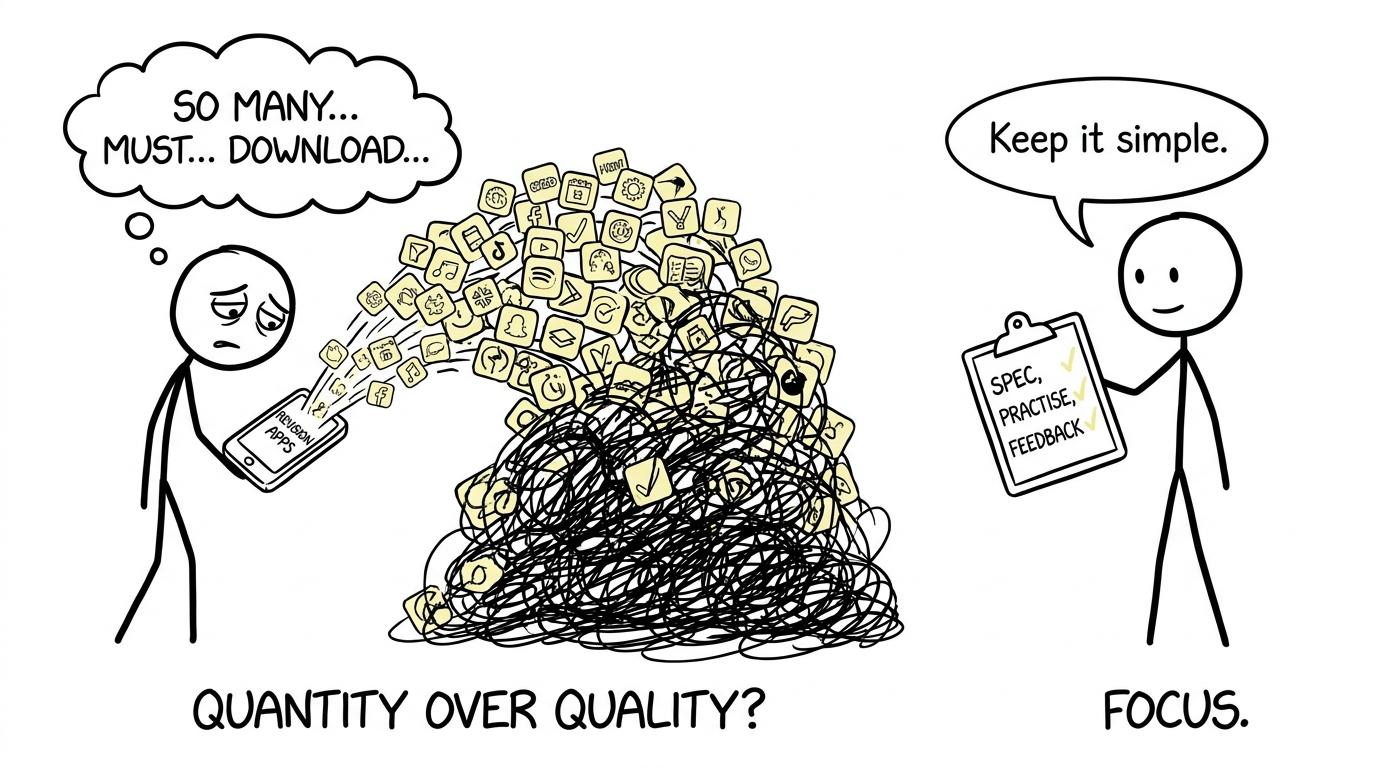 A student faces an avalanche of revision apps while a calmer checklist offers a simpler route
Your quick revision resource checklist
Before committing to an app, ask whether it does at least one of these jobs well:
- matches your exam board and the texts taught by your school;
- tests knowledge rather than merely displaying it;
- includes English Language reading and writing practice;
- helps you organise quotations, themes, characters and context;
- provides questions that resemble your real assessment;
- gives useful feedback or makes self-marking possible;
- works within your budget and on your usual device.
English Language and English Literature are separate GCSEs, so they require different revision. Language is largely about applying reading and writing skills to the task in front of you. Literature also requires secure knowledge of your set texts. Exact papers, assessment objectives and text choices differ across AQA, Pearson Edexcel, OCR and Eduqas, so compare any resource with your current specification and information from your teacher.
The best GCSE English Language and Literature revision apps
BBC Bitesize for clear explanations
BBC Bitesize is a sensible starting point when you need accessible summaries of reading skills, writing techniques, literary texts and terminology. Its short sections make it useful for repairing a specific gap without committing to a long course.
It is best used before practice, not instead of practice. Read the relevant guidance, close the page and explain the idea from memory. Then apply it to a question or passage. Simply recognising an explanation on screen can create confidence without recall.
Best for: concise explanations and topic overviews.
Watch out for: selecting material that does not match your board or set text.
Seneca Learning for structured retrieval
Seneca is popular because its courses divide content into manageable sessions and repeatedly test knowledge. It can be helpful for plot, character, theme, context and terminology revision, particularly when beginning feels difficult.
Its limitation is also its attraction: short interactive questions feel easier than constructing an analytical paragraph. Use Seneca to build knowledge, then move away from the app and produce something independently.
Core access may be free while some features or courses may require payment. Platform features and pricing can change, so check the current offer before subscribing.
Best for: guided recall and building a regular routine.
Watch out for: mistaking completed activities for exam-ready writing.
Quizlet for quotations and terminology
Quizlet can turn quotations, definitions and contextual ideas into flashcards and retrieval activities. It works particularly well when each card asks a focused question. A prompt such as “What does the recurring image suggest?” is more useful than a card containing an entire page of notes.
Student-created sets vary in accuracy. Check wording against your copy of the text and your teacher’s materials before learning it. A confidently memorised error remains an error.
Best for: quick retrieval of concise facts and quotations.
Watch out for: downloading large unverified sets and never editing them.
Anki for long-term memory
Anki uses spaced repetition to bring cards back as you are likely to need another review. It offers more control than many ready-made platforms, although setting up a good deck takes time.
Keep cards small. One quotation, interpretation or connection is enough. The goal is to retrieve knowledge, not to squeeze an essay onto a digital rectangle.
Best for: maintaining Literature knowledge over several months.
Watch out for: spending longer designing cards than answering them.
GCSEPod and school-provided platforms
GCSEPod offers short curriculum-focused videos and activities, often through a school subscription. Other schools provide platforms such as Century, Kerboodle or exam-board digital textbooks. If your school already pays for a service, explore that before buying another one: it may align more closely with your class texts and teaching sequence.
Access and included subjects differ between schools. Ask your English teacher which sections genuinely match your specification.
Best for: short, structured revision linked to school provision.
Watch out for: assuming every available video is relevant to your course.
The best free video channels and online resources
YouTube channels including Mr Bruff, First Rate Tutors and Stacey Reay are widely used for GCSE English explanations, text discussions and exam technique. Videos can make a difficult concept feel manageable, especially when a teacher models how an interpretation develops.
But video is a beginning. Pause before the explanation, predict what might be said and make brief notes from memory afterwards. For current paper structures or question wording, prioritise your exam board’s latest specification, sample assessment materials, past papers and mark schemes over any unofficial summary.
For Literature, use videos to expand your interpretation rather than obtain a script to memorise. Examiners reward a relevant response to the actual question, supported by references to the text. A pre-written answer may fit the theme you revised and still fail to answer the question you receive.
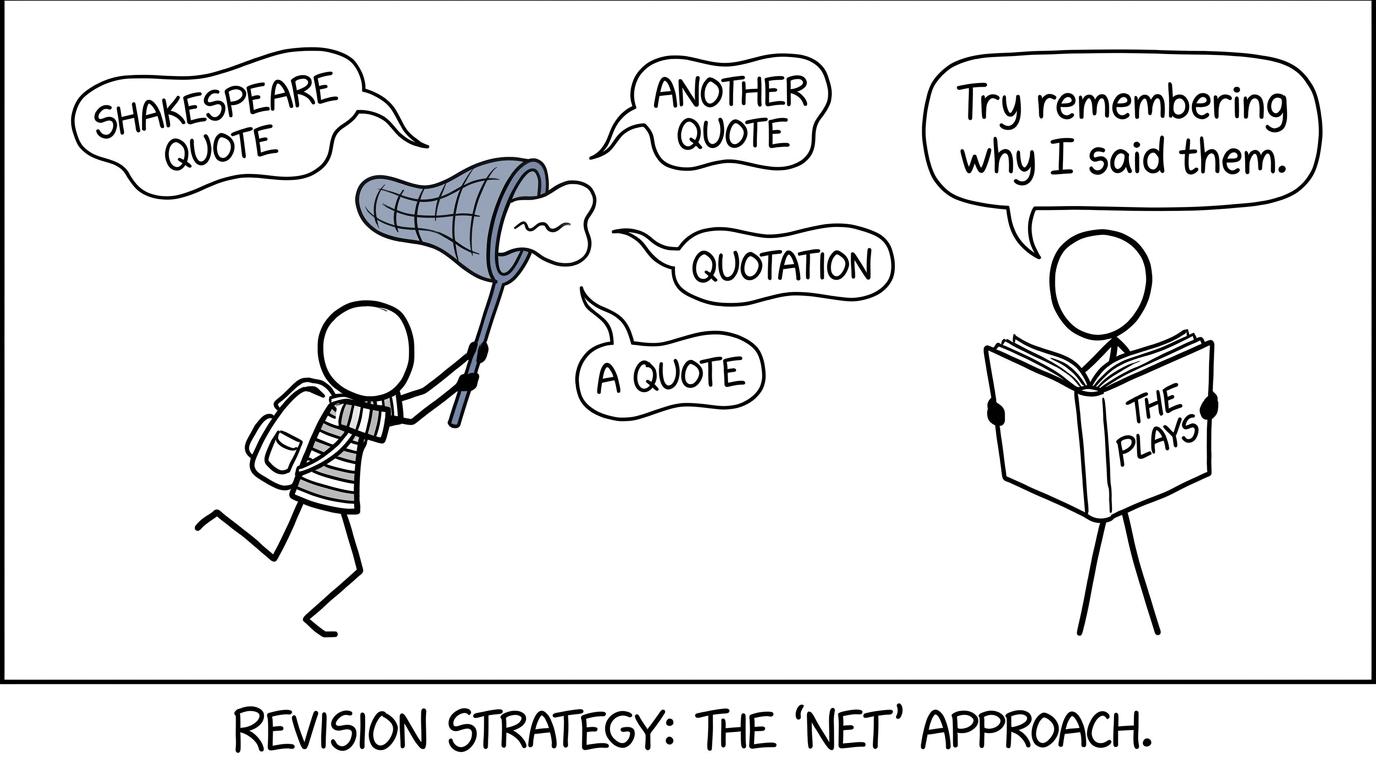 A student tries to catch quotations while a book asks them to remember why they matter
What is worth your time for English Language?
English Language is improved most effectively through deliberate practice. Useful resources should help you work with unseen fiction and non-fiction, compare ideas where required, analyse writers’ choices and produce clear writing for a particular purpose and audience.
A productive Language session might include:
- reading one unfamiliar extract actively;
- planning a response to one board-specific question;
- writing under a realistic time limit;
- checking the mark scheme and examiner guidance;
- identifying one change for the next response.
Online question banks and videos can support this process, but your exam board’s own papers remain the closest guide to its assessment. Do not assume that a technique designed for one board transfers perfectly to another.
Feedback matters here. A teacher can identify whether your response is genuinely analytical, sufficiently developed and technically controlled. If teacher marking is not immediately available, compare your work carefully with the assessment objectives and marked exemplars rather than assigning a grade from instinct.
What is worth your time for English Literature?
Literature revision has three connected layers: knowledge, interpretation and written argument.
Flashcards are useful for the first layer. Text guides, lessons and thoughtful videos can strengthen the second. Only planning and writing responses properly develops the third.
Build a compact bank of short, flexible quotations rather than trying to memorise the whole text. Connect each quotation to several possible themes, characters or ideas. You should also know the broad shape of the text so that your response shows understanding beyond a few isolated lines.
GCSE Literature examinations are normally completed without access to the full set texts, although the precise materials printed in a paper depend on the specification and question. Confirm the current arrangements for your board and texts rather than relying on advice written for another course or exam year.
How to balance English apps with maths revision
English and maths reward different kinds of practice, but the planning principle is the same: do the task you will eventually be assessed on.
For maths, that means solving questions and correcting errors. Start with the free GCSE maths revision lessons, where topics are organised by grade and supported by videos and practice questions. Then use GCSE exam papers to bring separate skills together.
For English, alternate retrieval with timed planning or writing. A balanced evening might contain one focused English task followed by one maths topic, rather than an unstructured session in which both subjects remain open in different browser tabs.
MathsGenie can carry the maths side of that routine. Alongside topic revision, use the MathsGenie predicted papers for additional exam-style practice and return to the MathsGenie home page whenever you need to move between GCSE resources. Students continuing beyond GCSE can also explore the free A Level maths revision resources.
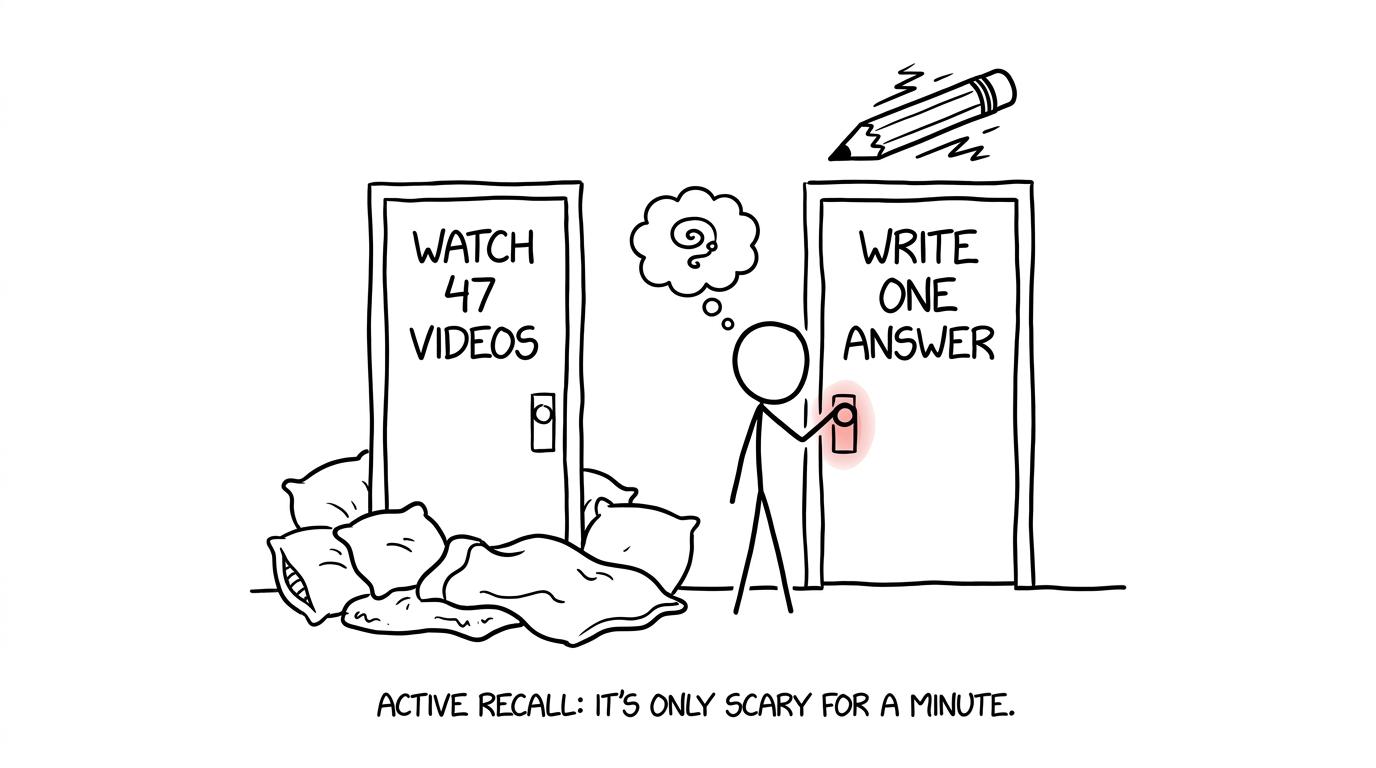 A student chooses the slightly scary writing door instead of watching endless videos
Common mistakes when using English revision resources
Collecting too many apps
Every new platform has a learning cost. Choose a small toolkit in which each resource has a clear purpose: explanation, retrieval, practice or feedback.
Revising the wrong specification
A polished lesson is useless if it covers a different set text or question format. Check your board, qualification and current specification before following detailed exam advice.
Watching without producing anything
Videos feel productive because the explanation is fluent. Test that fluency by closing the video and writing what you can remember, then apply it to a fresh question.
Memorising complete essays
A memorised response can drag your attention away from the wording of the real question. Learn adaptable evidence and interpretations, then practise building an argument around the task.
Ignoring mark schemes and feedback
Completion is not the same as improvement. Review what earned credit, what remained undeveloped and what you will change next time. This is equally important when using MathsGenie’s practice questions, video solutions and mark schemes for maths.
Build a small system that you will actually use
The best revision system is rarely impressive. It is repeatable.
Choose one course for explanations, one flashcard tool for retrieval, one trusted source of videos and your exam board’s papers for practice. Give every session an output: a plan, paragraph, comparison, quotation map or corrected response.
Then protect time for your other GCSEs. MathsGenie gives you a clear route through maths with free revision lessons, practice questions, mini tests, past papers, predicted papers, mark schemes and video solutions. Open the GCSE revision hub, choose the next topic you need rather than the one you already enjoy, and let consistent practice do what another downloaded app cannot.