

Best GCSE Economics Revision Apps for 2026
Best GCSE economics revision apps for 2026, compared by purpose. Build a smarter UK plan with free videos, flashcards, past papers and maths practice today.
Revision apps promise something every busy GCSE student wants: progress without wasted time. The difficult part is deciding which ones deserve a place on your phone.
The best GCSE economics revision apps are not necessarily those with the longest videos or most colourful dashboards. The useful ones help you retrieve knowledge, explain economic chains of reasoning, interpret data and answer questions in the style required by your exam board. A strong combination is usually one specification-matched course, one flashcard system, reliable videos and official past papers.
Economics also contains more maths than many students expect. Percentages, ratios, averages and graphs can all influence your marks. This guide therefore covers both economics resources and the free GCSE maths revision resources that can strengthen your quantitative skills.
Your GCSE Economics revision checklist
Before downloading another app, check whether your current revision system includes:
- your exact GCSE Economics specification and topic list
- short lessons for learning unfamiliar content
- retrieval practice using flashcards or quizzes
- opportunities to draw and interpret economic diagrams
- past-paper questions and official mark schemes
- practice with calculations, tables and data
- longer questions requiring analysis and evaluation
- a record of weak topics to revisit
An app is worth keeping when it fills one of these roles. If three apps do the same job, the extra choice may create friction rather than progress.
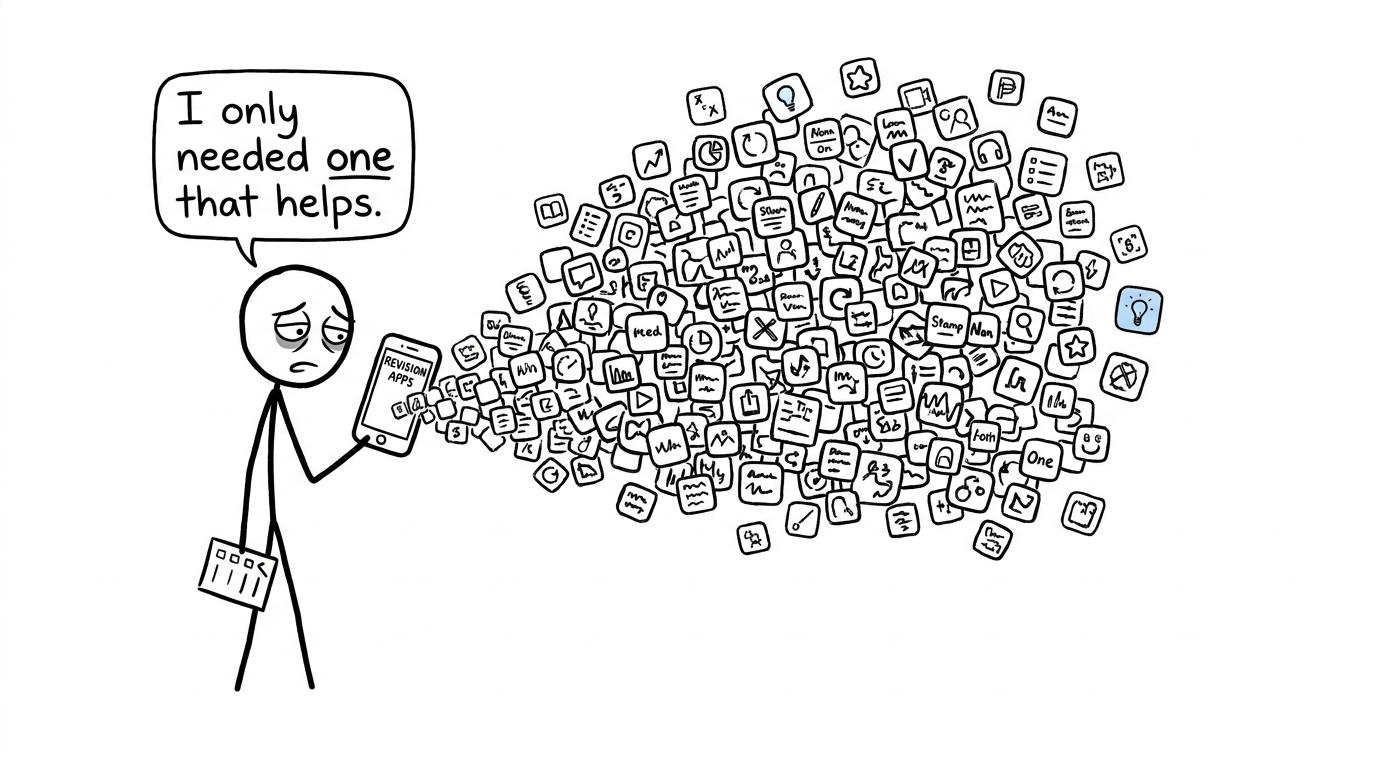 A student faces a stampede of revision apps while holding one useful checklist
Best GCSE Economics revision apps at a glance
Features, free access and course availability can change, so check each provider before committing to a revision plan.
| App or resource | Best use | Important limitation |
|---|---|---|
| Seneca Learning | Structured, specification-based revision | Clicking through lessons can become passive unless you also write answers |
| Quizlet | Quick definitions and retrieval practice | Public sets may contain mistakes or follow another specification |
| Anki | Long-term recall through spaced repetition | Building good cards takes time and discipline |
| YouTube | Understanding diagrams and chains of reasoning | Videos are not always organised around your exam board |
| Official exam-board materials | Specifications, past papers and mark schemes | They identify what is assessed but do not always teach it |
| Tutor2u Economics | Topic explanations, videos and current contexts | Some material is aimed beyond GCSE or sits within paid courses |
| MathsGenie | Percentages, ratios, averages, graphs and exam practice | It supports the mathematical side rather than teaching Economics content |
Seneca Learning for a structured course
Seneca is a practical starting point for students who want revision arranged into manageable sections. Where a course matches your board, it can combine short explanations with questions and repeated testing. This makes it more active than simply highlighting a textbook.
Use it to establish coverage, not as proof that a topic is mastered. Completing a section quickly can feel productive even when the knowledge cannot yet be used in an unfamiliar question. After a session, close the app and write down what causes a demand or supply curve to shift, or explain how one policy might affect different groups.
Check that the course matches the specification used by your school. In England, standalone GCSE Economics students are commonly entered for AQA or OCR, while international and other qualifications may differ. The name “GCSE Economics” alone is not enough to confirm a match.
Quizlet for definitions and short chains
Quizlet is useful for terminology such as opportunity cost, productivity, inflation and market failure. Its strength is speed: a small set can turn waiting time into retrieval practice.
However, recognition is not the same as recall. Seeing the correct answer among several options is easier than producing it independently. Use written-answer modes where available, say the answer before revealing the card, and include relationships rather than only definitions.
For example, a card might ask for the likely sequence following an increase in production costs. That requires a causal chain, not just one memorised phrase.
Public flashcard sets need checking against your textbook, teacher materials and specification. A polished set can still contain an inaccurate definition or material from a different board.
Anki for spaced retrieval
Anki is better suited to students who want control over what reappears and when. Its spaced-repetition system schedules cards according to how confidently they were recalled. That can make it valuable for retaining content across a long revision period.
The best cards are narrow enough to answer clearly. Avoid copying an entire textbook paragraph onto one card. Separate a large topic into definitions, causes, consequences, diagram changes and evaluation points.
Desktop Anki and AnkiDroid have traditionally provided free routes, while the official iOS app has used a different payment model. Availability and pricing may change, so verify the current version in your app store.
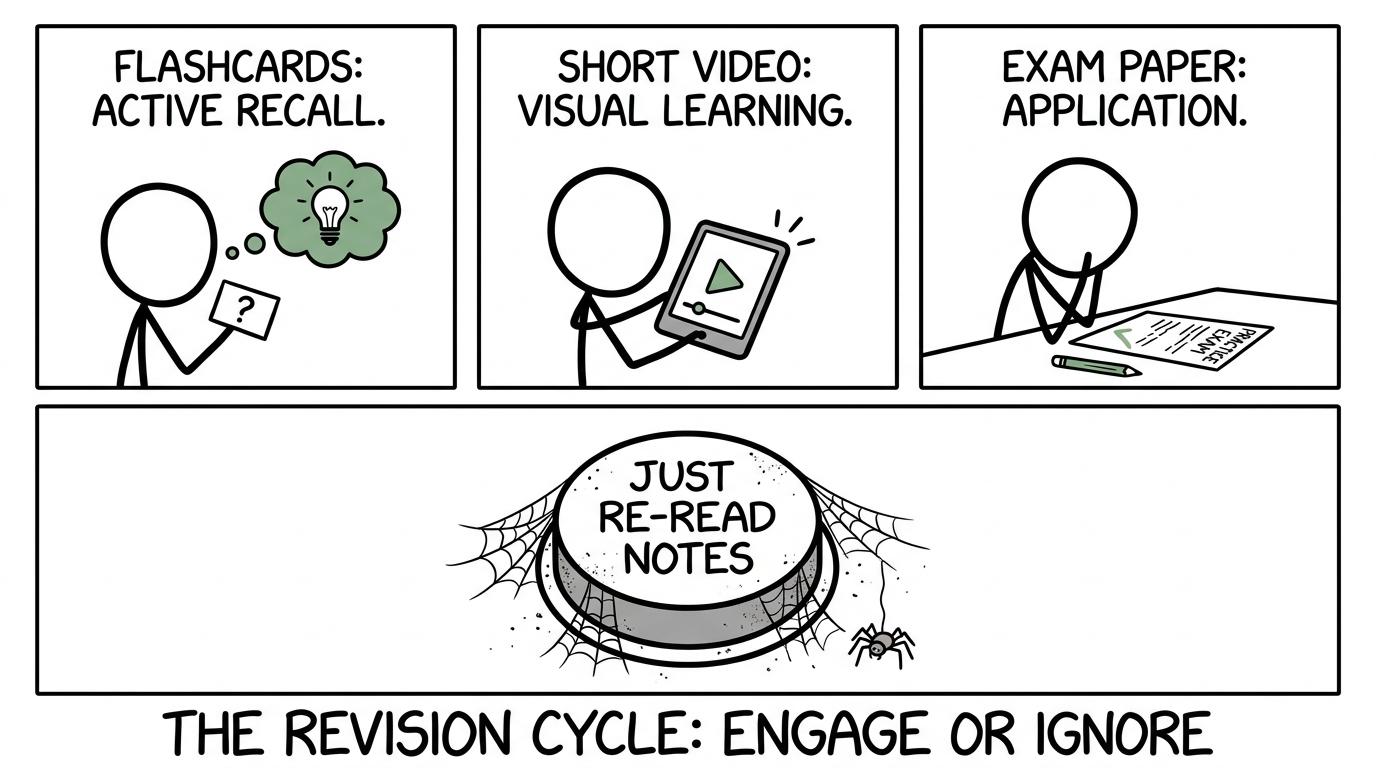 A student rotates between flashcards, videos and papers while passive rereading gathers cobwebs
YouTube channels that clarify difficult ideas
YouTube works best when a textbook explanation has not quite landed. Tutor2u Economics publishes explanations, diagram guidance and discussions of economic issues. EconplusDal is also widely used for clear economics teaching, although much of its library is designed for A Level students.
For GCSE revision, search by the precise concept and check it against your specification. A longer A Level explanation may add assumptions or terminology you are not required to use. That is not necessarily harmful, but it can consume time and blur the answer your mark scheme expects.
Turn every useful video into an action:
- draw the diagram without looking
- write three key points from memory
- answer a related exam question
- explain one limitation or alternative outcome
A video becomes revision only when you have to retrieve or apply something afterwards.
Official resources should anchor every app
Your exam board specification is the authoritative list of assessed content. The sample assessment materials, past papers, examiner reports and mark schemes show how that content becomes questions.
Apps should sit around these documents rather than replace them. In particular, pay attention to command words. “Explain”, “analyse” and “evaluate” require different levels of development. Mark schemes can also reveal where an answer needs context, a connected chain or a supported judgement.
Do not assume that resources labelled Edexcel, AQA, OCR or Eduqas are interchangeable. For GCSE Economics, confirm the exact qualification and specification code supplied by your school. Edexcel also offers International GCSE Economics, which is a distinct qualification rather than a reason to use its resources for every UK GCSE course.
Free websites and question banks worth considering
Tutor2u offers a substantial collection of economics articles, videos and teaching materials. Some content is free, while courses and particular products may require payment. It is particularly useful for finding real-world contexts, but always bring the discussion back to your GCSE specification.
Save My Exams provides organised notes and questions, although access limits and paid features can apply. Use any third-party notes to clarify content, then test yourself with official questions.
Your school may also provide digital textbooks, Microsoft Teams materials or another learning platform. These are easy to overlook because they feel less novel than an app, but teacher-selected resources are more likely to follow the order and terminology of your course.
Strengthen the maths used in GCSE Economics
Economics questions may ask you to handle data rather than perform advanced algebra. Typical skills include percentage change, ratios, averages, revenue, costs, profit and interpreting graphs.
Useful relationships include:
percentage change=new value−original valueoriginal value×100\text{percentage change}=\frac{\text{new value}-\text{original value}}{\text{original value}}\times 100percentage change=original valuenew value−original value×100 total revenue=price×quantity sold\text{total revenue}=\text{price}\times\text{quantity sold}total revenue=price×quantity sold profit=total revenue−total costs\text{profit}=\text{total revenue}-\text{total costs}profit=total revenue−total costsPrice elasticity of demand may be represented as:
PED=percentage change in quantity demandedpercentage change in price\text{PED}=\frac{\text{percentage change in quantity demanded}}{\text{percentage change in price}}PED=percentage change in pricepercentage change in quantity demandedIf these calculations feel less secure than the economics around them, revise percentage change, ratio skills and averages through MathsGenie. Graph interpretation also improves through regular GCSE maths practice rather than last-minute memorisation.
Students preparing for their maths exams can use the same practice to support Economics. MathsGenie's GCSE past papers build fluency with calculations, data and unfamiliar problem-solving, while predicted maths papers can help organise timed practice nearer an exam series.
Build a revision system instead of collecting apps
A sensible weekly system assigns a different purpose to each resource:
- Learn: use a specification-matched lesson or concise video.
- Retrieve: answer flashcards without notes.
- Apply: complete an exam question.
- Review: compare the response with the mark scheme.
- Repair: revisit the exact missing knowledge or skill.
Keep an error log with three headings: knowledge, application and exam technique. If a calculation caused the problem, add it to your maths practice list. If an explanation stopped too early, practise extending the chain with “therefore” and “as a result”.
Students considering Economics or Maths after GCSE can also explore MathsGenie's free A Level maths revision resources, but current GCSE preparation should remain the priority.
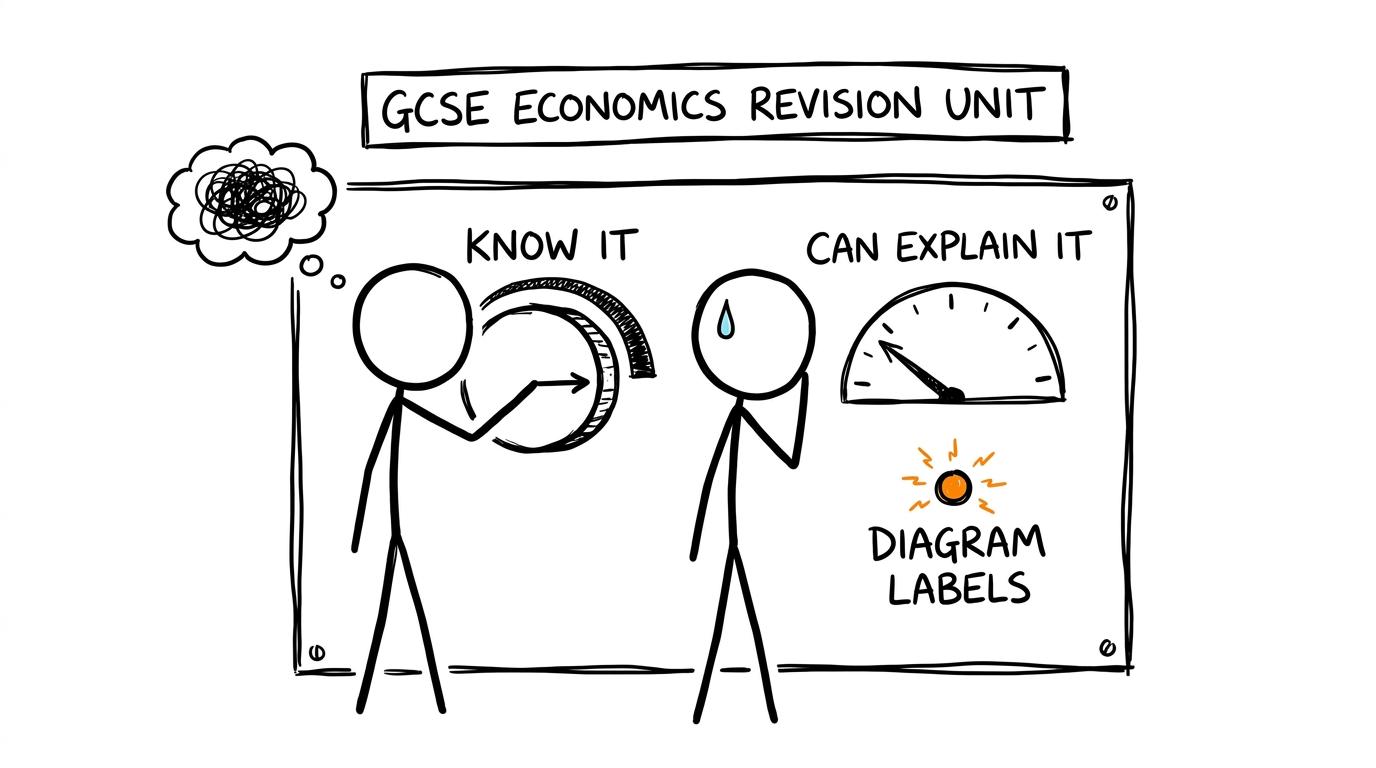 Students compare knowing a topic with being able to explain it at a revision control panel
Common mistakes when choosing revision resources
Downloading too many apps
A large collection creates the feeling of preparation without the benefits of practice. Choose one primary content source, one retrieval tool and official exam materials.
Revising the wrong specification
A resource may be accurate but irrelevant to your paper. Check the board, qualification and specification before creating a large deck of cards or watching a complete playlist.
Treating quizzes as exam practice
Short quizzes test knowledge efficiently, but they rarely reproduce extended questions, source material or mark allocations. Complete full questions and eventually timed papers.
Trusting public flashcards automatically
User-generated cards can contain ambiguous language, outdated content and errors. Check doubtful statements against official or teacher-approved material.
Ignoring calculations and graphs
Knowing a definition does not guarantee accurate data handling. Use MathsGenie's free maths revision lessons and targeted practice questions to keep quantitative skills secure.
Watching without retrieving
A clear explanation can create temporary familiarity. Pause, close the resource and reproduce the idea independently. What feels smooth while watching may be difficult to recall in an exam hall.
Choose fewer resources and use them better
The best GCSE Economics revision apps perform different jobs. Seneca can provide structure, Quizlet or Anki can support retrieval, and carefully chosen YouTube videos can clarify diagrams and reasoning. Official specifications, past papers and mark schemes should decide what you learn and how you practise it.
For the numerical side of Economics, make MathsGenie part of the same routine. Start with the GCSE maths revision hub, identify the percentage, ratio, average or graph skill holding you back, and complete the revision lesson, practice questions and mini test. Then progress to past papers, predicted papers and video solutions.
The goal is not to own the perfect app. It is to build a repeatable process in which every mistake tells you what to practise next.











