

Best GCSE Biology Revision Apps for 2026
Best GCSE biology revision apps for 2026, compared by purpose. Choose free videos, flashcards, quizzes and exam practice without wasting revision time.
Revision apps promise something every busy GCSE student wants: less effort wasted deciding what to do next. Yet downloading five platforms can create a new problem. You spend more time arranging revision than revising.
The best GCSE biology revision apps for 2026 are not simply the ones with the most features. They are the resources that match your exam board, make you retrieve knowledge, expose weak topics and lead you towards exam questions. For most students, a sensible free combination is BBC Bitesize or Cognito for explanations, Seneca for structured quizzes, Quizlet or Anki for recall, and official past papers for exam practice.
The important word is combination. No single app does every job equally well.
The quick GCSE Biology revision app checklist
Before committing your revision time, check whether a resource:
- matches AQA, Pearson Edexcel, OCR or Eduqas content;
- distinguishes separate Biology from Combined Science where necessary;
- covers practical methods, variables, data and evaluation;
- makes you answer questions rather than merely watch;
- provides reliable feedback or mark schemes;
- supports short, repeated sessions;
- includes the maths skills used in Biology;
- has a genuinely useful free version.
Also confirm your specification with your teacher. A beautifully designed course for the wrong exam board is still the wrong course.
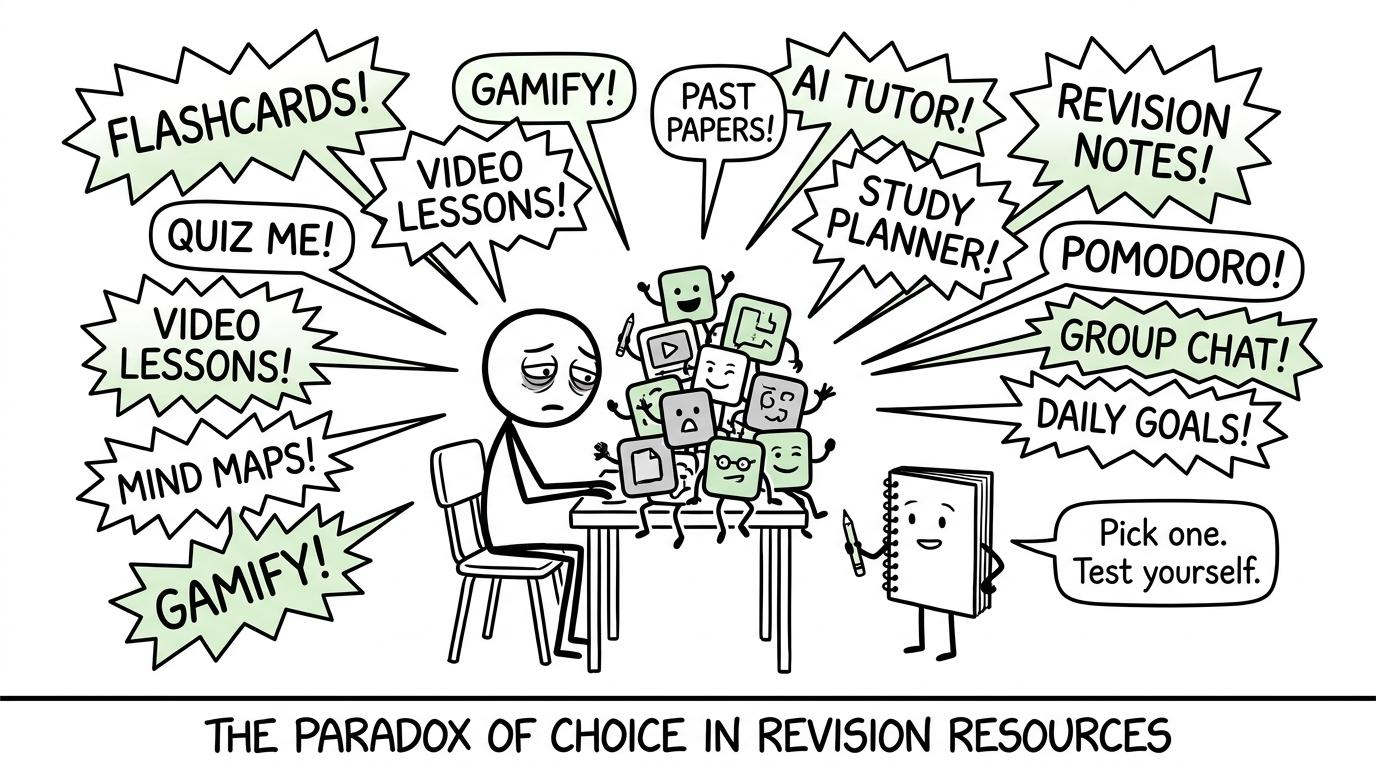 A GCSE student surrounded by too many revision apps while a calm notebook recommends choosing one
Best GCSE Biology revision apps at a glance
| Resource | Best for | Free-access picture | Main limitation |
|---|---|---|---|
| BBC Bitesize | Clear first explanations and flashcards | Free | Not a replacement for sustained exam-question practice |
| Cognito | Short science videos and specification-mapped lessons | Many core videos, lessons and questions are free | Some quiz, flashcard and tracking features may require Pro |
| Seneca Learning | Structured, interactive revision | Substantial free courses with optional paid features | Short prompts alone do not train every extended answer |
| Quizlet | Quick, accessible flashcards | Basic use is available free | Public sets can contain mistakes; some modes are limited or paid |
| Anki | Long-term spaced repetition | Free on desktop, web and Android; official iOS access differs | Requires more setup and provides no built-in GCSE course |
| YouTube science channels | Seeing difficult processes explained visually | Free | Watching can become passive very quickly |
| Exam-board papers | Authentic questions and mark schemes | Free from exam boards | They diagnose gaps but do not teach the missing content |
Features and subscription terms can change. Check the provider's current app-store listing or website before paying.
BBC Bitesize: best for a calm starting point
BBC Bitesize remains a strong first stop when a topic such as homeostasis, inheritance or ecology feels unfamiliar. Its GCSE materials combine concise explanations with video, quizzes and revision content. The BBC Bitesize exam revision app also offers GCSE flashcards across subjects including Biology.
Its strength is orientation. It helps you build the mental map before details pile up. Use it at the beginning of a topic, then close it and write or say everything you remember. That final step matters because recognising an explanation is not the same as recalling it in an exam.
Bitesize is less suitable as your only resource. Biology papers assess application, practical understanding, data analysis and longer responses, so introductory content must eventually lead to exam questions.
Cognito: best for visual science explanations
Cognito is particularly useful when a process needs to move rather than sit on a page. Its GCSE Biology courses provide short videos, notes and exam-board-mapped material, with coverage for major specifications including AQA, Edexcel and OCR routes. Core lessons, videos, topic questions and past-paper sections are available without requiring every feature to be paid, while additional tools can sit within its Pro offer.
A good Cognito session has two parts: watch one focused explanation, then answer questions without replaying it. If you keep returning to the video before attempting anything, the resource has become a comfort blanket rather than a test.
Students taking OCR can pair science content with MathsGenie's guide to revising OCR GCSE Biology efficiently, which emphasises active recall, practical evaluation and data questions.
Seneca Learning: best for structured interactive revision
Seneca is useful when a blank evening creates the question, "Where do I start?" Its GCSE Biology courses break specifications into manageable sections and interleave explanation with short questions. Current course listings include Biology options for major boards and tiers, although exact availability should always be checked against your own specification.
The platform works well for coverage, retrieval and identifying material that repeatedly goes wrong. It is especially helpful if your school already sets Seneca assignments, because your class route may be organised for you.
Its weakness is also its convenience. Selecting or typing a short response does not fully reproduce a six-mark explanation, a practical-design question or a calculation where working must be shown. Use Seneca to find gaps, not to avoid paper-based answers.
Quizlet and Anki: best for biological vocabulary
Biology contains a dense network of precise terms. Diffusion, osmosis and active transport are related, but they are not interchangeable. Flashcard apps help preserve those distinctions.
Quizlet is the easier starting point. You can create cards quickly and find public decks, but user-generated sets are not automatically accurate. Compare every borrowed deck with your specification, teacher materials or a trusted course before learning it.
Anki demands more setup but offers powerful spaced repetition. Cards return according to how confidently you recalled them, making it suitable for definitions, processes, required-practical details and common sources of error. Desktop, web and Android access can be used free, while the official iOS app follows a different payment model.
Keep each card narrow. One prompt should test one idea. A card containing an entire textbook paragraph mostly tests whether you can recognise a wall of words.
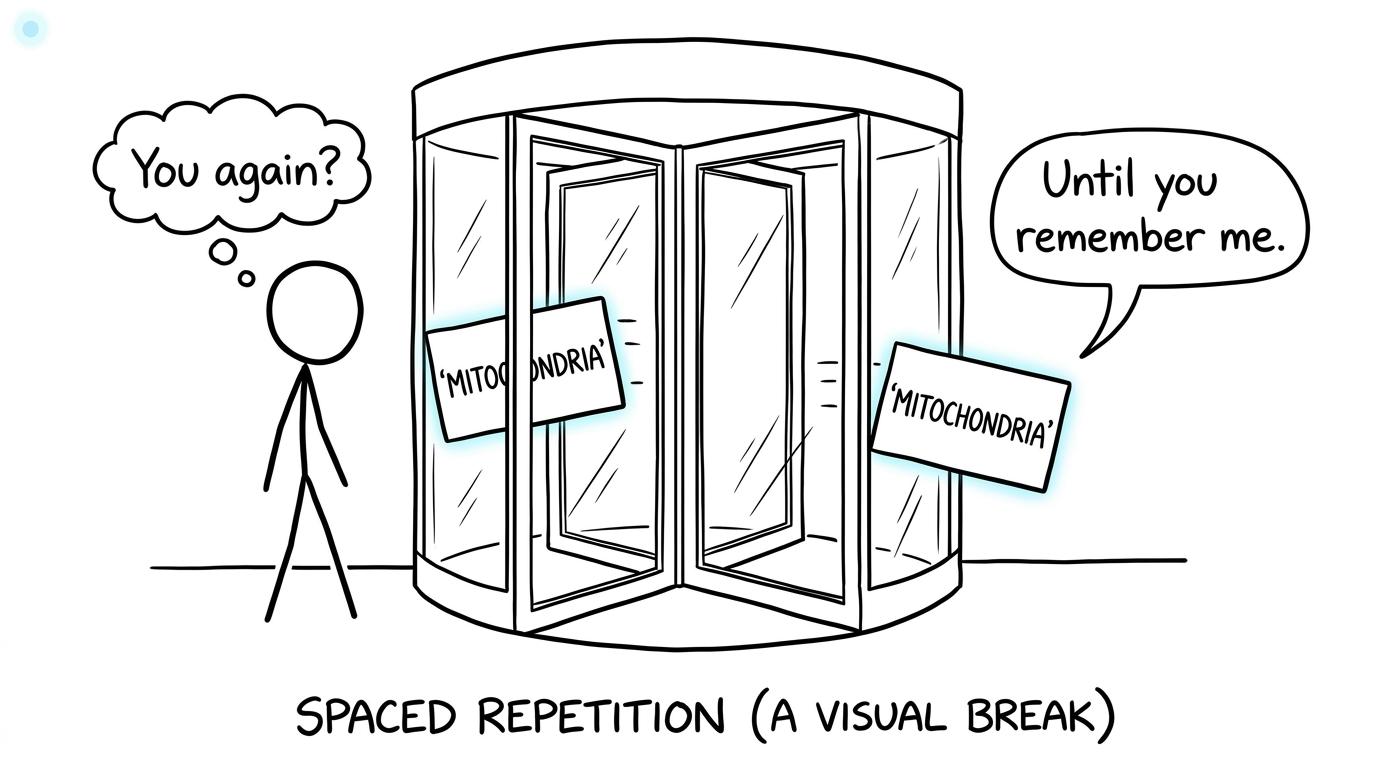 A recurring mitochondria flashcard jokes with a student about spaced repetition
YouTube channels: best when a process will not click
Video channels including Cognito, FreeScienceLessons and Malmesbury Education are commonly recommended for GCSE science explanations. Malmesbury Education is particularly useful for practical demonstrations, while concise topic videos can help with processes that are hard to imagine from static notes.
Search using your exam board and the precise topic rather than browsing a homepage. "AQA Biology osmosis required practical" is a more useful destination than "GCSE science revision".
Then convert viewing into output:
- pause before the explanation and predict the next step;
- draw the process from memory;
- list the variables in a practical;
- answer an exam question immediately afterwards.
A watched video is an input. Marks come from what you can produce afterwards.
Official specifications, practicals and past papers
Apps are convenient, but the specification decides what can be assessed. Exam-board materials are therefore essential free resources, even if they are less colourful.
Use the specification as a checklist and official past papers to test whether your knowledge survives unfamiliar wording. Required or core practicals deserve special attention: know the method, independent and dependent variables, control variables, hazards, measurements, repeats and possible improvements. The exact terminology and practical set vary by board and qualification, so follow your own specification.
Past papers should sit near the end of a revision cycle, not at the beginning of every session. Learn, retrieve, practise by topic, then test under timed conditions. MathsGenie's guide to when GCSE students should start past papers explains how to build from shorter sections towards complete papers.
Do not neglect maths in GCSE Biology
A revision app can make Biology look like a vocabulary subject. The specifications say otherwise. GCSE Biology includes quantitative skills such as ratios, percentages, standard form, means, probability, graph interpretation, rates and simple equations. Official requirements indicate that at least 10%10\%10% of marks in separate GCSE Biology assess relevant mathematical skills.
Your Biology revision should therefore include:
- percentage and percentage-change calculations;
- magnification, scale and unit conversion;
- surface-area-to-volume ratios;
- means, ranges and sampling data;
- rates of change;
- graph plotting, gradients and correlations;
- probability in genetic crosses;
- standard form and appropriate significant figures.
MathsGenie's free GCSE Maths revision hub lets you choose your board and practise the underlying methods. Useful Biology crossover pages include percentages revision, percentage change, standard form practice and scatter graphs.
This is one of the quieter advantages of revising maths properly: the same skill can earn marks in more than one subject.
How to build a revision system without app overload
Choose one resource for each job:
- Learn: BBC Bitesize or Cognito.
- Retrieve: Seneca, Quizlet or Anki.
- Apply: topic questions from a trusted course or exam board.
- Test: official past papers and mark schemes.
- Repair maths: MathsGenie lessons and practice questions.
A short session might contain a focused explanation, closed-book recall, several exam questions and careful marking. Keep an error log with four headings: topic, error, correct idea and re-test date.
This resembles the cycle used throughout MathsGenie: learn the method, practise it, mark it, fix it and meet it again later. The GCSE Maths topics by board and tier guide can help you organise the mathematical side without revising irrelevant material.
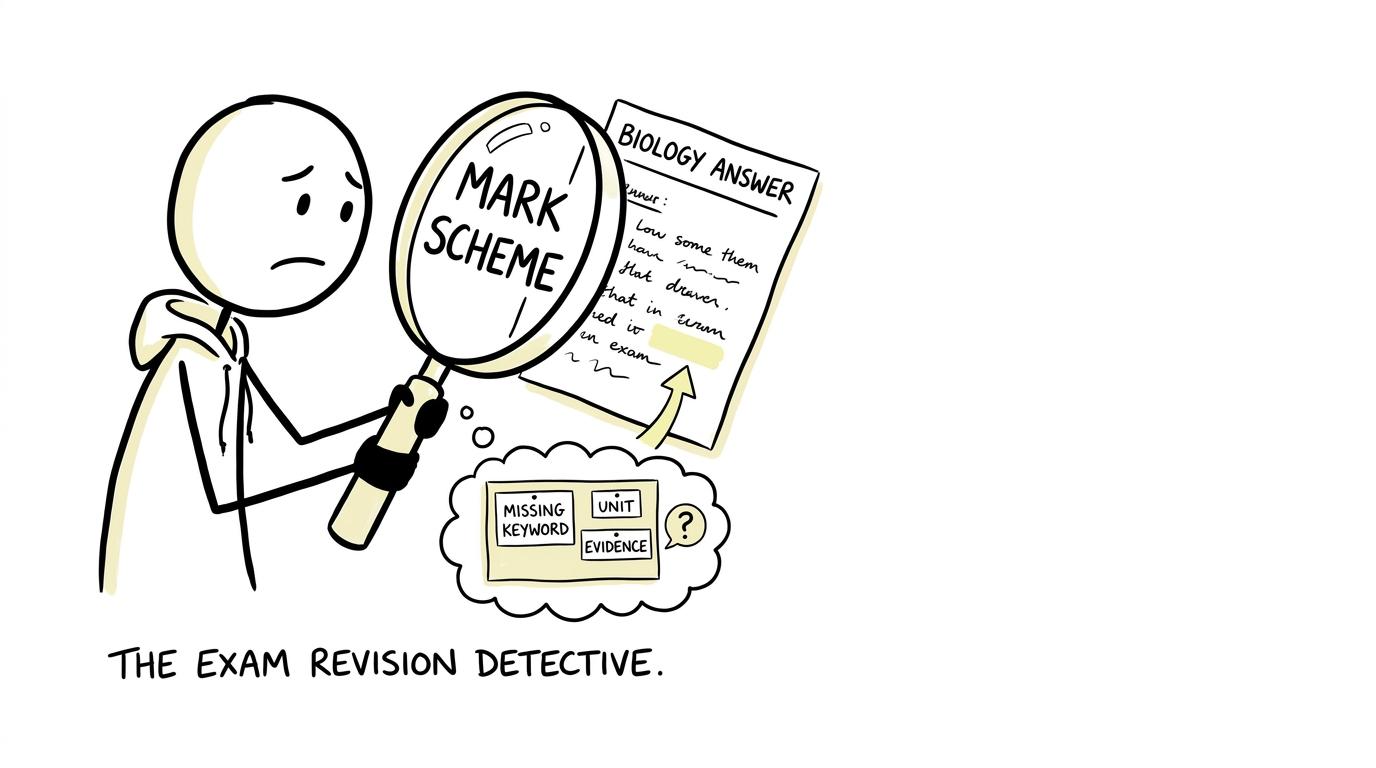 A GCSE student uses a mark scheme like a detective examining missing keywords, units and evidence
Common mistakes when using Biology revision apps
Collecting resources instead of using them
Downloading another app feels productive because it removes uncertainty for a moment. Improvement comes from answering, marking and correcting questions. Choose a small toolkit and use it consistently.
Revising the wrong course
Check your board, tier and whether you take Combined Science or separate Biology. Do not assume a deck labelled "GCSE Biology" precisely matches your paper.
Trusting public flashcards automatically
Spelling, definitions and required-practical details can be wrong or specification-specific. Verify borrowed cards before repetition turns an error into a durable memory.
Watching without retrieving
Pause, close the resource and reproduce the idea. If nothing has to come out of your head, retrieval has not happened.
Ignoring mark schemes
Mark schemes reveal the precision required by command words and show whether your answer needs a statement, explanation, calculation or evaluation. Treat them as feedback, not merely answer sheets.
Avoiding calculations
Do not abandon a Biology question because it contains data. Repair the underlying method, then return to the scientific context. MathsGenie's past-paper platform and topic resources help build the habit of showing working and checking solutions.
Choose fewer tools and use them more deeply
The best app is not the one that makes revision feel busiest. It is the one that makes your next weakness visible.
Start with one explanation platform, one retrieval tool and your exam board's questions. Add another resource only when it solves a specific problem. Keep Biology active: recall definitions, explain processes, analyse data, revisit practicals and mark written answers honestly.
For the calculation skills beneath those Biology questions, make MathsGenie your free revision base. Use revision lessons to repair methods, practice questions and mini tests to build fluency, then GCSE Maths past papers and resources with mark schemes, predicted papers and video solutions to test what remains. Fewer tabs. Better feedback. More revision that reaches the exam paper.










