

Best GCSE Astronomy Revision Apps and Resources 2026
Best GCSE astronomy revision apps for 2026, compared by purpose. Find free sky maps, trusted videos, past papers and a clear, focused Edexcel revision plan.
Revision apps create a comforting feeling: the whole night sky seems to fit inside your phone. Yet the exam does not reward how many constellations an app can name. It rewards accurate knowledge, careful calculations, observational understanding and answers shaped around the question.
The best GCSE astronomy revision apps therefore do more than look impressive. They help you visualise the sky, recall specification content, plan observations or practise exam skills. For most students, the strongest combination in 2026 is Stellarium for exploring the sky, a flashcard app for active recall, trusted educational videos for difficult ideas and official past papers for genuine exam practice.
This guide explains which tools deserve your time, what each one cannot do and how MathsGenie can support the mathematical skills behind GCSE Astronomy.
Your quick GCSE Astronomy revision checklist
A useful revision system should contain five different tools:
- The current specification to define exactly what you must know.
- A planetarium app to connect diagrams with the real sky.
- Short videos or revision lessons to explain unfamiliar concepts.
- Active-recall questions to test knowledge without notes.
- Past papers and mark schemes to develop exam technique.
Begin with the Edexcel GCSE Astronomy revision hub, where MathsGenie brings together lessons, questions and revision tools alongside past papers from recent examination series.
Pearson Edexcel GCSE Astronomy, specification 1AS0, is currently the GCSE Astronomy qualification available in England. It is untiered, so there are no separate foundation and higher papers. Students complete two externally examined papers: Naked-eye Astronomy and Telescopic Astronomy. Each lasts 111 hour 454545 minutes, carries 100100100 marks and contributes 50%50\%50% of the qualification.
That distinction matters. AQA, OCR and Eduqas students may meet astronomy ideas within science, while students taking GCSE Maths with those boards will use many of the same numerical skills. However, they are not following a separate AQA, OCR or Eduqas GCSE Astronomy specification.
The best GCSE astronomy revision apps by purpose
No single app covers the complete course. Choosing by purpose is better than searching for one magical download.
Stellarium for understanding the night sky
Stellarium is the best starting point for most GCSE Astronomy students. Its mobile version has a useful free tier, while Stellarium Web works through a browser without requiring an installation.
You can set a location and time, identify stars and planets, follow the changing sky and explore celestial coordinate ideas. This makes it particularly useful for topics involving constellations, circumpolar stars, diurnal motion and observation planning.
Use it actively. Predict where an object should appear before revealing its label. Change the date and explain why its position changes. Compare the simulated view with your own observation record. Simply moving a phone around the sky is interesting, but it is not yet revision.
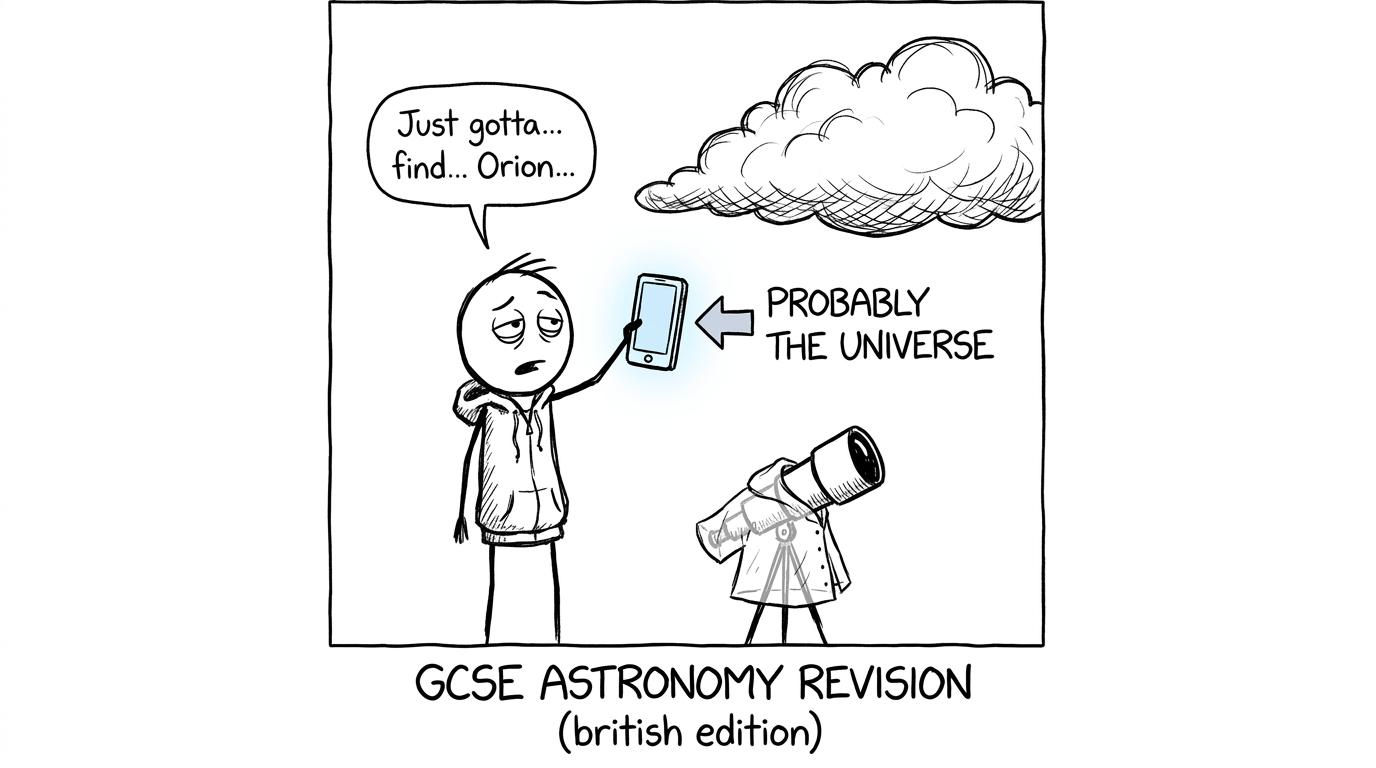 A GCSE student using a stargazing app beneath a very cloudy British sky
Sky Map for quick Android identification
Sky Map is a simple Android option for identifying objects by pointing your device towards the sky. Its uncluttered design suits students who want rapid orientation rather than a large collection of advanced features.
It is most valuable outside, when you need to check a direction or identify a bright object. Stellarium is generally stronger for planned exploration at a desk, while Sky Map is convenient for immediate identification.
Remember that phone compasses can be affected by calibration, magnetic cases and nearby metal. Treat the display as a guide, then confirm directions and observations independently.
Clear Outside for observation planning
Clear Outside provides astronomy-focused weather information, including cloud forecasts. It does not teach the specification, but it can prevent an observation session from becoming an hour spent staring at cloud.
Check conditions in advance, prepare the target and equipment, and decide what information you need to record. Never look directly at the Sun, either with the naked eye or through optical equipment. Solar observations require approved methods, suitable equipment and proper supervision.
For the summer 2026 series, Pearson required centres to confirm that candidates had completed at least one unaided and one aided observation. An app can support planning and orientation, but it cannot replace the observation or your own recorded evidence. Follow your teacher's instructions and the requirements for your examination series.
NASA for reliable space context
The official NASA app is useful for mission information, imagery, videos and current space exploration. It can make topics such as planetary missions and astronomical imaging feel less abstract.
Its weakness is also clear: it is not arranged around Edexcel specification statements. Use it to deepen understanding after identifying a syllabus topic, not as your main revision course. Interesting astronomy and examinable astronomy overlap, but they are not identical.
Anki or Quizlet for active recall
Flashcard apps are valuable when the cards demand retrieval rather than recognition. Good cards might ask you to distinguish two models, identify the purpose of an instrument or state what a graph shows. Weak cards contain an entire page of notes on one side.
Keep each prompt narrow. Review difficult cards more often and delete duplicates. Where your school has a preferred platform, follow its privacy and account guidance.
MathsGenie's GCSE standard form flashcards can also strengthen a skill that appears repeatedly when astronomical distances and measurements become very large or very small.
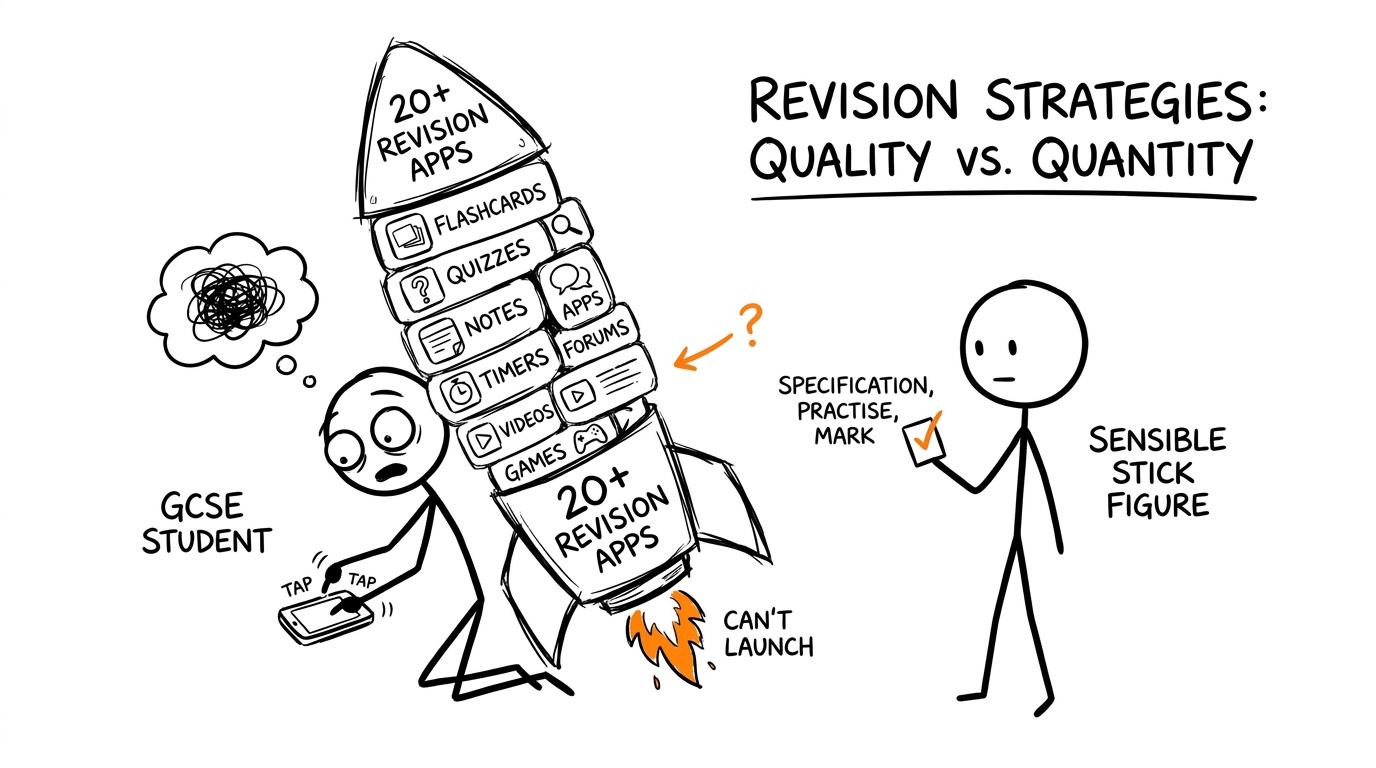 A revision-app rocket unable to launch because it has too many apps
Free channels and resources worth using
Apps are strongest when they sit inside a wider revision system. The following free resources perform different jobs.
Pearson specification, formula sheet and past papers
The official specification is your boundary. Turn its statements into a checklist and label each one secure, developing or not yet understood. Use the official formula and data sheet while practising so that you know what is supplied and what understanding you must bring yourself.
Past papers reveal the language, diagrams, calculations and extended responses used in the real qualification. MathsGenie hosts accessible exam material, including a GCSE Astronomy Paper 1 past paper and a corresponding style of official Astronomy mark scheme.
Do not read a mark scheme immediately after getting stuck. Attempt the question, mark it, identify the missing idea and then answer it again without copying.
Royal Observatory Greenwich
The Royal Observatory Greenwich provides free GCSE Astronomy videos and worksheets arranged around relevant topics. Its materials cover areas including coordinate systems, the Sun-Earth-Moon system, observation, stellar evolution, galaxies and cosmology.
Its YouTube channel is particularly helpful when a static diagram does not make a three-dimensional movement clear. Pause before each explanation, sketch what you expect and then compare your model with the video.
National Schools' Observatory
The National Schools' Observatory offers educational activities, simulations and access to astronomical imagery. It is useful for connecting classroom ideas with the evidence astronomers actually analyse.
Use such resources to ask better questions: what was measured, what uncertainty exists, and which conclusion is supported? These habits help with the analytical and evaluative demands of GCSE Astronomy.
MathsGenie for the mathematical foundations
Astronomy often feels like a science of enormous ideas, but many marks depend on ordinary mathematical habits performed carefully.
Standard form is essential for handling extreme scales. Refresh the definition and operations with the standard form revision guide. A value in standard form has the structure
a×10n,1≤a<10,a \times 10^n, \qquad 1 \leq a < 10,a×10n,1≤a<10,where nnn is an integer.
Angles and trigonometry support work involving scale drawings, elevation and geometrical relationships. The SOHCAHTOA revision guide is useful whether your GCSE Maths board is Edexcel, AQA, OCR or Eduqas, although you should always practise questions matched to your own specification.
Astronomy also requires graph reading, substitution, proportional reasoning and rearranging formulae. The broader guide to GCSE Maths topics that appear regularly provides a practical checklist, while the advice on revising GCSE Maths without wasting time explains how to combine topic practice, feedback and timed paper sections.
A revision routine that makes the apps useful
A calm weekly routine is more effective than opening several apps whenever revision anxiety appears.
Learn, retrieve, apply and review
Choose one specification statement and follow four stages:
- Learn: use a short lesson, worksheet or carefully selected video.
- Retrieve: close the resource and write what you remember.
- Apply: answer examination questions or interpret relevant data.
- Review: mark the work and record one precise correction.
A planetarium app belongs mainly in the learning and observation stages. Flashcards belong in retrieval. Past papers belong in application. Mark schemes belong in review. Once each tool has a job, revision becomes less distracting.
For paper practice, begin with short sections before attempting a full 111 hour 454545 minute examination. MathsGenie's question banks, mini tests and video solutions can help you repair individual maths weaknesses before they cost marks inside an astronomy calculation.
Common mistakes when choosing astronomy resources
Collecting apps instead of practising
Downloading five sky maps does not create five times as much understanding. Choose one main planetarium app and learn to use it well.
Revising fascinating content outside the specification
Black holes, missions and new discoveries are compelling. But when time is limited, check every session against the current specification. Enrichment should deepen the required content rather than displace it.
Treating videos as active revision
A video can feel clear because the presenter is doing the thinking. Pause, predict, draw and explain. If you cannot reproduce the idea afterwards, watch less and retrieve more.
Ignoring calculations until the end
Students sometimes separate the beautiful ideas from the arithmetic. In the examination, they meet on the same page. Practise standard form, calculator input, units, graphs and formula rearrangement throughout the course.
Using unofficial questions without checking their level
A polished worksheet may still omit specification detail or use the wrong terminology. Prioritise Pearson materials, trusted educational institutions and resources clearly aligned with Edexcel 1AS0.
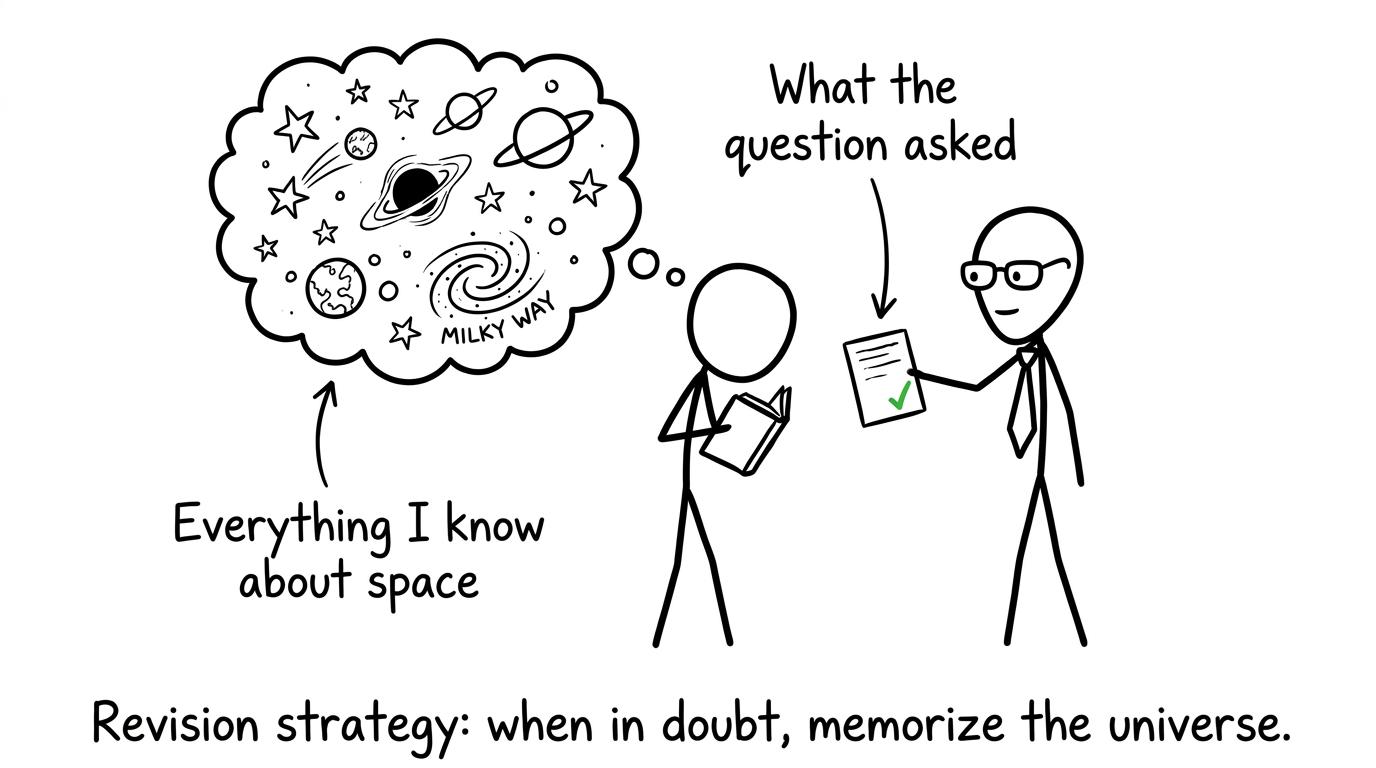 An examiner-shaped alien offers a mark scheme to a student memorising the entire galaxy
Build a small revision system, not a crowded phone
The best resource is rarely the one with the most features. It is the one that leads to a useful action: finding an object, retrieving a definition, correcting a calculation or improving an exam answer.
Start with the specification. Use Stellarium to make the sky intelligible, trusted channels to clarify difficult ideas and flashcards to strengthen recall. Then move towards the evidence that matters most: questions, past papers and mark schemes.
Make MathsGenie's Edexcel GCSE Astronomy resources your starting point, and use MathsGenie's free revision lessons, practice questions, mini tests, video solutions, past papers, predicted papers and revision planner to organise the mathematical work around them. The universe is vast. Your next revision step should be small, specific and clear.











