AQA English Language Paper 1 Question 4 Guide
AQA English Language Paper 1 Question 4 made clear with a step-by-step method, original extract and annotated grade 4 and grade 5 answers.
A student can understand a story perfectly and still feel stuck when asked whether they agree with someone else's opinion about it. That is the challenge at the heart of AQA English Language Paper 1 Question 4. You must evaluate a statement, make a clear judgement and prove that judgement by analysing the writer's choices.
The short answer is this: decide how far you agree, select precise evidence from the specified part of the source, and explain how the writing creates the impressions described in the statement. You are not reviewing whether the story is entertaining. You are evaluating how successfully the writer presents something.
This guide gives you a repeatable method, followed by an original extract and annotated grade 4 and grade 5 responses. It is especially designed for resit students who need a reliable route into the question rather than a complicated collection of sentence starters.
What Question 4 is testing
Question 4 appears in the reading section of AQA GCSE English Language Paper 1. The official AQA assessment objective is AO4: evaluate texts critically and support this with appropriate textual references.
The question provides a student's statement about a particular section of the source. It then asks you to evaluate that statement. The wording may direct you to consider your own impressions, how the writer creates those impressions and relevant evidence from the text.
This is the practical checklist:
- Read only the section identified in the question.
- Identify the two or three central claims in the statement.
- Decide how far you agree.
- Select short, precise quotations.
- Analyse words, imagery, sentence choices, contrast, tone or narrative focus.
- Explain the effect within this particular scene.
- Keep returning to the statement and your judgement.
Question 4 is worth 202020 marks. It deserves a developed response, not one rushed paragraph at the end of the reading section.
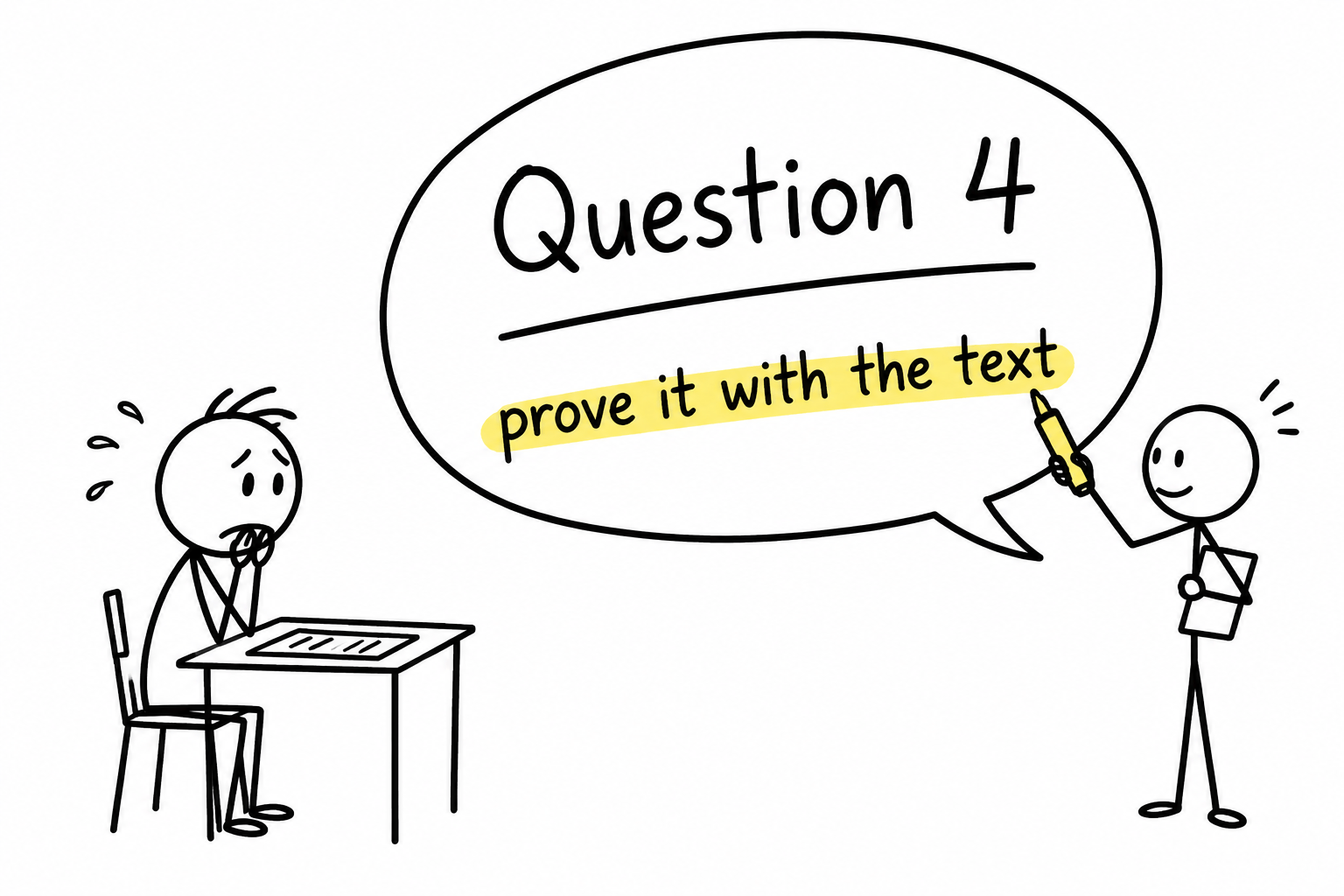 A student discovers that Question 4 mainly wants proof from the text
A step-by-step approach to the evaluate question in English
A strong method should reduce thinking pressure without making every answer sound identical. Use the following sequence each time you practise.
Break the statement into claims
Imagine the statement says:
The station seems threatening and abandoned. The writer makes the reader feel that Daniel is in serious danger.
This contains three connected claims:
- the station is threatening;
- the station is abandoned;
- Daniel appears to be in serious danger.
Turn these into targets. You now know what your evidence must help you evaluate.
Make a definite judgement
You can fully agree, partly agree or disagree. Full agreement is often the simplest route, but it is not automatically better. Your judgement earns value only when the text supports it.
A useful opening is:
I strongly agree because the writer initially makes the setting appear lifeless, before introducing signs that Daniel may not be alone.
This is stronger than simply writing, “I agree.” It identifies the writer's method of development and previews the argument.
Find evidence with analytical potential
Do not choose a quotation merely because it mentions the subject. Choose one containing a word, image or contrast you can explore.
A short quotation such as “swallowed the road” is usually easier to analyse closely than a copied sentence of four lines. The quotation is the evidence. Your explanation is where most of the thinking becomes visible.
Analyse how the writing works
Move through this chain:
judgement → evidence → method → meaning → effect → link to statement
For example:
The description of the darkness as having “swallowed the road” personifies it as a predatory force. “Swallowed” suggests that the familiar route has been consumed, leaving Daniel isolated and unable to escape. This strongly supports the view that the setting is threatening.
Naming personification helps, but the explanation of “swallowed” does the important work. Technique spotting without interpretation rarely produces a convincing evaluation.
Develop two or three distinct ideas
A paragraph should not merely repeat that something is frightening. Each paragraph needs a fresh angle, such as:
- the hostile setting;
- Daniel's physical reaction;
- the gradual suggestion of another presence;
- a change from uncertainty to immediate danger.
Three developed paragraphs are generally more useful than several thin ones. Quality matters more than following a fixed paragraph count.
Finish with an overall judgement
A brief conclusion can show that you have evaluated the statement as a whole:
Overall, the statement is convincing because the writer combines an apparently empty setting with increasingly clear signs of pursuit, making Daniel's danger feel both mysterious and immediate.
This is not compulsory as a separate paragraph, but a controlled final judgement helps create a complete argument.
Original sample extract
Read this fictional extract, written for practice. Daniel has missed the last bus and is walking past a disused railway station.
The station crouched beyond the fence, its windows dull beneath the rain. Weeds had forced their way through the platform and wrapped themselves around a rusted luggage trolley. Daniel told himself that there was nobody there. There could not be. The place had been locked for years.
Then the waiting-room door moved.
It opened only a fraction, paused, and settled back into darkness. Daniel stopped. Behind him, the empty road shone under one failing streetlamp; ahead, the footpath narrowed beside the fence. He listened. At first there was only the rain tapping against the station roof. Then came a slower sound: scrape, silence, scrape.
Daniel began to walk again. So did the sound.
Practice statement:
A student said, “The station feels neglected and threatening. The writer makes Daniel's fear convincing and leaves the reader certain that he is being followed.”
Evaluate this statement, using evidence from the extract.
Planning the sample response
Before writing, build a compact evidence plan:
| Claim to evaluate | Useful evidence | Possible interpretation |
|---|---|---|
| The station is neglected | “weeds had forced their way” | Nature has taken control because people no longer maintain the station |
| The station is threatening | “station crouched” | The building resembles an animal waiting to attack |
| Daniel's fear is convincing | “There could not be” and “Daniel stopped” | His repeated self-reassurance and physical reaction reveal anxiety |
| He is being followed | “So did the sound” | The sound responds to his movement, although its source remains uncertain |
Notice one complication. The reader may strongly suspect that Daniel is being followed, but cannot be certain because the source of the sound is never revealed. That gives you an opportunity to partly challenge the final word of the statement.
Annotated grade 4 response
The following is an illustrative response pitched around a secure grade 4 standard. Grades are awarded across a whole qualification rather than guaranteed by one answer, so use the label as guidance, not a prediction.
I mostly agree that the station is neglected and threatening. The writer says that the “weeds had forced their way through the platform”. This shows that nobody has looked after the station because the weeds have been allowed to grow everywhere. The word “forced” also sounds quite violent, so the station does not seem safe. [Clear judgement, relevant quotation and a valid comment on one word.]
Daniel's fear is believable when he tells himself, “There could not be” anyone there. The short sentence shows that he is trying to calm himself down, but it also makes it sound like he is worried that somebody is inside. When the door moves, “Daniel stopped”, which shows his fear through his physical reaction. [Two suitable references are linked directly to Daniel's fear.]
I agree that he could be followed because when Daniel walks, the sound also starts again. The final sentence, “So did the sound”, is short and creates tension. However, I do not completely agree that the reader is certain because we never find out who or what makes the noise. [A sensible evaluation considers both the evidence and the limit of the statement.]
Why this works at grade 4 level
The answer stays focused, uses several references and offers clear explanations. It comments on particular choices, including “forced” and the short final sentence. Most importantly, it evaluates rather than merely summarising events.
To move higher, the response could explore imagery and structural development in greater depth. Some comments, such as a short sentence “creates tension”, could be made more precise by explaining why the timing and placement intensify the reader's concern.
Annotated grade 5 response
This version offers more developed analysis and a more nuanced judgement.
I agree that the station appears both neglected and threatening, although the claim that the reader is “certain” Daniel is being followed is slightly too definite. The writer personifies the station as it “crouched beyond the fence”. “Crouched” gives the building the posture of an animal preparing to spring, while the fence seems less like protection than a boundary separating Daniel from a hidden threat. [A clear, qualified judgement is followed by close analysis of imagery.]
Neglect is presented as something aggressive rather than passive. The weeds have “forced their way through the platform” and “wrapped themselves around” the trolley. The verbs suggest that nature is invading and trapping what people have abandoned. This makes the setting unsettling because ordinary objects are being slowly overwhelmed. The station therefore feels beyond human control. [The answer connects language choices, setting and the precise statement.]
Daniel's fear is convincing because the narration reveals the gap between what he says and what he believes. His repeated reassurance, “There was nobody there. There could not be”, sounds increasingly desperate. The short sentences imitate urgent thoughts, and the modal phrase “could not” suggests he is insisting on safety without having proof. His fear then becomes physical when he “stopped” to listen. [Several connected choices are analysed rather than simply identified.]
Finally, the writer delays confirmation through the pattern “scrape, silence, scrape”. The repeated pauses make Daniel and the reader wait for the sound to return. The closing line, “So did the sound”, connects the noise directly to his movement, strongly implying pursuit. However, its source remains hidden. The ending therefore makes following seem highly likely, but uncertainty is exactly what sustains the threat. [The response evaluates the student's claim while examining the development of tension.]
What lifts this towards grade 5
The grade 5 response develops each inference. It does not just label personification or short sentences; it explains how those choices shape the station, Daniel and the reader's expectations. It also tests the wording of the statement instead of agreeing mechanically.
That is the central lesson of English Paper 1 Q4: evaluation means weighing how convincing a viewpoint is. Analysis supplies the proof.
Common mistakes in AQA English Language Paper 1 Question 4
Retelling the extract
Explaining that Daniel sees the door move and then hears a noise shows understanding, but not evaluation. Follow each piece of evidence with an explanation of how the writing supports or challenges the statement.
Ignoring the specified lines
The question directs you to a particular part of the source. Evidence from elsewhere will not answer the task properly. Mark the relevant section before planning.
Treating agreement as analysis
Repeating “I agree” does not develop an argument. State your judgement once, then make the evidence earn it.
Listing techniques
“The writer uses a verb, personification and a short sentence” is feature spotting. Explain what each choice suggests in its context and why that affects your judgement.
Making unsupported claims about the reader
Avoid vague lines such as “this makes the reader want to read on”. Say what the reader is encouraged to suspect, fear or question, and connect that response to specific language.
Forcing disagreement
You do not need to disagree to appear perceptive. A thoughtful full agreement can be excellent. Qualify the statement only when the text gives you a genuine reason.
Writing a memorised response
Sentence frames can help you begin, but the evidence must control the paragraph. A useful flexible frame is:
I agree to a large extent because... The description “...” suggests... In particular, “...” implies... This supports the statement because...
How to practise efficiently for a resit
Resit revision is often a question of rebuilding confidence through evidence. Begin with untimed plans. Take one statement, divide it into claims and find one quotation for each. Then write a single analytical paragraph. Only after the method feels familiar should you practise full responses under timed conditions.
Keep a simple checklist beside your work: judgement, evidence, method, interpretation and evaluation. Use official AQA papers and mark schemes whenever possible so that you become familiar with authentic question wording and AO4 expectations.
MathsGenie is primarily a free maths revision resource, but the same deliberate revision habits apply across a GCSE resit programme. If you are also retaking maths, use the GCSE Maths revision hub to organise topic practice, then test exam technique with GCSE past papers. Students sitting Edexcel maths can also work through the Edexcel GCSE Maths revision resources and Edexcel GCSE Maths past papers, which include mark schemes and worked support where available.
A resit rarely turns on one dramatic revision session. Improvement is quieter than that. One precise quotation. One developed inference. One honest check against the mark scheme. Repeat that process, and Question 4 becomes less like a demand for a clever opinion and more like a structured argument you know how to build.