Apprenticeship Maths and English Requirements by Age
Apprenticeship maths and English requirements explained by age, including current adult rules, GCSE grades, Functional Skills and employer criteria.
A missing GCSE can feel like a locked door. You find an apprenticeship that suits you, then notice the reference to English and maths. Can you still apply?
Often, yes. Apprenticeship maths and English requirements in England depend on your age when training begins, the apprenticeship level and employer or occupational conditions. Since February 2025, standalone qualifications have been optional for apprentices who started aged 19 or over, subject to employer agreement. Different rules apply to younger apprentices.
The key distinction is between an employer's entry criteria and the requirements for completing the programme.
The requirements at a glance
This summary reflects England's apprenticeship funding rules for 2026-27. Scotland, Wales and Northern Ireland have different arrangements.
| Age when training begins | General English and maths position |
|---|---|
| 16-18 | English and maths are mandatory where you lack the required acceptable qualifications. |
| 19 or over | Standalone qualifications are generally optional, provided the employer agrees. |
| Any age | An employer, apprenticeship standard or regulated occupation may impose specific requirements. |
Before applying, check your age when training starts, the apprenticeship level, the vacancy criteria and your existing qualifications. A training provider can confirm whether your certificates count as approved equivalents.
Apprentices aged 16-18
If you begin training aged 16-18 without suitable English and maths qualifications, you will normally need to continue working towards them. The completion requirement depends partly on the apprenticeship level.
Level 2 apprenticeships
Young apprentices without the required qualifications must normally study at the appropriate level and take the relevant assessment. Broadly, those below level 1 work towards level 1; those with approved level 1 qualifications but without level 2 work towards level 2.
Passing level 2 is not automatically necessary to complete every level 2 apprenticeship. Follow the requirements in your training plan and check whether the occupational standard imposes a stricter condition.
Level 3 and higher apprenticeships
Apprentices starting aged 16-18 must hold or achieve approved level 2 qualifications in both subjects before successfully completing a level 3 or higher apprenticeship.
Common acceptable qualifications include GCSE grade 4 or above, the old grade C or above, and Functional Skills Level 2. Other approved equivalents exist, so ask your provider to check unfamiliar certificates.
For maths support, the GCSE Maths revision hub provides free lessons, questions, worksheets and papers for foundation and higher tier.
What changed for adult apprentices?
The adult reform took effect on 11 February 2025. Apprentices who were aged 19 or over when training began no longer had to achieve standalone English and maths qualifications simply to complete their apprenticeship.
For adults without accepted level 2 qualifications:
- Standalone English and maths study is generally optional.
- The employer and provider decide whether to include it in the training plan.
- Funded study towards approved qualifications up to level 2 can remain available with employer agreement.
- If agreed, apprentices must participate and normally attempt the assessment.
- Passing that standalone qualification is generally not a completion requirement.
Mandatory regulatory or occupational requirements within an apprenticeship standard still apply. Ask the provider to identify these before enrolment.
The reform changes a general completion rule. It does not remove an employer's ability to request qualifications when recruiting.
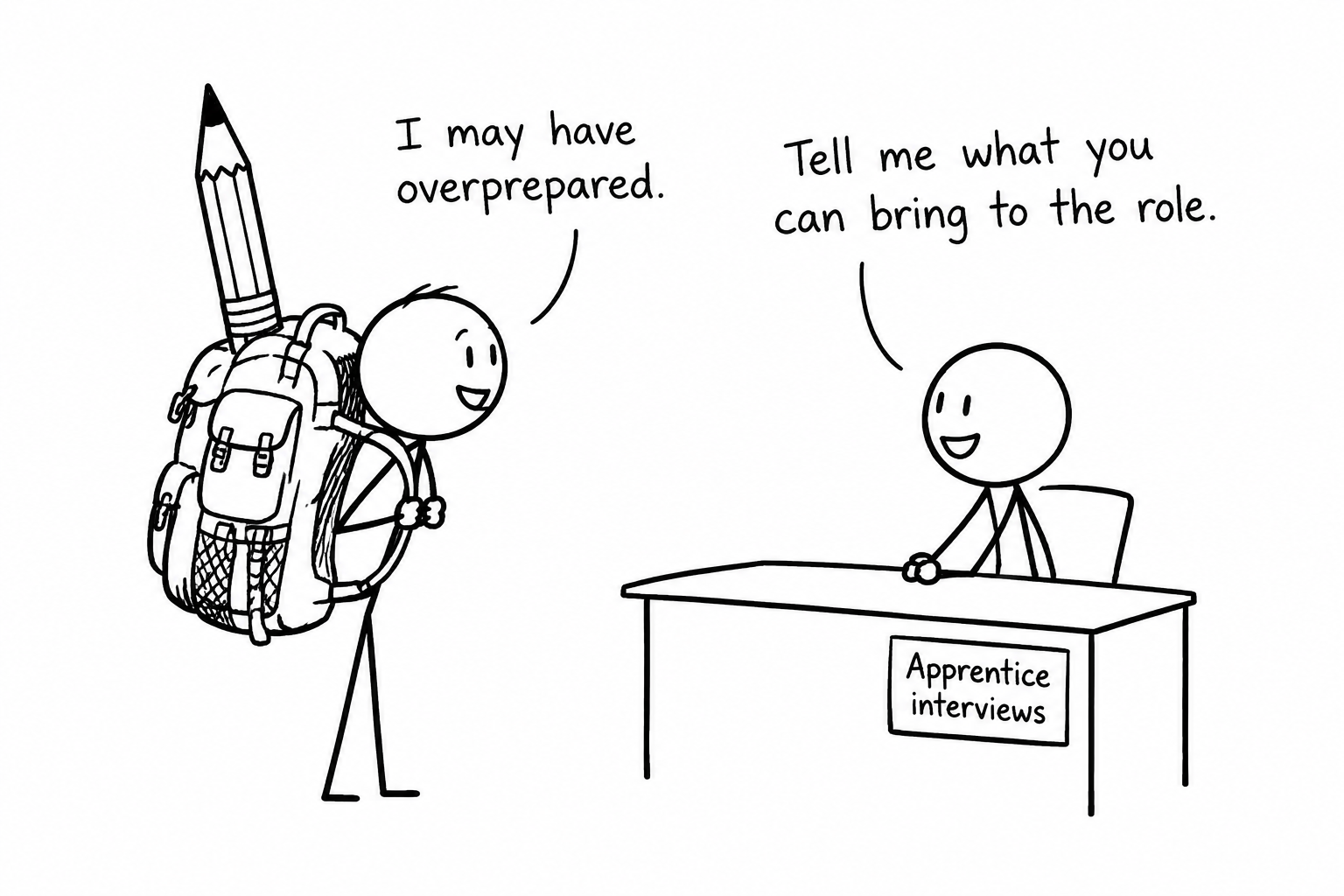 A student humorously overprepares for an apprenticeship interview with an enormous pencil
Can employers still ask for GCSEs?
Yes. Employers can set entry criteria independently of the general programme rules. A vacancy might request GCSE grade 4, accept Functional Skills Level 2 or assess literacy and numeracy during recruitment.
Separate these questions:
- Can you apply? Check the employer's stated criteria.
- Can you enrol? The provider checks qualifications and prior learning.
- What must you complete? Check your age at the start, apprenticeship level, training plan and standard.
If GCSEs are “desirable”, lacking them may not prevent an application. If they are “essential”, ask whether approved equivalents count. Unclear wording deserves clarification before you rule yourself out.
GCSEs and Functional Skills
A Functional Skills apprenticeship route generally emphasises practical applications of English and maths. Functional Skills Level 2 is commonly accepted for apprenticeship purposes.
GCSE maths covers a broader specification, while Functional Skills maths emphasises numerical reasoning in realistic contexts. Your choice depends on programme requirements, provider availability and future plans.
Acceptance for an apprenticeship does not guarantee acceptance for every later course or job. Some specifically request GCSEs.
If GCSE maths suits your route, use resources aligned with your exam board, including Edexcel GCSE Maths revision or OCR GCSE Maths revision. Matching your revision to the specification keeps your practice focused.
What if you lack grade 4 in maths?
Start with the vacancy. Some employers require the grade before recruitment; others allow continued study during training.
Ask your provider:
- Does my existing qualification count?
- Will I study GCSE maths or Functional Skills?
- What level will I start at?
- Must I pass, or study and attempt the assessment?
- Does this occupational standard impose an additional condition?
If you need a GCSE resit, use MathsGenie's free revision resources to identify gaps. Work through one topic, answer questions independently, then check your method. The fractions, decimals and percentages lesson supports skills useful in examinations and workplaces.
Then practise full papers. Use Edexcel GCSE Maths past papers or OCR GCSE Maths past papers, with mark schemes and worked solutions where available. Record why marks were lost and revisit those topics before attempting another paper.
Common mistakes when checking requirements
Confusing entry and completion rules
Adult programme flexibility does not cancel an employer's GCSE entry criteria. Check both before making an application decision.
Using your age at the wrong moment
The relevant age is normally your age when apprenticeship training begins, rather than when you browse vacancies or finish training.
Assuming every level 2 certificate counts
“Level 2” alone does not establish equivalence. Give your provider the exact qualification title, awarding organisation and result.
Applying adult flexibility to younger apprentices
The optional approach applies to those starting aged 19 or over. Mandatory requirements remain for those starting aged 16-18.
Dismissing optional study
A qualification can support future applications even when it is unnecessary for completing your current apprenticeship. Consider your next step too.
Take the next step with clear information
Read the vacancy carefully and ask the provider to confirm your requirements in writing. Keep that explanation alongside your training plan so you understand what you have agreed to complete.
If maths forms part of your route, turn uncertainty into a manageable routine with MathsGenie. Watch a revision lesson, answer practice questions, check the mark scheme and use video solutions to understand mistakes. Progress to past or predicted papers when ready.
A requirement is something to understand and plan for. Start your free GCSE Maths revision and build the evidence your next application needs.