Do Apprenticeships Require GCSE Geography?
Apprenticeship GCSE geography requirement explained: discover which routes may set a grade, how vacancies differ, and what to do if your result falls short.

A subject requirement can feel like a locked gate. You find an apprenticeship that looks right, scan the entry criteria and suddenly wonder whether one GCSE result will decide everything.
The short answer is reassuring: an apprenticeship GCSE geography requirement is uncommon. Most apprenticeships do not demand Geography specifically. Employers are much more likely to ask for GCSE Maths and English, often at grade 444 or above, although every vacancy can set its own criteria.
Geography may become essential for an individual geographic technician, geospatial, surveying, environmental or land-based vacancy. Even then, the requirement belongs to that particular employer, training provider or linked qualification, not automatically to every apprenticeship with the same title.
The practical lesson is simple: read the current vacancy, separate essential requirements from preferences, and ask the employer if anything is unclear.
The quick checklist
Before deciding whether you can apply, check:
- whether Geography is listed as essential, preferred or simply useful;
- the exact grade requested, including whether an older letter grade is shown;
- whether the requirement comes from the employer, training provider or university;
- whether equivalent qualifications are accepted;
- whether applicants awaiting GCSE results may still apply;
- whether there is flexibility for a near-miss;
- the application deadline and contact details;
- the rules for your UK nation, as apprenticeship systems differ across England, Scotland, Wales and Northern Ireland.
Never assume that one advert represents an entire career. Two employers recruiting for similar apprenticeships can choose different entry criteria.
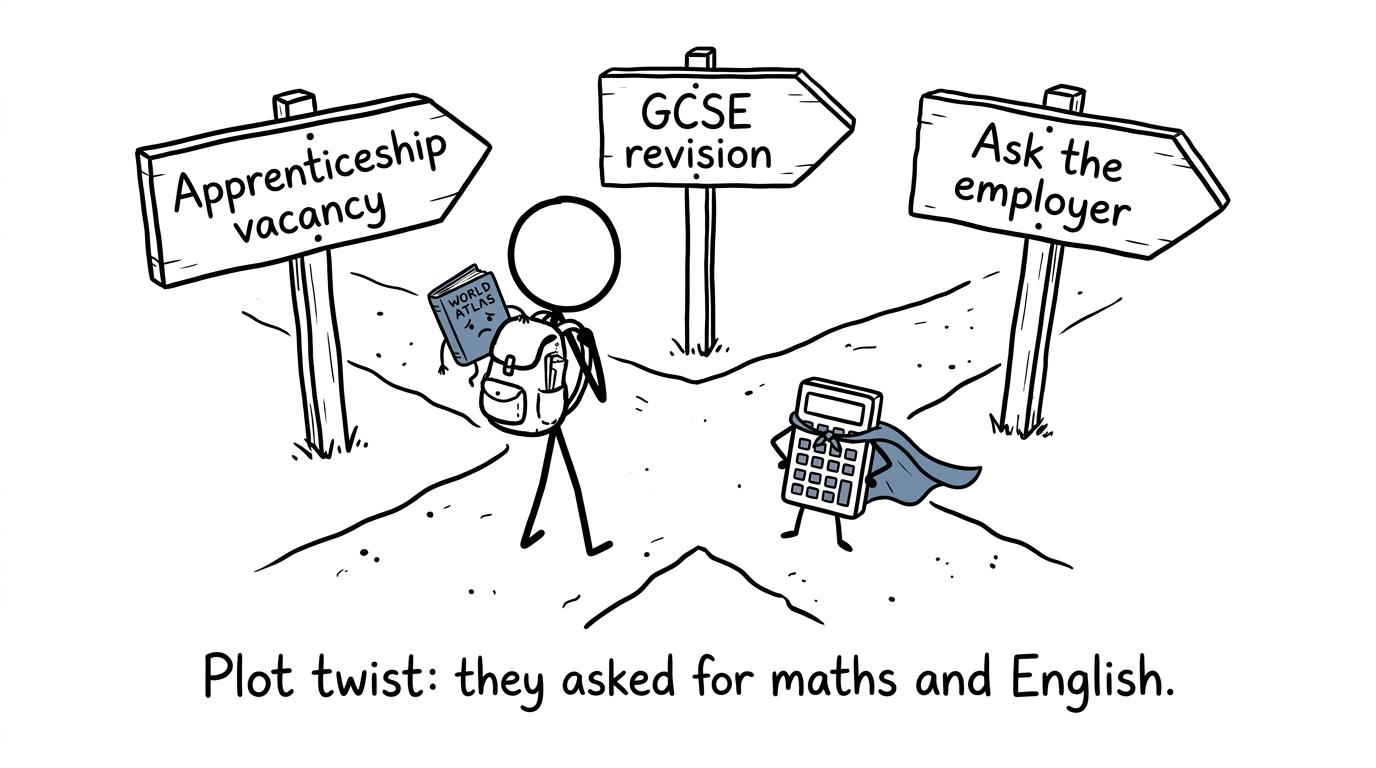 A student discovers that an apprenticeship advert asks for maths and English rather than an atlas
Which apprenticeship routes may require GCSE Geography?
There is no universal rule requiring a particular Geography grade across an apprenticeship standard. The occupational standard describes the knowledge, skills and behaviours needed for the job, while employers normally decide whom they recruit. A training provider or university may add separate academic entry conditions.
A specific Geography requirement is most plausible in the following areas.
Armed Forces geographic technician roles
Geographic and geospatial technician recruitment in the Armed Forces is one of the clearest categories in which GCSE Geography can appear as a named entry subject. These roles can involve terrain analysis, geographic information, mapping and support for operational planning.
The precise trade name, grade threshold and accepted alternatives can change. Students should therefore treat the live recruitment page as the authority rather than relying on an old careers leaflet or search-result summary.
This is also a useful distinction: an Armed Forces role may include an apprenticeship qualification, but its military eligibility and recruitment rules can go beyond the requirements of the apprenticeship standard itself.
Geospatial surveying and mapping
Geospatial apprentices may collect, interpret and present information about locations, land and the built environment. Geography naturally supports this work, particularly experience with maps, fieldwork, data and geographic information systems.
However, many vacancies prioritise Maths, English and sometimes Science rather than insisting on GCSE Geography. One employer might call Geography desirable; another might accept a related subject; a third may not mention it at all.
That is why searching only for the apprenticeship title is not enough. Read the person specification attached to each vacancy.
Environmental and countryside roles
Environmental practitioner, countryside, water, sustainability and land-based apprenticeships can value Geography because the subject develops understanding of physical processes, human activity and environmental decision-making.
Yet valued is not the same as required. Employers may accept Geography, Biology, Environmental Science or another related subject. Some focus on general GCSE attainment and evidence that the applicant is interested in the environment.
Planning, transport and civil engineering
Geography is relevant to spatial planning, transport networks, development and infrastructure. It may therefore be included among preferred subjects for planning, surveying or civil engineering vacancies.
A named minimum Geography grade is still less common than a Maths requirement. Civil engineering and surveying involve measurement, scale, proportion, data and estimation, so strengthening GCSE Maths can protect a wider range of options even when Geography is your main interest.
MathsGenie's GCSE revision by grade makes it easier to identify the topics between your current performance and your target grade.
Why similar apprenticeships have different requirements
An apprenticeship is both employment and structured training. Several organisations can therefore influence entry criteria.
The employer decides what it wants from a new employee. The training provider must be confident that the apprentice can complete the programme. For a degree apprenticeship, the university can impose course-entry requirements as well. Separate funding, eligibility or professional-body rules may also apply.
Consequently, one geospatial vacancy might require GCSE Geography at grade 444, while another describes it as desirable and a third asks only for GCSE Maths and English. The title alone cannot settle the question.
Requirements may also be written using the old letter-grade system. Broadly, grade 444 is aligned with the former grade C threshold, but applicants should follow the wording and equivalency information supplied by the recruiter rather than making their own assumption.
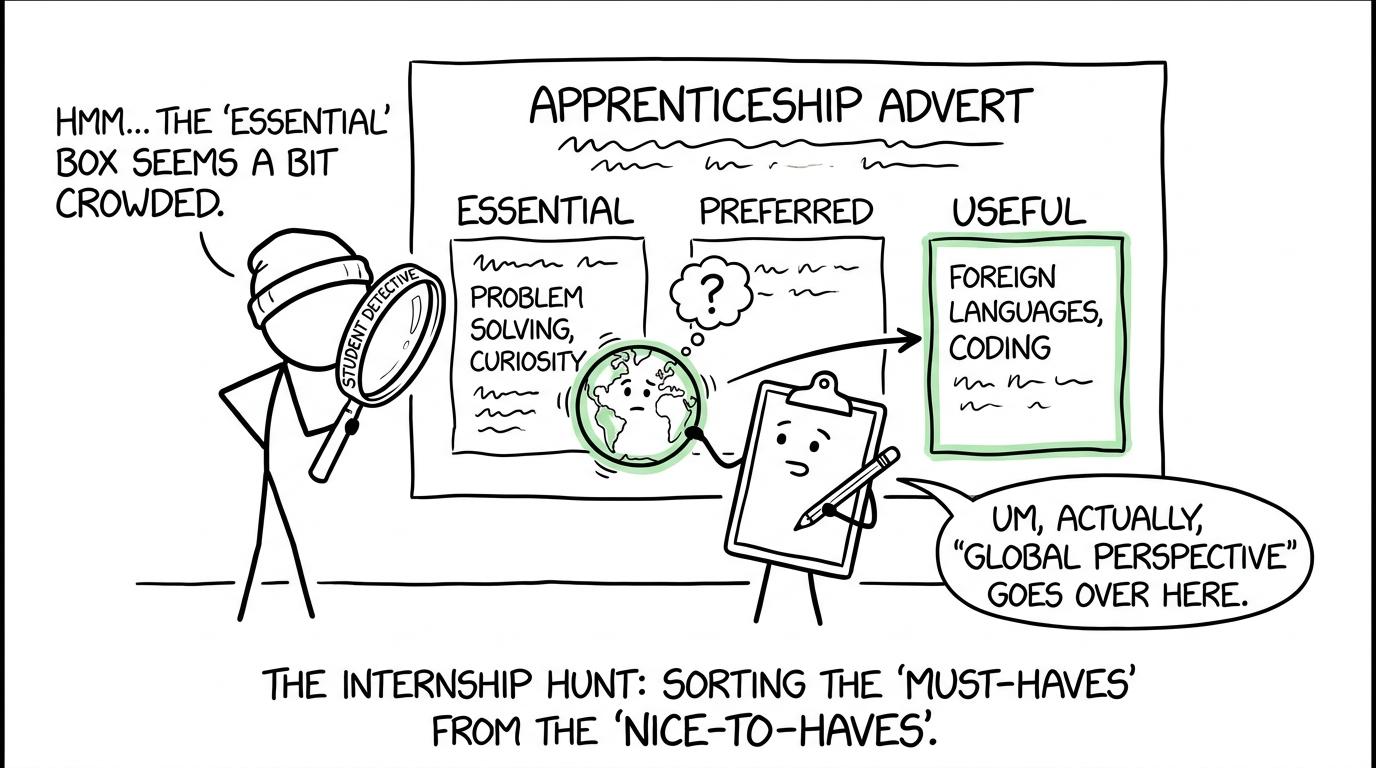 A student detective separates essential, preferred and useful requirements
How to read an apprenticeship advert properly
Small words carry a surprising amount of weight in recruitment.
Essential normally means that the employer expects you to meet the condition. If the advert says GCSE Geography at grade 444 or above is essential, do not claim that you have it when you do not. Contact the recruitment team and ask whether an equivalent subject, a pending resit or relevant experience can be considered.
Desirable or preferred means that the qualification can strengthen an application but is not necessarily a condition of applying. You can still demonstrate suitability through fieldwork, map-reading, data handling, volunteering, projects or genuine knowledge of the occupation.
Including Geography is usually stricter than including Geography or a related subject. Read the complete sentence and any linked eligibility document.
Also check whether grades must already have been achieved. Some vacancies accept predicted grades and make a conditional offer, while others require certificates before employment begins.
What to do if you are short of the required grade
Being below a stated threshold is a problem to investigate, not a reason to disappear from the process.
Contact the employer before ruling yourself out
Write a short, precise message. State your achieved or predicted Geography grade, mention the published requirement and ask whether there is flexibility or an accepted equivalent. If you are awaiting a review or planning a resit, say so clearly.
Do not ask the employer to ignore its rules. Ask what routes are genuinely available.
Check for equivalent evidence
A recruiter may consider a related GCSE, overseas qualification or later qualification, but only the recruiter can confirm equivalence. Practical experience can strengthen an application, although it does not automatically replace an essential certificate.
Keep copies of certificates and obtain official confirmation of results. Memory is not evidence, particularly when an offer is conditional.
Consider a resit
If Geography is essential for a route you strongly want, a resit may be worthwhile. Speak to your school, college or an examination centre about availability, costs, deadlines and the specification you would sit. Geography resit arrangements are not the same as the established November resit opportunities for GCSE Maths and English, so confirm the available series rather than assuming there will be an autumn paper.
Apply to comparable vacancies
Do not confuse one employer's threshold with the whole occupation. Search for similar geospatial, environmental, planning, surveying or technician roles and compare their criteria.
A sensible application list contains realistic alternatives. That is not lowering your ambition. It is recognising that careers have more than one entrance.
Protect your Maths grade too
For many technical apprenticeships, GCSE Maths is more likely to be named as essential than Geography. If Maths is currently the weaker result, begin with the MathsGenie grade 333 revision topics, grade 444 revision topics or grade 555 revision topics, depending on your target.
Each topic can be approached in a steady order: learn the method, attempt practice questions, mark the work honestly and revisit errors. Once individual skills are secure, use GCSE Maths past papers to practise selecting methods under exam conditions.
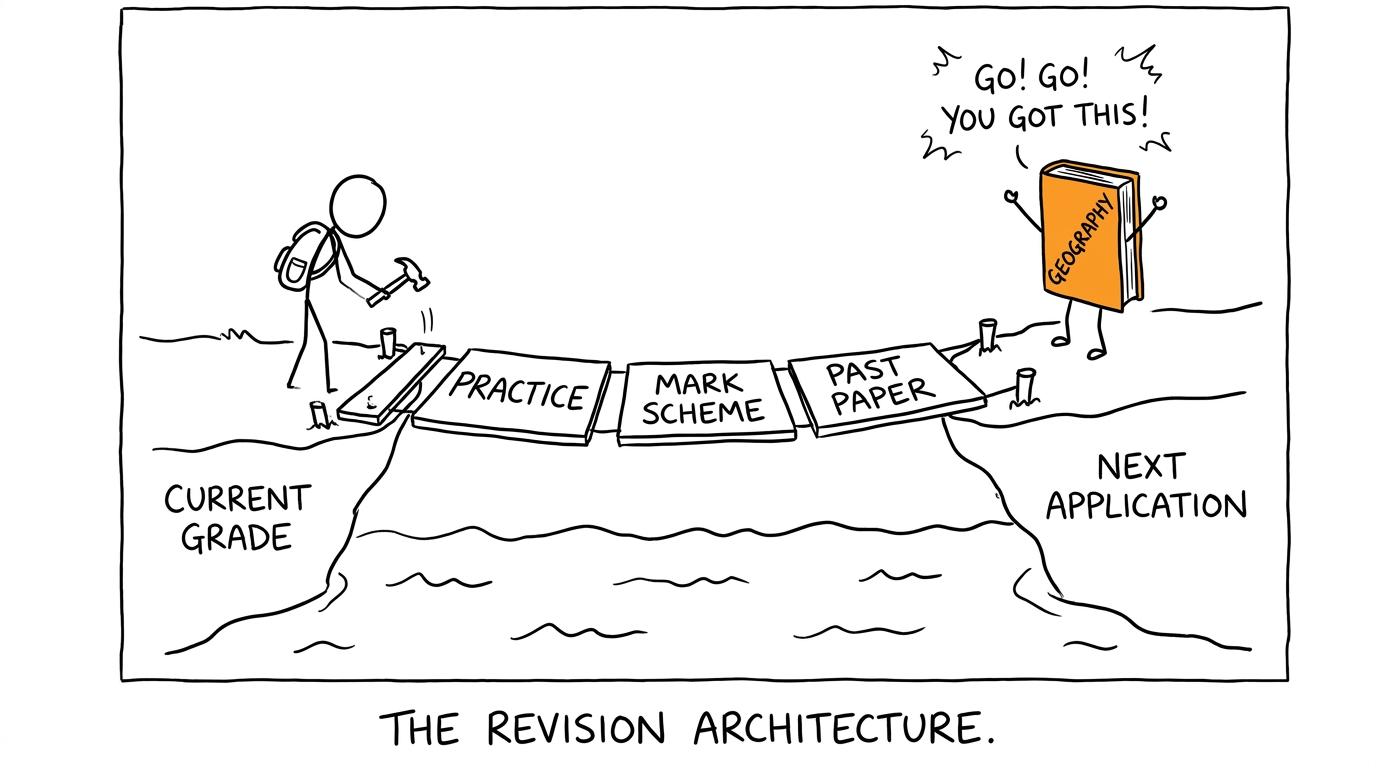 A student builds a revision bridge using practice, mark schemes and past papers
Build evidence beyond one GCSE result
Grades matter when they are listed as entry conditions, but employers are also recruiting a future colleague. Your application should show why the work interests you and how you approach responsibility.
For geography-related roles, useful evidence might include:
- explaining what you learnt from GCSE fieldwork;
- describing careful collection or interpretation of data;
- showing an interest in maps, places, infrastructure or the environment;
- giving evidence of teamwork and safe working;
- demonstrating digital confidence;
- checking your conclusions rather than guessing.
Maths revision builds several of the same habits. You interpret information, choose a method and test whether an answer is reasonable. Moving from short topic questions to MathsGenie GCSE mini tests can help you practise recalling methods without being told which topic is being assessed.
Closer to the examination, MathsGenie predicted papers provide additional practice alongside official past papers. Predicted papers are revision resources, not forecasts of the exact questions that will appear.
Common mistakes to avoid
Treating a preference as a fixed rule
If Geography is desirable, that does not mean applicants without it are automatically excluded. Read the essential criteria separately.
Assuming every employer uses the same threshold
Apprenticeship standards do not make all recruitment adverts identical. Check every live vacancy independently.
Relying on an old screenshot
Entry requirements, role names and application windows can change. Return to the current employer or training-provider listing before applying.
Hiding a lower grade
Never alter or misrepresent a result. Be accurate, ask about alternatives and explain any resit honestly.
Focusing on Geography while neglecting Maths and English
A geography-related career can still depend heavily on numeracy and communication. Use foundation and higher GCSE Maths revision resources to work at the tier appropriate to your examination entry.
Revising without checking mistakes
Completing questions is only the first half of practice. Compare your reasoning with the mark scheme or video solution, identify where marks were lost and try the skill again without looking.
Your next step
A specific GCSE Geography grade can matter, particularly in an individual geographic technician or closely related vacancy. But it is not a blanket apprenticeship rule, and it should not be inferred merely because a job involves maps, land or the environment.
Find the live advert. Identify who sets the condition. Ask whether alternatives are accepted. Then strengthen the qualifications that keep appearing across your preferred vacancies.
For GCSE Maths, MathsGenie gives you a free route from uncertainty to organised practice: revision lessons, video solutions, practice questions, mini tests, mark schemes, past papers and predicted papers. Start with the topic at the edge of your confidence, practise it carefully, and let each corrected mistake make the next application a little stronger.