Angles and Pythagoras GCSE: Quick Wins for Your Resit
Angles and Pythagoras GCSE revision for your resit: learn angle rules, parallel lines and missing sides with clear examples, reasons and focused practice.
A familiar diagram can feel surprisingly unfamiliar when you are resitting GCSE maths. You recognise the triangle or parallel lines, but cannot quite remember which rule comes next. That gap between recognition and action is where focused practice helps.
For angles and Pythagoras GCSE questions, start with three decisions: identify the angle relationship, write the reason, and check whether a triangle is right-angled before calculating a missing side. These habits give you a repeatable way into questions that might otherwise feel like guesswork.
You do not need to revise every geometry topic at once. Begin with the facts that connect to several question types, then practise choosing between them.
Your quick-win checklist
Before tackling mixed questions, check that you can:
- Recall angle totals for a straight line, a full turn and a triangle.
- Recognise vertically opposite angles and equal angles in an isosceles triangle.
- Identify corresponding, alternate and co-interior angles on parallel lines.
- Write a precise reason beside an angle calculation.
- Identify the hypotenuse and use Pythagoras to find either type of missing side.
- Check units, rounding and whether your answer fits the shape.
Use MathsGenie's GCSE angle revision resources to revisit any facts that feel uncertain. Try questions before reading their solutions: that reveals what you can retrieve independently.
Angle rules GCSE: facts that unlock the diagram
An angle question often becomes manageable once you label something you know. That first calculation may reveal the next one.
Keep these facts close:
| Situation | Angle fact |
|---|---|
| Angles on a straight line | Add to 180∘180^\circ180∘ |
| Angles around a point | Add to 360∘360^\circ360∘ |
| Vertically opposite angles | Are equal |
| Interior angles of a triangle | Add to 180∘180^\circ180∘ |
| Interior angles of a quadrilateral | Add to 360∘360^\circ360∘ |
| Base angles of an isosceles triangle | Are equal |
Use the markings and information given. A triangle that merely looks symmetrical is not enough to establish that two angles are equal.
Exam-style example: an isosceles triangle
Triangle ABCABCABC has AB=ACAB=ACAB=AC. The angle at AAA is 46∘46^\circ46∘. Find the angle at BBB, giving reasons.
The equal sides meet at AAA, so the equal base angles are at BBB and CCC.
First find their combined total:
180∘−46∘=134∘180^\circ-46^\circ=134^\circ180∘−46∘=134∘Then divide equally:
∠ABC=134∘÷2=67∘\angle ABC=134^\circ\div 2=67^\circ∠ABC=134∘÷2=67∘Reasons: angles in a triangle add to 180∘180^\circ180∘, and the base angles of an isosceles triangle are equal.
Writing only “isosceles” leaves part of the explanation unstated. Name the property you actually used.
Parallel lines: identify the relationship first
Parallel-line diagrams become less intimidating when you stop searching for a familiar orientation. The lines can be tilted or the page rotated; the relationships stay the same.
A transversal is a line crossing the parallel lines. Look at where each angle sits relative to that transversal and the two intersections.
- Corresponding angles occupy matching positions and are equal.
- Alternate angles lie on opposite sides of the transversal. Alternate interior angles lie between the parallel lines and are equal.
- Co-interior angles lie between the parallel lines on the same side of the transversal and add to 180∘180^\circ180∘.
Letter shapes can help you recognise a relationship, but write its mathematical name in your answer. MathsGenie's angles in parallel lines lessons are useful for practising this recognition.
Exam-style example: two connected steps
Two parallel lines are crossed by a transversal. An interior angle is 112∘112^\circ112∘. Angle xxx is alternate to it. Angle yyy is adjacent to xxx on a straight line. Find both angles and give reasons.
First:
x=112∘x=112^\circx=112∘Reason: alternate angles on parallel lines are equal.
Then:
y=180∘−112∘=68∘y=180^\circ-112^\circ=68^\circy=180∘−112∘=68∘Reason: angles on a straight line add to 180∘180^\circ180∘.
This is a useful exam habit: attach a reason to each step as you go. You avoid reaching the end with the correct number but no clear explanation of how you obtained it.
Practise with parallel-line exam-style questions, including diagrams drawn at different angles.
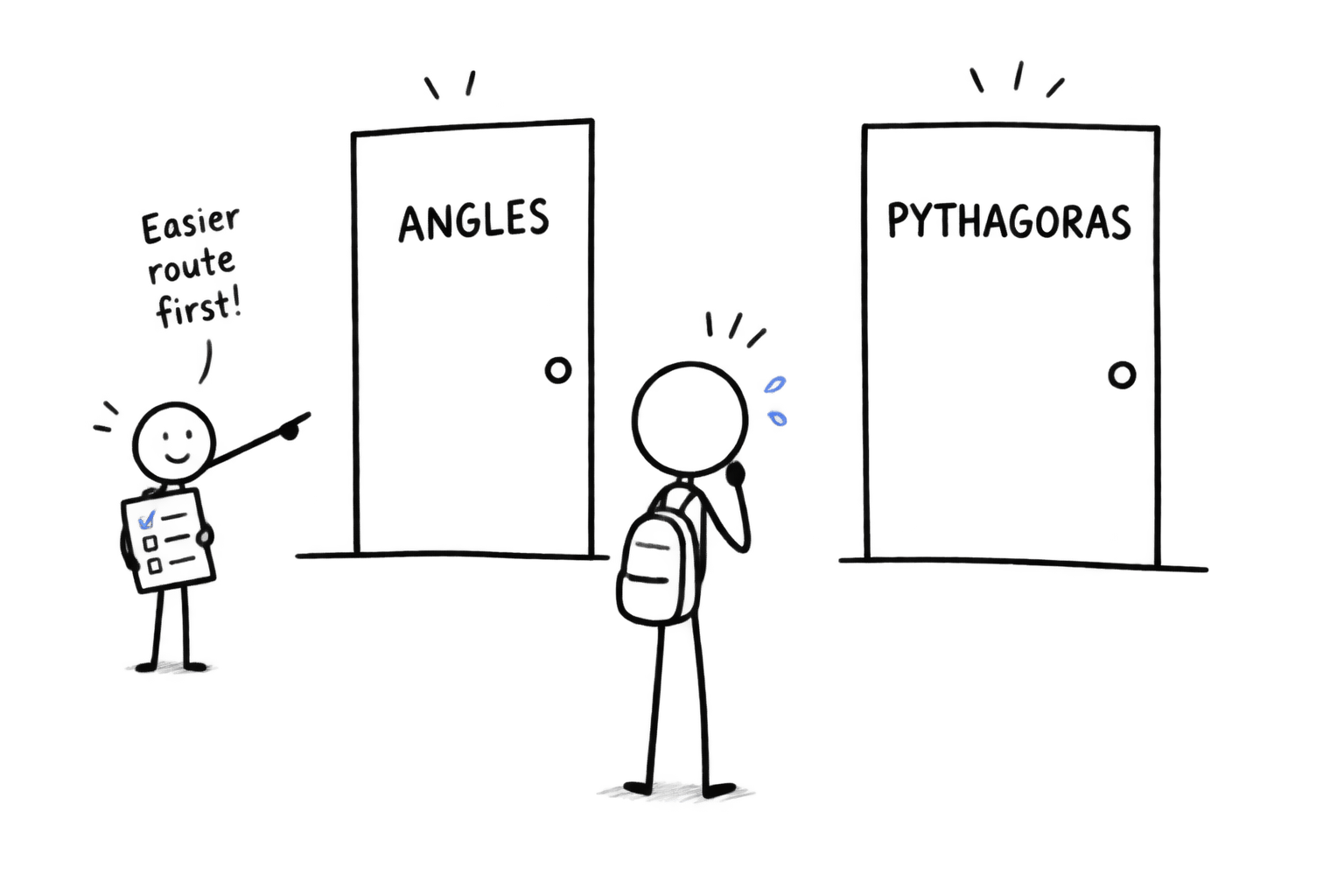 Minimalist stick-figure comic showing a nervous resit student choosing between doors labelled Angles and Pythagoras, helped by a calm figure with a checklist
Pythagoras theorem foundation: choose the correct side
Pythagoras connects the three side lengths of a right-angled triangle:
a2+b2=c2a^2+b^2=c^2a2+b2=c2Here, ccc is the hypotenuse: the side opposite the right angle and the longest side. The letters are labels, so a question may use different ones.
Before substituting anything, mark the hypotenuse. This small pause helps you decide whether to add or subtract the known squares.
If you are finding the hypotenuse, add:
c=a2+b2c=\sqrt{a^2+b^2}c=a2+b2If you are finding a shorter side, subtract its partner's square from the hypotenuse squared:
a=c2−b2a=\sqrt{c^2-b^2}a=c2−b2The MathsGenie Pythagoras revision resources let you practise both arrangements. Keep both in your revision: recognising when subtraction is needed matters just as much as remembering the theorem.
Exam-style example: find the hypotenuse
A right-angled triangle has perpendicular sides of 6 cm6\text{ cm}6 cm and 8 cm8\text{ cm}8 cm. Find the hypotenuse, ccc.
c2=62+82=36+64=100c^2=6^2+8^2=36+64=100c2=62+82=36+64=100 c=100=10 cmc=\sqrt{100}=10\text{ cm}c=100=10 cmReason: Pythagoras' theorem applies because the triangle is right-angled.
Check the result: 10 cm10\text{ cm}10 cm is longer than both known sides. That is consistent with finding the hypotenuse.
Exam-style example: find a shorter side
A ladder is 13 m13\text{ m}13 m long. Its foot is 5 m5\text{ m}5 m from a vertical wall on horizontal ground. How high up the wall does it reach?
The wall and ground form a right angle. The ladder is opposite that angle, so it is the hypotenuse. Let the height be hhh.
h2+52=132h^2+5^2=13^2h2+52=132 h2=169−25=144h^2=169-25=144h2=169−25=144 h=144=12 mh=\sqrt{144}=12\text{ m}h=144=12 mReason: Pythagoras' theorem applies to the right-angled triangle formed by the wall, ground and ladder.
Notice that 144144144 is the squared height. Taking the square root completes the calculation. The height is also shorter than the ladder, which provides a useful check.
When angles and Pythagoras work together
Sometimes you must establish the right angle before using the theorem.
Suppose a triangle has two angles of 35∘35^\circ35∘ and 55∘55^\circ55∘. Its remaining angle is:
180∘−35∘−55∘=90∘180^\circ-35^\circ-55^\circ=90^\circ180∘−35∘−55∘=90∘Reason: angles in a triangle add to 180∘180^\circ180∘.
You now know the triangle is right-angled. If two side lengths are given, you can identify the hypotenuse and use Pythagoras to find the third.
The important connection is the order: establish the angle, then choose the side-length method. Pythagoras calculates lengths; it does not directly calculate an unknown angle.
A calm routine for unfamiliar diagrams
When a diagram combines several facts, resist the urge to calculate immediately. Read the final instruction first, then work backwards: what fact would let you find that angle or length? Mark equal sides, parallel arrows and the right-angle symbol. Next, copy known values onto the part of the diagram where you will use them. This turns a crowded picture into a sequence of small decisions.
Before pressing the calculator, write the rule or equation. For angles, this might be x+68∘=180∘x+68^\circ=180^\circx+68∘=180∘. For Pythagoras, it might be x2+72=122x^2+7^2=12^2x2+72=122. A visible setup can earn method marks even if later arithmetic goes wrong, subject to the mark scheme for that paper. It also makes checking easier: if xxx is supposed to be an acute angle, an answer above 90∘90^\circ90∘ should prompt another look.
On non-calculator questions, show exact arithmetic clearly. On calculator questions, keep unrounded values in your calculator and round only when instructed. Finally, reread the wording. “Find” asks for a value; “show that” requires a convincing chain of working; “give a reason” means the geometry fact must be stated, not merely implied.
Common mistakes that cost avoidable marks
Judging by appearance. Diagrams may not be drawn accurately. Use stated lengths, angle labels and markings rather than measuring by eye.
Giving a vague reason. “Parallel lines” describes the diagram. “Corresponding angles on parallel lines are equal” explains the step.
Adding every time. Adding squares finds the hypotenuse. Finding a shorter side requires subtraction after rearranging the equation.
Choosing the sloping side automatically. The hypotenuse is opposite the right angle. Its position on the page does not define it.
Forgetting the square root or units. A squared length is an intermediate result. Finish with a length in the correct units, and follow any rounding instruction.
Rounding too early. Keep the full calculator value until the final answer when further calculations depend on it.
Turn a revision session into reliable practice
Begin with a few angle questions, including written reasons. Then attempt one Pythagoras question of each type. The Pythagoras exam booklet gives you a focused source of practice.
Mark your work, identify the first incorrect step and retry the question without the solution. Use revision lessons or video solutions to resolve the specific difficulty, then return to independent practice.
Build a short mini test mixing the topics. Once the methods feel secure, use MathsGenie's GCSE revision and paper resources to practise selecting them within longer papers. Past papers and mark schemes help you review your working; predicted papers offer further practice, without guaranteeing what your exam will contain.
Add a return session to the revision planner. Your next step is manageable: complete a small set today, correct it carefully, and come back to the difficult questions. MathsGenie's free revision resources give that effort somewhere clear to go.