AI Quiz GCSE Engineering: Revise Safely
AI quiz GCSE engineering guide: learn to prompt, verify and use AI for productive self-testing while strengthening the GCSE maths skills engineers need.
A quiz can feel productive even when it is teaching you the wrong thing. That is the strange risk of AI: it can ask polished questions, praise a weak answer and explain an invented fact with complete confidence.
So, can you use an AI quiz for GCSE engineering? Yes. An AI tool can generate retrieval questions, vary their difficulty and test the mathematical skills used in engineering. But it should be treated as a practice partner, not an exam board, teacher or mark scheme. Give it precise source material, answer without help, and verify anything uncertain against your specification and trusted revision resources.
The distinction matters. A fast quiz is useful. A confidently inaccurate quiz is not.
Your quick AI engineering quiz checklist
Before starting, make sure you can answer yes to these questions:
- Have you named your qualification and exam board?
- Have you supplied the exact topic or pasted an approved topic list?
- Have you told the AI not to reveal answers immediately?
- Will you write calculations on paper and show every step?
- Will you check questionable answers against your specification, notes or mark scheme?
- Are you using AI only for revision, rather than asking it to produce assessed work?
- Have you avoided sharing your name, school, candidate details or original coursework?
That final point is important. Department for Education guidance warns that generative AI outputs can be inaccurate, biased, out of date or taken out of context. It also recommends protecting personal data. Meanwhile, JCQ rules require work submitted for assessment to be a student's own.
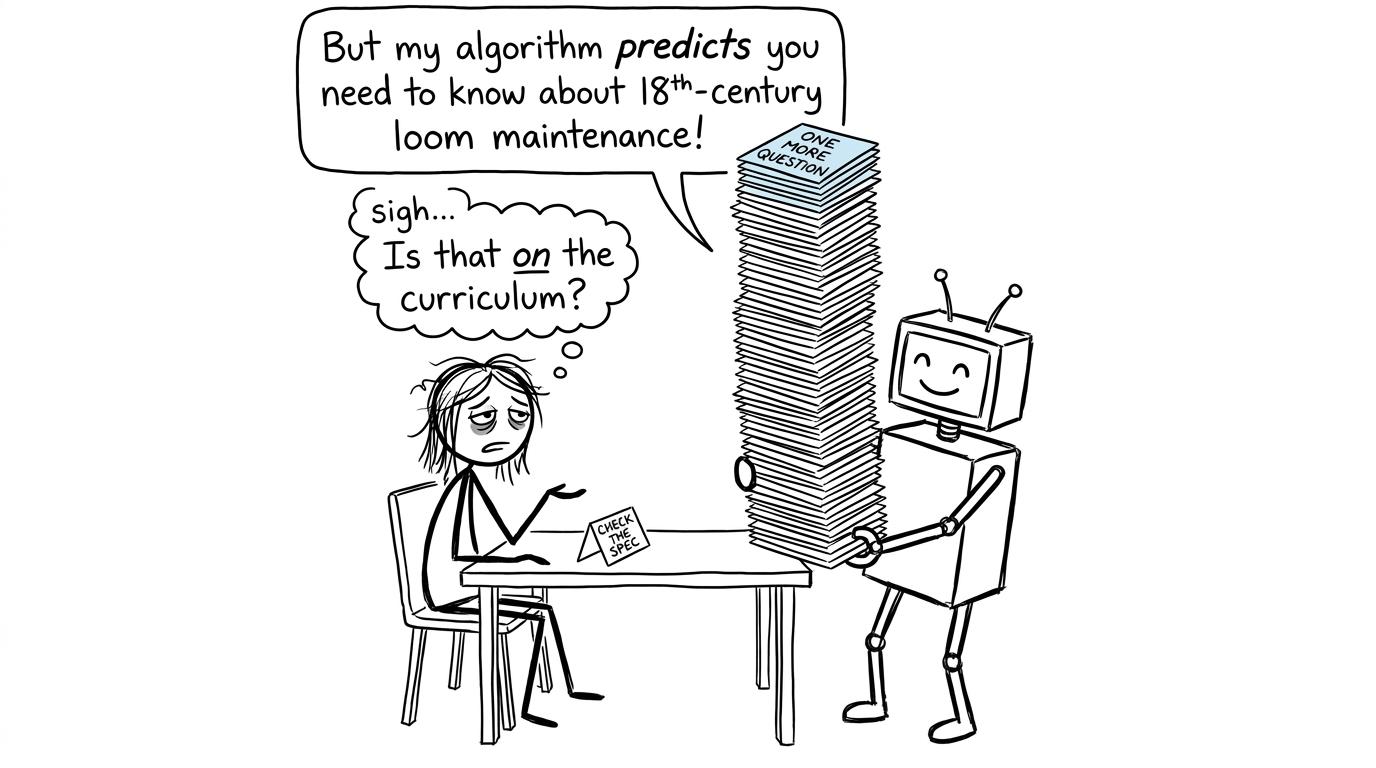 A student asks an enthusiastic AI quizmaster to check the specification
What GCSE Engineering actually requires
Start with the qualification you are taking rather than a generic idea of engineering. Specifications differ, and an AI tool may mix GCSE Engineering with Design and Technology, GCSE Physics, vocational engineering qualifications or overseas courses.
For example, the current AQA GCSE Engineering specification includes a written paper and non-exam assessment. The written examination lasts two hours, carries 120120120 marks and contributes 60%60\%60% of the qualification; the NEA contributes 40%40\%40%. The specification expects students to apply engineering knowledge, practical understanding and mathematics in engineering contexts.
Its mathematical content includes arithmetic, standard form, ratio, percentages, trigonometry, Pythagoras' theorem, significant figures, means, algebra, rearranging formulae, graphs and gradients. Relevant engineering equations include:
ρ=mV\rho = \frac{m}{V}ρ=Vmfor density,
σ=FA\sigma = \frac{F}{A}σ=AFfor stress, and
I=VRI = \frac{V}{R}I=RVfor current using Ohm's law.
This overlap is valuable if you are preparing for GCSE maths exams. Engineering gives abstract maths a purpose: ratio can describe gears, graphs can show experimental data, and area affects calculations involving pressure or stress.
Use MathsGenie's ratio revision guide, shape, area and volume resources and standard form practice questions to repair the underlying mathematical skill when an engineering calculation exposes a gap.
How to create a useful AI quiz for GCSE Engineering
The quality of the prompt sets the boundaries of the quiz. A vague request such as “Test me on engineering” gives the tool permission to wander. A focused request makes errors easier to detect.
State the qualification and source
Tell the tool your exam board, qualification title and topic. If your teacher permits it, paste a short section of the specification or a teacher-approved knowledge list and instruct the AI to use only that material.
A useful prompt structure is:
Act as a GCSE Engineering quiz partner. Use only the topic list I provide. Ask one question at a time, wait for my answer, and do not introduce content from other qualifications. Label any point you cannot verify as uncertain.
Do not assume that selecting “GCSE level” is enough. The AI may still blend content from AQA, OCR, Eduqas, an older specification or a completely different course.
Choose the kind of thinking you want
A good quiz should do more than test definitions. Ask for a balanced mixture of:
- factual recall;
- selection of appropriate materials or processes;
- interpretation of engineering information;
- short calculations;
- explanations of why a choice is suitable;
- analysis and evaluation questions;
- interpretation of tables and graphs.
You can also request separate rounds. Begin with short retrieval questions, move to application, then finish with questions requiring a justified judgement. This prevents the session becoming a stream of easy multiple-choice questions that create confidence without depth.
Make the AI wait
Tell the tool to ask one question at a time and withhold the answer until you commit to a response. For calculations, work on paper before typing your final answer.
If the tool reveals the method immediately, you practise recognition rather than recall. Recognition feels smooth because the answer is already in front of you. An examination requires you to produce the method yourself.
Demand useful feedback
Ask the AI to separate its feedback into:
- what was correct;
- what was missing;
- whether units and rounding were appropriate;
- which part requires verification;
- one follow-up question testing the same idea differently.
For formula work, insist that it checks substitution, rearrangement and units separately. If algebra is the problem, use MathsGenie's changing the subject of a formula lessons before returning to the engineering context.
Turn the quiz into a revision loop
The AI session should diagnose weaknesses, not become the whole revision plan.
After every ten questions, divide mistakes into three groups:
| Type of mistake | Best next action |
|---|---|
| Engineering knowledge gap | Return to the specification and class notes |
| Mathematical method gap | Use a focused MathsGenie lesson and question set |
| Careless or exam-technique error | Reattempt later without hints and under time pressure |
Keep a short error log. Record the topic, what went wrong and the next resource you will use. “Forgot units” is more actionable than “bad at calculations”. “Could not rearrange the equation” tells you exactly what to practise.
MathsGenie's GCSE maths worksheets by topic are useful here because they let you isolate the mathematical technique. Later, use GCSE predicted papers to test whether that technique survives inside unfamiliar exam-style questions.
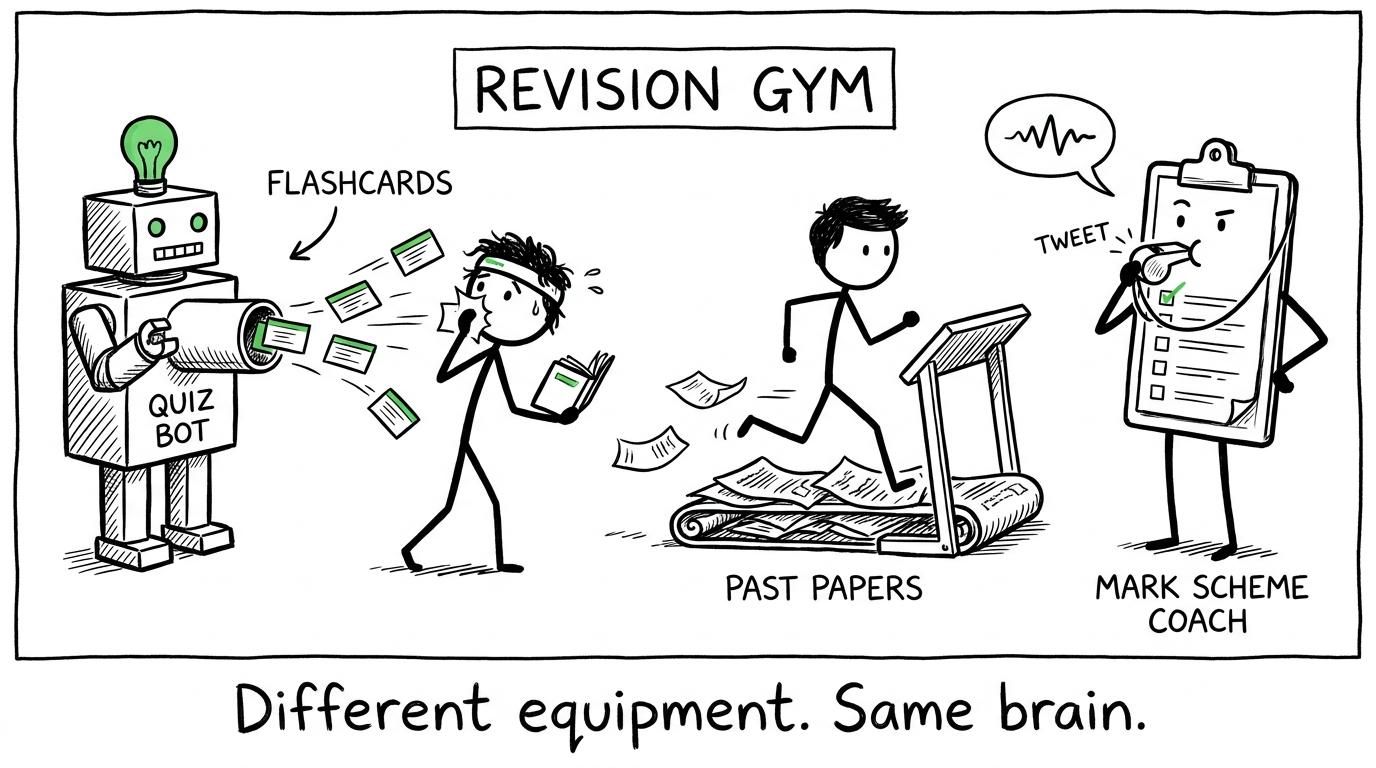 A student trains with AI quizzes, past papers and a mark scheme
Where AI tends to give bad information
AI is strongest at generating variations and weakest when you treat fluent language as evidence of accuracy. Generative systems predict plausible responses from patterns; they do not possess a mark scheme or understand your course in the way a qualified teacher does.
Invented or blended specification content
An AI tool may attribute a topic, equation or assessment rule to the wrong board. It might also describe an old course as current. Verify assessment structure and required content using the specification provided by your school or exam board.
Incorrect formulae and units
A small change in notation can alter an engineering equation. AI may confuse mass and weight, radius and diameter, or area and volume. It may also overlook unit conversions.
Check that quantities are dimensionally sensible. Area should use squared units, such as mm2\text{mm}^2mm2, while volume should use cubed units, such as mm3\text{mm}^3mm3. Density might be stated in kg/m3\text{kg}/\text{m}^3kg/m3 or g/cm3\text{g}/\text{cm}^3g/cm3, but the values placed into the formula must use compatible units.
Unreliable marking
AI feedback can be helpful, but it is not an official mark scheme. It may reward a vague explanation, miss a required justification or deny credit for a valid alternative method. Use official mark schemes and teacher feedback to understand how marks are awarded.
For GCSE maths, MathsGenie combines practice with solutions and mark schemes. Its free GCSE and A Level maths revision hub provides a more dependable route from explanation to independent practice.
False references and technical vocabulary
An answer can sound engineering-specific while containing an invented process, standard or component. Ask the AI to distinguish information taken from your supplied material from information generated from its wider training. Then verify unfamiliar terminology before learning it.
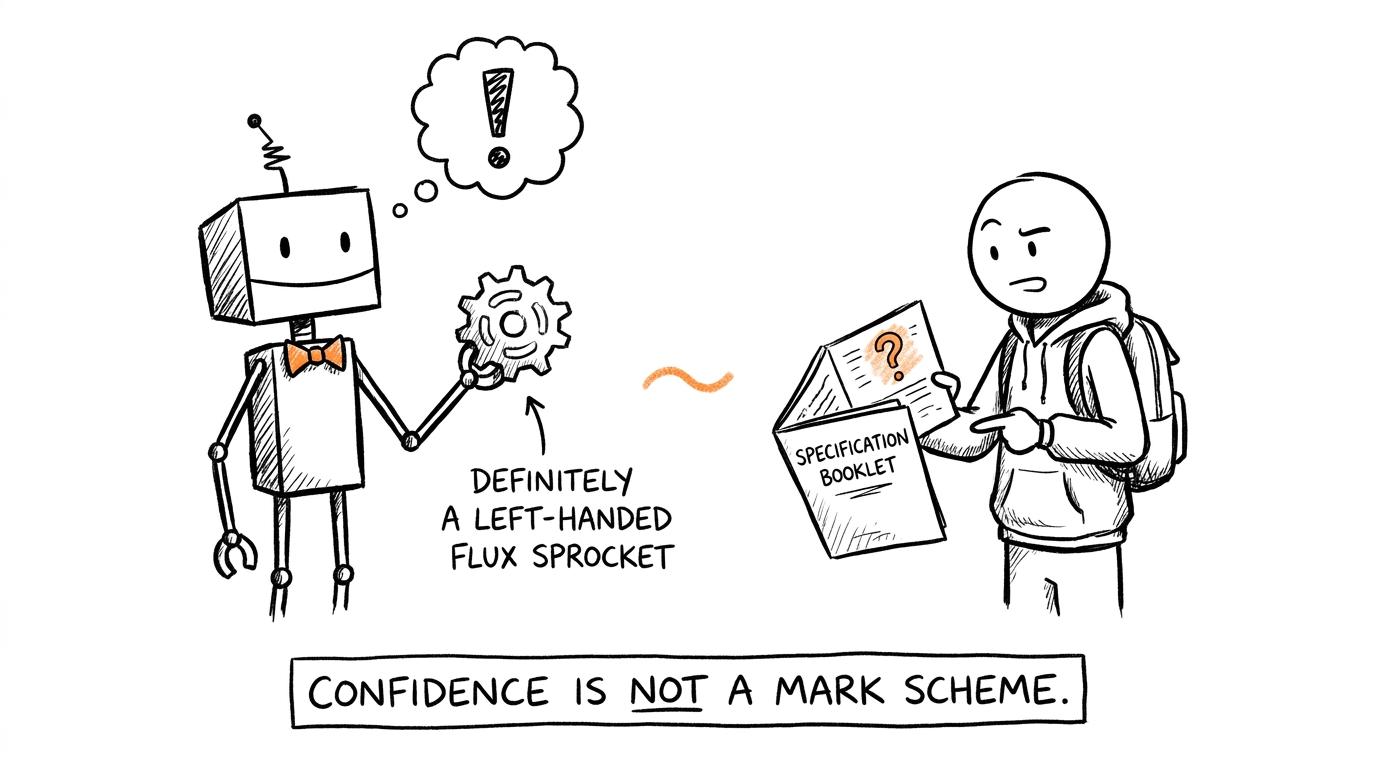 A confident robot invents a component while a student checks the specification
AI revision and your engineering NEA
Using AI for a private revision quiz is different from using it to create assessed work. GCSE Engineering can include non-exam assessment, and JCQ rules require submitted work to be your own. Copying or paraphrasing generated material without proper acknowledgement can constitute malpractice.
Follow your school's AI policy and your teacher's instructions. Do not ask a tool to write your investigation, design justification, manufacturing plan, testing section or evaluation. Do not upload confidential task materials, personal information or original portfolio work unless your school has explicitly approved the platform and the use.
A safe boundary is simple: let AI ask you questions about knowledge you are revising; do not let it become the author of evidence submitted for marks.
Common mistakes when using an AI engineering quiz
Trusting confidence instead of checking evidence
Polished wording is not proof. Pause when a claim conflicts with your notes, uses unfamiliar terminology or gives an equation you do not recognise.
Asking questions that are too broad
“Quiz me on everything” usually produces shallow coverage. Choose one specification section and one mathematical skill per session.
Accepting hints too quickly
Struggle is not wasted time. Give yourself a genuine attempt before requesting a clue, especially when selecting or rearranging an equation.
Revising only through chat
Conversation does not reproduce the pressure of reading a paper, selecting information and showing a complete method. Combine AI retrieval with written topic questions, mini tests and timed papers.
Ignoring the error log
A score tells you how the session went. An error log tells you what to do tomorrow. Follow a repeatable routine such as the one in MathsGenie's one-month GCSE maths revision plan: diagnose, practise, mark and revisit.
Make AI the assistant, not the authority
An AI quiz can make GCSE Engineering revision more responsive. It can keep asking, adapt the wording and return to a weak topic without becoming impatient. That is useful. But its speed does not remove your responsibility to verify the content, protect your data and keep assessed work genuinely your own.
Use AI to uncover the gap. Then close that gap with reliable material: a specification, a teacher, a mark scheme and deliberate written practice.
For the maths behind engineering, make MathsGenie your revision base. Start with a revision lesson, build accuracy through practice questions, check your reasoning with solutions and mark schemes, then pressure-test it using mini tests, past papers and predicted papers. The aim is not merely to answer the robot. It is to become ready for the paper.