Adults Retake GCSE Art and Design: How It Works
Adults retake GCSE Art and Design through a college or approved exam centre. Learn about courses, private entry, portfolios, fees and assessment.
A qualification can remain unfinished in your mind long after school ends. Perhaps Art and Design was the subject you dropped, the grade you want to improve, or the creative direction you only discovered later.
So, can adults retake GCSE Art and Design? Yes. Adults can enrol on a course at a college or adult learning centre, study through a distance-learning provider, or prepare independently and enter through an approved exam centre. The important complication is that GCSE Art and Design includes a portfolio and supervised practical assessment. You cannot simply book a written paper and arrive on exam day.
For students balancing creative ambitions with GCSE maths revision, the real task is not choosing between the subjects. It is building a plan that gives both enough uninterrupted time.
GCSE Art and Design retake checklist
Before paying for a course or examination entry, confirm:
- which exam board and Art and Design title you will follow
- whether you will be an enrolled learner or a private candidate
- who will supervise, authenticate and mark your portfolio
- where you will complete the supervised practical assessment
- what tuition, materials and examination fees are included
- whether any previous assessment result can be carried forward
- the centre's internal deadlines and access-arrangement process
- how the course will fit around work and other GCSE exams
That third point matters most. A centre must be able to confirm that the submitted work is yours and administer the non-exam assessment correctly.
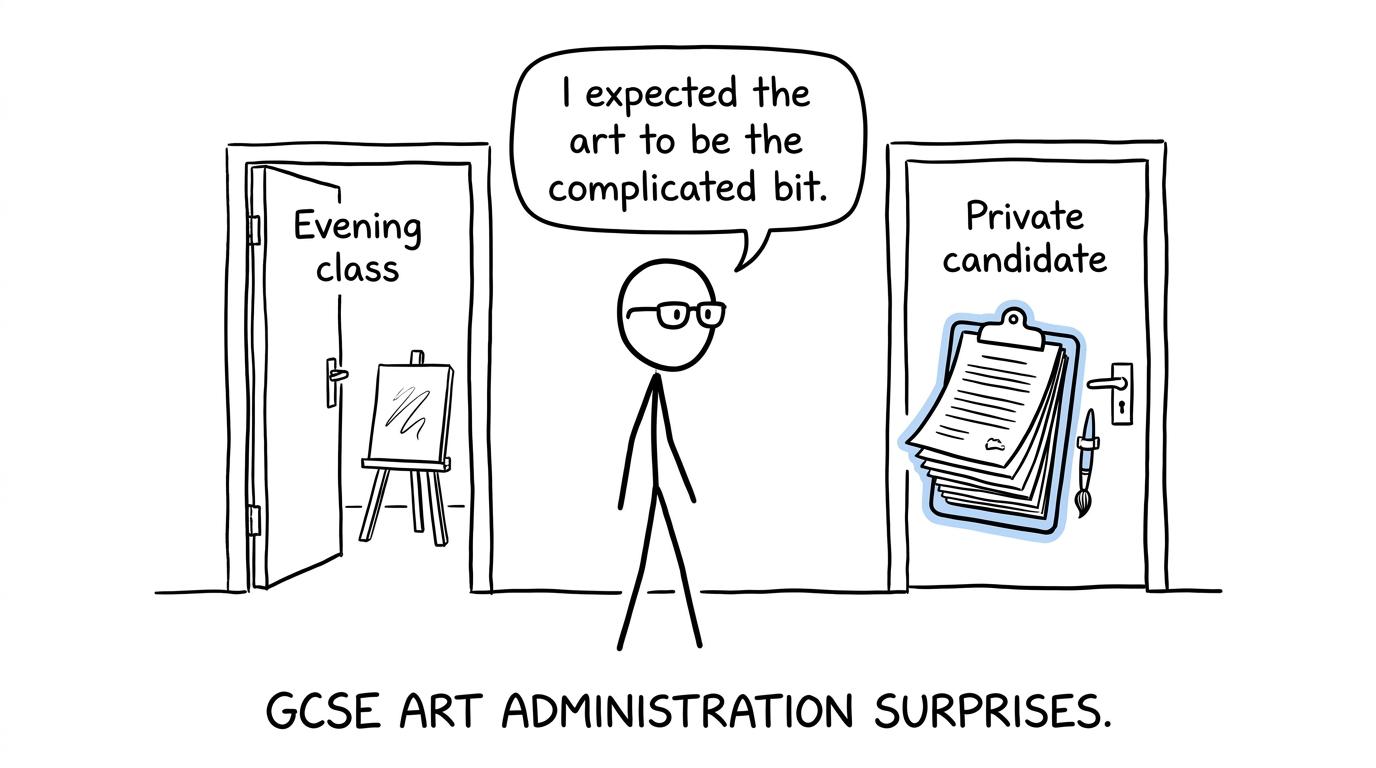 An adult learner discovers that choosing an Art retake route involves more paperwork than expected
How adults retake GCSE Art and Design
There are three main routes. None is automatically best; the right choice depends on local availability, your schedule and how much practical support you need.
Evening classes and adult learning courses
An evening or part-time course is usually the most straightforward route. You enrol with a further education college or adult learning provider, attend scheduled lessons and complete the qualification through that centre.
The centre can normally provide:
- an Art and Design teacher
- access to suitable materials and specialist equipment
- structured portfolio deadlines
- supervision and authentication of your work
- internal marking and exam-board administration
- a suitable space for the externally set task
This support is valuable because assessment rewards the development of ideas, not just a polished final piece. Regular feedback can help you show research, experimentation, refinement, recording and a meaningful response across the project.
Search local college and council adult-learning listings early. Not every provider offers GCSE Art and Design, and some courses may lead to a different Level 222 creative qualification. Ask for the exact qualification title, specification and awarding organisation before enrolling.
Distance learning with centre support
A distance-learning course can suit adults whose work, caring responsibilities or location make weekly attendance difficult. Lessons and tutor feedback may be delivered online, while practical work is completed at home.
However, the course provider and examination centre are not always the same organisation. Before enrolling, ask who will:
- authenticate the portfolio
- formally assess the work
- arrange the supervised assessment
- make the exam-board entry
- store or present physical work for moderation
A course that supplies lessons but leaves all assessment arrangements to you may still be useful, but it does not remove the hardest part of entering as a private candidate. Get the complete arrangement in writing before paying.
Entering as a private candidate
A private candidate prepares independently, with a tutor or through distance learning, then enters through an approved school, college or examination centre. Awarding organisations do not normally accept a GCSE entry directly from an individual.
Art and Design is more difficult to arrange privately than a wholly written subject. The host centre must be willing and able to supervise, authenticate, mark and administer the non-exam assessment. Accepting private candidates generally does not mean that a centre accepts them for every subject.
Contact prospective centres early and state the complete qualification, board and title. For example, Fine Art, Photography, Graphic Communication and Textile Design are distinct titles. Ask specifically whether the centre accepts private candidates for GCSE Art and Design with non-exam assessment.
Board rules matter too. OCR's current specification permits private candidates where an approved centre agrees to host and administer the assessment. AQA explains that a centre accepting an entry involving non-exam assessment must take responsibility for its supervision, authentication, marking and administration. Pearson's current GCSE Art and Design administration guidance states that its specification is not available to private candidates. Availability must therefore be checked against the current specification rather than assumed from a centre's general exam-board list.
What the assessment involves
GCSE Art and Design is not built around a conventional written examination. Across the main specifications, assessment normally consists of two parts:
- a portfolio or personal portfolio worth 60%60\%60%
- an externally set assignment worth 40%40\%40%
The externally set assignment includes preparation followed by 101010 hours of supervised practical work. Precise rules, release dates and submission procedures depend on the exam board and examination series.
Work is assessed against four equally weighted assessment objectives. Broadly, these consider whether you can:
- develop ideas through investigation and contextual understanding
- refine ideas by experimenting with materials, techniques and processes
- record observations, ideas and insights
- present a personal and meaningful response
This explains why submitting several attractive final pieces is not enough. The portfolio must reveal the journey: where an idea began, what influenced it, what you tested, what changed and why the outcome took its final form.
Sources must be acknowledged, and written annotation should clarify decisions rather than merely describe what is visible. Your centre also needs enough direct knowledge of your practice to authenticate the submission.
Choosing the right exam board and title
AQA, Pearson Edexcel, OCR and Eduqas offer related structures, but their administrative rules are not interchangeable. Do not choose a board solely because you have found its specification online. First find a centre capable of delivering it.
You will also need the correct title. Depending on the board, choices may include:
- Art, Craft and Design
- Fine Art
- Graphic Communication
- Photography
- Textile Design
- Three-Dimensional Design
- Critical and Contextual Studies
The broad Art, Craft and Design route can require work spanning more than one area, whereas an endorsed title such as Photography has a narrower disciplinary focus. Read the current specification with your centre before starting the portfolio.
If this is a genuine resit rather than your first entry, ask whether an earlier non-exam assessment result can be carried forward. Rules vary by board and qualification. OCR currently allows eligible retaking learners to carry forward their most recent result for a component, while other routes may require new work. Never reuse a previously submitted portfolio without written confirmation that the specification permits it.
Fees, funding and practical costs
There is no single national price for an adult GCSE Art and Design retake. Possible costs include tuition, exam-board entry, centre administration, assessment, moderation arrangements, studio access and materials. A private centre may combine these into one fee or charge separately.
Funding also depends on age, location, previous qualifications, income, employment status and the provider's funding arrangements. In England, adult funding gives particular legal entitlements for eligible English and maths qualifications. A GCSE in Art and Design is not automatically free simply because it is a GCSE.
Ask a provider for a written breakdown covering:
- tuition and registration
- assessment and centre fees
- essential materials
- late-entry or withdrawal charges
- arrangements if the course does not recruit enough learners
Scotland and Northern Ireland use different qualification and funding systems, while Wales has its own arrangements. Confirm local rules rather than applying guidance for England across the whole UK.
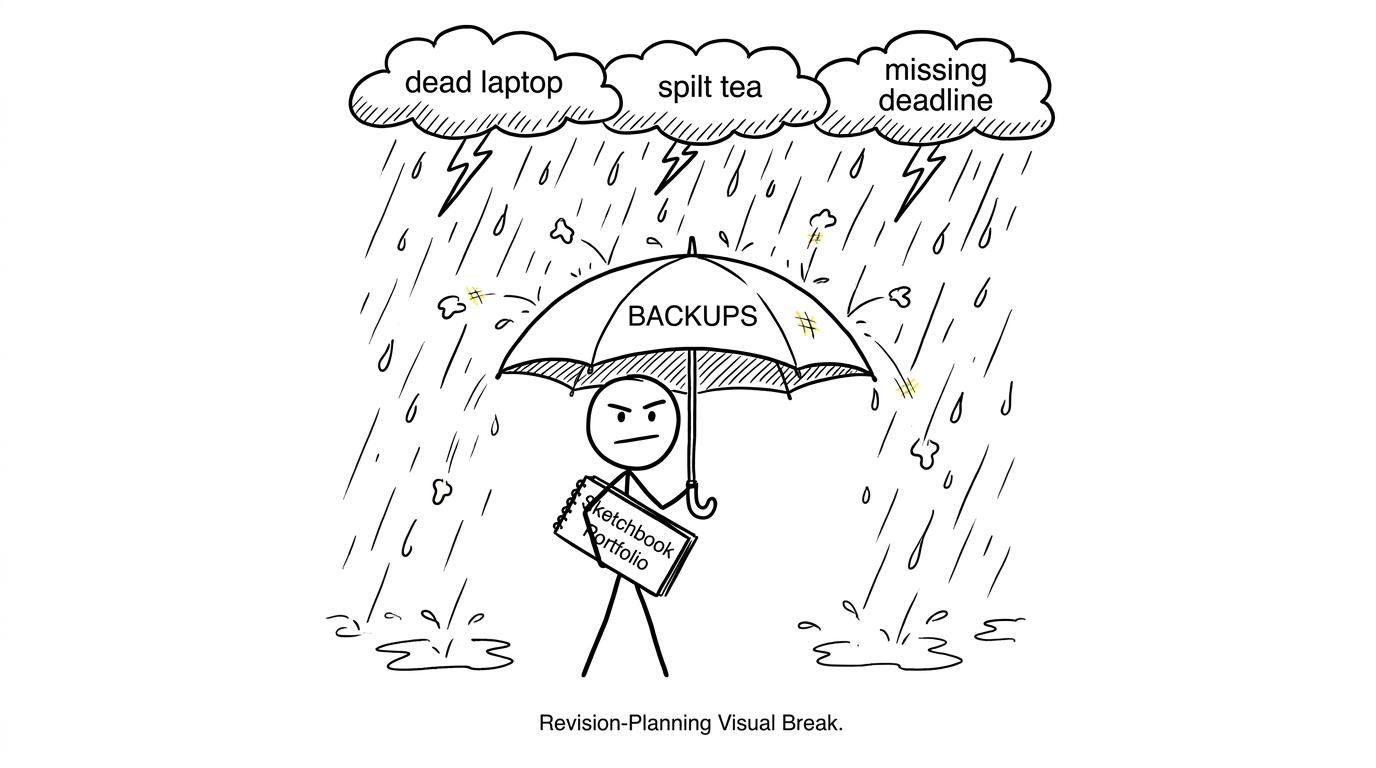 A carefully backed-up portfolio survives the traditional hazards of deadlines, laptops and tea
Balancing Art and Design with GCSE maths revision
Art expands to fill unprotected time. Maths revision can do the same. A realistic timetable should separate long creative sessions from short, focused maths practice.
Use two kinds of block:
- longer sessions for making, experimentation and portfolio development
- shorter sessions for maths retrieval, practice questions and marking
Start by using the GCSE Maths Revision hub to identify your exam board and tier. Then use the MathsGenie self-assessment resources to find the topics that actually need attention.
A useful weekly rhythm might contain several focused maths sessions, one timed set and protected portfolio blocks. The principle matters more than the exact number: each subject should have a visible next action. The GCSE maths revision timetable guide can help you build that structure.
When maths exams approach, use past papers properly: complete a suitable paper, mark it, diagnose the lost marks and return to the relevant lesson. If time is limited, MathsGenie's one-month GCSE maths revision plan provides a calmer framework than trying to revise everything at once.
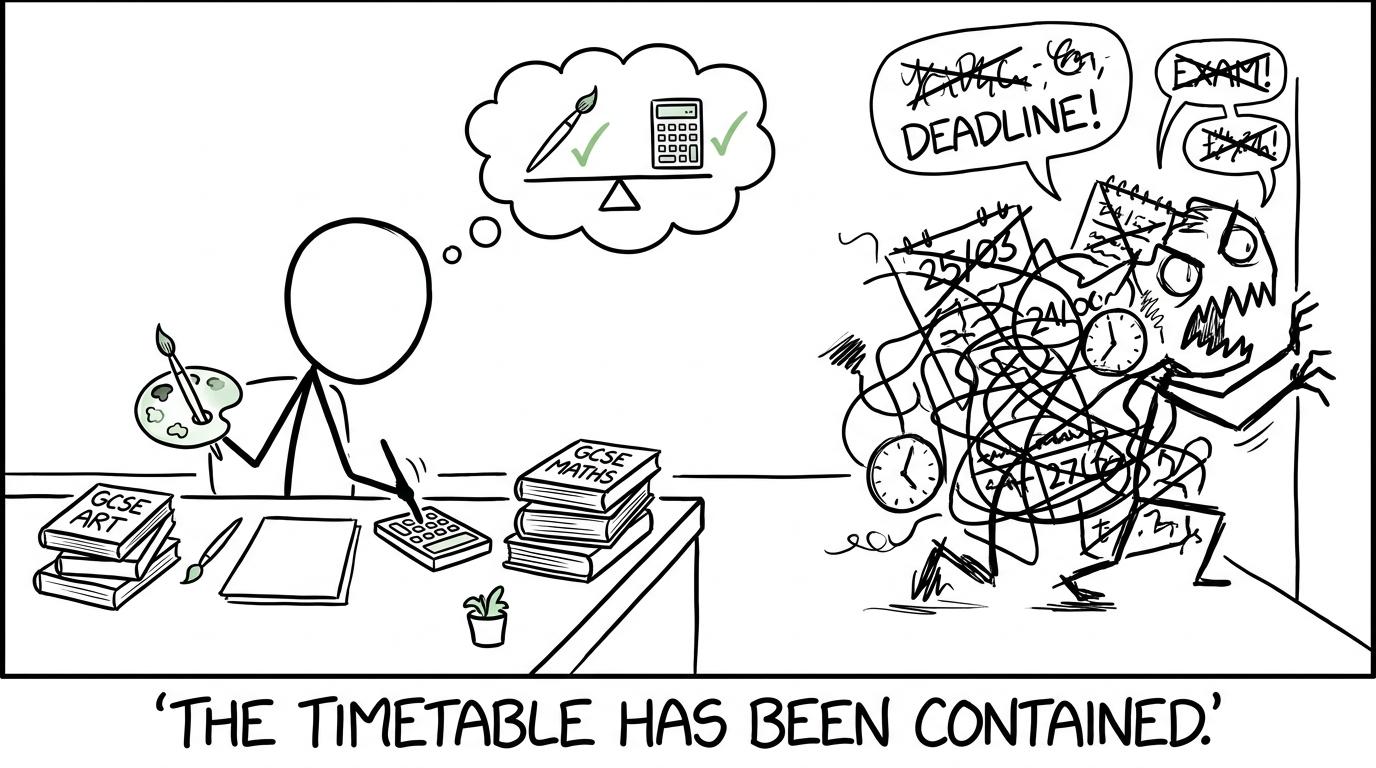 An adult learner contains the timetable monster by giving Art and Maths their own protected sessions
Common mistakes when arranging an adult Art retake
Assuming every private exam centre offers Art
A centre may accept private candidates for written GCSEs but refuse subjects involving portfolios or practical assessment. Ask about the exact Art and Design specification.
Creating a portfolio before finding a centre
The centre needs to supervise and authenticate the work. A completed independent portfolio may not be acceptable if the centre cannot verify how it was produced.
Choosing a course without checking the qualification
An adult art class may be enjoyable without leading to a GCSE. Confirm the awarding organisation, specification code, title and examination series.
Focusing only on final outcomes
The assessment objectives require development, experimentation, recording and reflection. Preserve sketchbooks, studies, photographs, annotations and evidence of changes.
Missing internal deadlines
Centres set deadlines earlier than final awarding-organisation dates so that work can be authenticated, marked and prepared for moderation. Treat the centre's date as the real deadline.
Leaving access arrangements too late
If you need reasonable adjustments, discuss them when registering. The centre must collect evidence and follow the relevant JCQ process before the published deadline.
Letting one subject consume the whole timetable
A portfolio deadline can quietly displace maths revision. Keep a separate maths routine using topic lessons, mini tests and timed papers. Near the exams, Edexcel predicted papers can complement past-paper practice, but they should not replace learning weak topics.
Your next step
Adults can retake GCSE Art and Design, but the route must be organised around the practical assessment from the beginning. An evening or part-time college course usually offers the simplest administration. Distance learning can add flexibility. Private entry can work with a suitable board and centre, but only when the centre explicitly agrees to supervise, authenticate, mark and submit the work.
Find the centre first. Confirm the specification, title, full costs and assessment arrangements. Then build a timetable that respects both the creative process and your other exams.
For maths, keep that plan simple with MathsGenie. Begin with free revision lessons and practice questions, move into mini tests, and then use past papers, mark schemes, video solutions and predicted papers to turn weak areas into reliable marks. The portfolio may be personal, but your revision does not have to be improvised.