Active Recall GCSE Latin: Does It Actually Work?
Active recall GCSE Latin strategies turn vocabulary, grammar and set texts into testable knowledge. Learn why retrieval beats passive rereading for exams.
You close the vocabulary book. A word that looked completely familiar ten seconds ago has vanished.
That uncomfortable moment explains why active recall GCSE Latin revision can be so effective. Instead of looking at information repeatedly, you practise retrieving it without help. Yes, active recall tends to work better than rereading alone because exams require you to produce knowledge, not merely recognise it on a page.
For Latin, that means recalling vocabulary, identifying endings, explaining grammar and analysing prescribed material before checking your answer. It is not a shortcut, and it should not replace translation practice. It is a way to make each revision session reveal what you genuinely know.
Active recall GCSE Latin checklist
A useful routine includes:
- closing the book before answering;
- recalling Latin vocabulary in both directions;
- retrieving noun, verb and adjective forms;
- explaining grammatical choices aloud or on paper;
- testing prescribed literature and civilisation content;
- attempting unseen translation regularly;
- checking answers immediately and correcting errors;
- returning to difficult material after a delay.
The central rule is simple: retrieve first, check second.
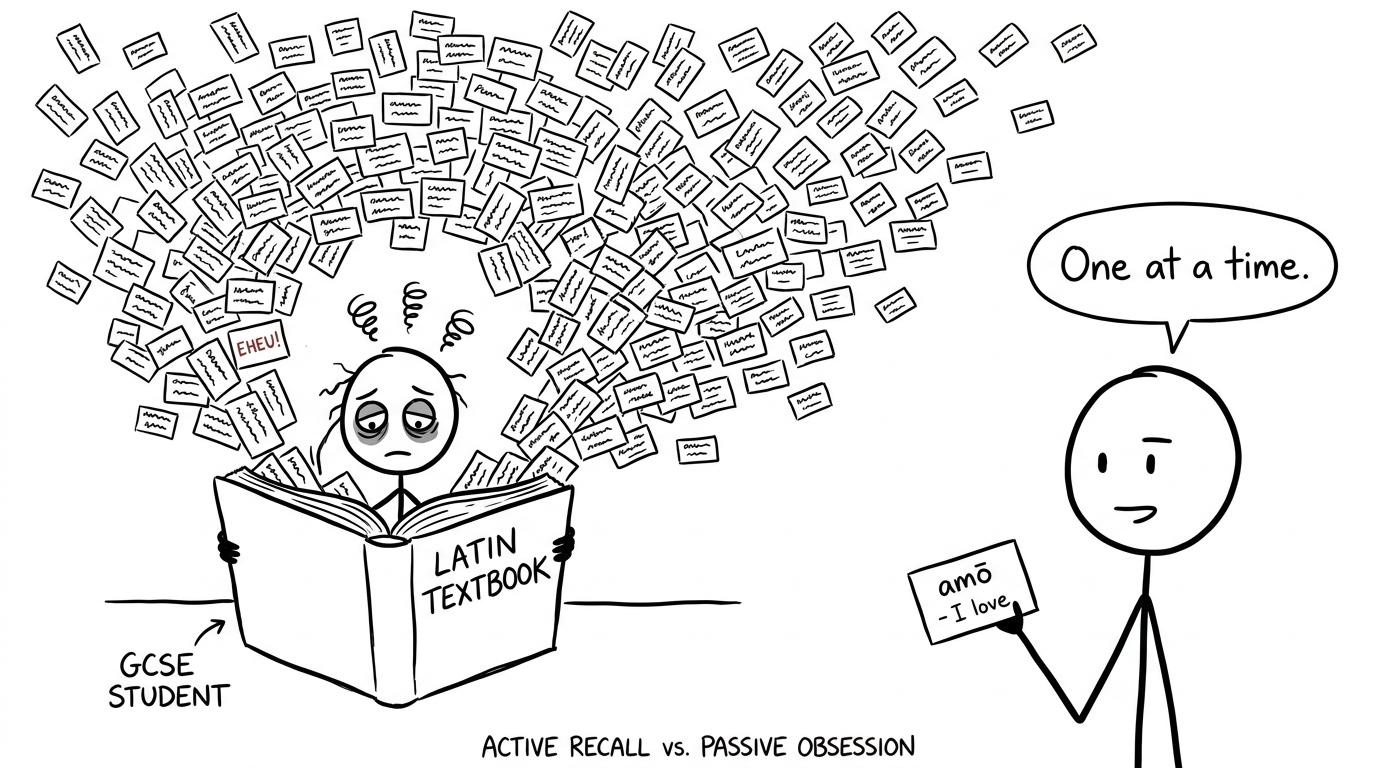 A GCSE student calmly confronting a flock of Latin vocabulary cards
Why active recall tends to beat rereading
Rereading feels productive because the material becomes increasingly familiar. Familiarity, however, is not the same as recall. Seeing puella and thinking, “I know that,” is easier than covering the definition and producing “girl” unaided.
Research into retrieval practice has repeatedly found that attempting to retrieve learned information can improve later retention more effectively than repeatedly reviewing it. Education reviews also identify practice testing and distributed practice as particularly useful learning techniques. The precise effect varies with the learner, material and quality of feedback, so active recall should not be treated as a guarantee of a particular grade.
Its value comes from three practical features.
It strengthens access to knowledge
An exam question does not show you a completed vocabulary list and ask whether it looks familiar. You must bring the relevant meaning, form or rule to mind. Retrieval practice rehearses that act of access.
The effort matters. If an answer comes slowly but correctly, that struggle can be more useful than another effortless reread. Revision does not always feel effective while it is working.
It exposes gaps early
Rereading can hide uncertainty. A closed-book question makes it visible.
Perhaps you know that servus means “slave” but cannot recognise an inflected form. Perhaps you remember a set-text translation but cannot explain why the writer chose a particular word. Those are different weaknesses, requiring different practice.
Active recall gives you information about your knowledge. That makes the next revision decision easier.
It makes feedback meaningful
Checking an answer after committing to a response creates a clear comparison between what you thought and what is correct. That comparison is more informative than reading a highlighted page again.
Feedback is essential. Recalling an incorrect answer repeatedly can reinforce the error, so use your current specification, teacher-approved resources and official materials when checking content. GCSE Latin is currently offered through specifications including OCR and Eduqas, but prescribed content and assessment requirements can change. Always follow the specification for your own course and exam series.
How to apply active recall to GCSE Latin
Latin combines several kinds of knowledge. A single stack of ordinary flashcards will not train all of them. Your questions should match the task you eventually need to perform.
Retrieve vocabulary in both directions
Latin-to-English recall supports comprehension and unseen translation. English-to-Latin recall demands more precise retrieval and can reveal words that you only recognise passively.
Use short, manageable sets. Include principal parts, gender or other information where your course requires it. After checking, separate secure words from hesitant or incorrect ones. Test the difficult group more frequently without abandoning older vocabulary entirely.
Do not rely exclusively on isolated words. Once a word is reasonably secure, practise recognising it in short phrases or passages. Context can change the most suitable English translation.
Test morphology, not just dictionary forms
Knowing a headword is only the beginning. Latin communicates meaning through inflection, so prompts should ask you to identify features such as case, number, gender, person, tense or voice where relevant to your specification.
Useful recall prompts include:
- What information does this ending communicate?
- Which forms could this word represent?
- What clue in the sentence resolves the ambiguity?
- Which noun and adjective agree?
- What is the subject of this verb?
These are questions, not notes. The distinction matters. Notes store an explanation; recall prompts ask your brain to produce one.
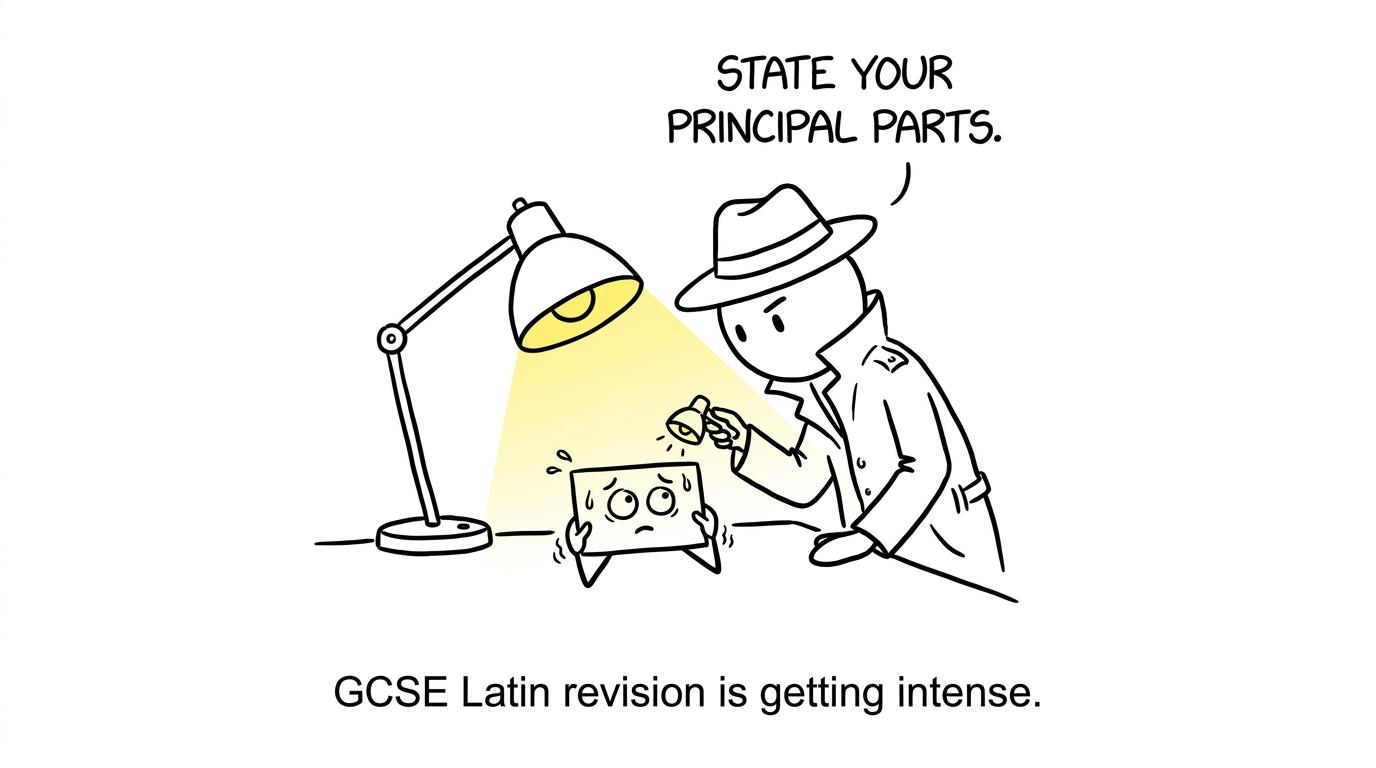 A Latin flashcard being questioned about its principal parts
Use blank-page grammar retrieval
Choose one grammar area and write everything relevant that you can remember before opening your notes. You might retrieve endings, usage rules, recognition clues and common sources of confusion.
Then compare your page with a reliable reference. Add missing details in another colour and convert each gap into a future question.
Keep the task narrow. “Write everything about Latin grammar” is overwhelming and difficult to assess. “Recall how to recognise and translate the passive voice” produces clearer evidence.
Turn prescribed material into questions
For literature or civilisation components, rereading a translation or commentary can create a particularly strong illusion of mastery. Replace headings with prompts such as:
- What happens immediately before this section?
- Which detail supports this interpretation?
- What effect does the writer create here?
- Which Latin word or phrase provides the evidence?
- How does this passage connect with its wider context?
Recall quotations or references only to the level expected by your specification and teacher. Memorising a translation word for word is not enough if the assessment asks you to analyse language, explain context or respond to the Latin text.
Combine recall with unseen translation
Active recall supports translation, but it cannot substitute for it. Translation also requires you to coordinate vocabulary, morphology, syntax and judgement.
Attempt passages without consulting notes immediately. Mark uncertain words or constructions, continue where possible, and check afterwards. Turn recurring problems into targeted recall prompts. If you repeatedly miss verb endings, for instance, the next step is not simply to reread more passages; it is to retrieve those forms deliberately and then meet them again in context.
A practical revision cycle
A sustainable cycle can be brief:
- Recall: answer from memory without notes.
- Check: compare with an accurate source.
- Correct: write or say the complete answer.
- Classify: record whether it was secure, hesitant or incorrect.
- Return: test it again after a delay.
- Apply: use the knowledge in an exam-style task.
Spacing matters because a successful answer today does not guarantee durable knowledge next week. Revisit material across multiple sessions rather than compressing every repetition into one evening.
Avoid spending equal time on every card. Secure content still needs occasional review, but weak material deserves more attention. A revision planner can help you balance Latin with your other GCSE subjects rather than letting one difficult topic consume the entire week.
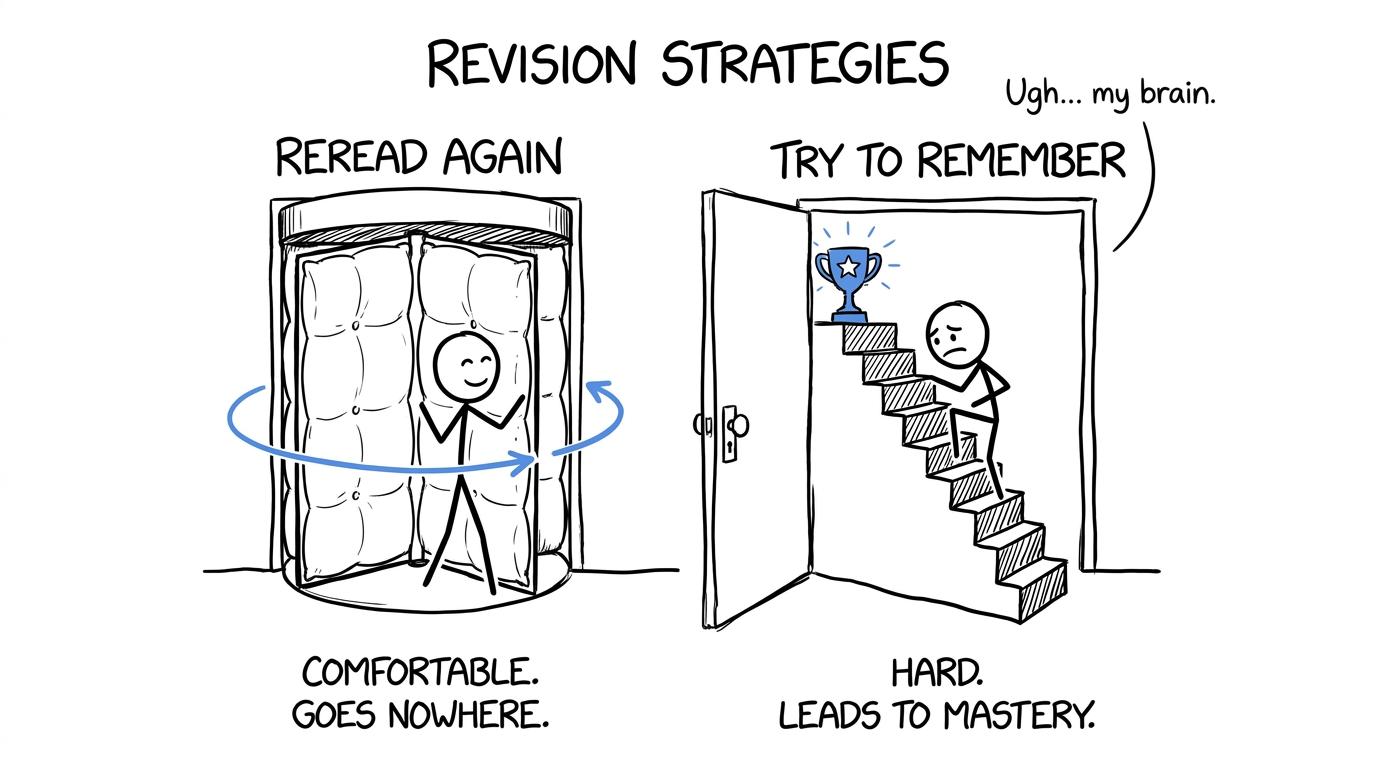 A comfortable rereading door going nowhere beside the staircase of retrieval practice
Active recall does not mean flashcards only
Flashcards are convenient, but active recall describes a mental process rather than a particular product. You can retrieve knowledge through:
- self-quizzing;
- oral explanation;
- closed-book summaries;
- diagram labelling;
- mini tests;
- practice questions;
- essay plans;
- unseen translations;
- past-paper questions.
The strongest method depends on what you need to remember. A flashcard may suit a vocabulary definition. It is less suitable for planning an extended analytical response or translating a connected passage.
This principle transfers directly to maths revision. Looking through solved questions is not the same as selecting and applying a method independently. MathsGenie's GCSE maths revision lessons combine topic guidance with questions that let you retrieve and apply what you know. You can then use GCSE past papers to practise under more realistic conditions.
Students continuing beyond GCSE can use the same approach with A Level maths revision and A Level past papers. The subject changes, but the principle remains: an answer you can produce is more useful than one you merely recognise.
Common active recall mistakes
Looking too quickly
Trying for a moment and immediately turning over the card reduces the retrieval demand. Give yourself enough time to search your memory, but do not spend several minutes trapped on one item.
Testing recognition instead of recall
Multiple-choice questions and visible answers can be useful, but they supply cues. Include questions requiring you to generate the answer without options.
Treating every answer as correct or incorrect
A hesitant correct answer is not as secure as an immediate, confident one. Record uncertainty so that fragile knowledge returns sooner.
Making cards too large
A card asking for an entire topic encourages vague self-marking. Break broad material into focused prompts with answers you can judge accurately.
Ignoring connected exam practice
Hundreds of vocabulary cards do not automatically create fluent translation or strong literary analysis. Use recall to build knowledge, then apply it through specification-relevant tasks and papers.
Copying answers during correction
Copying can become another form of passive review. After reading the correction, hide it and reproduce the right answer from memory.
Revising only what feels comfortable
Easy cards provide quick success but limited information. Spend more time on recurring errors while periodically checking older, secure content.
Build a revision system that produces answers
Active recall works best when it is ordinary rather than heroic: a short closed-book test, honest checking, a correction and a planned return. For GCSE Latin, use it across vocabulary, morphology, grammar and prescribed content, then connect that knowledge through translation and exam-style practice.
Apply the same discipline to your maths preparation. Begin with MathsGenie's free revision resources, work through the relevant practice questions and video solutions, and use mark schemes to diagnose errors. As exams approach, predicted papers can complement revision lessons and official past-paper practice.
Rereading often tells you that you have seen something before. Active recall asks the more useful question: can you bring it back when the page is closed? Start with one topic today, retrieve before checking, and let each mistake decide what you practise next.