Active Recall GCSE Bengali: Does It Work?
Active recall GCSE Bengali: learn why retrieval beats rereading and use a practical plan for vocabulary, listening, speaking, reading and writing revision.
You can reread a Bengali vocabulary list until every word looks familiar. Then someone covers the page, asks what one of those words means, and your mind goes quiet. That gap between recognising and remembering is exactly why active recall GCSE Bengali revision tends to work better than rereading alone.
The short answer is yes: active recall works because it makes you retrieve Bengali from memory, which is what an exam eventually requires. Research into retrieval practice consistently supports its value for long-term retention, particularly when students check their answers and revisit material over time. For GCSE Bengali, the method can strengthen vocabulary, grammar, listening, speaking, reading and writing, but it must be adapted to each skill.
The active recall checklist
A useful GCSE Bengali recall session follows a simple loop:
- Choose one small theme or language skill.
- Study the material briefly if it is new.
- Hide the notes, transcript or model response.
- Retrieve the answer by speaking, writing or recalling it mentally.
- Check against a reliable answer, transcript or mark scheme.
- Correct mistakes immediately.
- Return to the same material on another day.
- Finish with an exam-style task rather than flashcards alone.
The important step is not making attractive cards. It is attempting the answer before looking.
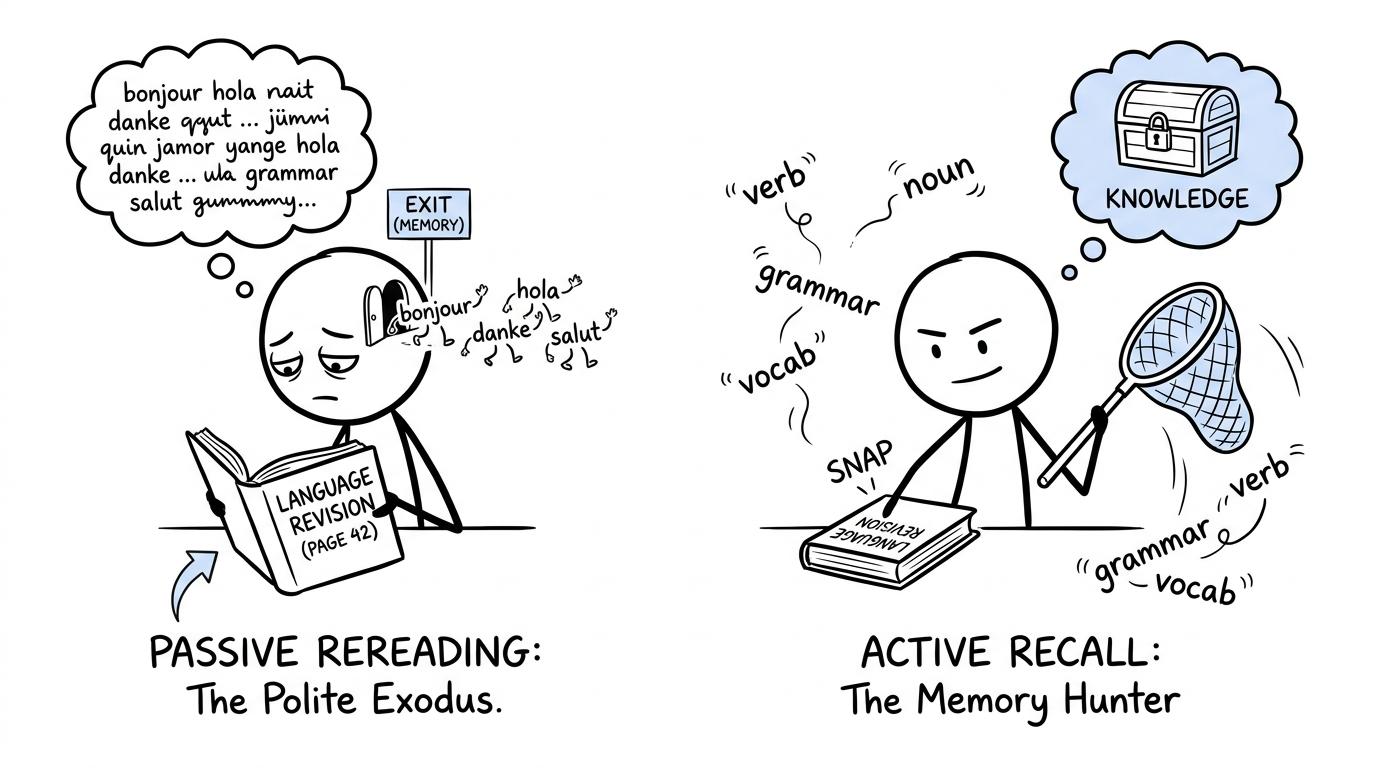 A comic about words escaping during rereading while another student catches recalled ideas
Why active recall tends to beat rereading
Rereading creates familiarity. You see a phrase and think, “I know that.” Sometimes you do. Sometimes the page is doing more of the work than you realise.
Active recall removes that support. When you close the book and reconstruct an answer, you discover whether the knowledge is genuinely available. That effort strengthens access to the information and exposes gaps while there is still time to fix them.
Systematic reviews of retrieval practice in classrooms generally find that it improves learning compared with weaker, passive approaches such as repeated reading. The evidence does not mean rereading is useless. Reading is necessary when you first meet vocabulary, understand a text or study a grammatical structure. The stronger sequence is:
Read, retrieve, check, correct and retrieve again later.
Feedback matters. Recalling an incorrect spelling repeatedly can strengthen the error, so every attempt should eventually be checked against your teacher’s materials, an official transcript, a mark scheme or an accurate vocabulary source.
This principle will feel familiar to students using MathsGenie’s GCSE maths revision hub. Watching a revision lesson can explain a method, but independent questions reveal whether you can produce it yourself. Bengali revision works in much the same way: input begins the learning, while retrieval tests whether it can be used.
Match recall practice to your Bengali qualification
Before creating cards or downloading papers, confirm the exact qualification with your school. AQA GCSE Bengali and Pearson Edexcel International GCSE Bangla are different qualifications with different assessment structures. Do not assume that a resource labelled “Bengali GCSE” matches your specification.
Under the current AQA GCSE Bengali specification, students are assessed in listening, speaking, reading and writing. Each skill contributes an equal share of the qualification. It is a linear course, and students take all four papers in the same exam series and at the same tier. Foundation tier covers grades 111-555, while higher tier covers grades 444-999.
That matters because a vocabulary-only recall routine prepares just one part of what the assessment demands. Your prompts should reflect your board, tier, themes and question formats.
How to apply active recall to GCSE Bengali
Vocabulary: retrieve in both directions
A card with English on the front and Bengali on the back is useful, but it practises only one direction. Reverse some cards so that you must also recognise Bengali and produce the English meaning.
Include more than isolated nouns. Recall:
- verbs in useful forms;
- adjectives and their opposites;
- time phrases;
- connectives;
- opinion phrases;
- topic-specific expressions;
- common spelling contrasts.
Say the answer before turning the card. Then write difficult words to check spelling. Place missed or hesitant cards into a smaller pile and revisit them more frequently. A correct guess that took a long time is not yet secure.
Speaking: use prompts rather than scripts
Memorising an entire paragraph can feel efficient, but one unexpected question may break the sequence. Instead, put short prompts on cards based on your specification themes. Answer aloud without reading a prepared script.
After speaking, ask:
- Did I answer the actual question?
- Did I give and justify an opinion?
- Did I use more than one time frame where appropriate?
- Was my pronunciation clear?
- Could I continue after a follow-up question?
Record selected responses and listen back. This turns vague confidence into evidence. You may know what you intended to say, yet the recording reveals pauses, repeated vocabulary or unclear endings that were invisible in the moment.
Listening: recall before checking the transcript
Listening practice can become passive if the audio plays repeatedly while you follow the transcript. A stronger routine is to listen once without text, pause and write down the key details you can recall.
Listen again for missing information, then check the transcript or answers. Finally, close everything and summarise the recording aloud. Change the focus across sessions: gist, opinions, reasons, times, negatives or specific details.
The transcript is feedback, not the starting point. If you read it first, you may be testing reading rather than listening.
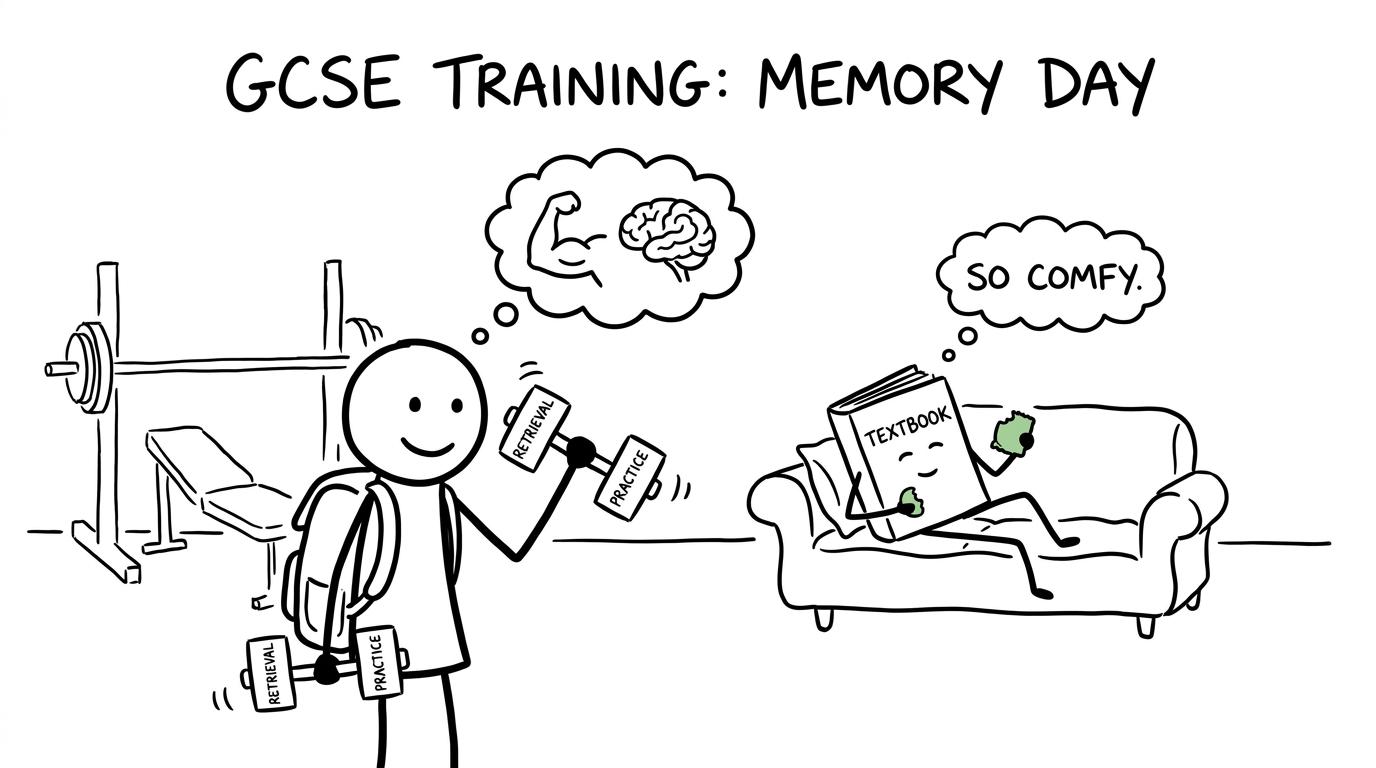 A comic showing vocabulary cards acting as memory-training weights
Reading: reconstruct meaning from memory
After reading a short Bengali passage, cover it and list its main ideas. Recall who was involved, what happened, the writer’s opinion and any reasons given. Then reopen the text and identify what you omitted or misunderstood.
For translation preparation, retrieve phrases and sentence patterns rather than trying to memorise whole passages. Translation requires decisions about meaning, tense and natural expression. It is therefore better tested through fresh sentences than through recognition of a passage you already know.
Writing: retrieve the building blocks
Writing needs vocabulary recall, grammatical control and organisation. Use prompts that ask you to produce one useful element from memory: an opinion with a reason, a past event, a future plan, a contrast or a developed description.
Move gradually from individual phrases to timed responses. After writing, compare your work with the task requirements and relevant assessment criteria. Highlight recurring weaknesses, then convert them into new recall prompts.
For example, if your issue is consistently forgetting how to introduce a contrasting idea, the next session should begin by retrieving several suitable structures without notes. This is targeted correction, not a full worked example to memorise.
A practical weekly routine
Active recall works best as a repeatable system rather than an occasional long session. A balanced week might include:
- one vocabulary and spelling session;
- one listening recall session;
- one reading or translation session;
- one recorded speaking session;
- one timed writing task;
- a short mixed review of previous mistakes.
Keep an error log with the prompt, your response, the correct form and the next review date. Spend more time on items you cannot retrieve than on material that merely feels pleasant to review.
Spacing is important. Revisiting a topic after some forgetting has occurred makes retrieval more demanding. A simple pattern is to return after one day, several days and then the following week, adjusting the interval according to performance. There is no universal perfect timetable; successful recall should lead to a longer gap, while repeated errors need earlier attention.
Students balancing Bengali with maths can use the same structure across both subjects. The MathsGenie guide to stopping maths content from being forgotten combines retrieval, spaced practice and feedback. The twenty-minute GCSE revision routine is also useful when several subjects are competing for the same evening.
Turn recall into exam performance
Flashcards can help you remember vocabulary, but an exam does not present your card deck in a convenient order. You must eventually retrieve knowledge inside unfamiliar listening extracts, reading passages and open-ended prompts.
Use official Bengali past papers and mark schemes that match your qualification. Complete short sections first, mark them carefully and convert each mistake into a future prompt. Later, add timed papers to develop stamina and decision-making.
This is the same progression MathsGenie recommends for maths: learn a small unit, retrieve it, practise exam questions, mark honestly and retest. Finding your weakest GCSE topics explains how to turn lost marks into a focused revision list. For maths preparation, you can then use Edexcel GCSE maths past papers, GCSE predicted papers and board-specific practice rather than relying on rereading notes.
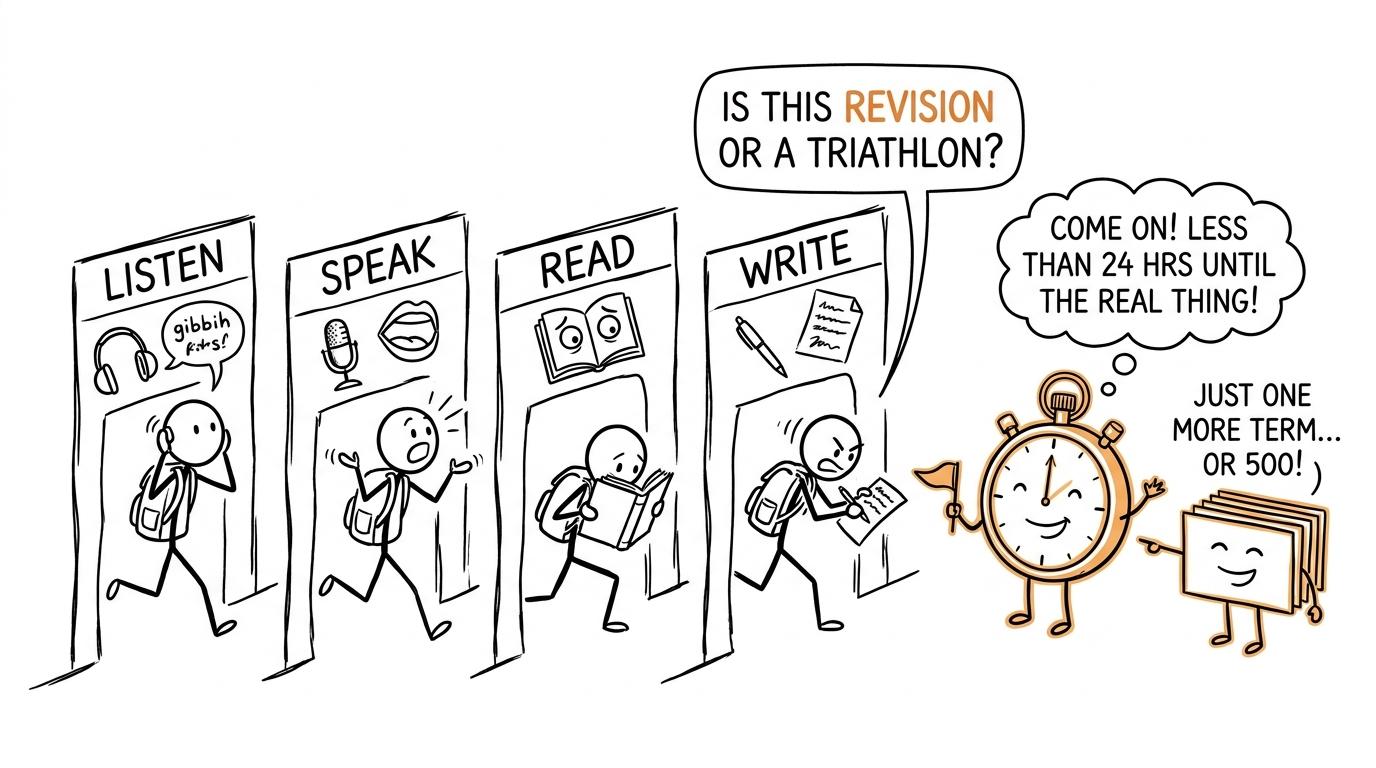 A comic revision obstacle course with listening, speaking, reading and writing stations
Common active recall mistakes
Turning the card over too quickly
If you reveal the answer as soon as recall becomes uncomfortable, you practise recognition. Wait long enough to make a genuine attempt, then check.
Recalling without feedback
Retrieval strengthens what you produce, including errors. Check spelling, grammar, meaning and pronunciation using reliable materials.
Using only English-to-Bengali vocabulary cards
GCSE assessment requires receptive and productive skills. Practise both directions and place vocabulary inside listening, reading, speaking and writing tasks.
Memorising fixed scripts
Prepared language can be useful, but rigid scripts are fragile. Practise adapting the same language to different questions and follow-up prompts.
Treating every item equally
Secure vocabulary does not need the same attention as repeatedly missed language. Let errors determine the next session.
Avoiding full exam questions
Recall is preparation, not the complete performance. Move from cards and closed-book summaries into specification-matched tasks and timed papers.
Confusing difficulty with failure
Rereading often feels fluent because the answer remains visible. Retrieval feels harder because memory must do the work. That difficulty can be productive, provided you check and correct the attempt.
Active recall is a method, not a shortcut
Active recall does work for GCSE Bengali, especially when compared with rereading the same notes without testing yourself. But it is not a promise that flashcards alone will produce a particular grade. Strong revision combines retrieval with accurate feedback, spacing, varied language practice and exam-style questions.
The larger lesson crosses subjects. Whether you are producing a Bengali response or recalling the first step of an algebra method, progress becomes visible when the notes are closed.
For your maths exams, make MathsGenie your free revision base. Begin with GCSE maths revision lessons and practice questions, test yourself with mini tests and past papers, use mark schemes and video solutions to correct mistakes, and add predicted papers when you are ready for focused exam rehearsal. Do not just reread the method. Retrieve it, practise it and prove that you can use it.