Active Recall for GCSE Arabic: Does It Work?
Active recall GCSE Arabic strategies that improve vocabulary, speaking and grammar recall, with a practical revision plan that goes beyond rereading.
There is a familiar revision trap: you reread a page of Arabic vocabulary, recognise nearly every word and close the book feeling prepared. The next day, without the page in front of you, the words seem to have disappeared.
That gap between recognising an answer and producing it explains why active recall GCSE Arabic revision tends to work better than rereading alone. Active recall means deliberately retrieving vocabulary, phrases, grammar and pronunciation from memory. Instead of looking at an answer until it feels familiar, you attempt to produce it before checking.
The short answer is yes: active recall can improve long-term retention when it is used consistently and combined with feedback, spaced practice and genuine listening, speaking, reading and writing tasks. But it is not a magic shortcut. Its value depends on what you recall and how closely your practice resembles the demands of your GCSE specification.
Active recall GCSE Arabic checklist
A useful approach should include:
- recalling vocabulary in both directions
- producing complete Arabic phrases, not isolated words alone
- retrieving grammar within sentences
- answering listening questions without a transcript at first
- responding aloud to unpredictable speaking prompts
- revisiting material after a delay
- checking every response and correcting errors
- applying recalled knowledge to exam-style tasks
The central habit is simple: close the book before asking your memory to work.
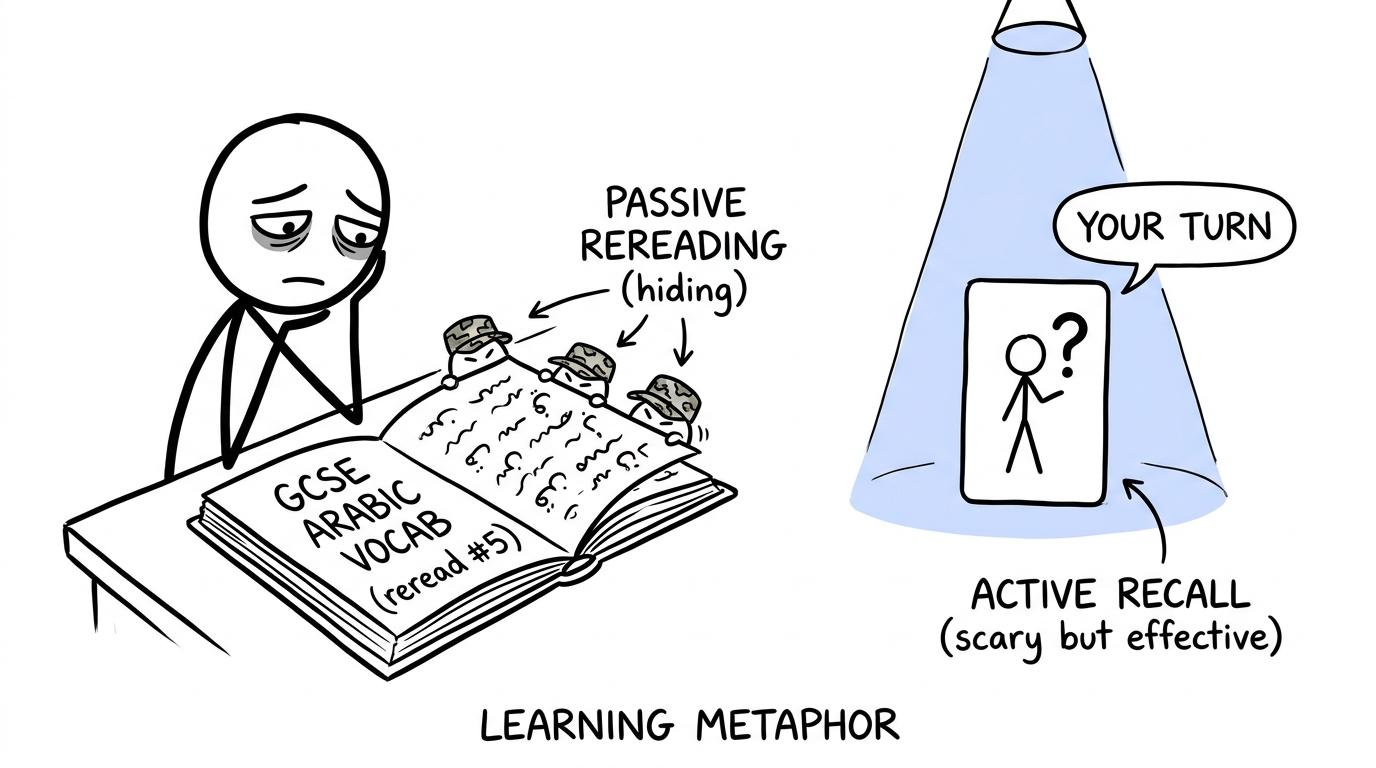 A vocabulary notebook discovers that flashcards expect an answer
Why active recall tends to beat rereading
Rereading is not useless. You need to encounter new vocabulary and understand a grammar rule before you can retrieve it. The problem is that repeated exposure can create fluency without secure knowledge. A page becomes easy to read partly because it is sitting in front of you.
Retrieval removes that support. When you cover the Arabic, hear a prompt or face a blank page, you discover what your memory can actually supply.
Research on retrieval practice across education consistently indicates that attempting to remember information can strengthen later retention more effectively than spending the same period repeatedly reviewing it. The attempt matters even when it feels difficult. Feedback then prevents an incorrect response from becoming established.
This produces three practical benefits for GCSE Arabic.
It reveals the difference between recognition and recall
You may recognise an Arabic word immediately but be unable to produce it from an English prompt. That distinction matters in writing and speaking, where the required language is not printed on the page.
Testing both directions gives a more honest picture:
- Arabic to English tests understanding
- English to Arabic tests production
- audio to meaning tests listening recognition
- a spoken prompt to an Arabic response tests spontaneous production
The harder direction is often the more informative one.
It makes forgetting visible
A weak memory can look strong immediately after revision. Delaying the next test reveals whether it has lasted. This is why active recall works particularly well alongside spacing: retrieve the material today, return after a short gap and revisit it again later.
There is no perfect interval for every student or every word. Difficult items should return sooner; secure items can wait longer. The aim is not to create an elaborate flashcard administration system. It is to spend more time on what you are close to forgetting.
It resembles the pressure of an assessment
GCSE language assessments require students to interpret or produce language without seeing a complete model answer. Although exact arrangements depend on the current exam board specification, students normally need preparation across listening, speaking, reading and writing.
Retrieval practice rehearses that moment of independence. Rereading prepares you to look again. Recall prepares you to answer.
How to apply active recall to GCSE Arabic
The best method changes according to the skill being developed. Flashcards can support vocabulary, but GCSE Arabic is larger than a deck of translated nouns.
Recall vocabulary in useful forms
Put a prompt on one side of a card and the answer on the other, whether you use paper or an app. Keep the answer hidden until you have made a genuine attempt.
For nouns, recall useful information such as gender and plural forms where required. For verbs, learn forms and phrases that let you describe different time frames. For adjectives and other structures, remember the agreement or word order needed to place them correctly in a sentence.
Avoid marking an answer correct merely because it was close. Check spelling carefully, especially when letters have similar shapes or sounds. A hesitation pile can also be useful: if an answer took too long, revisit it even when it was eventually correct.
Retrieve phrases rather than building every sentence from scratch
Individual words matter, but fluent communication relies heavily on usable combinations. Recall phrases for giving opinions, adding reasons, comparing ideas, describing past events and discussing future intentions.
A strong prompt asks for a communicative purpose rather than one memorised paragraph. For example, you might prompt yourself to express an opinion and justify it, then produce a suitable phrase without looking.
This builds flexible language. Memorising one long response can feel efficient, but it becomes fragile when the speaking question or writing task changes.
Use blank-page retrieval for grammar
After reviewing a grammar point, put the notes away. Write what you can remember about its structure, agreement and use. Then compare your account with the original material and correct it in another colour.
The goal is not to create beautiful notes. It is to expose missing knowledge. A page containing corrections may represent better revision than a perfectly copied summary because it records where learning actually occurred.
Follow this with sentence construction and exam-style questions. Recalling a rule is helpful; applying it accurately is what earns marks.
Turn listening into retrieval practice
Listening revision becomes passive when the transcript is visible too early. Start with audio alone. After a short section, pause and retrieve:
- the main message
- important details
- negatives or changes of opinion
- references to past, present or future
- unfamiliar words inferred from context
Listen again before opening the transcript. Once you check, note whether the problem was vocabulary, speed, pronunciation or a misleading assumption. Those require different responses.
For pronunciation and sound-letter connections, short dictation can help. Hear a brief phrase, write what you heard and then compare it accurately with the source.
Practise speaking without a script
Use topic prompts from your specification and answer aloud before consulting notes. Record the response if possible. On review, listen for clarity, pronunciation, tense choice, agreement and whether you developed the answer.
Do not repeat the identical response until it becomes automatic. Change the prompt or add an unexpected follow-up. Real recall must remain flexible enough to survive a different question.
A practical revision routine
A balanced session might move through four stages:
- Retrieve: test previously learnt vocabulary and phrases with no notes.
- Check: compare each answer carefully and identify the exact error.
- Apply: use the language in listening, speaking, reading or writing.
- Schedule: decide which weak items should return in the next session.
Keep a small error log divided by cause: forgotten vocabulary, spelling, grammar, misunderstanding, pronunciation or incomplete answers. This is more useful than recording only a score because it tells you what to do next.
Active recall should not occupy every minute. New language still needs explanation and modelling. Reading wider passages develops context, while extended writing and speaking build fluency. Retrieval is the bridge between first meeting the material and using it independently.
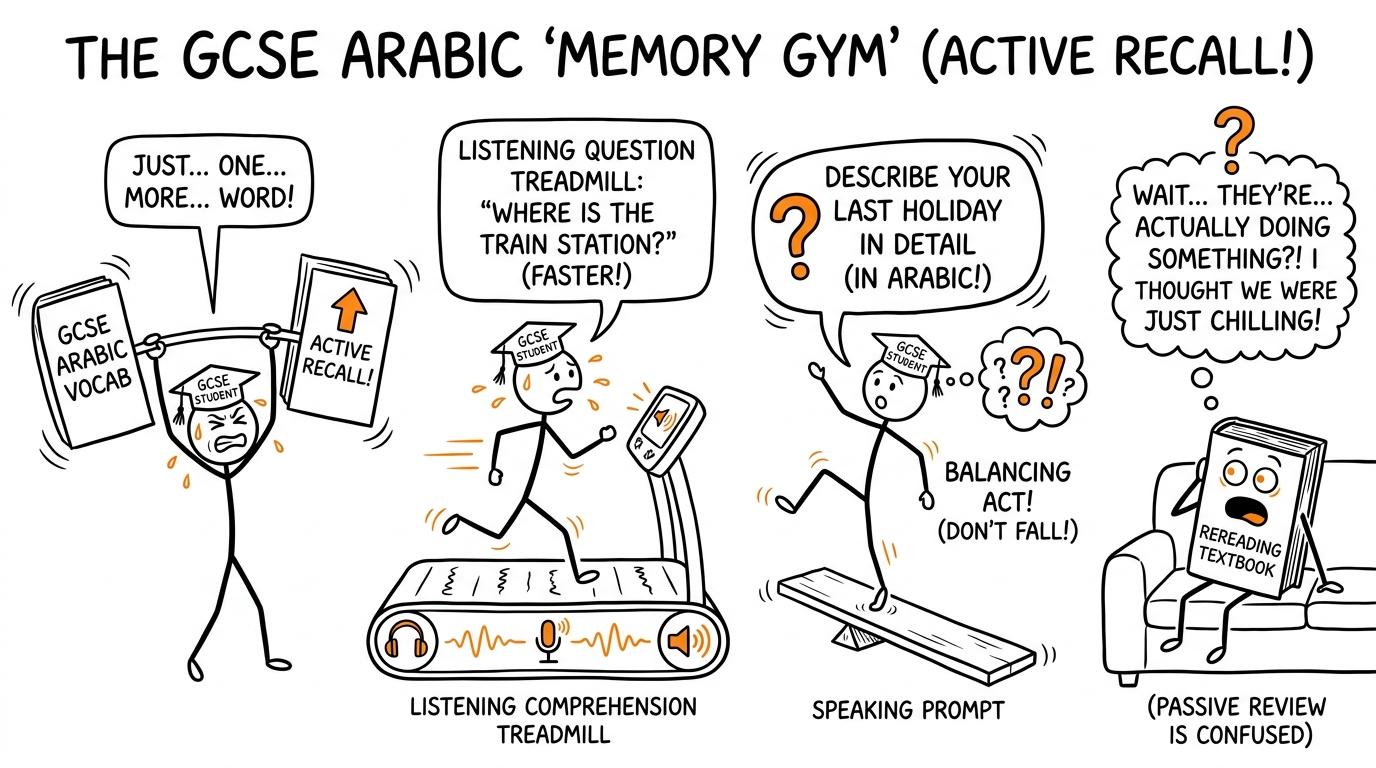 A student discovers that memory has its own revision gym
What GCSE maths students can learn from the same method
The same distinction between recognition and production appears in maths. Watching a solution can feel clear because each step is already visible. A blank exam question asks whether you can choose and execute the method yourself.
Students balancing Arabic with maths can use one shared revision principle: retrieve first, then check. On MathsGenie's GCSE revision page, select a topic, review the lesson and later attempt the practice questions without following the video at the same time. For algebra, resources such as solving equations revision and quadratic equations practice make that progression concrete.
Then move from topic recall to mixed assessment. GCSE maths past papers test whether you can recognise which method is needed when the topic is not announced. That is the mathematical equivalent of responding to an unfamiliar language prompt.
Students planning beyond GCSE can use the same habit with A Level maths revision and A Level past papers. The content becomes more demanding, but the principle survives: attempting, checking and correcting produces better evidence than familiarity alone.
Common active recall mistakes
Turning the answer over too quickly
Recall requires an honest attempt. A little struggle is useful, but staring indefinitely is not. Try, reveal the answer, correct it and schedule another attempt.
Testing only the easiest direction
Arabic-to-English recognition may become secure before English-to-Arabic production. Include listening and speaking prompts as well as written cards.
Treating every card equally
Repeatedly testing secure vocabulary wastes time that could be spent on weak items. Space confident answers and return sooner to errors or hesitations.
Recalling isolated words but never applying them
Knowing vocabulary does not guarantee accurate communication. Use recalled language in complete sentences, listening extracts, speaking prompts and extended writing.
Memorising scripts that cannot adapt
Prepared phrases are valuable. Rigid paragraphs are less dependable. Questions can be phrased differently, so practise changing details, time frames, opinions and reasons.
Skipping feedback
Retrieval without checking can preserve spelling or grammar errors. Compare against a reliable source, your current specification and teacher guidance.
Using recall instead of exam practice
Flashcards cannot reproduce an entire assessment. Active recall should support exam-style tasks, not replace them. The same rule applies in maths: topic practice builds knowledge, while papers develop selection, timing and interpretation.
The verdict: active recall works when it stays active
Active recall is effective for GCSE Arabic because it trains the act an assessment eventually demands: bringing language to mind without being shown the answer. Its advantage over rereading is not that rereading has no value. It is that retrieval provides stronger practice and more honest feedback about what you know.
Keep the method simple. Hide the answer, retrieve it, check precisely, correct the weakness and revisit it after a gap. Combine that cycle with authentic listening, spontaneous speaking, careful reading and extended writing aligned with your exam board's current specification.
When it is time to apply the same discipline to maths, begin with the free MathsGenie revision resources. Use revision lessons to understand a method, practice questions and mini tests to retrieve it, then past papers, predicted papers, mark schemes and video solutions to refine exam performance. Revision becomes more useful when it stops asking, “Have I seen this?” and starts asking, “Can I produce it myself?”