

A-Level vs AS Level Physics Grading Explained
A-level vs AS level Physics grading explained: why AS marks do not count in England, how linear grading works, and why boundaries change each year for students.
Results day can make two familiar labels feel unexpectedly confusing. If you completed AS Physics after one year and then continued to A Level, does that AS result become part of your final grade? For qualifications regulated in England, the short answer is no. Understanding A-level vs AS level Physics grading begins with one fact: AS Physics and A-Level Physics are separate qualifications.
Your AS grade does not contribute to your eventual A-Level grade in England. A-Level Physics uses linear grading, based on assessment across the full A-Level course at the end of the qualification.
The essential grading checklist
- AS Physics is a standalone qualification in England.
- An AS result does not count towards the corresponding A-Level result.
- AS grades run from A to E; there is no A* grade at AS.
- A-Level grades run from A* to E.
- A-Level Physics is linear, so the overall qualification mark determines the grade.
- Grade boundaries vary by exam board, specification and exam series.
- Boundaries are set after papers have been taken and marked.
- Rules differ in Wales and Northern Ireland, so check which regulator governs your qualification.
MathsGenie has separate AS Level Physics revision resources and a complete A-Level Physics overview, reflecting the fact that these are distinct awards.
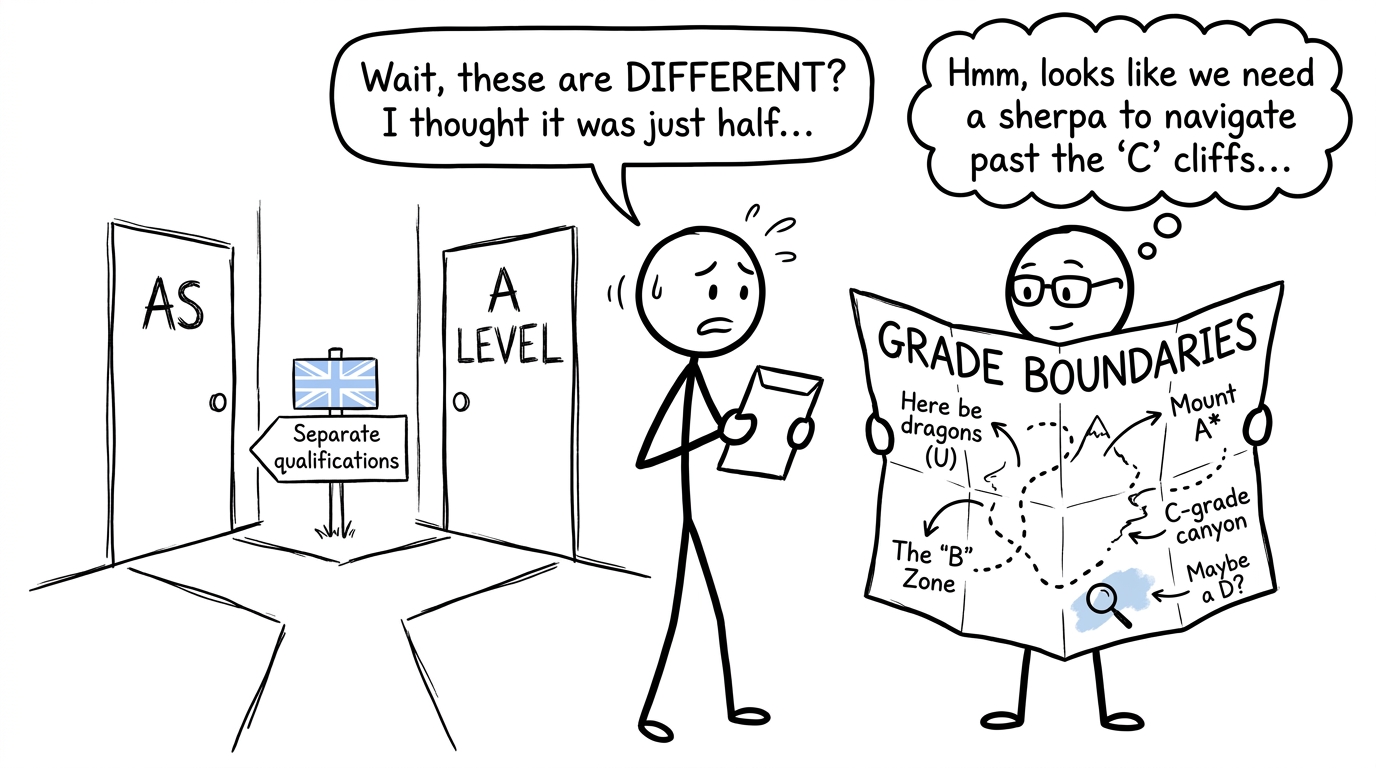 A student choosing between separate AS and A-Level qualification doors
AS Physics and A-Level Physics compared
| Feature | AS Physics in England | A-Level Physics in England |
|---|---|---|
| Status | Standalone qualification | Standalone qualification |
| Typical course stage | Usually completed after one year | Usually completed after two years |
| Grade range | A to E | A* to E |
| Contribution of AS marks | Does not contribute to A Level | Not applicable |
| Assessment model | Linear assessment for the AS course | Linear assessment across the full A-Level course |
| Grade boundary | Based on the AS qualification total | Based on the A-Level qualification total |
Although AS content may overlap with the first year of an A-Level course, overlap in teaching does not mean marks are transferred. A school may use an internal Year 12 examination or an official AS result to judge progress and inform predicted grades, but neither automatically becomes part of the final A-Level calculation.
That distinction matters. An AS grade can be useful evidence of attainment, yet the final A-Level result still depends on performance in the A-Level assessments.
How A-Level Physics linear grading works
A-Level Physics linear grading means that assessment is completed at the end of the course rather than accumulated through AS modules. For AQA, Edexcel, OCR and Eduqas qualifications regulated by Ofqual, marks from the relevant A-Level papers are combined into one total subject mark.
The overall grade boundary is then applied to that total. Published paper-level boundaries may be described as notional. They help students interpret performance on an individual paper, but they do not create separate certificated paper grades. A weaker result on one paper can therefore be balanced by stronger performance elsewhere.
A-Level Physics also includes practical work. In Ofqual-regulated A-Level Physics qualifications, the practical endorsement is reported separately as pass or not classified and does not add marks to the A* to E subject grade. Practical knowledge and data-handling skills can still be assessed in written papers.
Students should always revise from the correct specification. MathsGenie organises resources separately for AQA A-Level Physics, Edexcel A-Level Physics, OCR A A-Level Physics and Eduqas A-Level Physics.
Why AS Level Physics grade boundaries differ
AS Level Physics grade boundaries cannot be reliably inferred from A-Level boundaries. The qualifications contain different amounts of content, use different assessments and have different maximum marks. AS also has no A* grade.
Boundaries can change between years because awarding bodies review the demand of that particular set of papers after marking. If a paper proves more demanding, a comparable standard of work may correspond to a lower raw-mark boundary. If it proves less demanding, the boundary may be higher. There is no fixed percentage that guarantees a particular grade every year.
This is why last year’s boundary should be treated as a revision reference, not a promise. The latest confirmed boundaries available before the summer 2026 results are from the June 2025 series; boundaries for a new series are published on or around results day once awarding is complete.
 An examiner setting a grade boundary after the papers have arrived
England, Wales and Northern Ireland are not identical
The statement that AS does not count towards A Level is correct for Ofqual-regulated qualifications used in England. It should not be applied blindly across the UK.
In Wales, approved WJEC AS units generally contribute 40%40\%40% of the full A-Level result. Qualifications regulated by CCEA in Northern Ireland also retain a linked AS structure in which AS contributes 40%40\%40%. Some standalone qualifications available in Wales can follow different arrangements, so students should confirm the qualification title, exam board and regulator with their school.
The safest question is not simply, “Which exam board am I taking?” Ask, “Which specification and regulator apply to my entry?” Eduqas and WJEC names are especially easy to confuse, even though the relevant qualification structures may differ.
What students and parents should check on results day
Start with the qualification code and exam board shown on the results statement. Then check whether the result is AS Physics or the full A-Level qualification.
For an A-Level result, compare the total subject mark with the official overall boundary for that specification and exam series. Do not add an earlier AS mark. Do not combine apparent grades from individual papers, either.
If a result is close to a boundary, speak to the school or college before requesting access to scripts or a review of marking. A review can cause a mark to rise, remain unchanged or fall, and centres normally guide candidates through the process.
For preparation rather than prediction, use boundaries alongside real papers. The AQA A-Level Physics past papers include mark schemes and solutions where available, while MathsGenie’s Edexcel Physics revision guides and OCR A Physics revision guides support targeted topic repair.
Common mistakes to avoid
Adding AS marks to the A-Level total
For an Ofqual-regulated qualification in England, the AS result is separate. It cannot improve or reduce the final A-Level grade.
Treating an AS grade A as an A-Level A*
AS Physics has no A* grade. An A at AS is the highest AS grade, but it does not convert into an A* at A Level.
Comparing raw marks without checking maximum marks
Different boards and qualifications have different totals. A raw mark only becomes meaningful when paired with the correct specification, exam series and maximum mark.
Using notional paper boundaries as final grades
The overall subject mark determines the certificated grade. Individual component boundaries are usually illustrative rather than separate awards.
Assuming boundaries are fixed percentages
Past boundaries are useful for marking practice, but future boundaries cannot be known securely before awarding takes place.
Make the grading system work for your revision
Grading feels mysterious when it is viewed from results day backwards. It becomes more manageable when viewed from revision forwards: learn one topic, answer questions, mark honestly and correct the precise reason each mark was lost.
Begin with the MathsGenie A-Level Physics overview. Choose your exam board, then combine revision lessons and practice questions with past papers, predicted papers, mini tests, mark schemes and video solutions. An AS result may describe one stage of the journey, but consistent, specification-matched practice is what prepares you for the final A-Level assessments.











