A-Level vs AS Level Maths Grading Explained
A-level vs AS level maths grading explained: learn why AS no longer counts in England, how linear assessment works and why grade boundaries change yearly.
Results day can make two qualifications that share a name look as though they share a final grade. They do not. The central fact behind A-level vs AS level maths grading is simple: for Ofqual-regulated qualifications in England, AS Maths is a standalone qualification and does not contribute to your A Level Maths result.
Your school may use an AS result to review progress or help form a predicted grade. That is an internal decision, not part of the exam board's A Level calculation. Your final A Level grade comes from the assessments for the full A Level course.
The quick comparison
| Feature | AS Level Maths | A Level Maths |
|---|---|---|
| Typical point of assessment | End of one year | End of two years |
| Qualification status in England | Standalone qualification | Separate full qualification |
| Available grades | AAA to EEE, with UUU below the minimum pass boundary | A∗A^*A∗ to EEE, with UUU below the minimum pass boundary |
| Does AS count towards the A Level? | No | Not applicable |
| Assessment model | Linear | Linear |
| Grade boundaries | Set separately for AS | Set separately for A Level |
The easiest way to remember this is: related content does not mean shared marks.
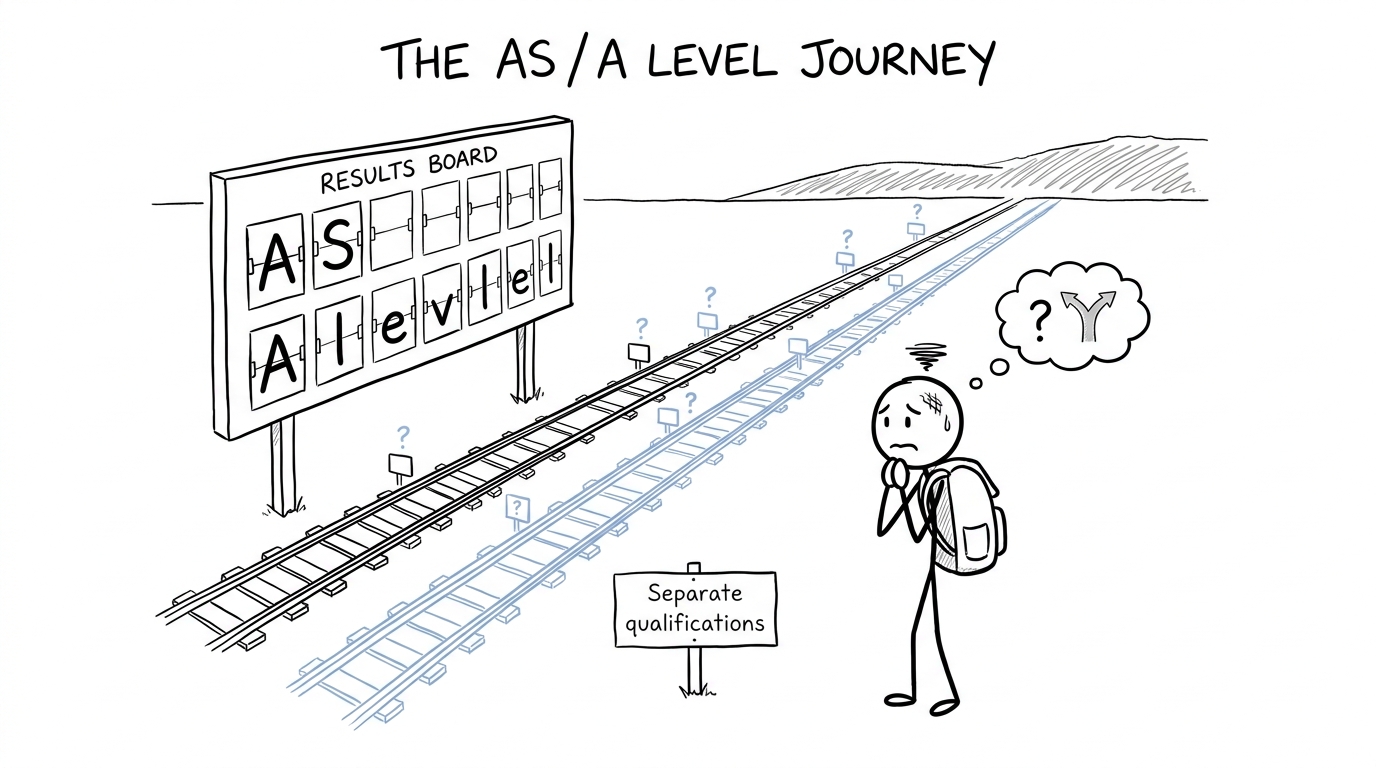 Two railway tracks show AS and A Level as separate qualifications
Why AS Maths no longer counts towards A Level
Older modular A Levels worked differently, which explains much of the confusion among parents and older siblings. Under that system, AS units could form part of the final A Level.
Reformed qualifications in England decoupled the two. AS became a qualification in its own right, while the full A Level became linear. A student can therefore receive an AS Maths grade after one year without that result being added to, averaged with or substituted into the later A Level grade.
This distinction applies to Ofqual-regulated qualifications offered in England, including specifications from AQA, Pearson Edexcel, OCR and Eduqas. Arrangements in Wales and Northern Ireland can differ, so students outside England should check the regulator, specification and advice from their school or college.
For a clear view of the course content beyond GCSE, visit the A Level Maths overview. You can also explore board-specific resources for Edexcel A Level Maths, AQA A Level Maths and OCR A Level Maths.
How A-Level Maths linear grading works
A-level maths linear grading means the assessments that determine the qualification are taken at the end of the course rather than banked as contributing modules along the way.
Exam boards add the raw marks from the relevant A Level papers to produce a total subject mark. That total is compared with the qualification-level grade boundaries for the correct board, specification and exam series.
You do not normally receive a separate official qualification grade for each paper. Exam boards may publish notional component boundaries, but these are guides for understanding performance, not independent grades that are averaged together.
This creates an important revision lesson. A difficult mechanics question and a straightforward pure question both contribute marks to the same overall total. Progress comes from collecting marks across the specification, not from trying to earn a particular grade on every individual paper.
How AS Level Maths grade boundaries differ
AS Level Maths grade boundaries are not shortened versions of the A Level boundaries. AS and A Level have different assessment totals, content coverage and candidate entries, so each qualification receives its own boundaries.
A boundary is the minimum raw mark required for a grade. AS uses grades from AAA to EEE and does not offer A∗A^*A∗. The full A Level uses grades from A∗A^*A∗ to EEE.
Boundaries can also change between exam series. Papers are designed to comparable standards, but their difficulty cannot be identical every year. Senior examiners therefore review evidence, including students' work and statistical information, before boundaries are confirmed. They are published on results day, after the papers have been marked.
This is why last year's boundary is useful for judging practice but cannot promise this year's result. MathsGenie's Edexcel A Level Maths grade boundaries show how the required raw marks have moved between series. AQA students can similarly use the AQA predicted grade calculator to interpret practice-paper totals using previous boundaries.
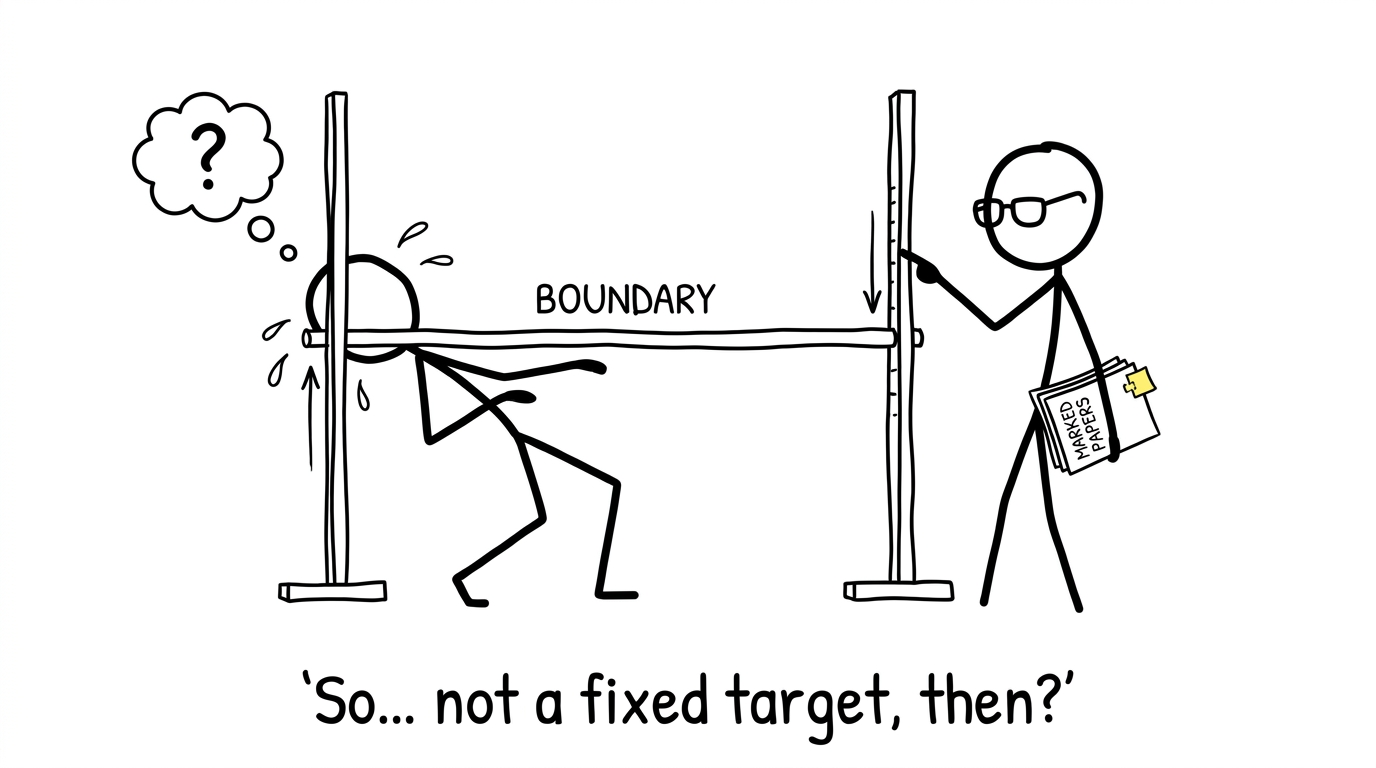 A student discovers that grade boundaries are not fixed targets
What an AS result means for future A Level study
An AS result can still be informative even though it contributes no marks to the final A Level. It can reveal whether algebraic fluency, proof, trigonometry, statistics or mechanics needs attention. Schools may also consider it alongside classwork and internal assessments when discussing progression or predicted grades.
The useful question is not, “How many AS marks can I carry forward?” The answer is none. Ask instead, “What does this result tell me to practise next?”
Turn that diagnosis into action with revision lessons and topic questions, then move to timed assessment. The Edexcel A Level Maths past papers include mark schemes and solutions where available. Once topic gaps are under control, A Level predicted papers can provide additional exam-style practice.
Common mistakes about AS and A Level grading
Assuming AS marks are worth half the A Level
That describes an older modular structure, not current Ofqual-regulated A Levels in England. AS marks are not carried into the full qualification.
Expecting an A∗A^*A∗ at AS Level
The highest available AS grade is AAA. The A∗A^*A∗ grade is available only for the full A Level.
Averaging paper grades
The overall qualification is determined from the total subject mark. Notional paper boundaries should not be treated as separate official grades to average.
Treating old boundaries as fixed targets
Boundaries vary by exam board, specification and series. Use previous figures to guide revision, but build a safety margin rather than aiming for the exact historical minimum.
Comparing raw marks from different qualifications
An AS total and an A Level total come from different assessments. Compare each score only with the correct qualification-level boundary.
Make the distinction work in your favour
AS and A Level Maths may sit on the same learning journey, but they lead to separate results. AS is graded from AAA to EEE and does not count towards the final A Level in England. A Level is graded from A∗A^*A∗ to EEE, with the grade determined by the total marks from its own end-of-course assessments.
Once that is clear, results day becomes less mysterious. Start with MathsGenie's A Level Maths overview, strengthen weak topics through free revision lessons and practice questions, then use mark schemes, video solutions, mini tests, past papers and predicted papers to turn understanding into dependable marks.