

A-Level vs AS Level Computer Science Grading
A-level vs AS level computer science grading explained: why AS marks do not count in England, how linear grading works, and how boundaries differ.
Results day can turn one small letter into a large source of confusion. A student may receive an AS grade after Year 12, continue with Computer Science, and naturally assume that result becomes part of the final A Level. In England, it does not.
The central fact behind A-level vs AS level computer science grading is simple: reformed AS and A Levels are separate, linear qualifications. An AS result is valuable in its own right, but its marks are not carried into the full A Level grade regulated by Ofqual.
This guide explains what that means, why AS level Computer Science grade boundaries differ from A Level boundaries, and what students and parents should check on results day.
The grading difference at a glance
| Feature | AS Computer Science | A Level Computer Science |
|---|---|---|
| Status in England | Standalone qualification | Separate full qualification |
| Does AS count towards it? | Not applicable | No |
| Grade range | A to E, with U below E | A* to E, with U below E |
| Assessment point | At the end of the AS course | At the end of the full A Level course |
| Content | Smaller AS course | Full two-year course |
| Grade boundary | Set for the AS qualification | Set independently for the A Level qualification |
The practical checklist is equally short:
- Confirm whether the result is AS or A Level.
- Check the correct exam board and specification code.
- Use that year’s qualification-level boundaries.
- Do not add AS marks to A Level marks in England.
- Do not compare raw marks from qualifications with different totals.
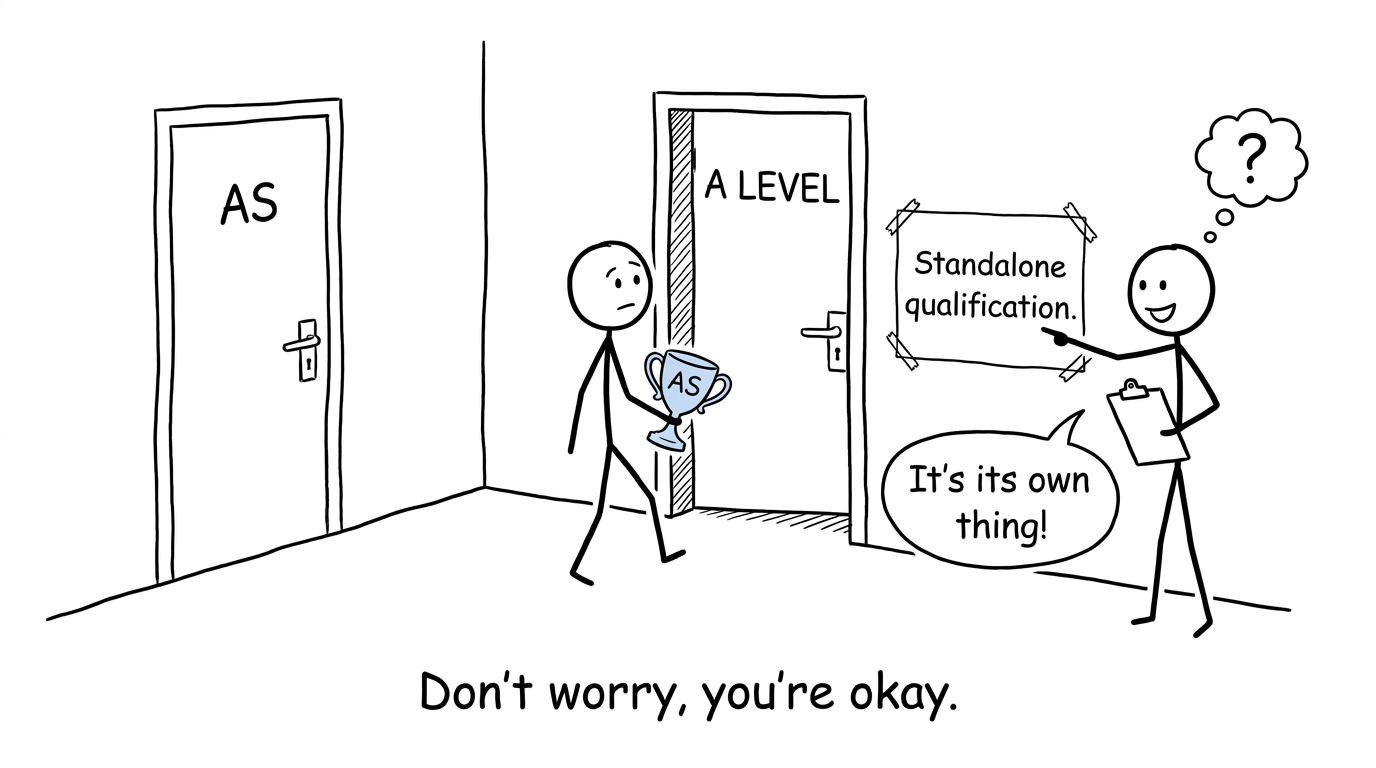 A student discovering that AS and A Level are separate qualifications
Why AS no longer counts towards the A Level
Before qualification reform, AS units could contribute to the final A Level. That history explains much of today’s confusion: parents, older siblings and even old online discussions may describe a modular system that no longer applies in England.
Under the current Ofqual-regulated structure, AS and A Level Computer Science are decoupled. A student can take AS as a standalone qualification, but taking it is not a compulsory stage of completing the corresponding A Level.
Schools may teach overlapping material because AS content provides a natural foundation for the first part of the full course. Shared content, however, does not mean shared marks. Students can review the distinction through MathsGenie’s OCR AS Level Computer Science overview and compare it with the OCR A Level Computer Science overview.
There is an important regional qualification. The decoupled explanation applies to Ofqual-regulated qualifications used in England. Wales and Northern Ireland have different qualification arrangements, so students there should check the regulator, awarding body and exact specification shown on their entry documents.
How A-Level Computer Science linear grading works
A-level Computer Science linear grading means the final award is based on assessment for the full qualification, rather than banking an AS grade and adding later A2 units.
For AQA and OCR A Level Computer Science, the course includes two examination components and a non-exam assessment programming project. Each board currently gives the project a weighting of 20%20\%20%, with the two examinations making up the remaining 80%80\%80%. The precise marks and assessment requirements depend on the board, so students should use the correct specification.
AQA, for example, scales its components before combining them into a qualification total. The grade is then determined from the overall total, not by averaging letter grades from individual components. The AQA A Level Computer Science revision page keeps board-specific lessons and revision tools together.
Component boundaries may be published to help schools interpret performance, but the qualification-level boundary determines the final grade. One weaker component can therefore be balanced by stronger performance elsewhere, provided the combined mark reaches the required boundary.
Why AS level Computer Science grade boundaries differ
A grade boundary is the minimum mark needed for a particular grade in a particular exam series. It is not a permanent pass percentage.
AS and A Level boundaries cannot be compared directly because the qualifications have different content, demand, assessment structures and maximum marks. AS also has no A* grade. Even boundaries from the same qualification can move between years because awarding organisations consider the difficulty of the assessments and available evidence before setting them.
At the time of writing, the latest published summer boundaries are from June 2025. They show why raw-mark comparisons are misleading. AQA AS Computer Science had a maximum of 150150150 marks, while AQA A Level Computer Science used a scaled total of 375375375 marks. OCR’s corresponding totals were 140140140 and 350350350. A boundary of 100100100 therefore means something entirely different in each qualification.
Use historical boundaries to judge the approximate standard of past-paper performance, not as a promise about a future grade. MathsGenie’s AQA A Level Computer Science past papers and OCR A Level Computer Science past papers let students practise with the correct board and then apply the boundary from that paper’s exam series.
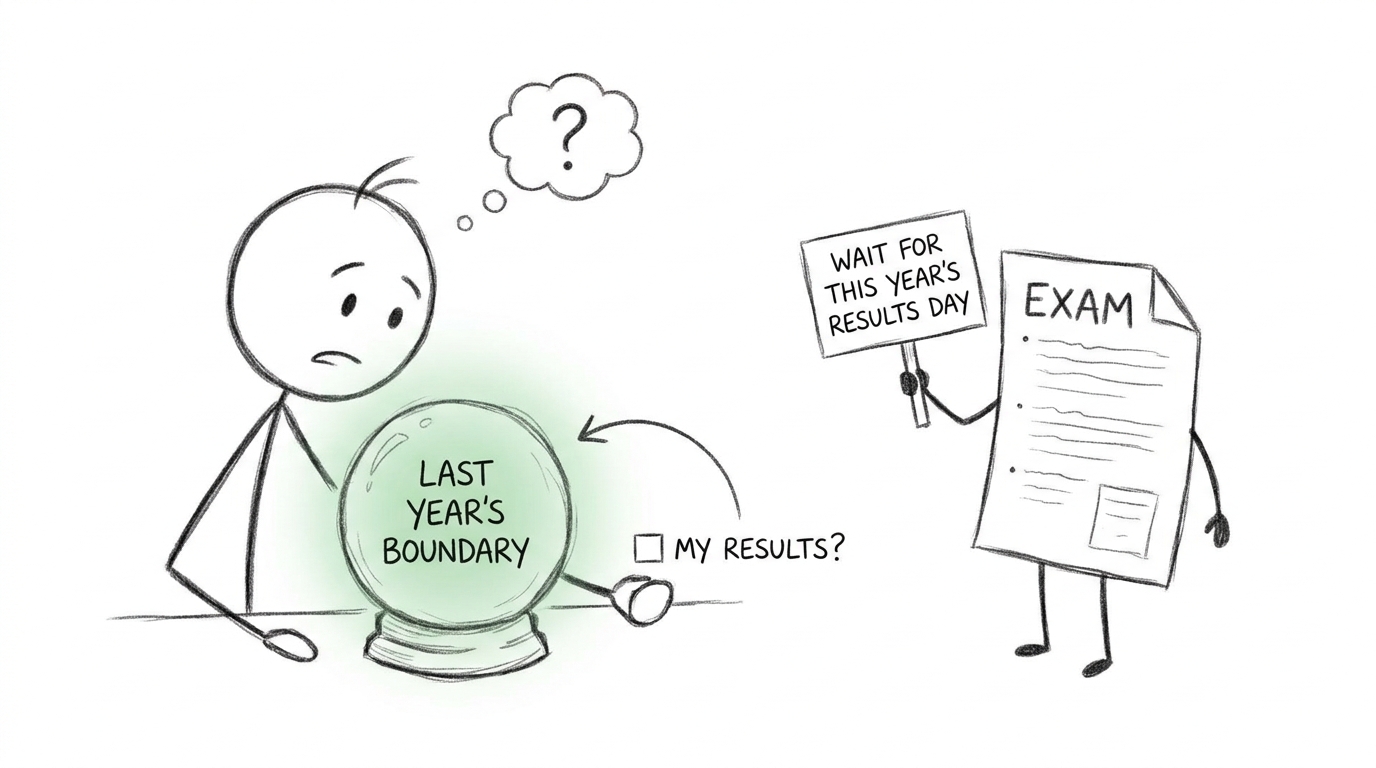 A student asking last year's grade boundary to predict the future
What to check on results day
Start with the qualification title and specification code. Then compare the reported mark with the overall boundary published for the same board, qualification and series. Do not rely on a boundary screenshot without checking its source and year.
If a result is unexpectedly close to the next grade, speak to the school or college. Staff can explain the marks, access to scripts and available post-results services. A review is not an automatic extra mark, and marks can sometimes go down as well as up.
For future preparation, focus on the skills that generate marks rather than trying to predict an exact threshold. Computer Science draws heavily on logic, data representation and quantitative reasoning. MathsGenie’s OCR A Level mathematical skills revision guide is a useful bridge between maths and computing, while GCSE students can build earlier foundations through the GCSE Computer Science revision hub.
Common grading mistakes
Treating an AS grade as part of the final A Level
In England, an AS result does not contribute marks to the corresponding reformed A Level. It remains a separate qualification.
Expecting an A* at AS
AS qualifications are graded from A to E. A* is available at full A Level, not AS.
Comparing boundaries as percentages alone
A similar percentage does not make two assessments equivalent. Their content, difficulty, weighting and qualification standard may differ.
Adding component letter grades
The final grade comes from the combined qualification mark. Individual component grades are not simply averaged.
Using last year’s boundary as a target guarantee
Boundaries can change each exam series. Build a safety margin by aiming above historical thresholds and marking practice honestly.
Make the grading system work for you
A grade boundary is the final line on a long journey, not a revision strategy. The useful work happens earlier: learning one concept, answering questions without notes, marking carefully and returning to the mistakes that keep costing marks.
Start with the relevant AQA A Level Computer Science overview or OCR A Level Computer Science overview. Use MathsGenie’s free revision lessons and practice questions to build understanding, then move to past papers, mark schemes, predicted papers, video solutions and mini tests. The grading may be linear, but improvement is built one corrected mistake at a time.











