A-Level vs AS Level Chemistry Grading Explained
A-level vs AS level Chemistry grading explained: learn why AS marks no longer count in England, how grade boundaries differ and what results mean.
Results day has a way of turning one letter into a hundred questions. If you are comparing an AS result with a predicted A Level result, the most important fact about A-level vs AS level Chemistry grading is simple: in England, a reformed AS Level is a standalone qualification. Its marks do not contribute to the final A Level Chemistry grade.
That distinction explains why AS Level Chemistry grade boundaries cannot be used to predict an A Level grade directly. The qualifications cover different amounts of content, use different assessments and receive separate boundaries.
The grading difference at a glance
| Feature | AS Level Chemistry | A Level Chemistry |
|---|---|---|
| Status in England | Standalone qualification | Full Level 3 qualification |
| Contribution of AS marks | Does not count towards the A Level | Grade comes from A Level assessments |
| Typical timing | End of Year 12 | End of Year 13 |
| Available grades | A to E, plus U | A* to E, plus U |
| Content | Broadly the first-year material | Content from across the full course |
| Assessment model | Separate linear qualification | Linear assessment at the end of the course |
| Practical endorsement | Not the separate A Level endorsement | Reported separately as pass or not classified |
The key points to remember are:
- an AS grade does not become part of an English A Level Chemistry grade;
- there is no A* grade at AS Level;
- each qualification has its own overall grade boundaries;
- boundaries may change between exam series;
- arrangements differ in Wales and Northern Ireland, so students should confirm their qualification with their school and exam board.
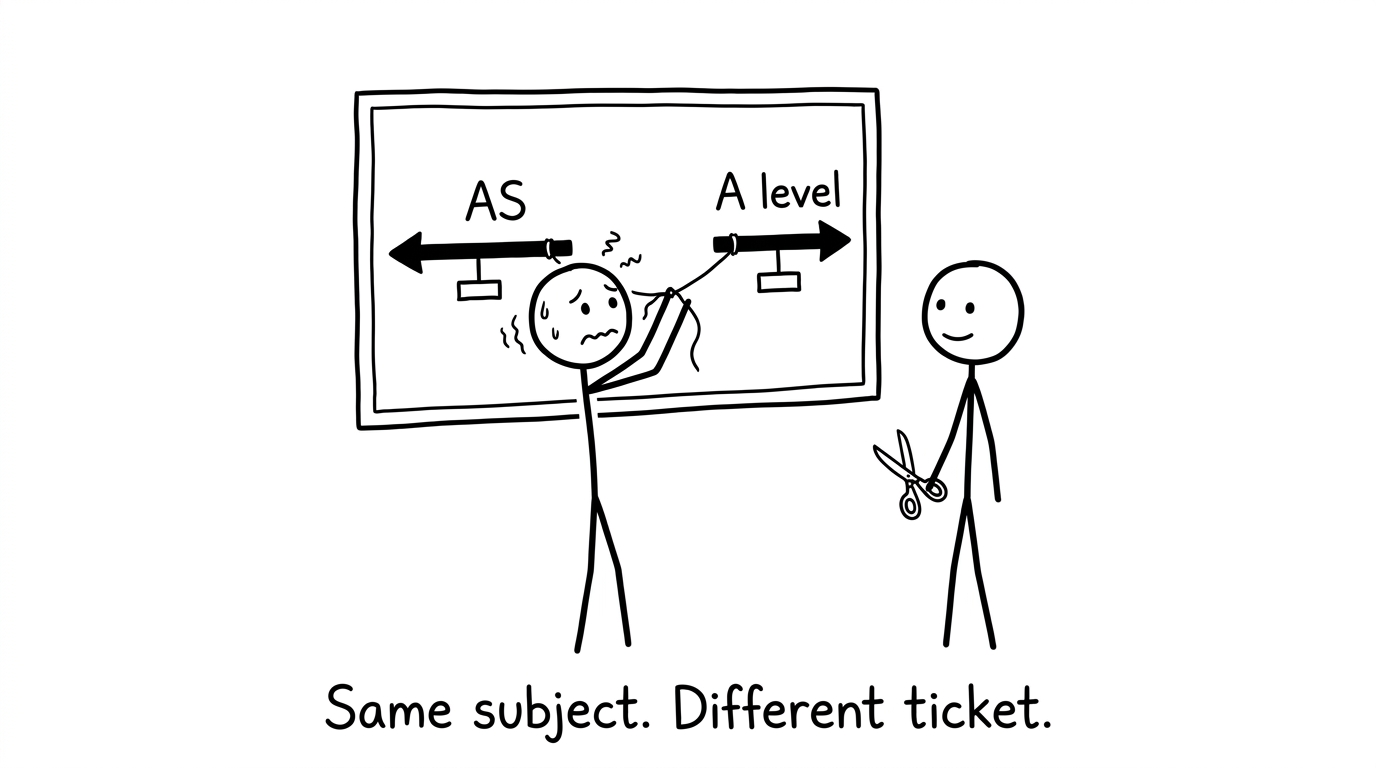 Student discovering that AS and A Level use separate grading routes
Why AS Chemistry no longer counts in England
Before A Level reforms, AS assessments commonly formed the first part of a complete A Level. That memory still shapes how many parents interpret Year 12 results.
For qualifications regulated by Ofqual in England, the system is now decoupled. AS Level Chemistry and A Level Chemistry are separate qualifications. A student may sit AS Chemistry at the end of Year 12, but the result is not carried forward or added to the marks earned in Year 13.
A student who receives a C at AS could later earn an A at A Level. Equally, a strong AS result does not guarantee the same A Level grade. The AS result is evidence about performance at that moment, not a weighted instalment of the final result.
This is what A-level Chemistry linear grading means in practice: the final grade is determined by the marks from the complete A Level assessments, normally taken at the end of the course. Students can explore the assessment resources for their board through the A Level Chemistry revision overview, including past papers, predicted papers, lessons and revision guides.
How AS Level Chemistry grade boundaries differ
A grade boundary is the minimum mark required for a particular grade in that exam series. It is not a permanent percentage that applies every year.
AS and A Level boundaries differ because they belong to different qualifications. Their papers have different total marks, content coverage and levels of demand. A Level also allows the A* grade, while AS Level stops at A.
Boundaries can move from one series to another so that grades represent a comparable standard when papers vary slightly in difficulty. This means an old boundary is useful for marking an old paper, but it is not a promise about a future results day.
Do not compare raw marks without checking the maximum available mark. A mark should be understood in relation to its total:
Percentage of available marks=raw markmaximum mark×100\text{Percentage of available marks}=\frac{\text{raw mark}}{\text{maximum mark}}\times 100Percentage of available marks=maximum markraw mark×100Even percentages do not create a reliable AS-to-A-Level conversion. The content and standard being assessed remain different.
Students should use resources written for the correct specification. MathsGenie provides dedicated pathways for AQA A Level Chemistry and Edexcel A Level Chemistry, rather than treating every board as interchangeable.
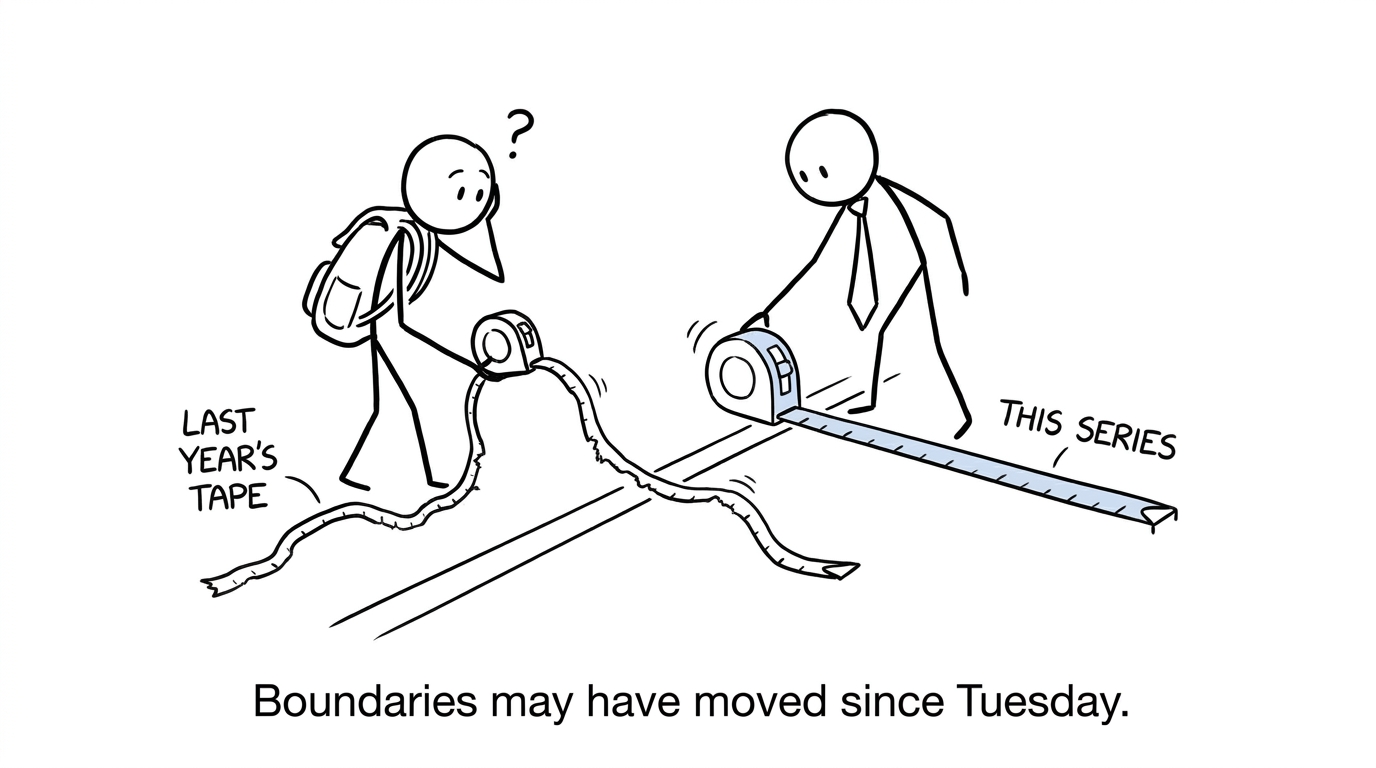 Exam boundaries moving between different exam series
What an AS result can still tell you
An AS result may not count towards the final grade, but it is not meaningless. It can reveal whether a student is secure with first-year knowledge, mathematical methods, practical interpretation and exam timing.
The useful question is not, “What will this convert into?” It is, “Where were the marks lost?”
Look through the paper and classify each loss:
- missing chemical knowledge;
- weak application to unfamiliar contexts;
- incomplete explanations;
- calculation, unit or significant-figure errors;
- poor timing or unanswered questions.
That diagnosis gives the result a purpose. A student following AQA can revisit the AQA Chemistry revision guides, while Edexcel students can use the Edexcel Chemistry revision guides. Eduqas students should work from the matching Eduqas Chemistry revision guides.
Results day checks for students and parents
Start with the qualification title and exam board on the results information. Confirm whether the result is AS or A Level and whether the course is regulated in England, Wales or Northern Ireland.
Then check:
- the overall qualification mark, not just marks for individual papers;
- the official boundary for that qualification and exam series;
- whether any paper marks shown are provisional or notional component grades;
- the separately reported practical endorsement for A Level Chemistry;
- the school or college process for requesting a script, clerical check or review of marking.
In a linear qualification, paper-level boundaries may be described as notional. The certificated grade comes from the total qualification mark, so a lower performance on one paper can be balanced by stronger marks elsewhere.
Common mistakes when interpreting Chemistry grades
Adding AS marks to A Level marks
For reformed qualifications in England, this is incorrect. The AS result stands alone and the A Level grade comes from the A Level assessments.
Expecting an A* at AS Level
AS qualifications are graded from A to E. A* is available only at full A Level.
Treating last year’s boundary as fixed
Grade boundaries are set for a particular qualification and exam series. Use historical boundaries to review past papers, not to guarantee a future grade.
Comparing different exam boards directly
AQA, Edexcel, OCR and Eduqas specifications differ in assessment structure and total marks. Compare performance using the correct specification, papers and mark schemes.
Applying England’s rules everywhere
The decoupled model described here applies to Ofqual-regulated qualifications. In reformed qualifications regulated in Wales and Northern Ireland, AS assessments can contribute to the complete A Level. Always check the precise qualification being taken.
Turn the result into a revision plan
A grade is a summary. Improvement comes from the detail beneath it.
Choose the correct exam board on MathsGenie, revisit weak topics through revision lessons, and then answer targeted practice questions. Move on to mini tests and full past papers once the individual skills are secure. Mark every attempt carefully with the mark scheme, and use predicted papers for additional exam-style rehearsal rather than as a forecast of exact questions.
Start with the MathsGenie A Level Chemistry overview. It brings together free lessons, question banks, revision guides, past papers, predicted papers and revision tools, helping an AS result become something more useful than a letter: a clear plan for the next step.