

A-Level vs AS Level Biology Grading Explained
A-level vs AS level Biology grading explained: learn why AS no longer counts in England, how linear boundaries work and what to check on results day.
Results day can make two familiar letters feel surprisingly complicated. A student may have an AS Biology result from Year 12, an A-level prediction from school and several different grade-boundary tables open at once. The essential answer to A-level vs AS level Biology grading is simple: in England, AS Biology is a standalone qualification. Its marks do not contribute to the final A-level Biology grade.
A-level Biology is instead a linear qualification. The final grade is determined by the assessments completed at the end of the full course, using the A-level boundaries for that exam board and exam series.
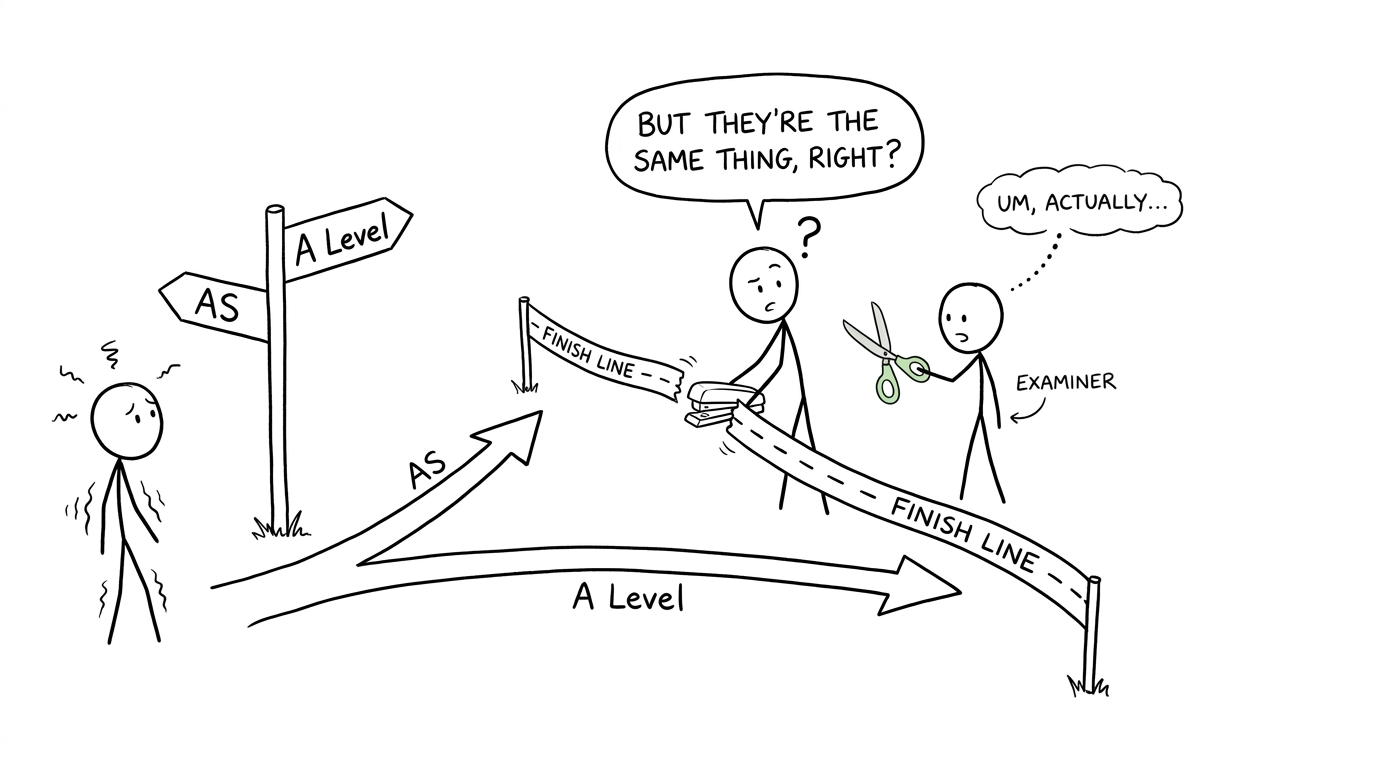 A student and parent discover that AS and A Level have separate finish lines
The grading difference at a glance
| Feature | AS Biology | A-level Biology |
|---|---|---|
| Status in England | Standalone qualification | Separate full A level |
| Typical assessment point | End of the AS course | End of the full A-level course |
| Contribution to A-level grade | None | Final assessments determine the grade |
| Available grades | A to E | A* to E |
| Content | Usually aligned with first-year material | Full course, including first-year content |
| Grade boundaries | Separate AS boundaries | Separate A-level boundaries |
| Practical endorsement | Not part of the A-level result | Usually reported separately from the written-exam grade |
Before interpreting a result, check four things:
- the qualification title: AS or A level;
- the exam board, such as AQA, Pearson Edexcel, OCR or Eduqas;
- the specification code;
- the correct exam series and year.
Why AS Biology no longer counts in England
Older advice can cause confusion because AS qualifications once formed part of the full A level. Following qualification reform, AS and A levels regulated by Ofqual became decoupled. They are now separate qualifications.
That means an AS grade cannot be added to, averaged with or substituted for part of an A-level grade. A strong AS result is encouraging evidence of progress, but it does not bank marks for Year 13. Equally, a disappointing AS result does not place a mathematical limit on the final A-level grade.
This distinction applies to reformed qualifications in England. Arrangements differ elsewhere in the UK. In Wales, some WJEC qualifications use an AS stage that contributes towards the full A level, while Northern Ireland also has different qualification structures. Students taking Eduqas in England should not assume that its rules are identical to those for WJEC qualifications in Wales. Always check the qualification regulator and specification named by the school.
How A-level Biology linear grading works
In a linear A level, the relevant paper marks are combined to produce a qualification total. That total is compared with the official subject-level boundaries for the particular exam series.
In general terms:
Total qualification mark=Paper 1 mark+Paper 2 mark+Paper 3 mark\text{Total qualification mark}=\text{Paper 1 mark}+\text{Paper 2 mark}+\text{Paper 3 mark}Total qualification mark=Paper 1 mark+Paper 2 mark+Paper 3 markThe precise number of papers, maximum marks and weightings depends on the board and specification. For example, AQA, OCR and Pearson Edexcel Biology specifications do not all use the same total mark. This is why comparing raw marks across boards can be misleading.
Official qualification boundaries decide the final grade. Boundaries sometimes shown for individual papers may be described as notional. They can help teachers analyse performance, but separate notional paper grades are not simply combined to create the qualification result.
You can see how boundaries are presented on MathsGenie's OCR A-level Biology grade boundaries page.
What happens to the practical endorsement?
For reformed A-level Biology qualifications in England, practical competency is generally reported separately as a pass or not classified result. It does not add marks to the overall A-level grade, although practical knowledge and data-handling skills are still examined in the written papers.
The distinction matters: the practical endorsement records practical competency, while the A* to E subject grade comes from the examined components.
Why AS and A-level Biology boundaries differ
AS level Biology grade boundaries cannot be used to predict an A-level grade directly. The qualifications differ in content, assessment demand, paper structure and total available marks.
Boundaries can also change between exam series. Exam boards set them after reviewing the assessments and evidence about how demanding the papers were. A harder paper may require fewer raw marks for the same grade standard; an easier paper may require more. This is designed to preserve the meaning of grades rather than reward or penalise a particular cohort for paper difficulty.
A useful comparison converts a boundary into a percentage of the available marks:
Boundary percentage=boundary markmaximum mark×100\text{Boundary percentage}=\frac{\text{boundary mark}}{\text{maximum mark}}\times 100Boundary percentage=maximum markboundary mark×100Even then, a previous percentage is only a revision guide. It is not a promise about a future boundary. The most reliable target is consistently producing accurate answers across the specification.
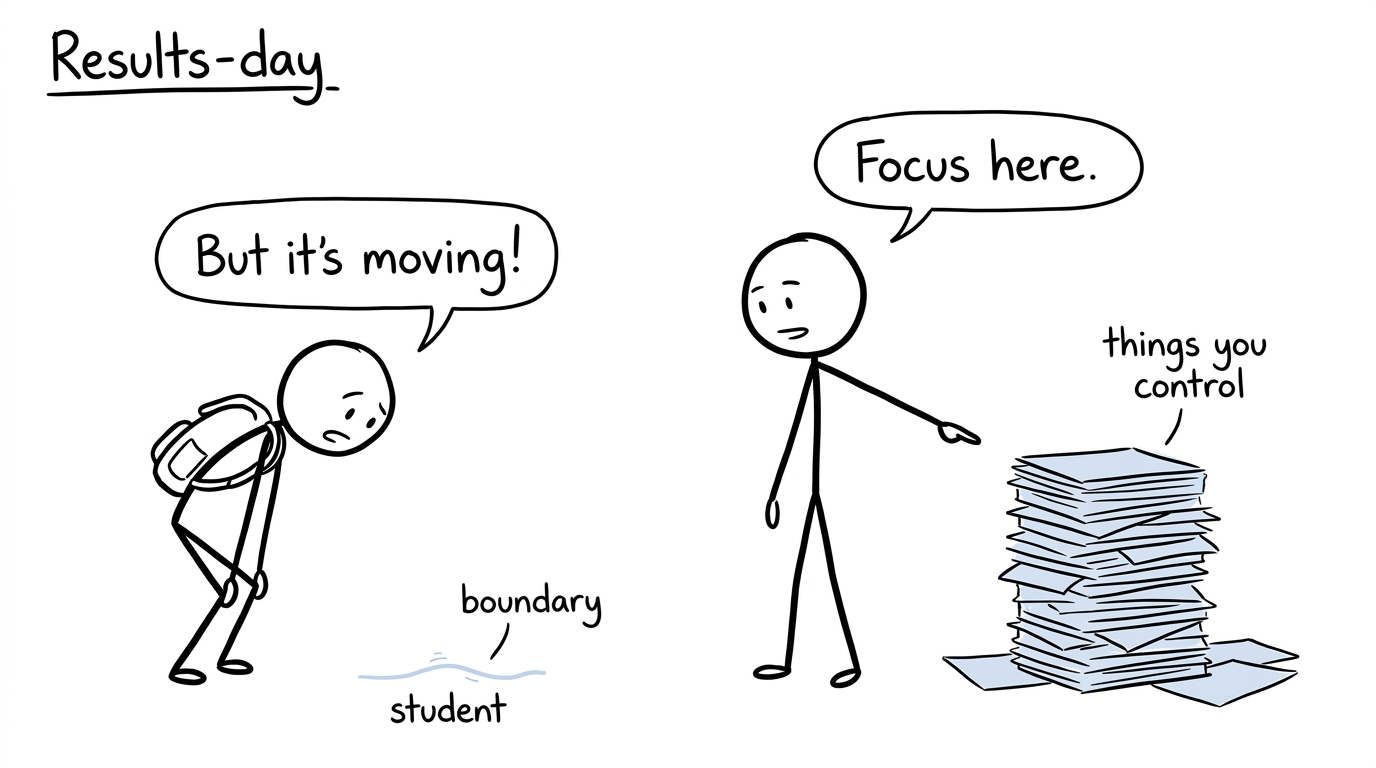 A student ignores a moving boundary and focuses on completed practice papers
The maths behind stronger Biology results
At least 10%10\%10% of the marks in reformed A-level Biology written assessments are allocated to mathematical skills at Level 2 or above. Biology students therefore need confidence with percentages, ratios, standard form, graphs, rates of change and statistical interpretation.
If those skills feel uncertain, revisit the GCSE Maths revision guides before tackling biological data questions. Students continuing with both subjects can use the A-level Maths revision hub or the board-specific Edexcel A-level Maths resources.
The revision method matters too. Complete questions without notes, mark them carefully and record why marks were lost. MathsGenie's Edexcel A-level Maths past papers and AQA AS and A-level Maths papers demonstrate the same useful cycle: attempt, check the mark scheme, correct and revisit.
Common mistakes on results day
Adding AS marks to the A-level total
For an Ofqual-regulated Biology qualification in England, the AS result is separate. Only the components specified for the full A level determine its grade.
Reading the wrong boundary table
Check the board, qualification level, specification code and exam series. AS Biology and A-level Biology have different boundaries even when they come from the same board.
Treating paper boundaries as final grades
In a linear qualification, the overall total determines the subject grade. Notional component boundaries are analytical tools, not separate awarded grades.
Assuming last year's boundary will be repeated
Boundaries are set for each exam series. Previous tables help with target-setting, but they cannot confirm a future result.
Forgetting regional differences
The statement that AS does not count applies to reformed qualifications in England. Families in Wales or Northern Ireland should confirm the structure with the school and current specification.
Move from boundary-watching to useful revision
Grade boundaries explain a result; they do not create the preparation behind it. The productive question is not, “Will the boundary fall?” but, “Which marks can I make more reliable?”
Start by confirming your Biology board and qualification code. Then use the specification as a checklist, complete timed questions and review every lost mark. Strengthen the calculations underneath Biology with MathsGenie's free GCSE and A-level maths revision resources, including revision lessons, practice questions, past papers, predicted papers, mini tests, mark schemes and video solutions. Small corrections made repeatedly are far more dependable than any guess about results-day boundaries.











