A-Level Statement of Results Explained
A-level statement of results explained clearly: decode grades, marks, subject codes and symbols, then know what to check and do next on results day.
Results day compresses two years of work into a few small boxes. That is why unfamiliar codes can look more important than they are. This A-level statement of results explained guide shows you how to read the slip calmly: confirm your personal details, find each qualification, read the overall grade, interpret any marks or symbols, and ask your exams officer about anything unexpected.
Your layout may differ because exam boards and school information systems do not all produce identical slips. The essential information, however, follows the same pattern.
Your results-slip checklist
Before thinking about boundaries or university offers, check:
- your name and identifying information;
- the subject and qualification level;
- the exam board or specification code;
- the overall grade;
- any component marks shown;
- symbols such as
Q,Xor#; - any practical endorsement result;
- whether the information matches the exams you took.
In 2026, A-level results may be released to candidates from 08:00 on Thursday 13 August. Your school or college will explain whether you should collect them in person or access them online.
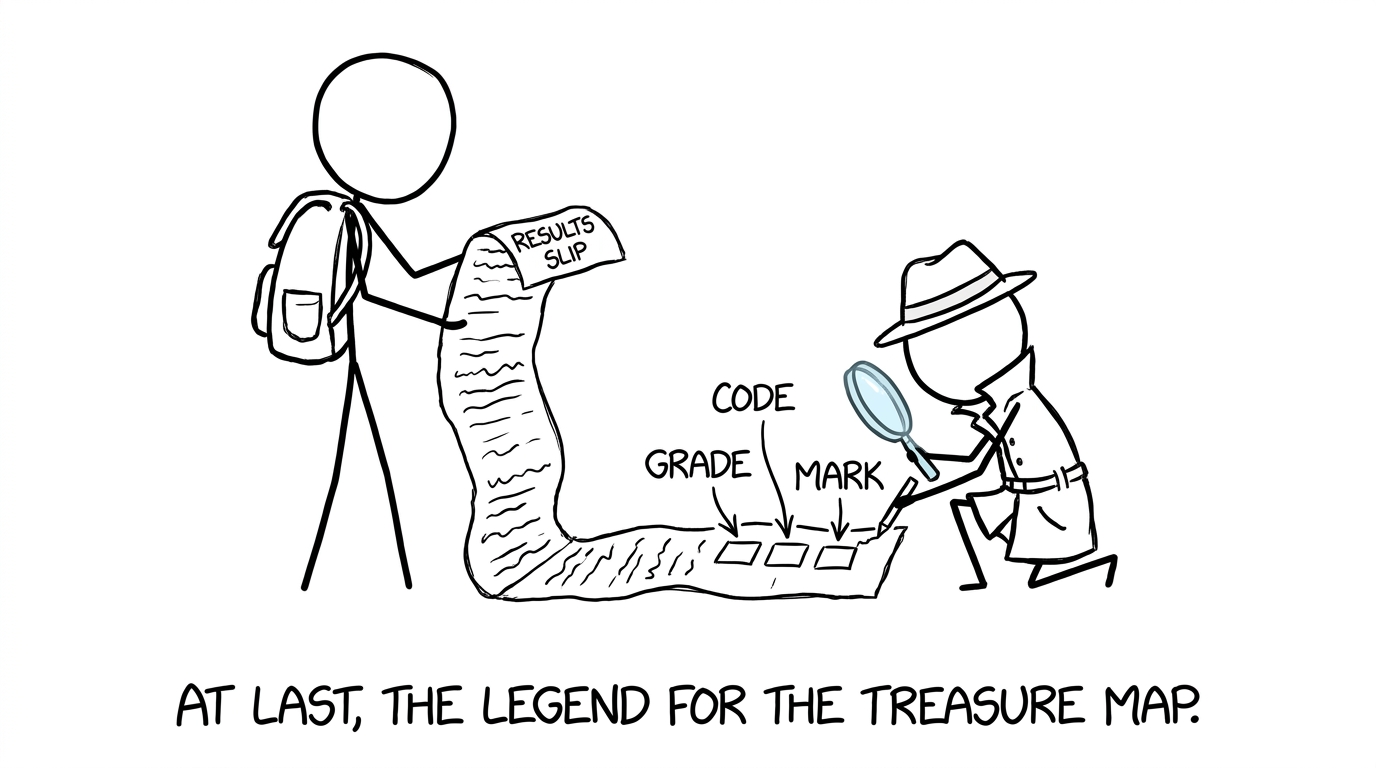 A student and tiny detective decoding the harmless boxes on a results slip
Reading an A-level results slip field by field
Candidate and centre details
The top of the document normally identifies you and your school or college. It may include your candidate number, centre number and Unique Candidate Identifier, often shortened to UCI.
The candidate number is usually the four-digit number written on your exam papers. The UCI is a longer identifier used to connect your entries and results across exam series and awarding organisations. Check that your name is correct, but avoid sharing photographs containing these personal identifiers publicly.
Qualification level and subject
Look for headings such as Advanced GCE, GCE A Level or AS Level. Then check the subject title carefully. Mathematics and Further Mathematics, for example, are separate qualifications.
Your slip may also display an award, specification or entry code. Codes differ across Edexcel, AQA, OCR and Eduqas, so an unfamiliar string of letters and numbers is not itself a warning. It identifies the precise qualification or component entered by your centre.
Overall grade
The most important field is the final qualification grade. A levels are awarded from A* to E; U means unclassified. The grade beside the overall qualification is the result used for your certificate.
Do not mistake a paper or component line for the final award. In England's linear A levels, the qualification grade is based on performance across the complete assessment. Any component boundaries published by an exam board are notional guides rather than separate official paper grades.
Marks and components
Some statements show marks for individual papers or coursework components; others provide less detail. A raw mark is the mark awarded for assessed work. It is not automatically a percentage, and it should only be compared with the correct exam board, specification, series and maximum mark.
For reformed linear A levels in England, the overall result is generally based on total raw marks. A Uniform Mark Scale may still appear for certain modular qualifications, including some international or legacy specifications. Ask your exams officer which mark scale your slip uses rather than assuming.
Use MathsGenie's Edexcel A Level Maths grade calculator and boundaries to interpret an Edexcel Maths total, but check the correct year. Grade boundaries can change between exam series because papers vary in difficulty.
Status symbols and endorsements
AQA identifies common provisional-results symbols including:
Q: a result is pending because required marks are not yet available;X: no result has been issued, potentially because all assessments were missed or for another stated reason;#: there was a partial absence, although a grade could still be issued.
Meanings and presentation can vary, so take any symbol straight to your exams officer. Science A levels may also show a separate practical endorsement, commonly reported as Pass or Not Classified. This does not alter the letter grade but may matter to a university or employer.
What to do after reading your results
First, compare the grades with your offer conditions. UCAS receives many results directly and sends them to universities, but not every qualification is transferred automatically. Check your application status and follow any instructions from your chosen university.
If a grade is unexpected, speak to your subject teacher and exams officer. They can obtain available scripts, discuss marking and explain review-of-marking services, consent requirements, fees and deadlines. Do not request a review simply because you are close to a boundary: marks can remain unchanged, rise or fall.
 A calm student reads the envelope while noisy phone notifications wait behind a barrier
Common mistakes when reading A-level results
- Treating the slip as the certificate: it is a Candidate Statement of Provisional Results. The certificate is issued later.
- Reading a component mark as the final grade: find the overall qualification line first.
- Using last year's boundary: compare marks only with the correct board, specification and exam series.
- Assuming UCAS shows every mark: UCAS displays the progress of your application, not a full replacement for your school-issued results.
- Posting the whole slip online: cover your candidate number, centre number and UCI.
Turn results into your next sensible step
A results slip is information, not a verdict on your ability. Read the overall grades first, check the supporting details, then ask for help where something is unclear.
If A-level Maths is still ahead, begin with the A Level Maths revision hub, then build confidence using A Level Maths past papers and mark schemes. GCSE students can prepare through the GCSE Maths revision hub, organise their weeks with the free revision planner, and use predicted papers, mini tests and revision resources.
MathsGenie brings revision lessons, practice questions, video solutions, past papers, predicted papers and mark schemes together for free. Start by checking the relevant grade calculator and grade boundaries, then let the result guide your next conversation or revision decision.