A-Level Sociology Resit: Your UCAS Application
A-level sociology resit UCAS application advice: explain your retake honestly, show academic growth and give universities evidence of a credible plan.
Results day can reduce two years of work to one letter on a screen. If that letter was lower than expected, it is natural to worry that universities will see only the result and not what happens next.
For an A-level sociology resit UCAS application, the best approach is simple: declare the original result and pending retake accurately, check each course's resit policy, then frame the decision through evidence, reflection and preparation. Do not apologise for half a personal statement. Show that you understand what needs to improve and have already begun improving it.
Your resit application checklist
Before sending your application:
- enter the original Sociology qualification and achieved grade;
- enter the resit separately with the result shown as pending;
- check the resit policy for every university and course directly;
- ask your referee to provide a predicted grade for the pending qualification;
- explain relevant extenuating circumstances factually, where appropriate;
- show what has changed in your revision or exam technique;
- support your claims with specific academic activity.
University policies vary, particularly for highly competitive courses, so never assume that one admissions policy applies everywhere.
 A student choosing between hiding from a resit and following an honest application plan
How to record an A-Level Sociology retake
UCAS requires applicants to include completed qualifications, unsuccessful results, pending qualifications and retakes. A resat qualification should therefore appear twice: once with the original achieved grade and once with the new result marked as pending.
Accuracy matters more than presentation here. Omitting the first result does not make an application stronger; it makes the education section incomplete.
Your referee can add a predicted grade for the pending retake. If illness, bereavement, caring responsibilities or another significant circumstance affected your first sitting, discuss whether the referee should explain it. With your permission, a UCAS reference may include circumstances affecting your education or achievement. Keep supporting information factual and proportionate.
Explaining a resit in the UCAS personal statement
For 2026 entry onwards, the UCAS personal statement is divided into three questions, with an overall limit of 4,000 characters. The second question, how your qualifications and studies have prepared you for the course, is usually the most natural place to mention a Sociology retake.
The resit should not dominate your answers. Admissions teams still need to understand why you want the degree, how Sociology has prepared you and what evidence supports your academic interest.
Use reflection, action and relevance
A strong explanation has three parts:
- Reflection: briefly identify what you learnt from the first sitting.
- Action: state what you changed and what you are doing now.
- Relevance: connect that work to readiness for the degree.
This moves the focus from disappointment to response. Universities cannot assess determination from the word “resit” alone. They can assess the evidence surrounding it.
Example wording for explaining a resit
You might adapt wording such as:
I am retaking A-Level Sociology after reviewing my first result and identifying that my evaluation and timed essay planning needed greater consistency. I have introduced weekly timed responses, structured feedback reviews and closer use of mark schemes. This process has strengthened both my sociological understanding and my ability to respond constructively to academic setbacks.
If genuine extenuating circumstances applied, a concise alternative is:
My first Sociology result was affected by circumstances that are addressed in my reference. Since then, I have followed a structured retake plan focused on timed essays, application of evidence and evaluation. The experience has reinforced my commitment to further study and helped me develop a more disciplined approach to independent work.
Use these as frameworks, not scripts. Your wording must remain truthful and reflect your own preparation.
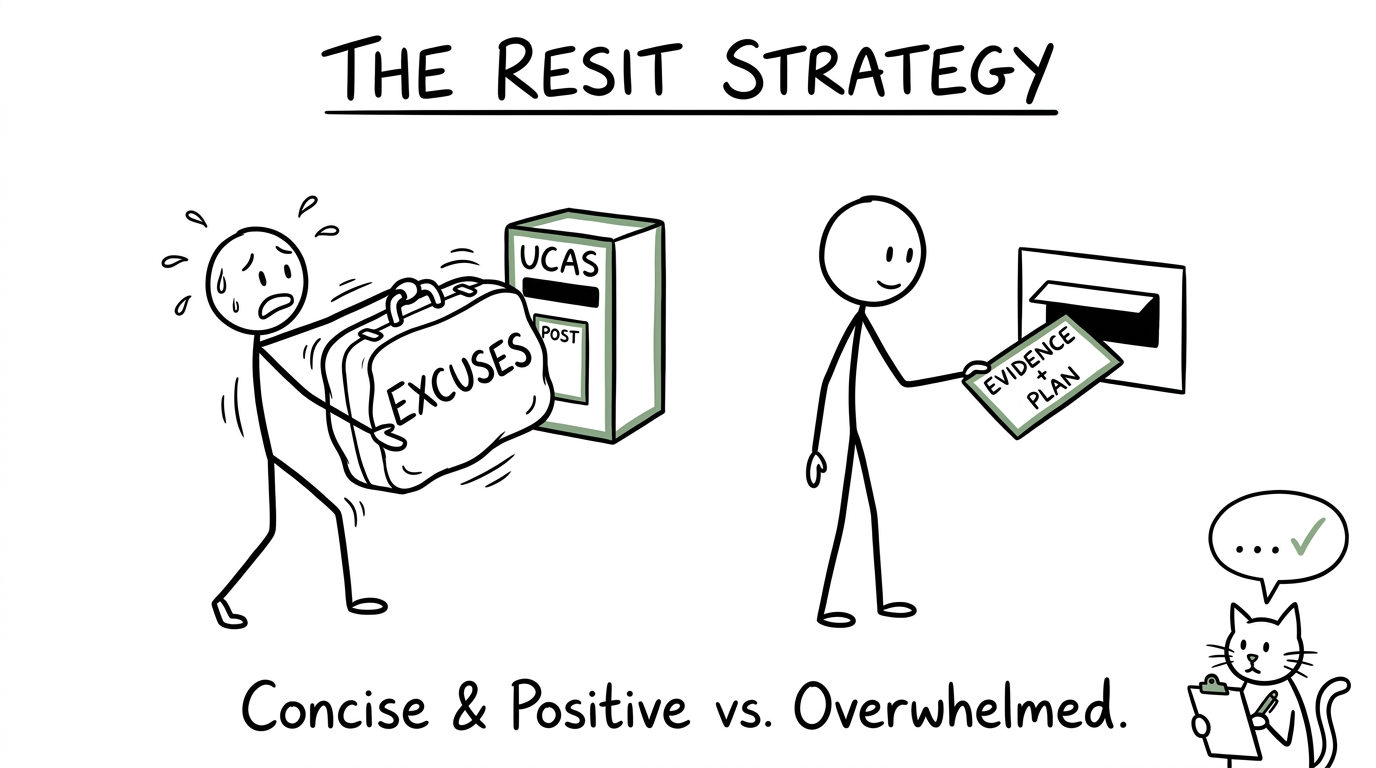 A student choosing a concise evidence and plan envelope instead of an oversized suitcase of excuses
Give universities evidence of change
“Working harder” is difficult to evaluate. A defined routine is more convincing. You could mention:
- completing timed essays under exam conditions;
- comparing responses with mark schemes;
- keeping a record of recurring AO1, AO2 and AO3 weaknesses;
- revisiting weaker specification areas;
- using teacher or tutor feedback systematically;
- completing past papers and reviewing each lost mark.
MathsGenie's free A-Level Sociology revision hub brings together lessons, revision guides and exam-board resources. AQA students can use the AQA A-Level Sociology revision page, then work through the AQA Sociology revision guides.
Specific resources can make your application claims real. For example, you might strengthen evaluation through the Sociology and social policy revision guide or improve contextual application with the Methods in Context guide. Use the MathsGenie revision planner to turn those intentions into a weekly schedule.
The same habit is worth building earlier. GCSE students can use the GCSE Maths revision hub to learn the cycle now: attempt, mark, diagnose, practise and retest.
Common mistakes when explaining resits
Hiding or inaccurately recording the original result
Declare both sittings correctly. Transparency is a basic application requirement, not a weakness.
Writing a long defence of results day
Context may matter, but your application should spend more space on academic readiness and improvement than on disappointment.
Blaming teachers, examiners or the paper
Even when the first experience felt unfair, blame does not demonstrate readiness. Focus on what you can now control.
Making claims without evidence
Replace “I am more motivated” with the concrete habits that demonstrate motivation.
Ignoring course-specific rules
Resit policies can differ between universities and even between courses at the same institution. Check current requirements and contact admissions teams if the published wording is unclear.
Turn the retake into a credible next chapter
A Sociology retake is part of your academic record, but it does not need to become the whole story. Record it honestly, explain it briefly and let your preparation carry the argument.
Start building that evidence today with MathsGenie's A-Level Sociology revision resources. Use revision lessons and guides to repair knowledge gaps, practise with past papers and mini tests, and review your work against mark schemes. A convincing application describes a plan. A convincing resit year follows one.