A-Level Sociology Remark: Results Day Guide
A-level sociology remark guidance: check scripts, deadlines and grade boundaries, then decide whether to request a review of marking or appeal.
Results day can reduce two years of work to one unsettling thought: I was so close. If you are considering an A-level sociology remark, the immediate answer is this: speak to your school or college, check how far you are from the next grade boundary, request your marked scripts where time allows, and ask a Sociology teacher to look for credible marking errors. Do not request a review simply because the grade feels disappointing.
The official term is review of marking, not re-mark. The reviewer checks whether the original examiner applied the mark scheme correctly. Your mark can rise, stay unchanged or fall.
For the June 2026 series, A-level results are released on Thursday 13 August. The JCQ deadline for a priority review is 20 August 2026, while the standard review deadline is 24 September 2026. Your school may impose earlier internal deadlines, so act promptly.
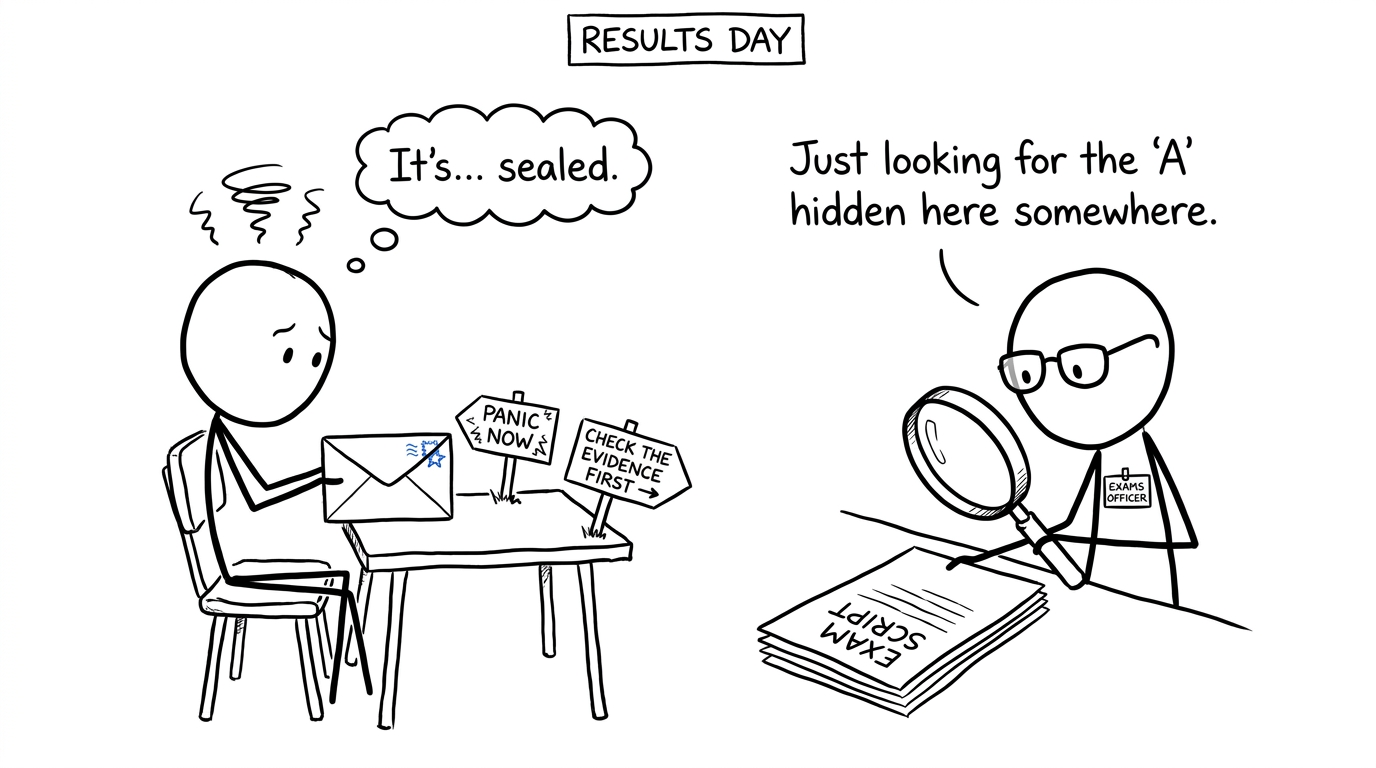 A student choosing between panic and checking the evidence on results day
Your results-day decision checklist
Before requesting an A-level Sociology review, ask:
- How many marks am I below the next overall grade boundary?
- Which paper appears weaker than expected?
- Has my teacher examined the marked script?
- Can they identify a plausible failure to apply the mark scheme?
- Could a higher grade affect a university, college or employment offer?
- Do I understand that the mark and final grade could go down?
- What are my centre's deadline and fee?
Start with the correct boundary for your board. MathsGenie brings together GCSE and A Level grade boundaries, while the A Level Sociology revision hub covers AQA, Eduqas, OCR and WJEC resources.
How the A-level Sociology re-mark process works
Check your marks against the grade boundary
Find your total subject mark and the published boundary for the grade you wanted. The useful calculation is:
marks required=next grade boundary−current total mark\text{marks required}=\text{next grade boundary}-\text{current total mark}marks required=next grade boundary−current total markBeing one mark short does not prove that marking was wrong. It tells you that a small justified change could alter the result. Being further away does not make a review impossible, but it means more marks must change before the overall grade moves.
AQA students can use the AQA Sociology predicted grade calculator and check the wider AQA A Level grade boundaries. Eduqas students should use the dedicated Eduqas Sociology grade boundaries.
Ask for the marked scripts
Your school or college can use the exam board's Access to Scripts service. You must give permission before a centre requests or uses your scripts.
Where deadlines allow, ask an experienced Sociology teacher to compare the scripts with the mark scheme and examiner guidance. They should look for evidence such as:
- a page or response apparently left unmarked;
- a clerical problem in recording or adding marks;
- relevant knowledge, application, analysis or evaluation that may not have been credited appropriately;
- a level-of-response judgement that appears inconsistent with the published descriptors.
Sociology contains extended writing assessed through levels. That creates legitimate professional judgement: two marks being possible does not automatically make the original mark wrong. The question is whether the mark scheme was applied correctly, not whether another examiner might simply prefer your argument.
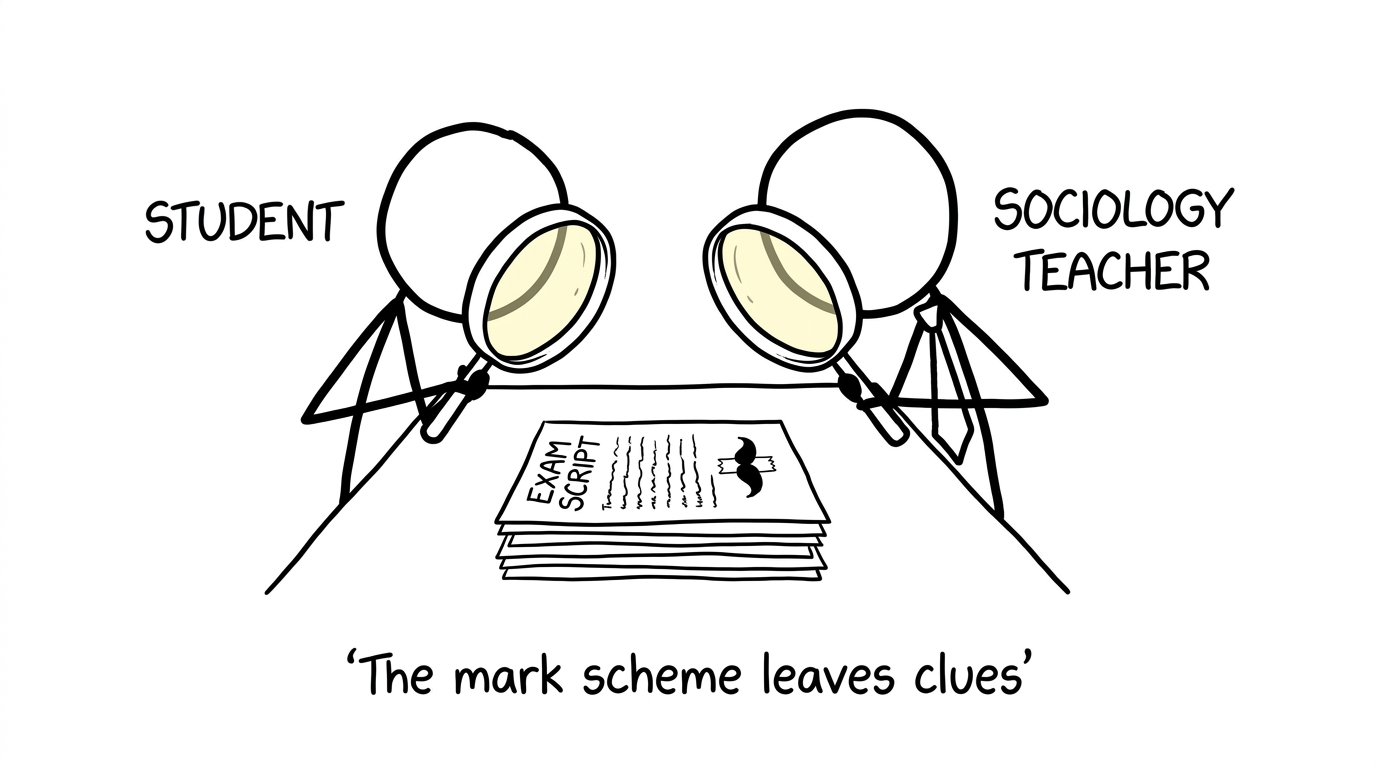 Sociology detectives searching an exam script for mark-scheme clues
Choose the appropriate service
A clerical re-check checks processes such as whether marks were recorded and totalled correctly. A review of marking includes clerical checks and considers whether the mark scheme was applied correctly to an externally assessed paper.
A priority review is intended for A-level candidates whose higher education place depends on the outcome. For 2026, awarding organisations aim to complete priority reviews within 15 calendar days and standard reviews within 20 calendar days. If a university place is uncertain, tell both your exams officer and the university immediately.
Most students cannot submit the request directly. Your school or college normally applies to the exam board and must obtain your written consent after results have been released. Private candidates may be able to approach the awarding organisation directly or work through the centre where they sat the examination.
Review the outcome before considering an appeal
The outcome replaces the original mark, even if it is lower. Fees and refund policies vary by exam board and centre, so obtain the current details from your exams officer before consenting.
Appealing an A-level Sociology grade is a later stage. An appeal can normally be made only after the review outcome and concerns whether the exam board followed its procedures or applied its processes properly. It is not a second opportunity to request a more generous academic judgement.
If your school refuses to request a review, it must provide a route for you to appeal that internal decision. Ask for the centre's written post-results policy immediately, because exam-board deadlines still apply.
When requesting a review makes sense
A review is most defensible when several signals point in the same direction: you are near a boundary, one component is unexpectedly low, an informed teacher has checked the script, and the script contains a specific possible marking error.
For AQA, the course uses three externally assessed papers, each worth 808080 marks and one-third of the qualification. Looking at the component marks can therefore be more informative than staring at the final letter alone. The AQA A Level Sociology revision page summarises the assessment structure and provides past papers with mark schemes for comparison.
A review is less compelling when it rests only on a predicted grade, a strong feeling after the examination or the belief that hard work should guarantee a particular result. Predictions describe expectations. Reviews investigate the application of the mark scheme.
Common mistakes to avoid
- Calling it a complete re-mark. It is a review of whether the original marking was correct.
- Looking only at the final grade. Check component marks and the exact boundary first.
- Waiting too long for a script. Priority deadlines arrive quickly after results day.
- Assuming marks can only rise. Your mark and grade may decrease.
- Treating disagreement as an error. Sociology essays involve legitimate examiner judgement within level descriptors.
- Ignoring the university. If a place is pending, contact the institution while the priority review is being arranged.
- Jumping straight to an appeal. The review-of-marking stage normally comes first.
Make the decision from evidence, not panic
A result can feel personal, but the best post-results decisions are procedural. Check the boundary. Inspect the script. Ask a subject specialist. Respect the deadline. Then decide whether the evidence justifies the risk and cost.
Begin with MathsGenie's A Level Sociology revision resources, then check the relevant Sociology grade boundaries and calculator before speaking to your exams officer. For students returning to GCSE or A Level maths revision, MathsGenie also provides free GCSE Maths revision and A Level Maths revision, including revision lessons, practice questions, mini tests, past papers, predicted papers, mark schemes and video solutions.