

A-Level Sociology Grade Boundaries History
A-level Sociology grade boundaries history from 2017 to 2025, with AQA marks, year-by-year trends and practical advice for interpreting results.
A grade boundary can look like a fixed target until you place several years beside one another. Then it starts to move. This A-level Sociology grade boundaries history tracks AQA Sociology from 201720172017 to 202520252025, the latest complete summer data available at the time of writing.
The clearest finding is that boundaries fell during the pandemic transition period and have since risen. For AQA Sociology, the $ $\mathrm{A^*}
boundary increased from $177$ marks in $2022$ to $190$ in $2025{\char"24}. But that does not mean students suddenly became better, or that one paper was automatically easier. Grade boundaries are part of the awarding process and must be interpreted in context. ## What the figures cover Before reading the table, check these details: - The data is for **AQA A-level Sociology specification $7192$**. - The qualification has three papers, each worth $80$ marks. - The overall maximum is therefore $240$ marks. - The figures are overall qualification boundaries, not targets for individual papers. - The $2020$ and $2021$ rows refer to autumn exam series, not normal summer examinations. - Other exam boards and specifications must be checked separately. You can view the figures through the [AQA A-level Sociology grade calculator](https://mathsgenie.co.uk/a-level/sociology/aqa/predicted-grade-calculator) or compare subjects using the wider [AQA A-level grade boundaries](https://mathsgenie.co.uk/grade-boundaries/a-level/aqa) collection. ## Past A-level Sociology grade boundaries by year The following boundaries are the minimum total marks needed for each grade. They have been checked against AQA's published grade-boundary tables. | Exam series | Maximum | $\mathrm{A^*}$ | $\mathrm{A}$ | $\mathrm{B}$ | $\mathrm{C}$ | $\mathrm{D}$ | $\mathrm{E}$ | Commentary | | --- | --- | --- | --- | --- | --- | --- | --- | --- | | June $2017$ | $240$ | $179$ | $160$ | $138$ | $117$ | $96$ | $75$ | First examination year for the reformed specification. | | June $2018$ | $240$ | $182$ | $164$ | $142$ | $121$ | $100$ | $79$ | Most boundaries rose slightly from $2017$. | | June $2019$ | $240$ | $183$ | $164$ | $142$ | $120$ | $98$ | $77$ | The final standard summer series before pandemic disruption. | | November $2020$ | $240$ | $174$ | $155$ | $132$ | $109$ | $86$ | $63$ | An exceptional autumn series; summer exams were cancelled. | | November $2021$ | $240$ | $171$ | $151$ | $128$ | $105$ | $83$ | $61$ | Another exceptional autumn series following cancelled summer exams. | | June $2022$ | $240$ | $177$ | $157$ | $131$ | $105$ | $79$ | $54$ | Summer exams returned with transitional grading arrangements. | | June $2023$ | $240$ | $185$ | $165$ | $139$ | $114$ | $89$ | $64$ | Grading returned broadly to pre-pandemic standards, with protection built in. | | June $2024$ | $240$ | $186$ | $167$ | $142$ | $117$ | $92$ | $67$ | A small rise across every grade compared with $2023$. | | June $2025$ | $240$ | $190$ | $171$ | $147$ | $123$ | $99$ | $76$ | Upper-grade boundaries reached their highest levels in this period. | 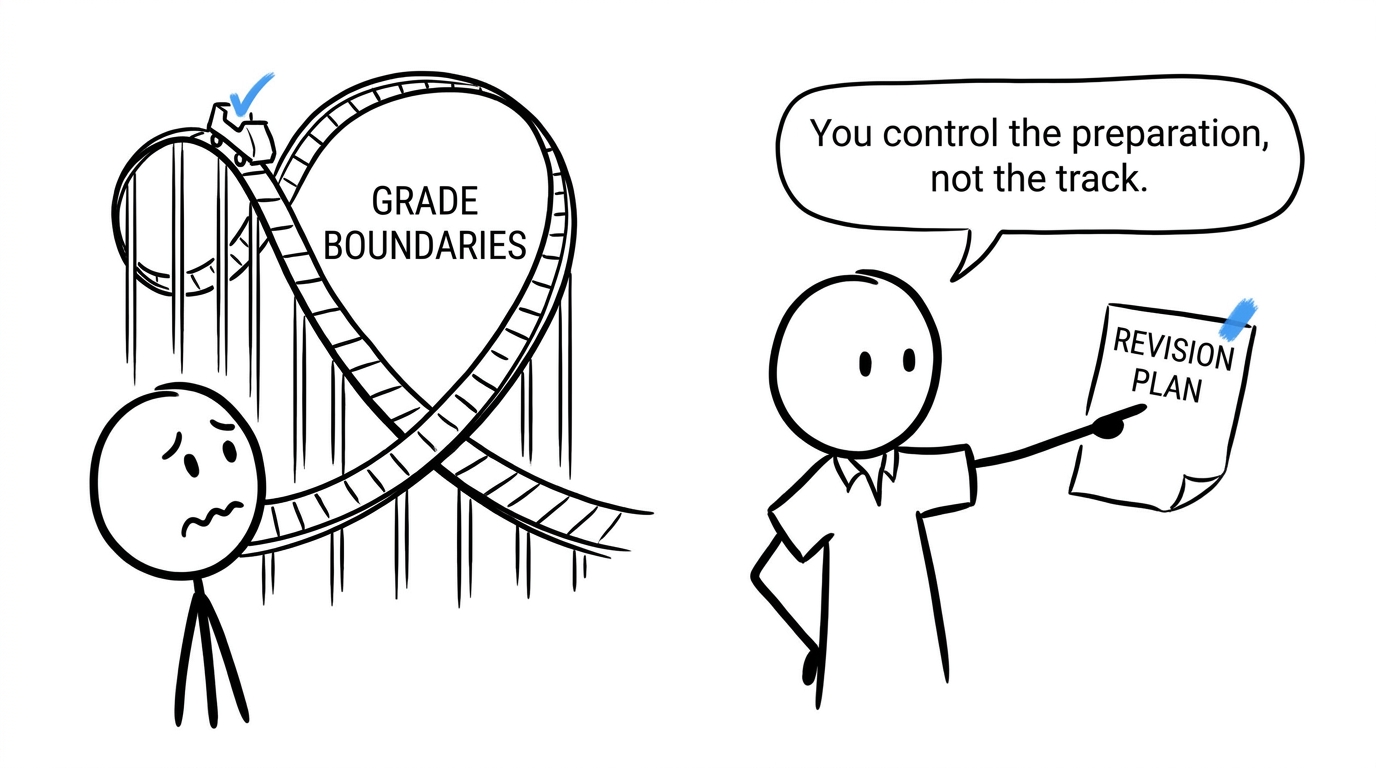 ## What the A-level Sociology grade boundary trends show ### The pre-pandemic years were fairly stable Between $2017$ and $2019$, the {\char"24} $\mathrm{A^*}boundary remained between 179179179 and 183183183. The \mathrm{A}
boundary moved from $160$ to $164$, while the $ $\mathrm{B}boundary stayed at 142142142 in both 201820182018 and $2019$.
That narrow movement is useful for teachers setting broad expectations, but no historical boundary should become a promised target. Each new examination series is awarded separately.
The pandemic years require careful interpretation
Summer A-level examinations did not take place normally in 202020202020 or 202120212021. Grades were awarded through exceptional arrangements, while optional autumn examinations produced the raw-mark boundaries shown above.
These rows should not be treated as directly equivalent to a full summer cohort. They involved different circumstances and a different group of candidates. Ofqual then described 202220222022 as a transition year, with grading intended to sit between pandemic-era outcomes and the pre-pandemic standard.
Boundaries have risen since 2022
The most visible recent trend is the rise between 202220222022 and 202520252025. Over those three years, the $ $\mathrm{A^*}
boundary rose by $13$ marks, while the $ $\mathrm{C}boundary rose by $18$ marks.
This is meaningful historical evidence, but it is not a forecast. Boundaries respond to evidence from the live examination series. A demanding paper may have lower boundaries, while a more accessible paper may have higher ones, so that standards remain comparable.
For the complete subject workspace, use AQA A-level Sociology revision, where papers, revision tools and the grade calculator sit together.
How to use historical boundaries sensibly
Past boundaries work best as a range rather than a single prediction. Mark several papers, record each total out of 240240240, and compare it with the boundary from the same examination series.
If you need a percentage for tracking, use:
Percentage score=marks achieved240×100\text{Percentage score}=\frac{\text{marks achieved}}{240}\times 100Percentage score=240marks achieved×100Keep a margin above the historical threshold rather than revising to land exactly on it. Boundaries can move, and marking your own extended answers may not reproduce an examiner's judgement perfectly.
Start with AQA A-level Sociology past papers, complete them under timed conditions and use the mark schemes closely. A MathsGenie revision planner can help spread this work across several weeks instead of compressing it into the final few days.
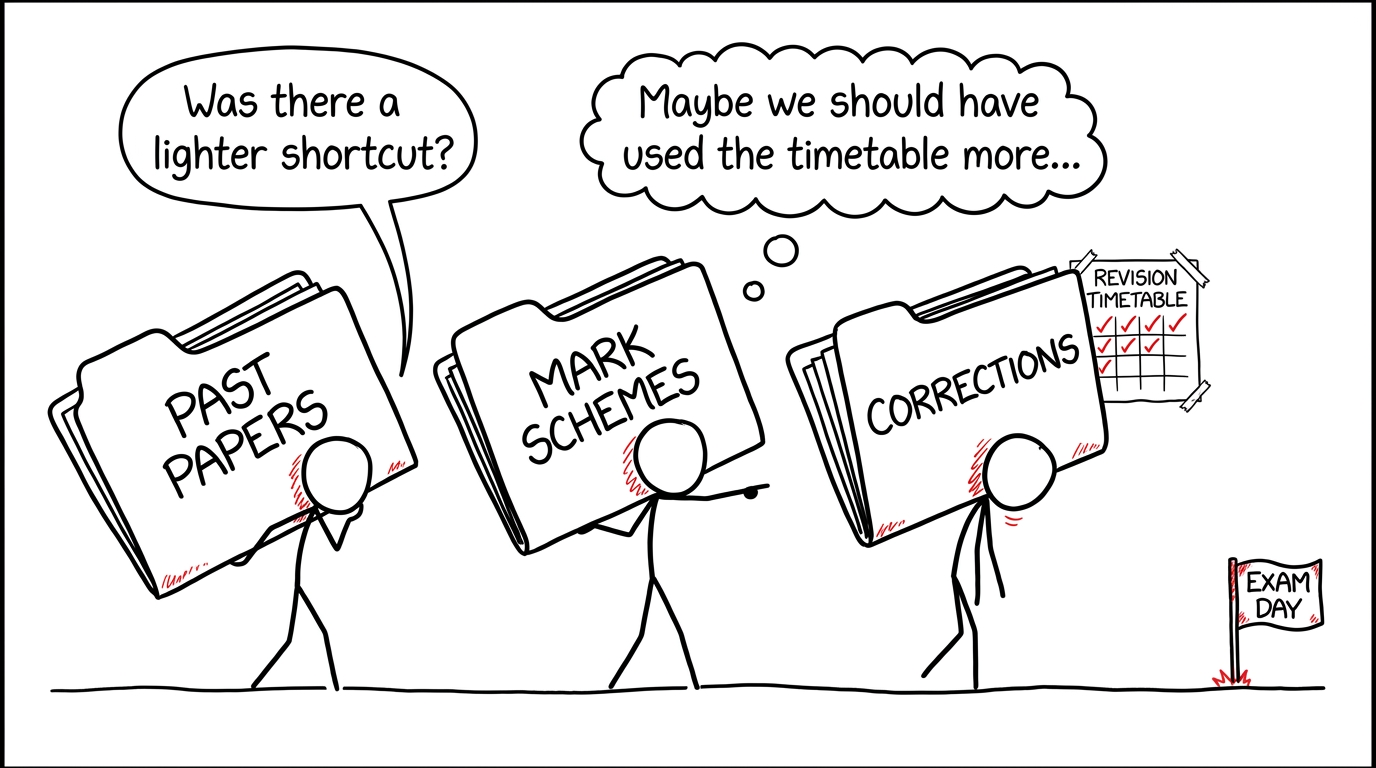 Students carrying past papers, mark schemes and corrections towards exam day
Common mistakes when analysing grade boundaries
- Comparing different exam boards directly. AQA, OCR, Eduqas and other specifications can have different papers, totals and assessment structures.
- Treating notional paper boundaries as official paper grades. The final AQA grade is based on the combined total across all three papers.
- Reading higher boundaries as proof of an easier paper. Awarding uses several forms of evidence; the boundary alone cannot explain paper difficulty.
- Using autumn 202020202020 and 202120212021 as ordinary summer comparisons. These were exceptional series following cancelled summer examinations.
- Assuming the next boundary will continue the trend. The 202620262026 boundary cannot be known before marking and awarding are complete.
- Confusing A-level and GCSE grading. A-level Sociology uses letter grades from A∗\mathrm{A^*}A∗ to E\mathrm{E}E, while GCSE Sociology uses grades 999 to 111. GCSE students should use the appropriate GCSE and A-level grade boundaries hub.
Turn the history into a revision decision
Past A-level Sociology grade boundaries reveal context, not destiny. They show stable pre-pandemic years, exceptional autumn series, a transitional return in 202220222022, and rising boundaries through 202520252025. What they cannot tell you is the exact mark required next time.
The productive response is simple: practise the full specification, mark honestly and build a safety margin. Visit MathsGenie's AQA A-level Sociology past papers to begin. Combine timed papers with mark schemes, revision lessons, practice questions, predicted papers and mini tests, then use the grade calculator to monitor your progress without mistaking an estimate for a guarantee.










