A-Level Results Day School Meeting: What to Ask
A-level results day school meeting guide: prepare questions, discuss reviews, university offers and next steps calmly with your school or college.

Results day can make one sheet of grades feel like a verdict on your entire future. It is not. An a-level results day school meeting is a chance to replace uncertainty with facts: what your results mean, whether an offer is confirmed, and which realistic options remain open.
For 2026, A-level results day is Thursday 13 August. If you are talking to college about A-level results, arrive ready to listen, take notes and ask specific questions. You do not need to have your whole future settled before the conversation begins.
Your quick meeting checklist
Before speaking to a teacher, exams officer or careers adviser:
- Collect your complete results and check your UCAS Hub if you applied to university.
- Bring your UCAS Personal ID and details of your firm and insurance offers.
- Write down the outcome you hoped for and the alternatives you would consider.
- Prepare questions about reviews of marking, Clearing, resits and other routes.
- Keep your phone charged and have somewhere to record names, advice and deadlines.
- Ask when and how you can contact the school again.
UCAS Hub shows the status of your university application, while your school or college provides your actual grades. Check both before assuming what has happened.
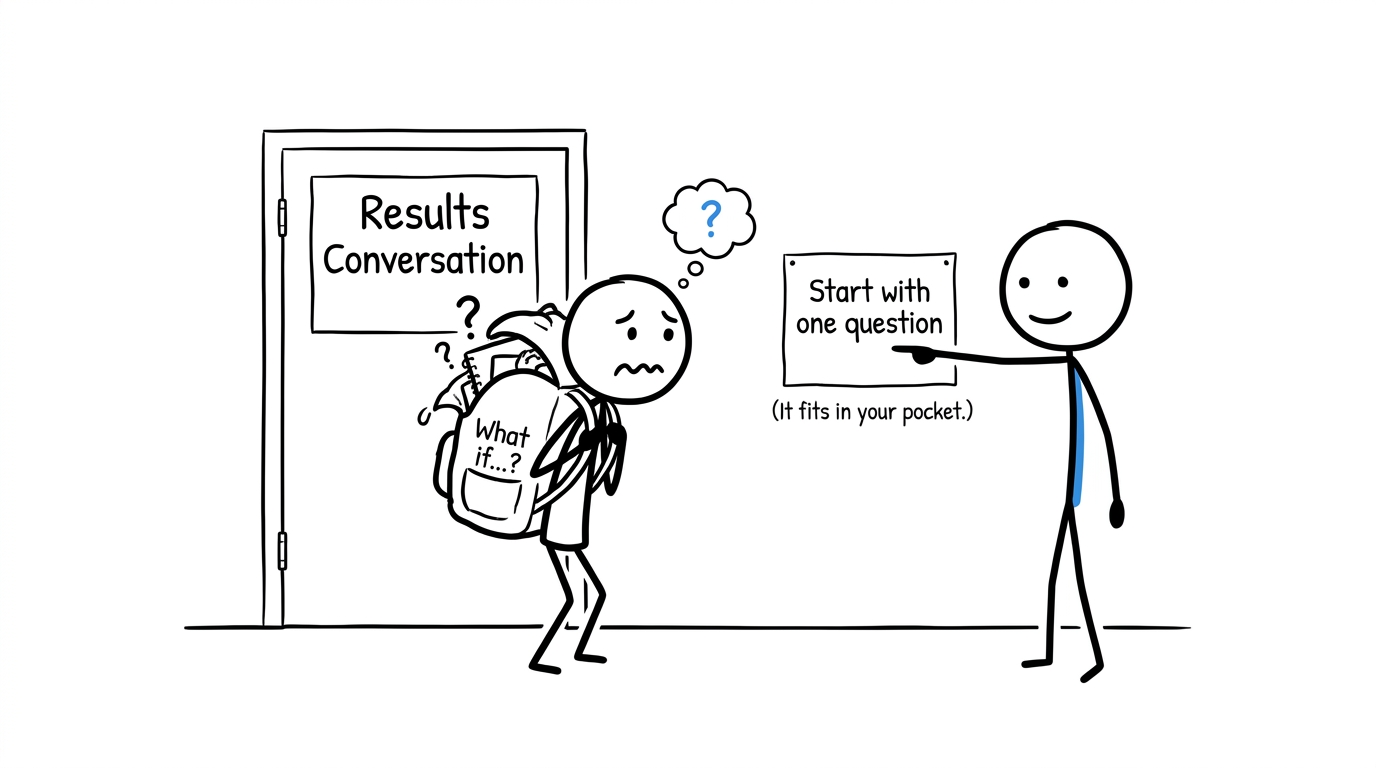 A nervous student discovers that one clear question makes a results conversation manageable
Tips for talking to college about A-level results
Start with the outcome, not the emotion
Feeling disappointed, relieved or confused is entirely understandable. But the most useful opening is simple: “Can you help me understand my position and the options available today?”
Ask whether your firm or insurance place has been confirmed. A university may accept you even if your grades differ from the original offer, so check UCAS Hub before concluding that you have missed your place.
Ask what evidence the school can examine
If a result seems unexpected, avoid demanding a “remark” immediately. The official process is usually called a review of marking. Ask:
- How far is the result from the next grade boundary?
- Can the school obtain the marked paper through Access to Scripts?
- Does a teacher think there may be a marking error?
- What are the deadline, fee and possible consequences?
Most students cannot request a review directly from the exam board. The school or college normally makes the request and needs your permission. If it decides not to proceed, ask about its internal appeal process for that decision.
A review is not a request for generosity. It checks whether the mark scheme was applied correctly. If a university place depends on the outcome, tell the exams officer and university immediately because time-sensitive post-results services may apply.
Discuss every credible route
A good conversation is broader than “Can my grade change?” Depending on your circumstances, options might include:
- accepting a confirmed firm or insurance place;
- contacting a university to explain your position;
- exploring suitable courses through Clearing;
- considering a different course, apprenticeship or employment route;
- resitting one or more qualifications;
- taking a planned gap year and applying again.
Ask what each route requires, when decisions must be made and whether accepting one option affects another. Speed matters on results day, but an unsuitable course does not become suitable merely because it is available.
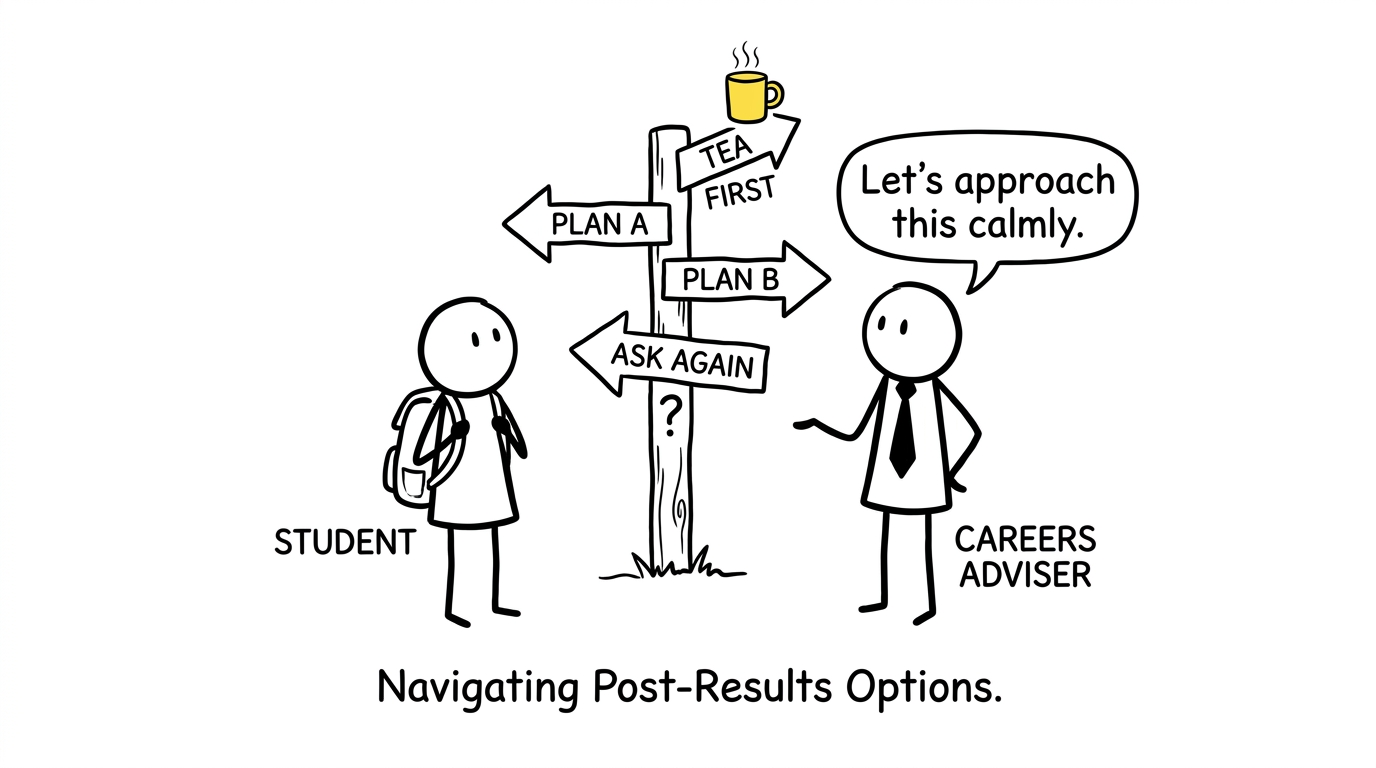 A student and adviser navigate an increasingly honest collection of post-results signposts
Leave with named next actions
Turn general advice into a short plan. Write down who will request a script, who will contact a university, and when you will speak again. Repeat the plan back to the member of staff so that misunderstandings are caught early.
If you are currently preparing for GCSEs, this habit is already useful. Ask teachers precise questions about entry requirements for A-level Maths, Further Maths or sixth-form courses. Meanwhile, the GCSE Maths revision hub brings together resources for Edexcel, AQA, OCR, Eduqas and other boards. You can also use the AQA GCSE Maths revision area or Edexcel GCSE Maths revision area for board-specific preparation.
Common mistakes during a results meeting
Assuming one disappointing grade closes every route. Ask which options remain open before making a decision.
Confusing a review with an appeal. A review of marking normally comes first. A formal appeal may follow if there are still concerns about the process or marking.
Leaving without deadlines. Post-results requests and university decisions can be time-sensitive. Get the school’s current dates in writing.
Letting someone else do all the talking. Support from a parent or carer can help, but you should understand and agree to the next steps.
Making an immediate choice to escape discomfort. Pause long enough to compare the course, location, costs and long-term fit.
Prepare for the conversation before you need it
Results conversations become easier when preparation has given you evidence rather than guesses. MathsGenie offers free Edexcel GCSE Maths past papers, Edexcel A-level Maths revision, AQA A-level Maths revision and Edexcel A-level Maths predicted papers.
Use revision lessons and practice questions to strengthen weak topics, then test yourself with mini tests, past papers, predicted papers, mark schemes and video solutions. Results day may contain surprises. Your next step does not have to be one of them.