A-Level Remark Request: Deadlines, Cost and Appeals
A-level remark request guide: learn who applies, 2026 deadlines, current costs, review risks and the formal appeal process after results day in the UK.

Results day can compress two years of work into one uncomfortable number. If your grade is lower than expected, an A-level remark request may be appropriate, but you normally need your school or college to submit it, and the official service is a review of marking, not a fresh re-mark.
For summer 2026, the priority deadline is 20 August 2026 and the standard review deadline is 24 September 2026. Your centre will probably impose an earlier internal deadline. Marks can rise, fall or remain unchanged, so speak to your exams officer and subject teacher before giving written consent.
Your post-results checklist
- Check your component marks against the correct grade boundary.
- Contact your exams officer immediately if a university place is at risk.
- Ask whether a copy of the marked script should be reviewed first.
- Choose the correct service: clerical re-check, standard review or priority review.
- Confirm the fee, internal deadline and paper being reviewed.
- Give written consent after results have been published.
- Inform your university if a priority review is pending.
- Consider an appeal only after receiving the review outcome.
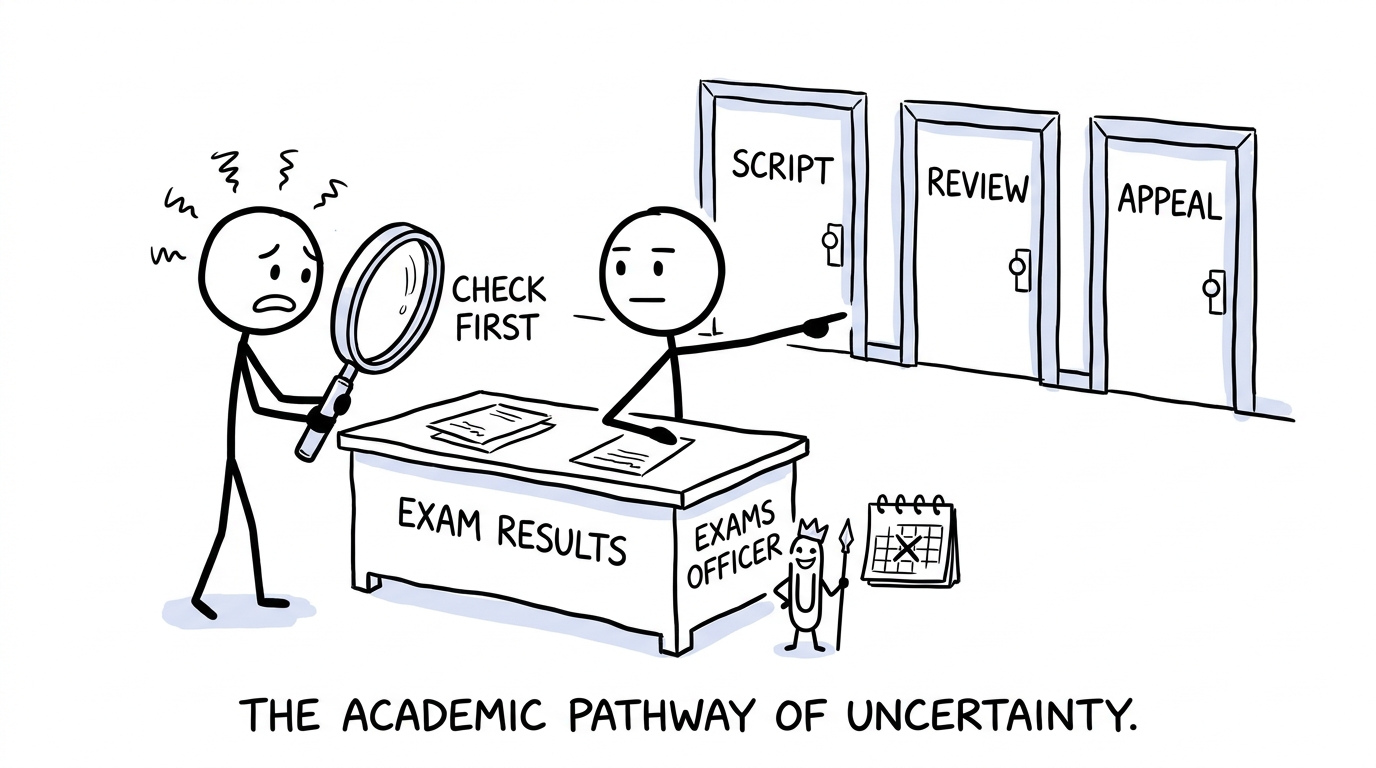 A student choosing between a script, review and appeal
Check how close you are to the boundary
Begin with evidence rather than disappointment. Use the A Level grade boundaries hub to select the correct exam board, subject and exam series. MathsGenie also has subject-specific pages for Edexcel A Level Maths grade boundaries, AQA A Level Maths grade boundaries and OCR A Level Maths grade boundaries.
Being one mark below a boundary does not prove that marking was wrong. Equally, being several marks away does not automatically make a review pointless. The better question is whether a teacher can identify places where the published mark scheme may not have been applied correctly.
For Edexcel maths, the A Level predicted grade calculator can help you organise component marks, but only the official result and boundary determine your grade.
A-level remark request deadlines for 2026
These are the awarding-body deadlines under the current JCQ timetable. A school or college needs time to collect consent, payment and supporting information, so its own deadline may be earlier.
| Stage | Summer 2026 deadline or timescale | What it means |
|---|---|---|
| A Level results day | 13 August 2026 | Contact your exams officer promptly |
| Priority review of marking | 20 August 2026 | Intended for time-sensitive higher education decisions |
| Standard review of marking | 24 September 2026 | Awarding body must receive the request by this date |
| Priority review outcome | Normally within 15 calendar days | Faster service for eligible A Level requests |
| Standard review outcome | Normally within 20 calendar days | Timescale begins when the board receives it |
| Formal appeal | Within 30 calendar days of the review outcome | Available only after the review has finished |
| Appeal hearing request | Usually within 14 calendar days of the preliminary appeal outcome | Used if the preliminary stage does not resolve the case |
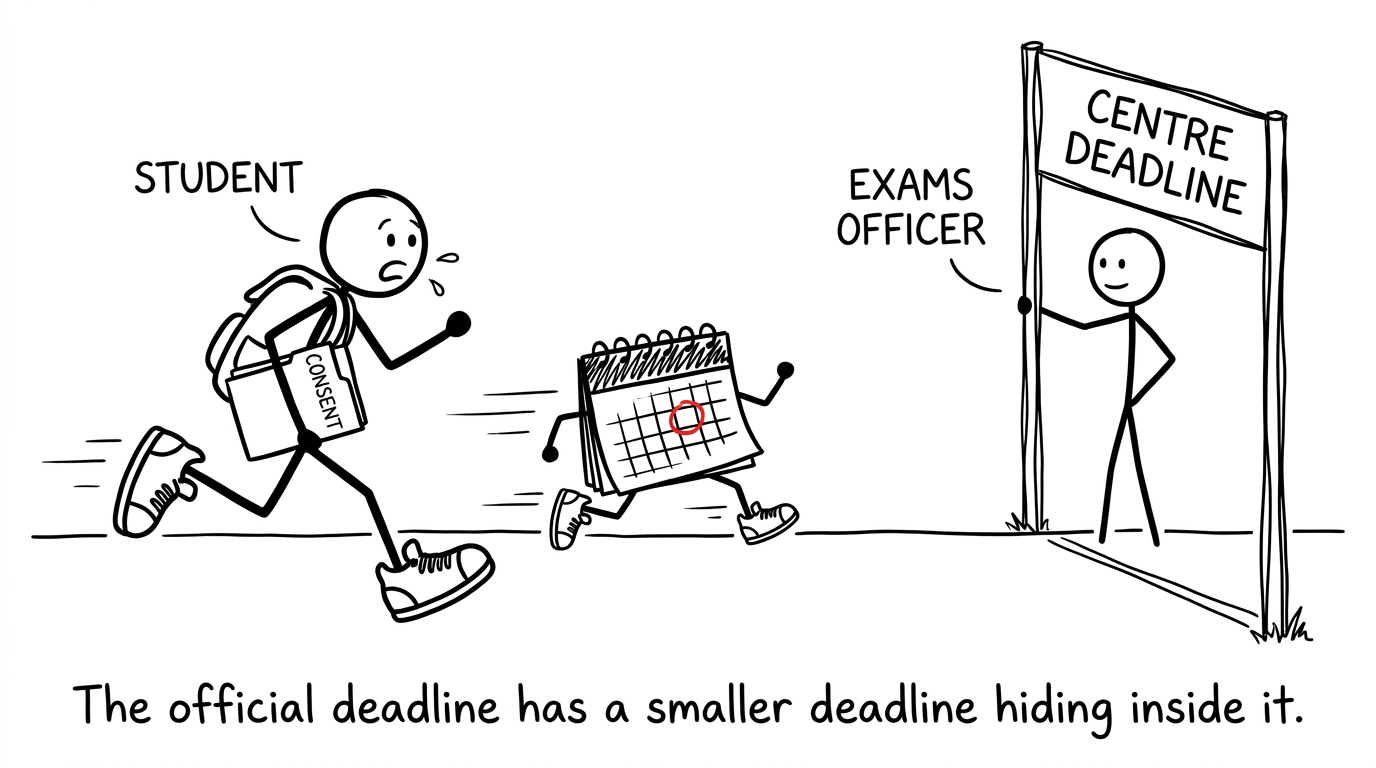 A student racing an unexpectedly early centre deadline
How to request a review of marking
Speak to your school or college
Exam boards normally accept requests from centres, not directly from students. Ask for the exams officer and explain whether a university, apprenticeship or course place depends on the result. Private candidates are the main exception and can approach their awarding body directly.
If your centre refuses to request a review, it must offer a way to appeal that internal decision. Ask for its published post-results policy immediately.
Ask for access to your script
A copy of the marked paper can help a teacher judge whether a review is sensible. This is especially useful in subjects involving extended judgement. In maths, teachers can compare the awarded method and accuracy marks with the mark scheme.
Do not let script access delay a time-critical priority application. Ask the exams officer which service and deadline apply.
Select the right service
A clerical re-check checks processes such as whether every response was marked and whether marks were totalled and recorded correctly.
A review of marking checks whether the original marker applied the mark scheme correctly. The reviewer corrects identified marking errors, but does not simply mark the entire paper again from scratch.
A priority review of marking covers the same essential review but is processed faster. It is available for eligible AS and A Level summer-series requests, particularly where a higher education place is pending.
Give written consent
Your centre must obtain consent after results are published because the mark and final grade can go down as well as up. Read the form carefully and verify the exact component before signing.
How much does an A Level review cost?
Fees are set independently by each exam board and usually apply per paper or component, not per whole subject. Your centre may also have its own charging arrangements.
As a current 2026 example, AQA lists an AS or A Level standard review at £51.95\pounds 51.95£51.95 per component and a priority review at £61.70\pounds 61.70£61.70 per component. OCR lists its standard review at £67.75\pounds 67.75£67.75. Edexcel and Eduqas publish their own fees, so obtain a written quotation from your exams officer before applying.
Some boards waive or refund review fees when the overall qualification grade changes. Appeal fees are normally refunded or waived when an appeal is upheld. Never assume this will happen; check the board and centre rules first.
The A-level appeal process after a review
An appeal is not the first step and it is not another opportunity to request a more generous marker. Your centre can appeal after the review outcome if it believes the awarding body did not follow its procedures correctly or reached an unreasonable marking decision under the applicable rules.
The process begins with a preliminary appeal. If the concern remains unresolved, the centre may request an appeal hearing within the relevant deadline. Marks and grades may still rise, fall or remain unchanged.
After the awarding body’s final appeal stage, a centre in England or Wales may be able to approach the relevant regulator’s Exam Procedures Review Service. That service examines procedure; it does not independently re-mark the paper or directly award a new grade.
Common mistakes to avoid
- Calling it an automatic re-mark: the official service reviews how the existing mark scheme was applied.
- Missing the centre deadline: it may be several days before the published awarding-body deadline.
- Reviewing every paper without evidence: fees are commonly charged per component.
- Assuming the mark cannot fall: written consent is required precisely because marks and grades can decrease.
- Using the wrong boundary: check the board, subject, qualification and exam series.
- Waiting silently when a place is pending: contact the university and exams officer as soon as a priority review is submitted.
- Treating an appeal as a second review: an appeal challenges the review decision or procedure; it does not guarantee fresh marking.
Make the next decision calmly
A disappointing result feels personal, but the best response is procedural: check the boundary, inspect the evidence, speak to your teacher and act before the internal deadline. If you are a GCSE student reading ahead, remember that similar post-results principles apply, although priority review availability and deadlines differ.
Whatever the outcome, keep moving. Use MathsGenie’s A Level Maths revision resources for revision lessons, practice questions, mini tests, past papers, mark schemes and video solutions. If a resit becomes the sensible route, combine real papers with A Level predicted papers. Start by checking your subject-specific grade boundary, then build a focused revision plan around the marks you can gain next time.