

A-Level Religious Studies Results Day Questions
A-level religious studies results day questions answered clearly: grades, UCAS, Clearing, marking reviews and calm next steps for families in 2026.
Results day compresses two years of essays, arguments and revision into a single letter. That can make even a good result feel strangely difficult to process. These A-level religious studies results day questions give students and parents the essential answers first: check the grade, check UCAS, speak to school before making decisions, and remember that a missed offer does not mean you have run out of routes.
For summer 2026, A Level results are released on Thursday 13 August. Your school or college controls exactly how you receive them, so confirm its arrangements in advance.
Your results-day checklist
- Have your school login and UCAS details ready.
- Charge your phone, but do not rely on one device or website.
- Collect your actual results from your school, college or portal.
- Check your UCAS application status separately.
- Keep university admissions numbers and course details nearby.
- Speak to a teacher before requesting a review of marking.
- Avoid making an irreversible decision while emotions are high.
Students still preparing for future exams can explore the free A Level Religious Studies revision hub, organised by exam board.
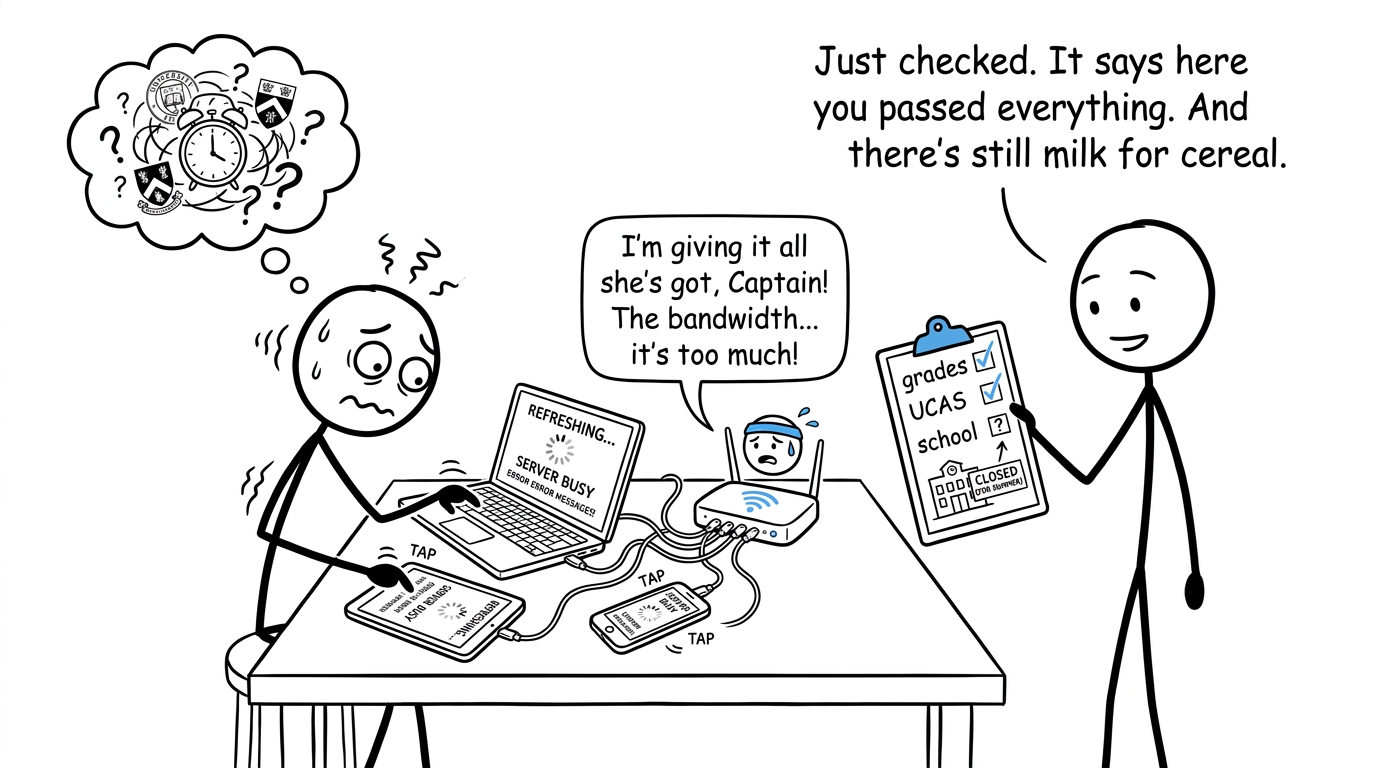 A nervous student refreshes three devices while a calm parent holds a results-day checklist
What time will I receive my A Level Religious Studies result?
Candidate results may be released from 8.00 am8.00\text{ am}8.00 am on Thursday 13 August 2026. Your school or college decides whether you collect them in person or receive them through email or a secure portal, and it may choose a later opening time.
UCAS also updates on results morning, but it shows the status of your university application rather than replacing your results slip. Check both. If UCAS is slow or your status is pending, do not assume that you have been rejected.
What will my Religious Studies result show?
Your result normally gives your final subject grade, from A∗\text{A}^*A∗ to E\text{E}E, or U\text{U}U where the qualification has not been awarded. Depending on your centre's system, you may also see overall or component marks.
The final qualification grade matters for university offers. A component result can still be useful because it helps your teacher judge whether an unexpected outcome warrants closer investigation.
Exam structures differ between AQA, Edexcel, OCR and Eduqas. Check the right specification rather than comparing component marks with a friend who sat another board. MathsGenie has dedicated pages for AQA A Level Religious Studies and Edexcel A Level Religious Studies.
How do Religious Studies grade boundaries work?
A grade boundary is the minimum mark needed for a particular grade in that exam series. Boundaries are set after the papers have been marked, so they can move from year to year. Last year's boundary is useful context, not a promise about this year's result.
Use the boundary matching your exam board, series and route. This is especially important in Religious Studies because some boards publish different totals for different option combinations. You can compare previous Edexcel Religious Studies grade boundaries and Eduqas Religious Studies grade boundaries on MathsGenie.
What if I miss my university offer?
Check UCAS before concluding that you have lost your place. A university may still confirm an applicant who narrowly missed the stated conditions. If your firm choice does not accept you but your insurance conditions are met, your insurance place may be confirmed instead.
If neither place is confirmed, Clearing allows eligible applicants to search for courses with vacancies. In 2026, Clearing runs from 2 July to 19 October, and applicants can add a Clearing choice from 1.00 pm1.00\text{ pm}1.00 pm on A Level results day after receiving an offer from the university.
Speak directly to admissions teams, ask clear questions and record any instructions. A thoughtful alternative course is more valuable than the first available course chosen in panic.
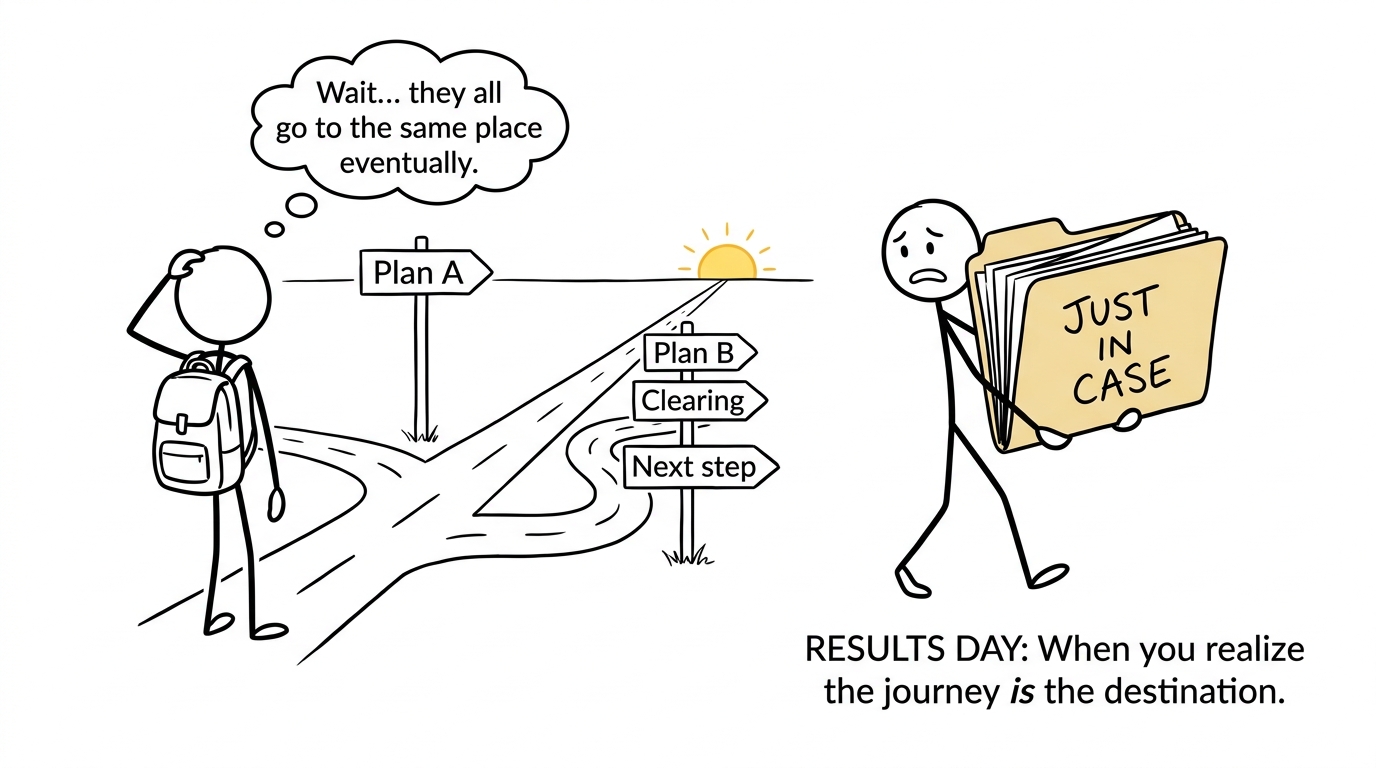 A student discovers that Plan A, Plan B and Clearing all lead towards new opportunities
What if I do better than expected?
First, enjoy the result. Then check whether your confirmed course still fits what you want.
If you hold an unconditional firm place but wish to look elsewhere, UCAS provides a process for declining that place and entering Clearing. This gives up the confirmed place and does not guarantee another offer, so speak to an adviser and contact potential universities before acting. You cannot simply swap your firm and insurance choices.
Can I ask for an A Level Religious Studies remark?
The formal service is called a review of marking, not a complete re-mark from the beginning. A reviewer checks whether the mark scheme was applied correctly and corrects identified marking errors. A clerical re-check instead checks matters such as whether marks were recorded and totalled correctly.
Requests normally go through your school or college, and written consent is required because a mark and grade can rise, stay unchanged or fall. Ask your teacher to compare your marks with the boundary and, where possible, review the script before deciding.
For the June 2026 series, the deadline for a priority review of marking is 20 August 2026. This service is intended for urgent cases such as a university place depending on the outcome. The standard deadline is 24 September 2026. Your centre may set an earlier internal deadline.
Is being one mark below a boundary enough reason for a review?
It is a reason to investigate, but not proof that the marking is wrong. The sensible question is not merely, “How close was I?” It is, “Is there credible evidence that the mark scheme was applied incorrectly?”
Essay subjects involve academic judgement, but reviewers cannot award extra marks simply because another interpretation seems possible. Ask an experienced teacher to examine the relevant paper, the mark scheme and any available script. Also consider whether a lower mark could affect your final grade.
What should parents do on results morning?
Be calm, practical and available. Help gather contact details, write down options and give the student room to absorb the result. The student must usually speak for themselves when dealing with universities, and their consent is needed for post-results services.
A useful parental question is: “What information do we need before deciding?” That keeps the morning focused on evidence rather than disappointment or excitement.
What if I am not applying to university?
The result still matters, but UCAS does not have to define the day. Confirm the entry requirements for an apprenticeship, employment, gap-year plan or further qualification. Contact the relevant organisation if the result differs from its conditions.
If a resit becomes part of the plan, discuss availability, entry arrangements and preparation with your school or an approved exam centre. Use the intervening time deliberately. The Edexcel Religious Studies revision guides can help identify content that needs rebuilding rather than simply repeating the same revision.
Common results-day mistakes
- Looking only at UCAS and forgetting to obtain the actual grades.
- Comparing marks across different boards or Religious Studies routes.
- Treating an old grade boundary as this year's guaranteed boundary.
- Requesting a review without considering that marks can decrease.
- Missing a school deadline while relying on the later national deadline.
- Declining a confirmed university place before checking alternatives.
- Allowing one grade to become a judgement about two years of effort.
Turn the result into a next step
A result is important, but its most useful feature is that it replaces uncertainty with information. Good news gives you a route forward. Unexpected news gives you questions to ask, deadlines to meet and alternatives to examine.
For current and future students, MathsGenie provides free A Level Religious Studies resources, including revision lessons, past papers, practice questions, mark schemes, predicted papers and mini tests where available. Choose your exam board, inspect the evidence and make the next decision calmly. Results day is a junction, not the end of the road.










