

A-Level Religious Studies Resit UCAS Application
A-level religious studies resit UCAS application advice: declare grades correctly, explain context briefly and show universities clear evidence of progress.
Results day can make one grade feel larger than the rest of your education. It is not. If you are preparing an A-level Religious Studies resit UCAS application, declare the original result and pending retake honestly, check each course's resit policy, and explain the decision briefly through relevant evidence rather than apology.
A resit does not need to dominate your application. Universities principally need to understand what happened, what you changed and why you are now prepared for the course. Your task is to make that progression easy to see.
Your resit application checklist
Before writing anything, complete these practical steps:
- Enter your achieved Religious Studies grade in the UCAS education section.
- Enter the qualification again with the resit result marked as pending.
- Ask your referee whether they can provide a realistic predicted grade.
- Check the resit policy for every course and university individually.
- Decide whether any relevant circumstances belong in your reference.
- Explain your academic development using specific, course-relevant evidence.
- Keep revising while the application is being prepared.
UCAS requires applicants to declare completed qualifications, unsuccessful grades, pending qualifications and previous exam sittings. Omitting the first result is therefore not a way to make an application stronger. Accuracy is.
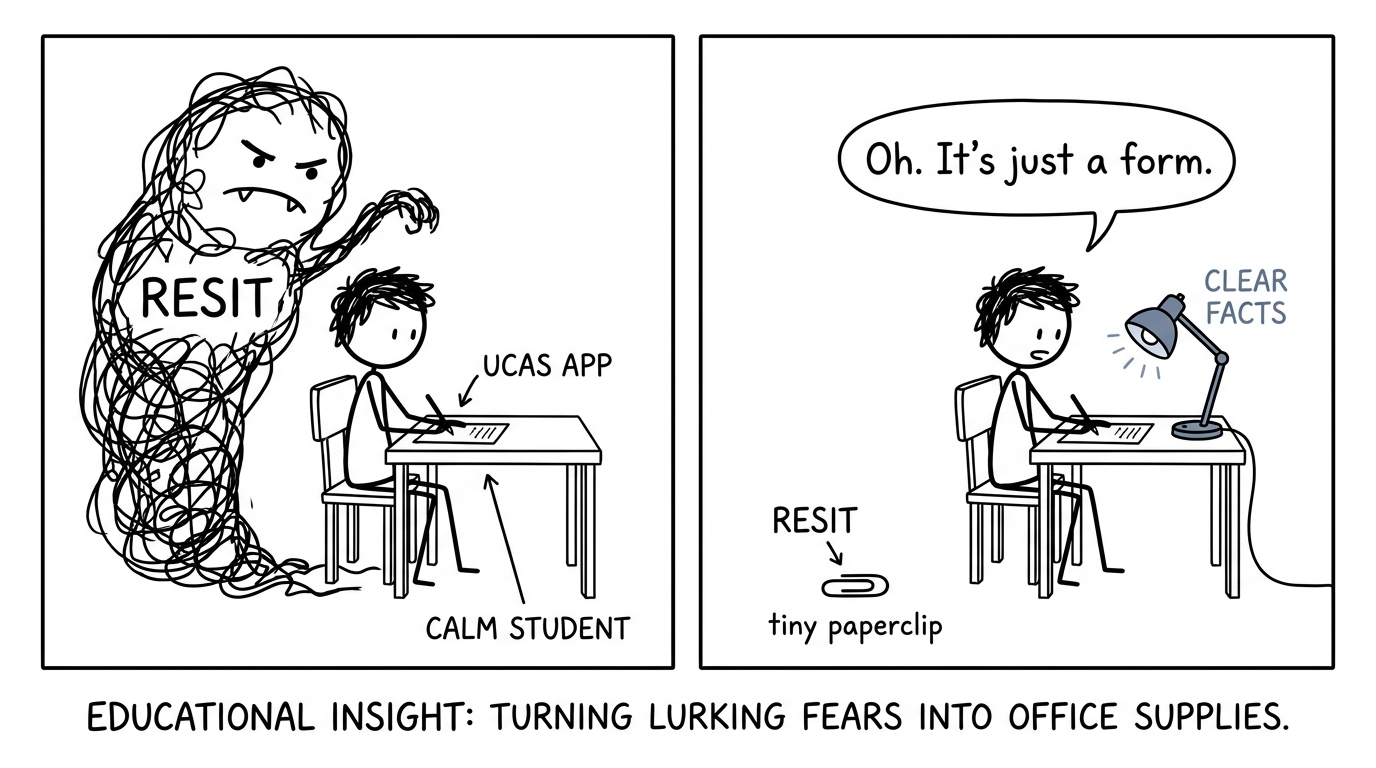 A dramatic resit monster becoming a tiny paperclip under the light of clear facts
What to do after Religious Studies results day
First, separate the emotional decision from the administrative one. A disappointing result may suggest a retake, but it does not automatically make one worthwhile.
Compare your achieved grades with the published requirements for the courses you intend to choose. Then contact admissions teams if their resit position is unclear. Policies vary: some universities accept A-level resits routinely, while certain competitive or professionally regulated courses may impose additional requirements.
Discuss the practical arrangements with your school, college or examination centre. Confirm that you can be entered for the correct Religious Studies specification and exam board, whether AQA, Edexcel, OCR or Eduqas. Also arrange an appropriate referee early. If you have recently left education, UCAS advises approaching someone who knows you academically where possible.
Students balancing a retake with another quantitative subject can organise their independent work through the free A Level Maths revision hub. The important principle applies across subjects: revision needs evidence, not simply more hours.
How to enter an A-level retake on UCAS
In the education section, enter the original A-level Religious Studies qualification with the grade you achieved. Add the qualification again with the expected resit date and a pending result.
Do not replace the old grade with your predicted one. A predicted grade is supplied for the pending qualification, normally by your referee or linked school or college.
Check every detail against your certificates and current entry information:
- qualification title;
- subject;
- examination board;
- school, college or examination centre;
- achieved grade;
- expected resit date;
- pending status.
This factual section tells universities that a retake is happening. Your written application and reference can then provide the useful context.
Explaining a resit on UCAS without sounding defensive
The strongest explanation is usually short. Use a simple sequence: fact, context, action and evidence.
State the decision plainly
Avoid opening with disappointment or trying to persuade the reader that the examination was unfair. A calm sentence is stronger:
I am retaking A-level Religious Studies to strengthen my academic preparation and demonstrate the standard I can reach through a more structured approach.
Explain what changed
Universities do not need a diary of your revision year. They need to see a credible response. Mention changes that are true and demonstrable, such as more timed essays, closer use of assessment objectives, improved evaluation or regular feedback from a teacher.
Possible wording is:
Since my first sitting, I have developed a more disciplined revision programme centred on timed comparative essays, precise use of scholarly arguments and critical evaluation of alternative viewpoints.
Connect the improvement to your chosen course
The retake becomes useful when it reveals academic readiness:
Revisiting the course has strengthened my ability to analyse competing interpretations, construct a sustained argument and respond thoughtfully to complex ethical questions, skills directly relevant to my proposed degree.
Adapt every sentence to your real experience. Do not claim activities you cannot discuss confidently if asked.
Where the explanation belongs
For applications using the current UCAS format, the personal statement is divided into three questions with an overall limit of 4,0004,0004,000 characters, including spaces. Each response has a minimum of 350350350 characters.
Your Religious Studies learning may fit naturally within the question about how your qualifications have prepared you for the course. However, the statement should remain focused on your suitability for that degree, not become a defence of one grade.
If illness, bereavement, caring responsibilities or other significant circumstances affected your first sitting, speak to your referee. With your permission, UCAS references can include circumstances that affected academic performance. Some universities also have their own extenuating-circumstances process, so check directly rather than assuming the reference is sufficient.
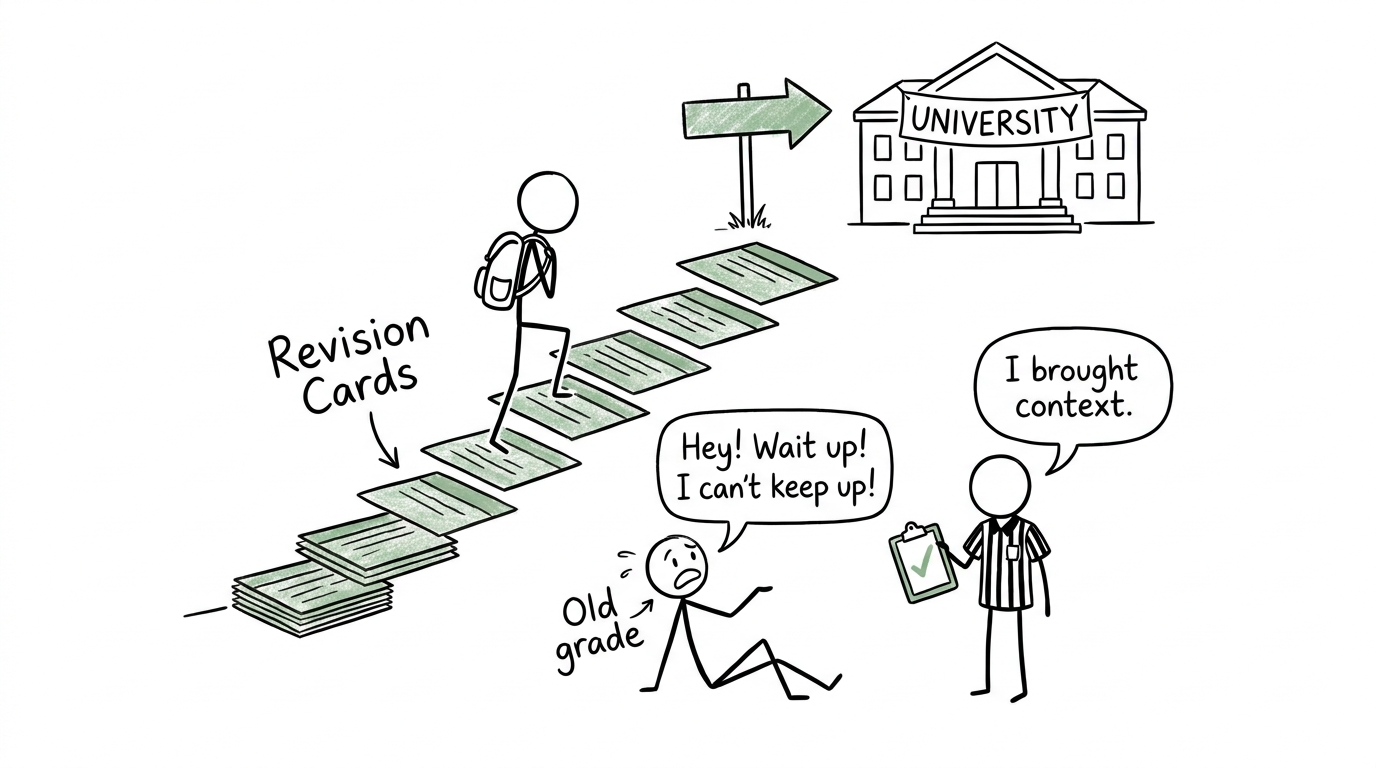 A student climbing revision-card stairs while an old grade falls behind and a referee brings context
Build evidence behind the application
A well-written paragraph cannot rescue an unstructured retake year. The words become convincing when your routine supports them.
Create a weekly plan with content review, timed essays, marking and deliberate correction. The same feedback loop is built into MathsGenie's Edexcel A Level Maths revision resources: learn a method, answer questions, use mark schemes and revisit weaknesses.
If you are also retaking GCSE Maths or maintaining it alongside your application, use the Edexcel GCSE Maths revision hub for lessons and topic questions. The GCSE papers collection provides past papers, predicted papers and mini tests, while the MathsGenie revision resources offer shorter practice for a busy reapplication year.
Common mistakes when explaining a resit
- Hiding the original result: UCAS requires previous and pending qualifications to be declared.
- Writing a long apology: acknowledge the retake, then move towards action and evidence.
- Blaming an examiner or teacher: this sounds defensive and does not demonstrate readiness.
- Using vague claims: “I worked harder” is weaker than identifying how your essay planning, evaluation or timed practice changed.
- Making the resit the whole statement: universities still need clear reasons for choosing the degree.
- Assuming every university has the same rules: check each course, particularly highly competitive programmes.
- Leaving the reference late: independent applicants still need an appropriate referee unless every chosen university has explicitly agreed otherwise.
Turn the retake into evidence of direction
A resit is a fact, not an identity. Declare it accurately, give proportionate context and show what your second attempt has taught you about disciplined academic work.
Then return to the work itself. If maths is part of your retake year, begin with MathsGenie's free revision resources: use revision lessons to repair gaps, practice questions to test understanding, and past papers, predicted papers, mini tests, mark schemes and video solutions to measure progress. A stronger application describes change. A stronger result proves it.










