A-Level Religious Studies Resit: A Practical Plan
A-level Religious Studies resit advice for results day onwards, with clear milestones for rebuilding knowledge, essay technique and exam confidence.
Results day can compress two years of work into one letter. If that letter was not what you expected, an A-level Religious Studies resit gives you another opportunity, but improvement requires more than repeating last year's revision.
Start by checking whether your result should be reviewed, confirming your exam entry arrangements and diagnosing where marks were lost. Then follow a structured plan combining specification coverage, active recall, essay practice and timed past papers.
Your resit preparation checklist
- Speak to your school or college about your marks and post-results options.
- Request access to your scripts if available and useful.
- Confirm your exam board, specification and components.
- Arrange an approved exam centre if entering as a private candidate.
- Turn every specification topic into a revision checklist.
- Separate knowledge weaknesses from evaluation and timing problems.
- Complete timed essays and full papers throughout the year.
- Use mark schemes to improve each answer before attempting another.
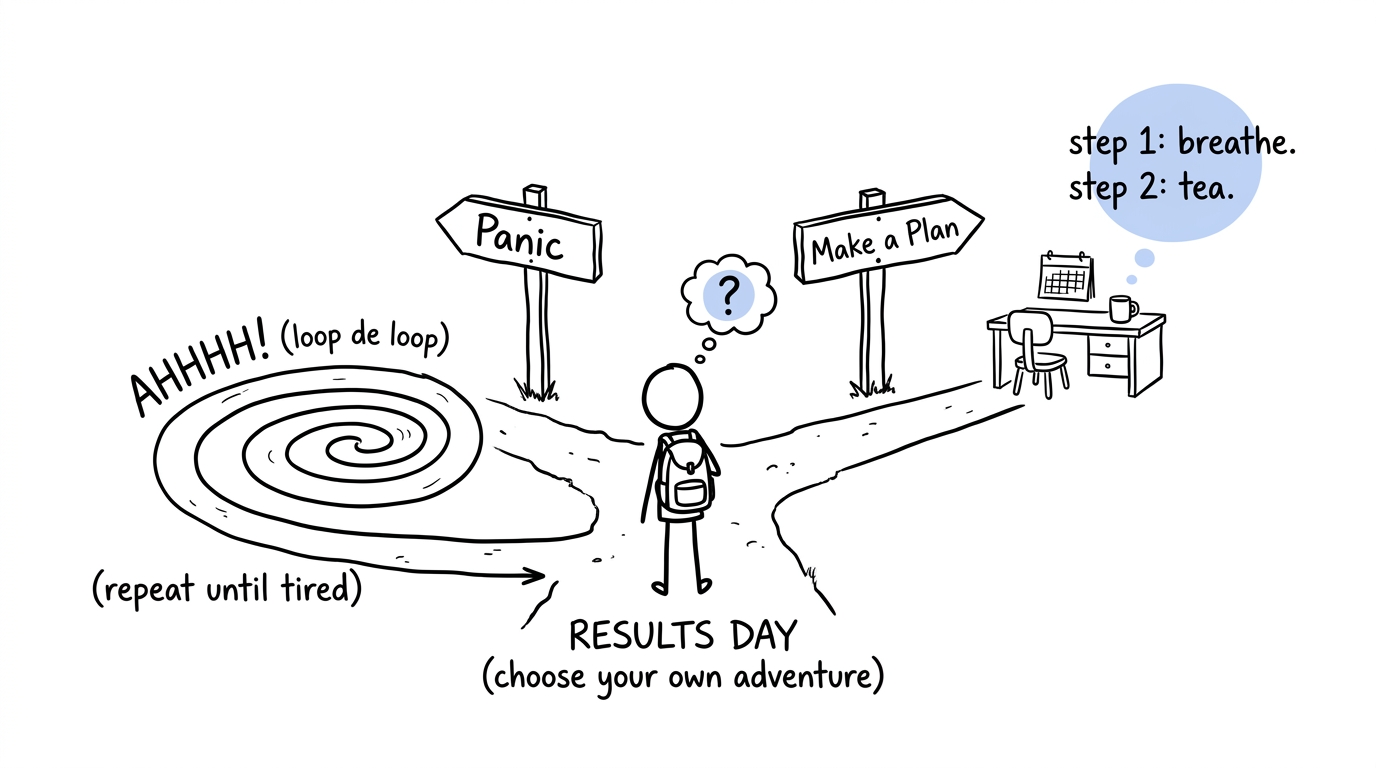 A student choosing between panic and making a plan after results day
What to do immediately after results day
Before committing to resitting A-level Religious Studies, ask your teacher for the component marks and an honest assessment of what happened. A disappointing grade can come from missing knowledge, weak evaluation, poor question selection, timing or one unusually difficult paper. Each cause needs a different response.
If the result appears inconsistent with your usual standard, discuss access to scripts, a clerical re-check or a review of marking with your centre. These services have deadlines and may involve fees. Marks can stay the same, rise or fall, so use the evidence in your script rather than treating a review as an automatic first step.
Most A-level examinations are taken in the summer series. If your school or college will not enter you again, you must find an approved centre accepting private candidates. The centre makes the entry and sets its own administrative arrangements and fees, so contact centres early. Confirm the awarding organisation, qualification code, papers and any relevant assessment requirements in writing.
University policies on resits can differ, particularly for competitive courses. Ask the admissions team directly whether a resit affects your application and how predicted grades should be supplied.
Build an evidence-based resit plan
A resit year can feel long in September and surprisingly short by spring. The solution is to divide it into milestones. The free MathsGenie revision planner can help you turn broad intentions into scheduled sessions.
| Period | Main milestone | Evidence of progress |
|---|---|---|
| Results day to September | Diagnose and organise | Script review, confirmed specification and exam entry plan |
| September to December | Rebuild course knowledge | Completed topic checks and short essay plans |
| January to March | Develop analysis and evaluation | Regular marked essays with fewer repeated weaknesses |
| April to early May | Apply knowledge under pressure | Timed sections and complete papers |
| Final weeks | Refine rather than relearn | Stable timing, targeted corrections and confident recall |
Results day to September: diagnose precisely
Download the specification for your exact board, AQA, Pearson Edexcel, OCR or Eduqas, and compare it with your notes. Do not revise from a generic list because component structures, options and command words differ.
Create three categories for every topic:
- Secure: you can explain it accurately and use relevant evidence.
- Developing: you recognise it but cannot construct a strong argument.
- Priority: you cannot recall the scholars, concepts or debates reliably.
If you take Pearson Edexcel, begin with the Edexcel A-level Religious Studies revision hub. You can also review the published Religious Studies grade boundaries, but remember that boundaries change between examination series. They provide context, not a guaranteed target for the next sitting.
September to December: rebuild knowledge actively
Your notes should become prompts, not a script you repeatedly reread. For each debate, practise recalling:
- the central claim;
- key terminology;
- relevant scholars or sources of authority;
- arguments supporting the claim;
- objections and responses;
- links to other parts of the specification.
The assessment objectives used across regulated A-level Religious Studies specifications distinguish knowledge and understanding, known as AO1, from analysis and evaluation, known as AO2. Current specifications typically weight these at 40%40\%40% and 60%60\%60% respectively. That makes accurate knowledge essential, but knowledge alone cannot secure the strongest overall result.
Use the Edexcel A-level Religious Studies lessons to rebuild philosophical arguments and key scholarship before moving into evaluation-heavy questions. Eduqas students can instead start from the Eduqas A-level Religious Studies revision hub.
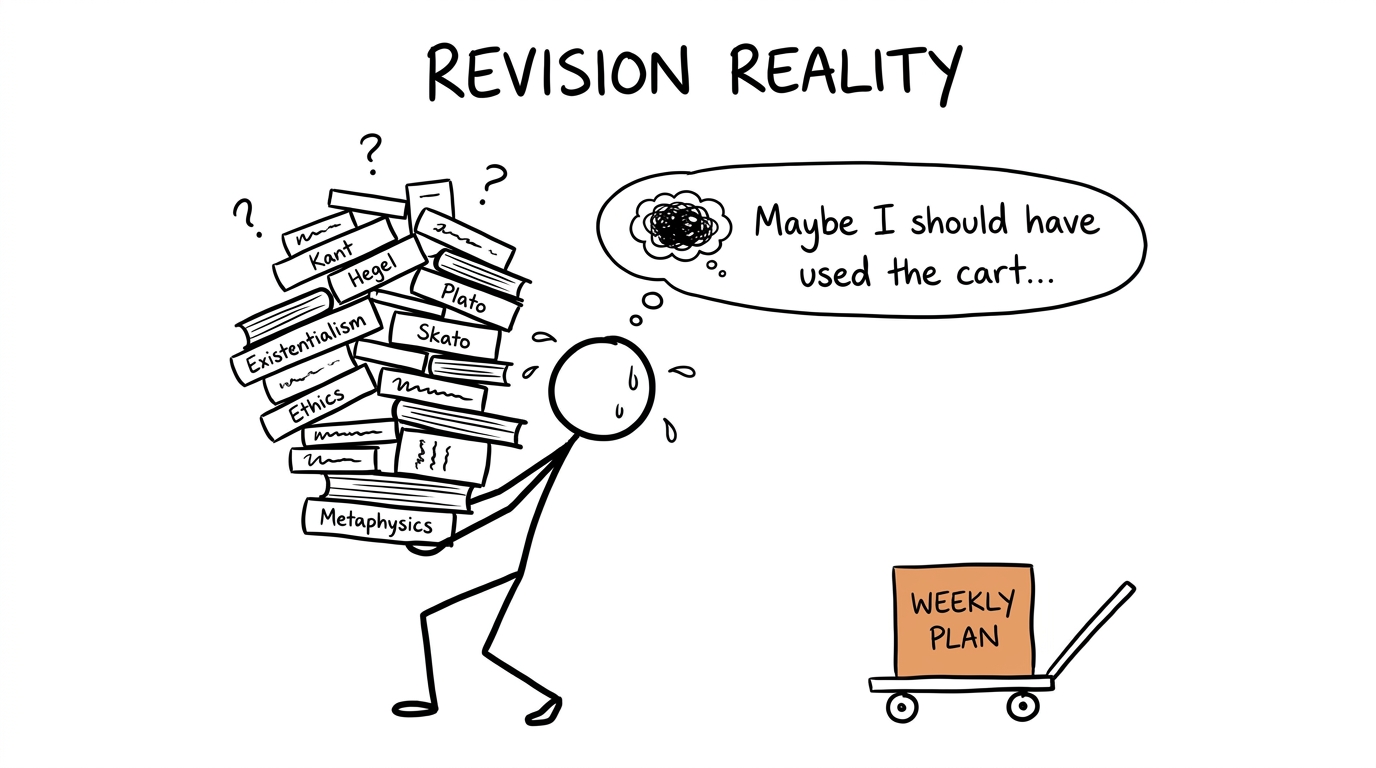 A student carrying too many books while ignoring a weekly revision plan
January to March: train argument quality
At this stage, a-level Religious Studies retake revision should become increasingly focused on writing. Plan essays before drafting them. Every paragraph needs a clear relationship with the precise claim in the question.
A useful paragraph should usually contain a relevant argument, supporting knowledge, analysis of its significance, a counterargument and a reasoned judgement. This is not a rigid writing formula. It is a check against descriptive paragraphs that explain a theory without evaluating it.
Complete at least one timed response regularly, mark it against the board-specific levels of response and record one improvement. A correction such as “add evaluation” is too vague. Write something actionable: “compare the objection with the scholar's original assumption” or “make the interim judgement answer the wording of the question”.
April onwards: use complete papers
Past papers reveal problems that topic revision can hide: slow planning, poor question choices and arguments that weaken under time pressure. Use Edexcel A-level Religious Studies past papers with the official mark schemes, beginning with individual sections before completing whole papers under exam conditions.
After each paper, classify every lost mark as a knowledge gap, an argument problem, a question-reading error or a timing issue. Return to the relevant A-level Religious Studies question and revision resources before attempting another paper. Predicted papers and mini tests can add variety where available, but specification-matched past papers should remain the foundation.
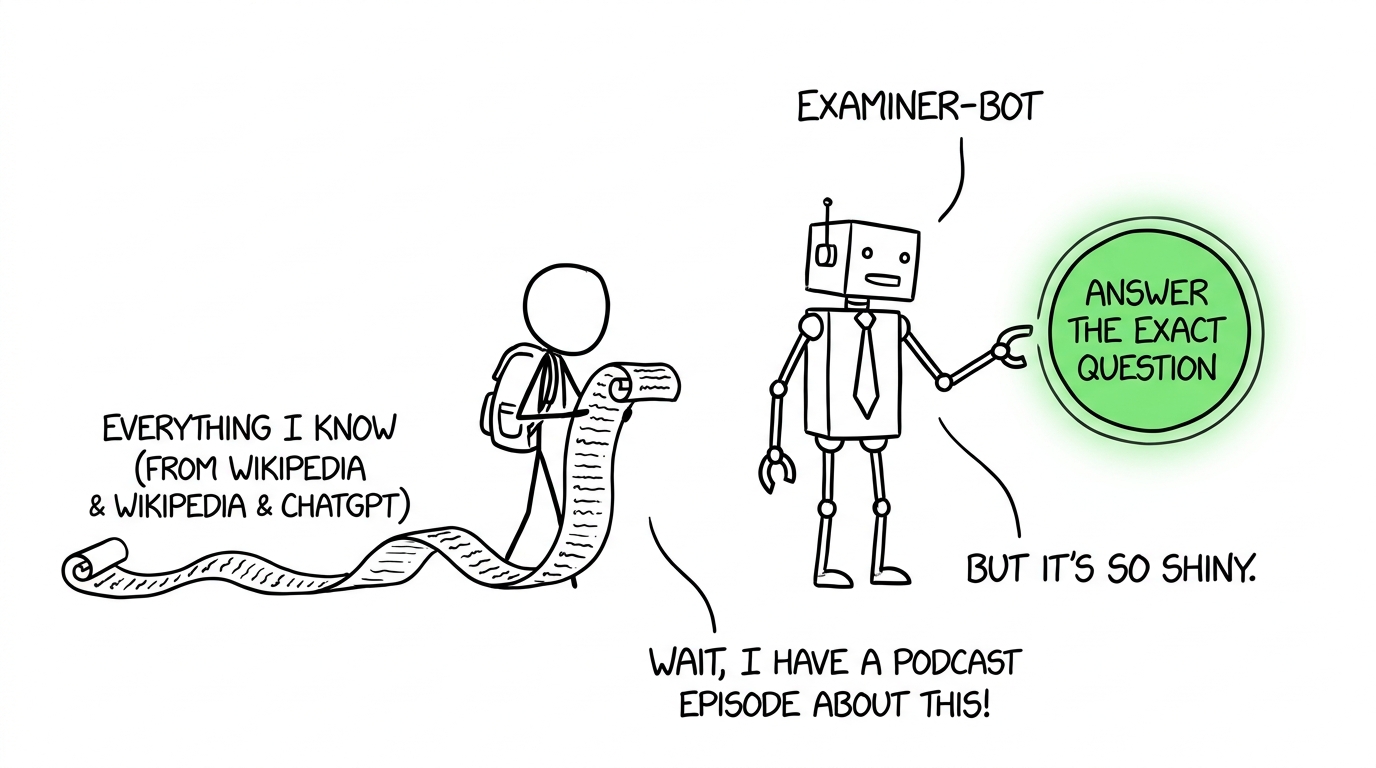 An examiner robot reminding a student to answer the exact question
Common mistakes when resitting A-level Religious Studies
Repeating the previous revision method
More hours do not repair an ineffective process. Replace passive reading with retrieval, essay planning, timed writing and detailed corrections.
Memorising complete essays
A memorised answer rarely matches the wording of a new question. Learn flexible arguments, evidence and counterarguments instead.
Ignoring the exact specification
Topics and paper structures differ across Edexcel, AQA, OCR and Eduqas. Revise only the components and options attached to your entry.
Writing everything you know
Examiners reward relevant knowledge and sustained evaluation, not the volume of remembered material. Keep returning to the exact proposition.
Saving past papers until May
Timed writing is a skill. Begin with individual questions early, then progress towards full papers so that timing problems are discovered while there is still time to fix them.
Make the second attempt different
A resit is not a request to relive the same year. It is a chance to work with better information: your original scripts, clearer weaknesses and a more deliberate routine.
Start today by opening the MathsGenie A-level Religious Studies revision hub, choosing one weak topic and scheduling your first timed response. Build knowledge through free revision lessons and question resources, then test it using past papers, mark schemes, predicted papers and mini tests where available. Small corrections, repeated consistently, are what turn a retake into a stronger result.